


Product name: Procyanidin B2
Synonym name: Proanthocyanidin B2
Catalogue No.: BP1147
Cas No.: 29106-49-8
Formula: C30H26O12
Mol Weight: 578.526
Botanical Source: Occurs in Crataegus, Cotoneaster, Nelia meyeri, Malus and Aesculus spp. peanut skins and buckwheat grain
Physical Description: Powder
Type of Compound: Procyanidins
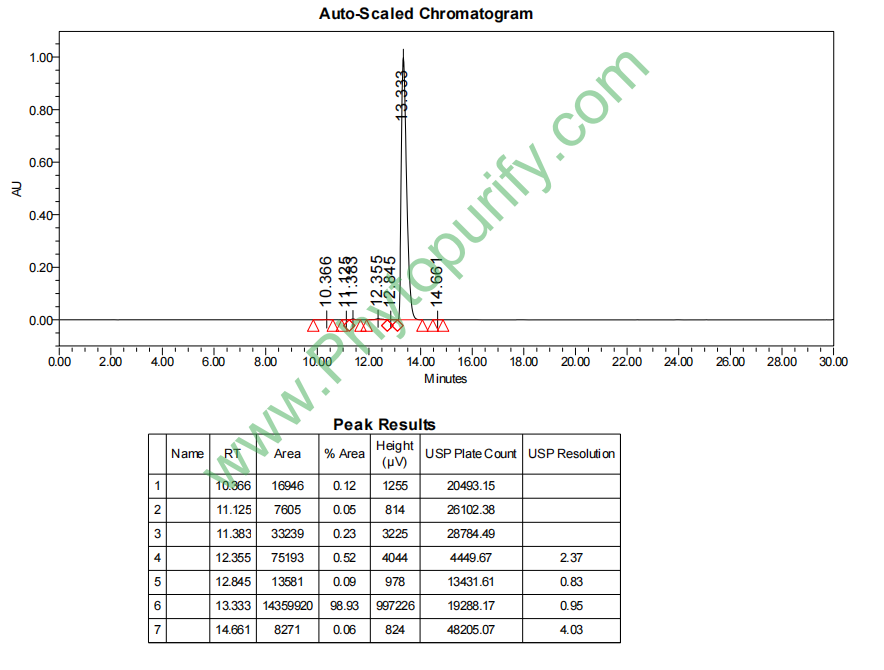
Purity: 95%~99%
Analysis Method: HPLC-DAD or/and HPLC-ELSD
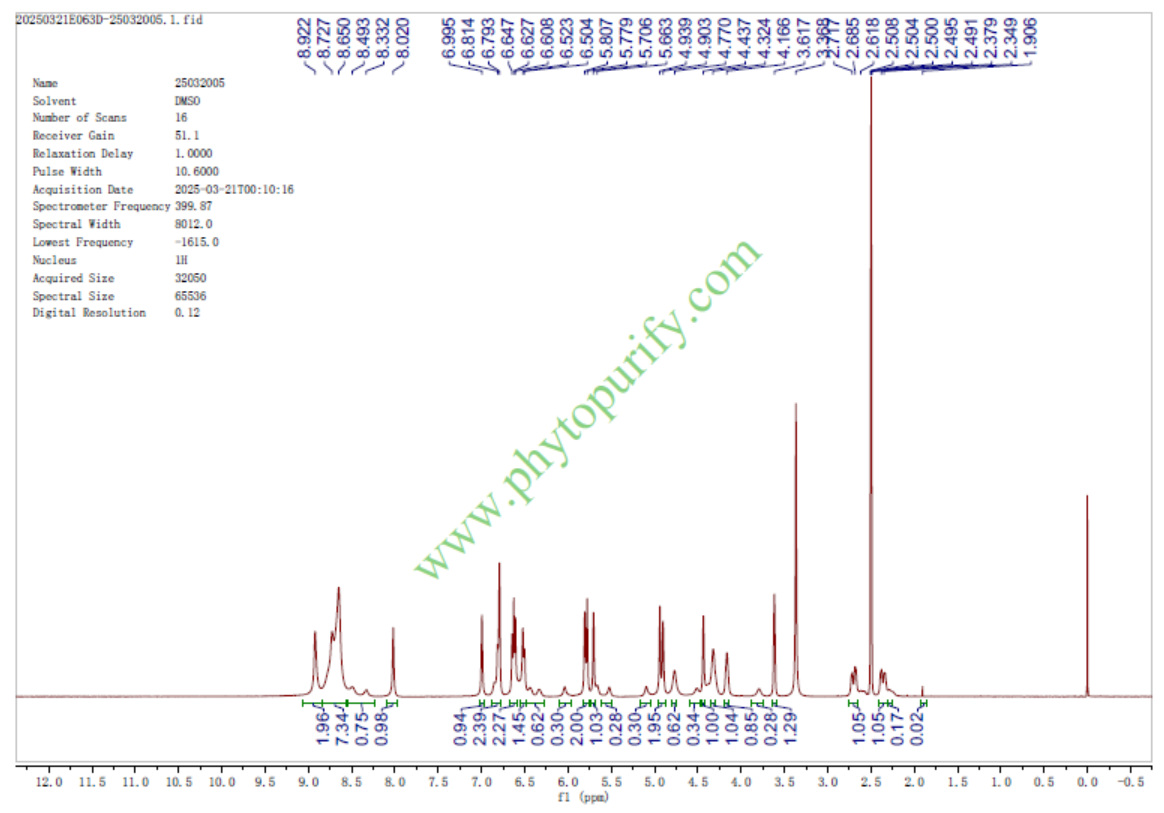
Identification Method: Mass, NMR
Packing: Brown vial or HDPE plastic bottle
Storage: Store in a well closed container, protected from air and light. Put into refrigerate or freeze for long term storage.
Whenever possible, you should prepare and use solutions on the same day. However, if you need to make up stock solutions in advance, we recommend that you store the solution as aliquots in tightly sealed vials at -20℃. Generally, these will be useable for up to two weeks.
The product could be supplied from milligrams to grams, up to kilograms
Inquire for bulk scale.
Descriptions:
Procyanidin B2 (PB2) is a naturally occurring flavonoid widely found in cocoa, red wine and grape juice, PB2 could protect against oxidative stress- and chemical-induced injury in colonic cells by modulating the endogenous cellular defence, PB2 protects against oxidative injury in colonic cells and up-regulate the expression of GSTP1 via a mechanism that involves ERK and p38 MAPK activation and Nrf2 translocation.[1]
Procyanidin B2 (PB2) is one of phenolic compounds in apple pomace, an agro-industrial byproduct in apple juice processing, PB2 at no less than 50 mu g.mL(-1) could significantly suppress inflammation in the LPS-induced cells, shows that high pure PB2 prepared from apple pomace has a remarkable anti-inflammatory property.[2]
Procyanidin B2 exhibits cytotoxic activity to MCF-7 cells and it could be a potential antineoplastic agent. [3]
Procyanidin B2 has toxic property towards triple negative breast cancer cells, it may shows new promise for therapeutic intervention of cancer.[4]
Procyanidin B2( PB2) is absorbed and excreted in urine, and a portion of the PB2 is degraded to (?)-epicatechin and to the metabolized conjugated and/or methylated (?)-epicatechin internally in the rat, PB2 also can reduces the accumulation of lipid peroxide in plasma oxidized by copper ions.[5]
Procyanidin B2 and a cocoa polyphenolic extract inhibit acrylamide-induced apoptosis in human Caco-2 cells by preventing oxidative stress and activation of JNK pathway.[6]
Procyanidin B2 has anti- and pro-oxidant effects on metal-mediated DNA damage by interacting with H2O2 and metal ions.[7]
References:
[1] Rodríguez-Ramiro I, Ramos S, Bravo L, et al.Eur J Nutr, 2012, 51(7):881-92.
[2] Zhang H, Ying C. Bangl J Pharmacol, 2011, 6(2):106-10.
[3] Avelar M M, Gouvêa C M. Indian J Pharml Sci, 2012, 74(4):351-5.
[4]Shilpi A, Parbin S, Sengupta D, et al. Chem-biol Intact, 2015, 233:122-38.
[5] Seigo Baba, Naomi Osakabe, Midori Natsume, et al. Free Radical Bio Med, 2002, 33(1):142-8.
[6] Ramos S, Bravo L, Goya L, et al. J Nutr Biochem, 2011, 22(12):1186-94.
[7] Sakano K, Mizutani M, Murata M, et al. Free Radical Biol Med, 2005, 39(8):1041-9.
[8] Cheng X G, Wen-Zheng J U, Dai G L, et al. Pharm Clin Res, 2013, 21(01):39-41.
HPLC of Procyanidin B2
HNMR of Procyanidin B2
Storage conditions:Short-term storage at 2~8℃, long-term storage at -20 ~ -80℃
220.7600
1.7550
1.7103
.1321
1.0335
.5559
Low
87.3857
4.5185
No
No
No
No
Yes
No
0.0
Yes
No
Yes
No
Natural products, as an important treasure trove for drug discovery and development, play an irreplaceable role in the long history of human fight against diseases. Among them, flavonoids have attracted much attention due to their wide range of biological activities and low toxicity. Procyanidin B2 (CAS number: 29106-49-8), as an important dimer of anthocyanins, is a key molecule that connects monomeric catechins with high molecular weight condensed tannins. In recent years, it has become one of the hotspots in natural product pharmacology research. Proanthocyanidin B2 is composed of two (-) - epicatechin units connected by a C4 → C8 bond (β configuration). This unique chemical structure endows it with excellent multiple biological activities such as antioxidant, anti-inflammatory, anti-tumor, and cardiovascular protection. With the development of modern molecular biology and systems pharmacology, its mechanism of action has gradually deepened from macroscopic antioxidant effects to precise regulation of specific signaling pathways and molecular targets, such as inhibition of key pathways such as IL-6/STAT3 and NF - κ B in inflammatory responses. This article aims to systematically review the chemical properties, plant sources, pharmacological activities, molecular mechanisms of action, pharmacological evaluation, and clinical application potential of anthocyanin B2, in order to provide comprehensive scientific references for the deep development and transformation of this natural product.
The chemical name of anthocyanin B2 is epicatechin - (4 β → 8) - epicatechin, with a molecular formula of C30H26O12 and a molecular weight of 578.5260. Its core structure consists of two flavan-3-ol units, namely (-) - epicatechin, connected by a carbon carbon single bond between a C4 (upper unit) and C8 '(lower unit), forming a B-type anthocyanin dimer. Each epicatechin unit contains two chiral centers (C2 and C3), typically in the 2R, 3R configuration. There are multiple phenolic hydroxyl groups in the molecule, which give it significant hydrophilicity and hydrogen bonding ability.
Based on its chemical structure, anthocyanin B2 exhibits typical physicochemical properties. Its calculated lipid water partition coefficient (LogP) is about 1.7550, indicating that it has a certain degree of lipophilicity, but overall it still leans towards hydrophilicity. The topologically polar surface area (TPSA) is as high as 220.7600 Å ², which is consistent with its abundant number of hydroxyl groups and indicates its strong ability as a hydrogen bond donor and acceptor. The water-soluble experimental data is about 0.1321 mg/mL, which belongs to the category of slightly soluble to poorly soluble, which to some extent limits its bioavailability. These physicochemical parameters are an important foundation for its subsequent pharmacokinetic behavior and formulation development.
Proanthocyanins B2 are widely distributed in nature and are one of the active ingredients in various medicinal and edible plants. Its main plant sources include:
1. Grape Especially abundant in grape seeds, grape skins, and grape leaves, they are important sources for commercial extraction.
2. hawthorn Hawthorn flowers and fruits are rich in anthocyanins, among which B2 is one of its characteristic components, closely related to the cardiovascular protective effect of hawthorn.
3. cinnamon The bark and peel of Ceylon cinnamon contain anthocyanin B2.
4. cinchona Its bark and cortex are traditional medicinal sources.
5. Gambir Plant Also known as cat claw grass, its roots contain this ingredient.
6. lychee Lychee peel is a good source of anthocyanin B2.
In addition, it also exists in common fruits and vegetables such as apples, cocoa beans, blueberries, etc.
The extraction method mainly depends on its polyphenol properties. The conventional methods include:
- Solvent extraction method The most commonly used solvents are methanol, ethanol, acetone, or their mixed solvents with water for leaching or reflux extraction. The water ethanol system is widely used due to its safety and low cost.
- Ultrasonic/Microwave Assisted Extraction Utilizing physical fields to enhance extraction efficiency, shorten time, and improve yield.
- Column chromatography purification: After the crude extract is initially enriched by macroporous adsorption resins (such as AB-8 and D101), it is often further separated and purified by silica gel column chromatography, dextran gel column chromatography (such as Sephadex LH-20) or high-performance liquid chromatography to obtain high-purity procyanidin B2. The Sephadex LH-20 column is an effective means to separate procyanidin homologues by using the dual principles of molecular exclusion and adsorption.
Numerous in vitro and in vivo studies have confirmed that anthocyanin B2 has diverse and significant pharmacological activities.
The pharmacological effects of anthocyanin B2 are not achieved through a single target, but rather through the synergistic effects of multiple targets and pathways, especially in the field of anti-inflammatory research. Its core mechanism of action is closely related to the regulation of the following key targets and pathways:
Although the pharmacological activity of anthocyanin B2 is significant, its medicinal properties face certain challenges, mainly influenced by its pharmacokinetic properties.
To improve its bioavailability, researchers are exploring various strategies, including: ① Structural modification Preparation of prodrugs or derivatives to improve lipid solubility and stability; ② New drug delivery system Develop drug delivery systems such as nanoparticles, liposomes, microemulsions, and phospholipid complexes to enhance their solubility, promote intestinal absorption, and target delivery; ③ combination therapy Combined with bioavailability enhancers such as vitamin C and piperine.
The clinical application prospects of anthocyanins B2 are broad, but most of them are still in the preclinical research or early clinical exploration stage.
Disease prevention and control field:
Challenges and Future Directions Faced:
As a structurally clear and widely active natural dimer flavonoid, anthocyanins B2 have strong antioxidant and anti-inflammatory core abilities, leading to multiple pharmacological effects such as anti-tumor, cardiovascular and cerebrovascular protection, and neuroprotection. Modern research is gradually uncovering the mystery of its multi-target and multi pathway synergistic effects, especially in regulating key inflammatory signaling nodes such as NF - κ B and STAT3. Although its low bioavailability poses a major challenge on the path of drug development, it also drives cross innovation in the fields of pharmacy, medicinal chemistry, and pharmacology. With the development of new delivery systems, in-depth elucidation of the mechanism of action, and the advancement of high-quality clinical research, anthocyanin B2 is expected to be successfully transformed from a highly anticipated natural active molecule into a drug or functional product with practical application value in the fields of chronic inflammatory diseases, metabolic diseases, and tumor adjuvant therapy, contributing to human health with the power of nature. The research process also fully reflects the integration and sublimation from traditional medicinal wisdom to modern precision medicine.
