


Product name: Procyanidin B1
Synonym name: Proanthocyanidin B1
Catalogue No.: BP1146
Cas No.: 20315-25-7
Formula: C30H26O12
Mol Weight: 578.526
Botanical Source: Present in red wine
Physical Description: Powder
Type of Compound: Procyanidins
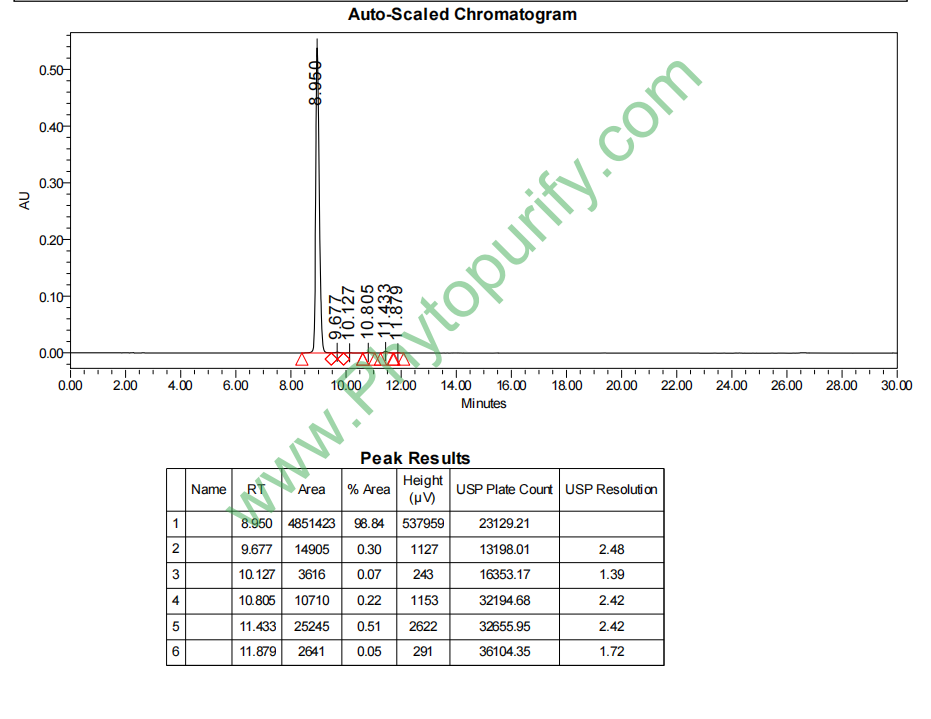
Purity: 95%~99%
Analysis Method: HPLC-DAD or/and HPLC-ELSD
Identification Method: Mass, NMR
Packing: Brown vial or HDPE plastic bottle
Storage: Store in a well closed container, protected from air and light. Put into refrigerate or freeze for long term storage.
Whenever possible, you should prepare and use solutions on the same day. However, if you need to make up stock solutions in advance, we recommend that you store the solution as aliquots in tightly sealed vials at -20℃. Generally, these will be useable for up to two weeks.
The product could be supplied from milligrams to grams, up to kilograms
Inquire for bulk scale.
Descriptions:
Procyanidin B1, one of the major components of Flavangenol, also suppresses fat accumulation and induced mRNA expression of the fatty acid oxidative enzymes.[1]
Procyanidin B1 suppresses HCV RNA synthesis, possibly as a HCV RNA polymerase inhibitor, it might contribute towards the development of more effective inhibitors for HCV infection from natural plants.[2]
Procyanidin B1 has neuroprotective effects, may attenuate the activation of caspase-3 by inhibiting that of caspase-8 and -9. [3]
Procyanidin B1 has anti-inflammatory effect on LPS-treated THP1 cells via interaction with the TLR4–MD-2 heterodimer and p38 MAPK and NF-κB signaling.[4]
Procyanidin B1 strongly inhibits the proliferation of HeLa S3 cells. [5]
References:
[1] Sano A, Yamakoshi J, Tokutake S, et al. Biosci Biotech Bioch, 2003, 67(5):1140-3.
[2] Li S, Kodama E N, Inoue Y, et al. Antiviral Chem Chemoth, 2010, 20(6):239-48.
[3] Kanno H, Kawakami Z, Tabuchi M, et al. J Ethnopharmacol, 2014, 159:122–8.
[4] Jing Xing, Rui Li, Nan Li,et al. Mol Cell Biochem, 2015, 407(1-2):89-95.
[5]Okamoto S, Ishihara S, Okamoto T, et al. Molecules, 2014, 19(2):1775-85.
[6] Zhao C Y, Wang M, Zhang G W, et al. J Shenyang Pharm Univ, 2014, 31(1):32-5.
HPLC of Procyanidin B1
Storage conditions:Short-term storage at 2~8℃, long-term storage at -20 ~ -80℃
220.7600
1.7564
1.7105
.1323
1.0481
.5547
Low
87.3857
4.5185
No
No
No
No
Yes
No
0.0
Yes
No
Yes
No
Natural products have always been an important source of innovative drug discovery and development, among which polyphenolic compounds have attracted much attention due to their broad biological activity and low toxicity. Procyanidins are a class of oligomers and oligomers of flavan-3-ol widely present in the plant kingdom, and are an important component of plant polyphenols. Procyanidin B1 (CAS number: 20315-25-7), as a key dimer in the anthocyanin family, is composed of one molecule of (-) - epicatechin and one molecule of (+) - catechin connected by a C4 → C8 'bond (β - configuration). It is not only an active ingredient in various common fruits, nuts, and medicinal plants, but also a hot topic in natural product pharmacology research in recent years due to its excellent pharmacological activities such as antioxidant, anti-inflammatory, and cardiovascular protection.
Modern pharmacological studies have shown that anthocyanin B1 can specifically bind to the Toll like receptor 4/myeloid differentiation protein 2 (TLR4/MD-2) complex, effectively inhibiting the overactivation of downstream inflammatory signaling pathways, providing a solid molecular basis for its anti-inflammatory effects. In addition, the study also revealed that it has significant potential in regulating blood lipids, protecting endothelial function, inhibiting platelet aggregation, and improving myocardial injury, involving multiple molecular targets closely related to cardiovascular disease such as SELP, HMGCR, PPARG, ACE, AKT1, NOS3, ICAM1, VCAM1, etc. Although its medicinal properties face challenges such as low water solubility and poor blood-brain barrier permeability, its clear activity, good safety (such as no hERG inhibition and Ames mutagenicity), and wide range of plant sources make it have broad application prospects in the development of functional foods, health products, and preventive drugs. This article aims to systematically review the chemical properties, plant sources, pharmacological activities, mechanisms of action, and medicinal properties of anthocyanin B1, in order to provide comprehensive scientific references for the in-depth research and development of this natural product.
Proanthocyanidin B1 is a typical flavan-3-ol dimer with a clear chemical structure, molecular formula C30H26O12, and molecular weight 578.5260 Da. Its structural core consists of two flavan-3-ol units: one (-) - epicatechin unit as the "upper" extension unit, and one (+) - epicatechin unit as the "lower" terminal unit. The two units are connected by a carbon carbon bond, specifically the C4 position of the upper (-) - epicatechin unit is connected to the C8 'position of the lower (+) - epicatechin unit, and the bond is in the β - configuration, which is a typical feature of B-type anthocyanins. Each unit contains two benzene rings (A ring and B ring) and one heterocyclic ring (C ring, dihydropyran ring), with multiple phenolic hydroxyl groups in its structure, which is the key to its strong antioxidant and protein interaction abilities.
Based on its chemical structure, anthocyanin B1 exhibits the following important physicochemical properties:
1. Lipophilic nature The calculated lipid water partition coefficient (LogP) is approximately 1.7564, indicating that the molecule has a certain degree of lipophilicity, but not high lipid solubility, which is consistent with its polyphenol hydroxyl structure.
2. Polar Surface Area The topologically polar surface area (TPSA) is as high as 220.760 Å ², mainly attributed to the abundant hydroxyl and ether oxygen atoms in the molecule. High TPSA is a key factor affecting its membrane permeability and solubility.
3. solubility Its water solubility is relatively low, about 0.1323 mg/mL. It has good solubility in polar organic solvents such as methanol, ethanol, acetone, and ethyl acetate, which guides its extraction and purification process from plant materials.
4. Stability Proanthocyanidin B1 is relatively stable under acidic conditions, but in neutral or alkaline environments, especially under light, high temperature, and the presence of oxygen, the resorcinol or catechol structures on its catechin units are prone to oxidation, polymerization, or degradation. Therefore, attention should be paid to avoiding light, low temperature, and inert gas protection during storage and handling.
These physicochemical properties directly determine the bioavailability, in vivo distribution, subsequent pharmacological activity, and pharmacological evaluation of anthocyanin B1.
Proanthocyanins B1 are widely distributed in nature and are common active ingredients in many edible and traditional medicinal plants.
Main plant sources:
1. Grapes (Vitis vinifera)Grape seeds, grape skins, and grape leaves are one of the most abundant sources of proanthocyanidin B1, especially in red wine and grape seed extracts with high levels.
2. Cinnamomum verum (Ceylon cinnamon)It mainly exists in its outer skin, bark or cortex, and is one of the important material bases for cinnamon to exert anti-inflammatory and antioxidant effects.
3. Uncaria guianensis A traditional medicinal plant whose roots contain anthocyanin B1, which is associated with its anti-inflammatory and immunomodulatory activities.
4. Peach (Prunus persica)The fruit pulp and peel contain this ingredient.
5. Other sources Apples, cocoa beans, hawthorn, blueberries, sorghum, etc. also contain varying amounts of anthocyanins B1 and its homologs.
Extraction and Separation Methods:
Efficient extraction of anthocyanin B1 from plant materials typically involves the following steps:
1. Extract Common solvent extraction methods. Due to the polarity and phenolic properties of anthocyanins B1, a mixed solvent of methanol, ethanol, acetone, and water (such as 70-80% acetone aqueous solution or 50-70% ethanol aqueous solution) is often used for extraction or ultrasound assisted extraction. These solvents can effectively dissolve anthocyanins while reducing the co extraction of impurities such as proteins and polysaccharides.
2. Enrichment and Purification:
* liquid-liquid extraction Extract anthocyanins from the aqueous phase using organic solvents such as ethyl acetate to achieve preliminary enrichment.
* column chromatography This is the core step of separation and purification. Macroporous adsorption resins (such as AB-8, D101, HP-20) are often used for initial decolorization and enrichment, and then silica gel column chromatography and Sephadex gel column chromatography are used for fine separation. The Sephadex LH-20 column utilizes the dual principles of molecular exclusion and adsorption to achieve excellent separation of anthocyanin dimers.
* High performance liquid chromatography (HPLC)Prepa HPLC is the ultimate key technology for obtaining high-purity anthocyanin B1 monomers. It typically uses a C18 reverse phase chromatography column and gradient elution with methanol water or acetonitrile water (often containing small amounts of formic acid or acetic acid to improve peak shape) as the mobile phase.
3. Identification and quantification The purified compound needs to be structurally confirmed by UV Vis spectroscopy (maximum absorption around 280 nm), mass spectrometry (MS, providing molecular weight and fragment ion information), and nuclear magnetic resonance spectroscopy (NMR, especially 1H NMR and 13C NMR). Conventional sample analysis often uses HPLC combined with diode array detector (DAD) or mass spectrometry detector techniques.
Numerous in vitro and in vivo studies have confirmed that anthocyanins B1 have multiple pharmacological activities, with cardiovascular protection and anti-inflammatory effects being the most prominent.
1. Cardiovascular protective effect
This is the most in-depth field of research on anthocyanin B1. Its protective effect is reflected on multiple levels:
* Protection of endothelial function Proanthocyanidin B1 can significantly promote the activation of endothelial nitric oxide synthase (eNOS, encoded by NOS3 gene), increase the production of nitric oxide (NO), thereby relaxing blood vessels, inhibiting platelet adhesion and leukocyte infiltration. At the same time, it can downregulate the expression of vascular cell adhesion molecule-1 (VCAM-1) and intercellular adhesion molecule-1 (ICAM-1) on endothelial cells, reducing the adhesion of inflammatory cells to the vascular wall.
* Anti atherosclerosis By inhibiting the activity of 3-hydroxy-3-methylglutaryl-CoA reductase (HMGCR), it may exert a mild lipid-lowering effect. More importantly, its strong antioxidant capacity can inhibit the oxidative modification of low-density lipoprotein (LDL), and oxidative LDL is the key starting factor of atherosclerotic plaque formation.
* Antiplatelet aggregation Research has shown that anthocyanin B1 can inhibit thrombin (EC 3.4.21.5) activity and downregulate the expression of P-selectin (SELP). P-selectin mediates the initial adhesion of platelets to white blood cells and endothelial cells, and its inhibition can effectively reduce the formation of pathological thrombosis.
* Hypotensive potential As a potential inhibitor of angiotensin-converting enzyme (ACE), it may lower blood pressure by inhibiting the renin-angiotensin system (RAS).
* Myocardial protection In the myocardial ischemia/reperfusion injury model, anthocyanin B1 may activate the AKT1 (protein kinase B) signaling pathway, inhibit myocardial cell apoptosis, alleviate oxidative stress and inflammatory response, thereby protecting myocardial cells.
2. Anti inflammatory activity
The anti-inflammatory mechanism of anthocyanin B1 is clear. It can directly bind to the TLR4/MD-2 complex on the surface of immune cells, blocking the binding of pathogen associated molecular patterns (PAMPs) such as lipopolysaccharides (LPS) to receptors, thereby inhibiting the activation of key inflammatory signaling pathways such as nuclear factor kappa B (NF - κ B) and mitogen activated protein kinase (MAPK). This leads to a significant decrease in the expression and release of downstream inflammatory mediators such as tumor necrosis factor - α (TNF - α), interleukin-6 (IL-6), interleukin-1 β (IL-1 β), as well as inducible nitric oxide synthase (iNOS) and cyclooxygenase-2 (COX-2). This mechanism has been validated in various animal models of acute and chronic inflammation, such as colitis, arthritis, and neuroinflammation.
3. Antioxidant activity
As a polyphenolic compound, anthocyanins B1 are effective free radical scavengers and metal ion chelating agents. The phenolic hydroxyl group on its benzene ring can provide hydrogen atoms or electrons, neutralize reactive oxygen species (ROS) and reactive nitrogen species (RNS), interrupt the lipid peroxidation chain reaction, and protect cell membranes, proteins, and DNA from oxidative damage. Its antioxidant capacity is one of the foundations of its anti-inflammatory and cardiovascular protective effects.
4. Other activities
Preliminary studies also suggest that anthocyanin B1 may have potential activities such as regulating blood glucose (possibly related to the activation of PPARG), neuroprotection, and anti-tumor adjuvant, but further research is needed to confirm them.
The multiple pharmacological activities of anthocyanin B1 stem from its interactions with multiple biomolecules, and its mechanism of action is complex and synergistic.
Core anti-inflammatory mechanism: TLR4/MD-2 complex antagonism
This is currently the most clear molecular mechanism of action. TLR4 is a key pattern recognition receptor for recognizing Gram negative bacterial LPS, and its overactivation is associated with various chronic inflammatory diseases. Proanthocyanidin B1 binds to the co receptor MD-2 of TLR4 through its specific spatial structure, competitively blocking the binding of LPS to MD-2, thereby inhibiting the dimerization of TLR4 and the activation of downstream myeloid differentiation factor 88 (MyD88) dependent and independent signaling pathways, ultimately leading to a decrease in transcription factors such as NF - κ B and AP-1 entering the nucleus and downregulation of inflammatory factor gene expression.
Target group related to cardiovascular protection:
Proanthocyanins B1 exert cardiovascular protective effects by acting on a target network:
* SELP (P-selectin)Inhibiting its expression and membrane translocation, reducing platelet leukocyte aggregate formation, and anti thrombotic.
* HMGCR (3-hydroxy-3-methylglutaryl-CoA reductase)May mildly regulate cholesterol synthesis by conformational inhibition or affecting its expression.
* PPARG (Peroxisome proliferator activated receptor gamma)As a potential agonist, it participates in regulating lipid metabolism, glucose homeostasis, and inflammatory response.
* ACE (angiotensin converting enzyme)Inhibiting its activity, reducing the production of angiotensin II, producing antihypertensive and improving cardiac remodeling effects.
* AKT1 (protein kinase B)Activate the PI3K/AKT signaling pathway, promote eNOS phosphorylation (activation), and increase NO production; Simultaneously inhibiting pro apoptotic proteins and protecting myocardial cells.
* NOS3 (endothelial nitric oxide synthase)Upregulation of its expression and promotion of its phosphorylation activation are the core steps in improving endothelial function.
* ICAM1&VCAM1 (intercellular/vascular cell adhesion molecule-1)By inhibiting pathways such as NF - κ B, downregulating their expression, and reducing inflammation and infiltration of the vascular wall.
Other interactions:
* Direct enzyme inhibition Has a direct inhibitory effect on thrombin, affecting the coagulation cascade reaction.
* Ion channel influence The data shows that it has no inhibitory effect on the hERG potassium channel (encoded by the KCNH2 gene), indicating a low risk of cardiac toxicity, which is a favorable pharmacological feature.
* Receptor regulation It may act as a regulator of β 2-adrenergic receptors (ADRB2), affecting vascular tone and bronchial smooth muscle, but the specific mechanism still needs to be elucidated.
In summary, anthocyanin B1 does not act on a single target, but rather forms a comprehensive pharmacological effect network of anti-inflammatory, antioxidant, and cardiovascular protection through the synergy and cross dialogue of multiple targets and pathways.
Although anthocyanin B1 has significant pharmacological activity, its drug like and pharmacokinetic properties are key considerations for its successful development as a drug.
Analysis of drug properties parameters:
According to the provided parameters:
* Molecular weight (578.5)Slightly higher than the 500 Da upper limit recommended by Lipinski's "Five Rules", but this range is still acceptable for natural products and their derivatives.
* LogP (1.76)Being within the ideal range (1-3) indicates a moderate lipophilic/hydrophilic balance.
* TPSA (220.8 Ų)The value is very high, far exceeding the threshold that is usually considered easy to penetrate the cell membrane (about 140 Å ²). This is the main adverse factor affecting its oral absorption and blood-brain barrier permeability.
* Water solubility (0.132 mg/mL)Poor, may lead to low oral bioavailability.
* Blood-brain barrier permeability Predicted as' low ', which is consistent with high TPSA, meaning it is difficult to enter the central nervous system, which is unfavorable for treating central nervous system diseases, but may also reduce the risk of central side effects.
* Security Warning:
* HERG inhibition A prediction of 'no' indicates a lower risk of inducing QT interval prolongation in the heart, which is an important safety advantage.
* Ames test The predicted value is 0.0, indicating no mutagenicity and low risk of genetic toxicity.
Pharmacokinetic characteristics(Based on existing literature and similar compounds inference):
The pharmacokinetic behavior of anthocyanin B1 exhibits typical characteristics of polyphenolic compounds
1. absorb After oral administration, the absorption rate is low and irregular. Part of it can be absorbed in the intestine, but its high polarity and high molecular weight limit its passive diffusion. The gut microbiota plays a crucial role in its metabolism.
2. distribution Due to the high binding rate of plasma proteins (mainly bound to albumin), they have a certain amount of retention in the blood. However, high TPSA limits its tissue distribution and makes it difficult to penetrate the blood-brain barrier, mainly distributed in organs with abundant blood flow such as the liver and kidneys.
3. Metabolism This is its main way of elimination. It undergoes extensive phase II metabolism in the body, including methylation, glucuronidation, and sulfation, producing various metabolites. Intestinal microbiota can break it down into smaller phenolic acids (such as benzoic acid, phenylpropanoid derivatives), which may contribute to its systemic biological effects.
4. excretion Metabolites are mainly excreted through urine and bile.
Challenges and Strategies in Drug Development:
The main challenge is Low oral bioavailability The improvement strategy includes:
* Formulation improvement Develop nano formulations (such as liposomes, nanoemulsions, polymer nanoparticles), phospholipid complexes, cyclodextrin inclusion complexes, etc. to improve their solubility, stability, and intestinal permeability.
* Structural modification By chemical modification (such as esterification, preparation of prodrugs), polarity can be reduced, lipid solubility and membrane permeability can be improved, but attention should be paid to maintaining or optimizing its activity.
* Combined administration Combined with absorption enhancers (such as piperine) or other natural products with synergistic effects.
As a safe and multifunctional natural active molecule, the clinical application development of anthocyanins B1 mainly focuses on the fields of prevention and adjuvant therapy.
Potential application directions:
1. Prevention and adjuvant therapy of cardiovascular and cerebrovascular diseases As the core component of functional food or dietary supplement, it is used for the early prevention of hyperlipidemia, hypertension and atherosclerosis. It can also be used as an adjuvant drug in combination with existing statins and antihypertensive drugs to enhance efficacy and reduce side effects.
2. Management of chronic inflammatory diseases: Based on its clear TLR4 antagonistic mechanism, it has development potential in inflammatory bowel disease (IBD), rheumatoid arthritis (RA), metabolic inflammation (such as complications of diabetes) and other fields.
3. Antioxidant health products Used in the fields of anti-aging, enhancing immunity, and protecting the skin from UV damage in health products and cosmetics.
4. Formula food for special medical purposes Develop specific full nutrition formulas or components containing anthocyanin B1 for postoperative rehabilitation and metabolic syndrome populations.
Future research prospects:
1. In depth mechanism research Using chemical biology methods such as photoaffinity labeled probes, molecular docking, and kinetic simulations to more accurately elucidate its interaction patterns with TLR4/MD-2 and other targets. Conduct systematic pharmacology research and draw a more complete network of "compounds targets pathways diseases".
2. Pharmacokinetic optimization This is the core bottleneck of conversion. We need to strengthen the systematic PK/PD (pharmacodynamic) research of its different dosage forms in animals and humans, and find the optimal delivery system.
3. High quality clinical research Currently, there is a lack of large-scale, randomized double-blind, placebo-controlled human clinical trials. In the future, rigorous clinical studies need to be designed to confirm its effectiveness and safety in specific populations, such as cardiovascular high-risk individuals and patients with mild inflammation, and to establish biomarkers.
4. Structure Activity Relationship (SAR) and Derivatives Systematically study the effects of structural modifications (such as methylation, glycosylation, and changes in polymerization degree of hydroxyl groups) on activity, solubility, and metabolic stability, guiding the synthesis of derivatives with better activity and drug properties.
5. Extraction and Quality Control of Industrialization Develop green, efficient, and low-cost large-scale extraction and purification processes, and establish strict quality control standards based on technologies such as HPLC-MS to ensure the stability and consistency of raw materials and products.
As a natural source of flavan-3-ol dimer, anthocyanin B1 exhibits remarkable pharmacological potential in anti-inflammatory, antioxidant, and cardiovascular protection due to its unique chemical structure and multi-target mechanism of action. It regulates the inflammatory response by antagonizing the TLR4/MD-2 complex, and forms a cardiovascular protection network by acting on a series of targets such as SELP, NOS3, ACE, AKT1, reflecting the pleiotropy of natural products. Although its high polar surface area and low water solubility pose challenges for oral administration in terms of bioavailability, its good safety features (no hERG inhibition and mutagenicity) lay an important foundation for its development. Currently, the research on anthocyanin B1 is in a critical stage of transitioning from basic pharmacology to application development. In the future, through innovative dosage form technology, in-depth clinical validation, and rational drug design based on structure-activity relationships, it is expected to overcome the bottleneck of drug development and transform this ancient plant component into an effective tool in modern preventive medicine and precision nutrition intervention, providing new natural solutions for the prevention and treatment of cardiovascular and chronic inflammatory diseases.
