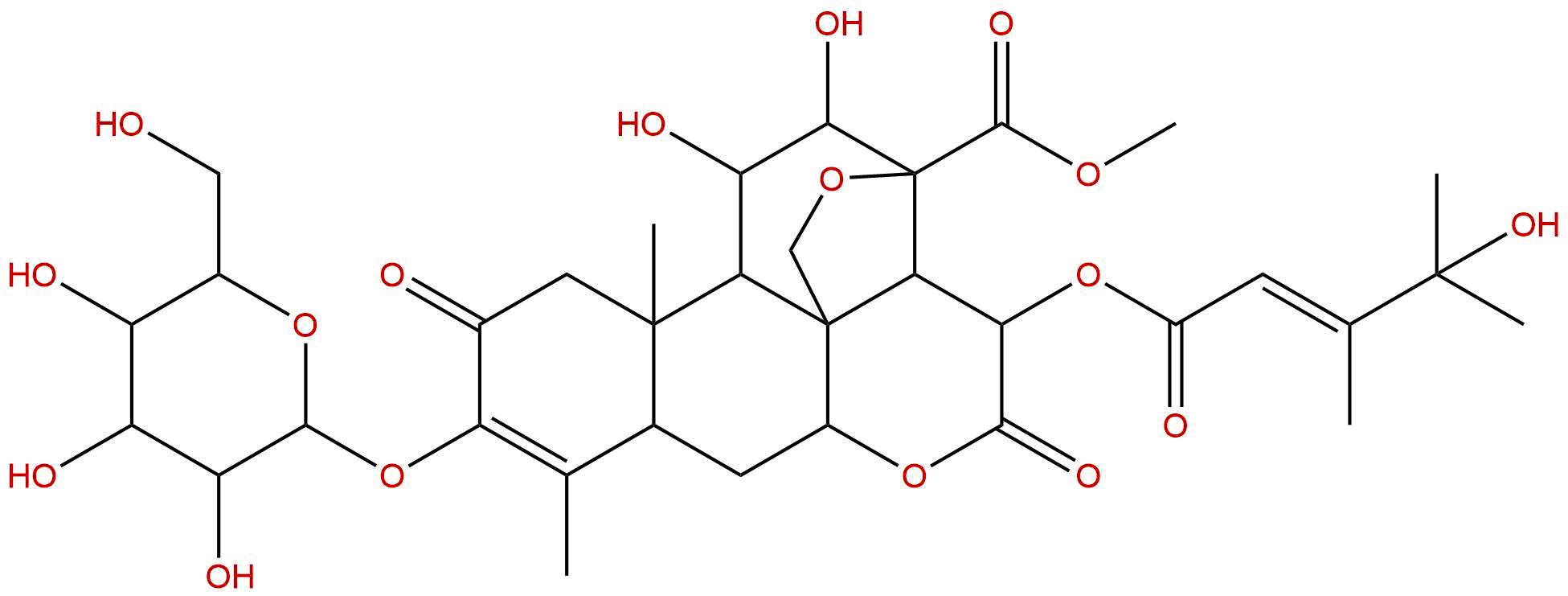


Product name: Yadanzioside L
Synonym name:
Catalogue No.: BP5378
Cas No.: 99132-97-5
Formula: C34H46O17
Mol Weight: 726.725
Botanical Source:
Type of Compound: Diterpenoids
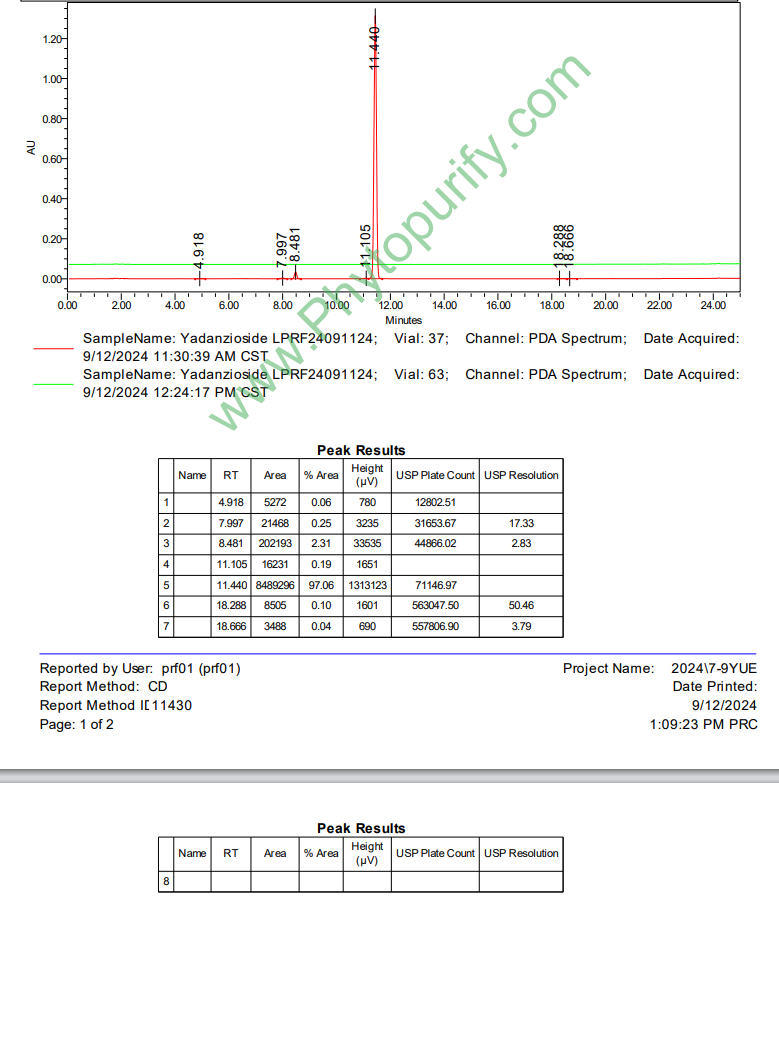
Purity: 95%~99%
Analysis Method: HPLC-DAD or/and HPLC-ELSD
Identification Method: Mass, NMR
Packing: Brown vial or HDPE plastic bottle
Storage: Store in a well closed container, protected from air and light. Put into refrigerate or freeze for long term storage.
Whenever possible, you should prepare and use solutions on the same day. However, if you need to make up stock solutions in advance, we recommend that you store the solution as aliquots in tightly sealed vials at -20℃. Generally, these will be useable for up to two weeks.
The product could be supplied from milligrams to grams
Inquire for bulk scale.
For Reference Standard and R&D, Not for Human Use Directly.
HPLC of Yadanzioside L
Storage conditions:Short-term storage at 2~8℃, long-term storage at -20 ~ -80℃
265.2700
-.1031
-.1031
2.0467
.4605
.7301
Low
55.3697
7.1277
No
No
No
No
Yes
No
0.0
Yes
No
No
Yes
Natural products, as an important source of drug discovery, play an irreplaceable role in the long history of human fight against diseases. Among them, quassinoids derived from Simaroubacheae plants have long been a hot topic in natural product chemistry and pharmacology research due to their unique and significant biological activities, especially anti-tumor and antiviral activities. Brucea Javanese(Brucea javanica (L.) Merr., as a medicinal plant of the genus Brucea in the family Sapindaceae, its fruits and seeds are widely used in traditional medicine to treat dysentery, malaria, warts, and certain cancers. Modern research has isolated and identified over 100 types of bitter lignin compounds from brucea, among which Yadanziosides are an important glycosylated bitter lignin with diverse pharmacological potential.
Yadanzioside L, with CAS number 99132-97-5, is a representative bitter lignin glycoside compound in Yadanzioside. Its chemical structure belongs to the highly oxidized tricyclic or tetracyclic triterpenoid lactone skeleton, and is connected to sugar units. Early studies have revealed that Brucea Javanese Glycoside L has significant anti Tobacco Mosaic Virus (TMV) activity, with a half maximal inhibitory concentration (IC ₅₀) of 4.86 μ M, indicating its potential application value in the field of plant virus control. However, what is even more remarkable is that with the deepening of research, bruce acid glycoside L has shown broader prospects in the field of anti-tumor. Its mechanism of action involves the regulation of multiple key signaling pathways and targets, including inducing cell apoptosis, inhibiting cell proliferation, anti angiogenesis, and reversing multidrug resistance, demonstrating great potential as a novel anti-tumor candidate drug. This article aims to provide a systematic review of the chemical structure, plant origin, extraction methods, pharmacological activity, mechanism of action, medicinal properties, and clinical application prospects of brucea Javanese glycoside L, in order to provide comprehensive references for the in-depth research and development of this natural product.
The chemical structure of Brucea Javanese Glycoside L belongs to the typical class of bitter lignin glycosides. Bitter lignin compounds are a class of triterpenoid compounds with a unique carbon skeleton, typically composed of 20 carbon atoms, forming highly oxidized tetracyclic (C ₁ or C ₂ ₀) or tricyclic (C ₁ or C ₁) lactone structures. The aglycone part of Yaguzi glycoside L belongs to the brucine class, and its core structure consists of a cis fused A/B ring system, a δ - lactone ring (C ring), and a D ring that forms an ether bridge between C-8 and C-11, forming its unique lignin lactone skeleton. Multiple sites on the skeleton (such as C-1, C-2, C-3, C-6, C-7, C-11, C-12, C-15, etc.) are often highly substituted by oxygen-containing functional groups such as hydroxyl, acetoxy, carbonyl, etc., endowing the molecule with abundant chemical modification sites and diverse biological activities.
The molecular formula of Brucea Javanese Glycoside L is C ∝₄ H ₄₆ O ₁₇, with a molecular weight of 726.7250 g/mol. Its structural feature lies in the presence of a sugar unit connected by a β - glycosidic bond at the C-21 position (or C-15 position, depending on the naming system) of the naringenin glycoside. The sugar group is usually D-glucose or modified sugars such as xylose, arabinose, etc. The specific sugar group composition and connection mode determine the difference between bruce acid glycoside L and other bruce acid glycoside compounds (such as A, B, C, D, E, F, G, H, I, J, K, M, N, O, P, etc.). The presence of sugar groups not only increases the water solubility of molecules, but may also affect their interactions with biological targets and pharmacokinetic behavior.
In terms of physical and chemical properties, Brucea Javanese Glycoside L exhibits typical characteristics of polyhydroxy and polyoxometalated natural products. The calculated lipid water partition coefficient (LogP) is -0.1031, indicating that the compound has good hydrophilicity, which is consistent with the structural characteristics of the molecule containing multiple hydroxyl and sugar units. Its polar surface area (TPSA) is as high as 265.2700 Å ², far exceeding the recommended upper limit of 140 Å ² for oral medications, indicating that its oral absorption may be poor and its membrane permeability limited. The water solubility parameter is 2.0467, indicating that it has a certain degree of solubility in water, but it may not be ideal. In addition, the ability of Brucea Javanese Glycoside L to penetrate the blood-brain barrier (BBB) is predicted to be low, which to some extent limits its application in the treatment of central nervous system diseases, but may also mean a lower risk of central nervous system side effects after peripheral administration. These physicochemical properties provide important reference for subsequent formulation design and route of administration selection.
Brucea Javanese Glycoside L is mainly derived from the genus Brucea in the family Simaroubacheae(Brucea javanica (L.) Merr.)。 This plant is mainly distributed in southern China (such as Guangdong, Guangxi, Fujian, Yunnan, Taiwan and other provinces), Southeast Asia, India and northern Australia. Its medicinal parts are mainly mature fruits (such as brucea) and seeds. In addition to Brucea, other plants in the genus Brucea include Brucea mollis、Brucea sumatrana It may also contain bruce acid glycoside L, but the content is usually low.
The extraction and separation of brucelloside L from brucea typically follow the classic natural product chemical process, which mainly includes the following steps:
Raw material pretreatment and extraction After crushing the dried fruit or seeds of brucea, polar solvents are used for extraction. Given the high polarity of Brucea Javanese Glycoside L, commonly used extraction solvents include methanol, ethanol, or their aqueous solutions. Usually, cold soaking, percolation, or reflux extraction methods are used. In order to improve extraction efficiency and selectivity, different concentrations of ethanol are sometimes used for gradient extraction. The extract was concentrated under reduced pressure to obtain the total extract.
Preliminary separation and enrichment The total extract is usually suspended in water and then subjected to liquid-liquid extraction using organic solvents of different polarities such as petroleum ether, ethyl acetate, n-butanol, etc. Due to its good water solubility and moderate polarity, bruce acid glycoside L is mainly enriched in the n-butanol extraction site or water site. This step can effectively remove lipid soluble impurities (such as chlorophyll, oil) and some moderately polar aglycones.
Chromatographic Separation and Purification The extracted fraction enriched with Brucea Javanese Glycoside L needs to undergo a series of chromatographic techniques for fine separation. Common methods include:
Structural Identification The obtained pure compounds need to be structurally confirmed through modern spectroscopic techniques, mainly including nuclear magnetic resonance spectroscopy (¹ H-NMR, ¹ ³ C-NMR, 2D-NMR such as HSQC, HMBC, COSY, etc.), high-resolution mass spectrometry (HR-ESI-MS), infrared spectroscopy (IR), and ultraviolet spectroscopy (UV). By comparing the spectral data of Brucea Javanese Glycoside L reported in the literature, its chemical structure was ultimately determined.
It is worth noting that due to the generally low content of bruce acid glycoside L in plants and its coexistence with multiple structurally similar bruce acid glycosides, its separation and purification process is challenging and requires precise chromatographic strategies and multiple purification steps. In recent years, new separation technologies such as high-speed countercurrent chromatography (HSCCC) have also been applied to the separation of bitter lignin components in brucea, demonstrating high efficiency and speed advantages.
The pharmacological activity research of Brucea Javanese Glycoside L mainly focuses on two fields: antiviral and anti-tumor. In addition, it has also been found to have other potential activities such as anti-inflammatory and immune regulation.
1. Antiviral activity
The earliest reported activity of Brucea Javanese Glycoside L was its anti tobacco mosaic virus (TMV) activity. TMV is a typical plant virus that causes serious harm to economic crops such as tobacco and tomatoes. Research has found that Brucea Javanese Glycoside L has significant inhibitory activity against TMV, with an IC ₅₀ value of 4.86 μ M. This activity level is comparable to some known anti plant virus drugs, suggesting that it may serve as a lead compound for the development of novel, efficient, and low toxicity plant virus control agents. The mechanism of its anti TMV effect may be related to the inhibition of viral RNA replication or virus particle assembly, but the specific molecular mechanism remains to be elucidated.
2. Antitumor activity
The anti-tumor activity is the most concerned direction in the research of Brucea Javanese Glycoside L. A large amount of in vitro and in vivo experimental evidence shows that Brucea Javanese Glycoside L exhibits significant proliferation inhibition and cytotoxicity on various human tumor cell lines, including but not limited to:
* Lung cancer Has inhibitory effects on non-small cell lung cancer cell lines such as A549 and H460.
* liver cancer Has inhibitory effects on liver cancer cell lines such as HepG2 and Huh-7.
* breast cancer: It has inhibitory effect on breast cancer cell lines such as MCF-7, MDA-MB-231.
* prostate cancer Has inhibitory effects on prostate cancer cell lines such as PC-3 and DU145.
* leukemia Has inhibitory effects on leukemia cell lines such as HL-60 and K562.
* colorectal cancer It has inhibitory effects on colorectal cancer cell lines such as HT-29 and HCT-116.
Its anti-tumor activity is usually stronger or equivalent to that of its parent compound, brucea baicalensis, indicating that glycosylation modification may not weaken its activity, and may even enhance its in vivo effect by improving pharmacokinetic properties. The selective toxicity of Brucea Javanese Glycoside L to various tumor cells and its relatively low toxicity to normal cells make it a highly promising candidate molecule for development.
3. Other pharmacological activities
In addition to antiviral and anti-tumor activities, preliminary studies also suggest that bruce acid glycoside L may have other pharmacological effects. For example, reports have shown that it has certain anti-inflammatory activity and can inhibit the production of nitric oxide (NO) and prostaglandin E ₂ (PGE ₂) in macrophages induced by lipopolysaccharide (LPS). In addition, its regulatory effect on immune function also deserves further exploration.
The anti-tumor mechanism of Brucea Javanese Glycoside L is a complex process involving multiple targets and pathways, involving inducing cell apoptosis, inhibiting cell proliferation, blocking cell cycle, inhibiting angiogenesis, reversing multidrug resistance, and other aspects. Its key molecular targets are highly consistent with relevant disease databases such as MCL1, BCL2, STAT3, etc. that you provided.
1. Inducing cell apoptosis
This is one of the core mechanisms of the anti-tumor effect of Brucea Javanese Glycoside L. It is mainly achieved through the following channels:
* Regulating Bcl-2 family proteins Brucea Javanese Glycoside L can downregulate the expression of anti apoptotic proteins (such as MCL1, BCL2, BCL xL), while upregulating the expression of pro apoptotic proteins (such as Bax, Bak). This change in balance leads to an increase in mitochondrial outer membrane permeability, the release of cytochrome c, which in turn activates Caspase-9 and Caspase-3, ultimately triggering apoptosis through the mitochondrial pathway (endogenous pathway).
* Inhibition of STAT3 signaling pathway STAT3 is a key transcription factor that is continuously activated in various tumors, promoting cell proliferation, survival, and angiogenesis. Brucea Javanese Glycoside L can inhibit the phosphorylation of STAT3 (Tyr705 site), thereby blocking its nuclear translocation and transcriptional activity, downregulating the expression of downstream target genes such as MCL1, BCL2, Cyclin D1, VEGF, etc., and synergistically promoting apoptosis and inhibiting proliferation.
* Activate the death receptor pathway Some studies also suggest that Brucea Javanese Glycoside L may upregulate the expression of death receptors such as Fas and DR5, activating Caspase-8 and initiating exogenous apoptosis pathways.
2. Inhibit cell proliferation and cycle arrest
Yaguzi glycoside L can block the tumor cell cycle in G0/G1 or G2/M phase, thereby inhibiting cell proliferation. The mechanism may be related to the downregulation of G1 phase key regulatory proteins such as Cyclin D1, CDK4, and CDK6, or the upregulation of CDK inhibitory factors such as p21 and p27. In addition, the regulation of the MAPK1 (ERK2) signaling pathway is also involved. The MAPK/ERK pathway is a core pathway that promotes cell proliferation and differentiation, and bruce acid glycoside L may exert anti proliferative effects by inhibiting the activation of this pathway.
3. Inhibit angiogenesis and invasion/metastasis
The growth and metastasis of tumors depend on the formation of new blood vessels. Brucea Javanese Glycoside L can inhibit the expression and stability of hypoxia inducible factor 1 alpha (HIF1A), thereby downregulating the transcription and secretion of its downstream target gene vascular endothelial growth factor (VEGF), thereby inhibiting tumor angiogenesis. At the same time, it can also inhibit the expression and activity of matrix metalloproteinase 2 (MMP2), which is a key enzyme in degrading extracellular matrix. Reduced activity of MMP2 helps to inhibit the invasion and metastasis of tumor cells.
4. Inhibition of topoisomerase and reversal of multidrug resistance
In summary, Brucea Javanese Glycoside L forms a complex network regulatory mechanism by acting on multiple key targets such as MCL1, BCL2, STAT3, MMP2, TOP1, HIF1A, TOP2A, MAPK1, ESR1, CYP19A1, etc., synergistically exerting its powerful anti-tumor effect.
Based on the physicochemical properties and preliminary pharmacokinetic studies of Brucea Javanese Glycoside L, its pharmacological properties can be preliminarily evaluated.
1. Pharmaceutical advantages
* Clear pharmacological activity Has significant anti-tumor and antiviral activity, with a clear mechanism of action involving multiple important targets.
* Low hERG inhibition risk The predicted results show that it has no hERG inhibitory activity, indicating a low risk of causing QT interval prolongation and fatal arrhythmias in the heart, which is an important safety advantage.
* Low Ames test risk The Ames test result is 0.0, indicating no significant mutagenicity and a low risk of genetic toxicity.
* Low blood-brain barrier penetration For the treatment of peripheral solid tumors, low BBB penetration can reduce central nervous system side effects.
2. Challenges in drug development
* Low oral bioavailability This is the biggest challenge faced by Brucea Javanese Glycoside L. Its molecular weight is relatively large (>700 Da), TPSA is extremely high (>260 Å ²), and LogP is negative, all of which do not meet the requirements of Lipinski's "Five Rules" for oral medication. High polarity and high molecular weight make it difficult for it to passively diffuse through intestinal epithelial cells, resulting in poor oral absorption and extremely low bioavailability.
* Metabolic stability issues As a natural glycoside compound, Brucea Javanese Glycoside L may be hydrolyzed by glycosidases in the gastrointestinal tract and liver, or metabolized by cytochrome P450 enzymes in the liver, resulting in a short half-life and low systemic exposure.
* Water solubility Although LogP is negative, its water solubility (2.0467) may still not be sufficient to meet the requirements for injection administration, and solubilization techniques such as cyclodextrin inclusion, liposome encapsulation, nanoparticles, etc. need to be used to improve it.
3. Pharmacokinetic characteristics (preliminary speculation)
* absorb Oral absorption is poor, and intravenous injection may be the main route of administration. Transdermal or pulmonary inhalation administration may also be alternative options.
* distribution Due to its high polarity, it is mainly distributed in the extracellular fluid, and tissue distribution may be limited. The plasma protein binding rate needs to be studied.
* Metabolism Mainly in liver metabolism, phase II metabolic reactions such as hydrolysis, oxidation, and glucuronic acid binding may occur.
* excretion Mainly excreted in the form of metabolites through bile and urine.
4. Strategies for improving drug properties
* Prodrug design Esterification or phosphorylation modification of hydroxyl groups in molecules to enhance lipid solubility and improve oral absorption. After enzymatic hydrolysis in the body, the original drug is released.
* nano-formulation Using nanocarrier systems such as liposomes, polymer nanoparticles, and micelles to encapsulate bruce acid glycoside L, improving its water solubility, stability, targeting, and bioavailability.
* Structural modification On the basis of retaining the pharmacophore, simplify or modify the glycosyl portion or aglycone skeleton to reduce molecular weight and polarity while maintaining or enhancing activity.
* Optimization of administration route Develop intravenous, intramuscular, local (such as intratumoral) or transdermal formulations to bypass oral absorption barriers.
Despite facing challenges in drug development, the unique chemical structure and strong pharmacological activity of Brucea Javanese Glycoside L, especially its multi-target mechanism of action in the field of anti-tumor, make it have broad clinical application prospects.
1. Anti tumor therapy
* combination therapy Due to its multi-target nature, Brucea Javanese Glycoside L has great potential to be used in combination with existing chemotherapy drugs (such as paclitaxel, cisplatin, doxorubicin) or targeted drugs (such as sorafenib, gefitinib) to enhance overall therapeutic efficacy through synergistic effects, overcome drug resistance, and reduce toxicity. For example, its inhibition of STAT3 and reversal of MDR activity make it an ideal partner for overcoming tumor drug resistance.
* Specific tumor types: Based on its regulation of MCL1, BCL2, STAT3 and other targets, Brucea javanica L may show better efficacy in hematological tumors (such as leukemia, multiple myeloma), liver cancer, breast cancer, lung cancer and other tumors that rely on these signal pathways.
* Development of new formulations By using nanotechnology (such as targeted liposomes and polymer micelles) to deliver bruce acid glycoside L to the tumor site, not only can its bioavailability be improved, but it can also achieve passive or active targeting, reducing toxicity to normal tissues. For example, developing integrin α v β 3 targeted nanoparticles or pH responsive release nanoparticles.
2. Antiviral therapy
* Plant virus control The anti TMV activity of Brucea Javanese Glycoside L provides a possibility for its application in the agricultural field. It can be developed into environmentally friendly plant-based antiviral agents for the prevention and control of viral diseases in crops such as tobacco, tomato, and chili.
* Antiviral drugs for human use Given that lignin compounds have inhibitory activity against various viruses (such as HIV, influenza virus, herpes virus, coronavirus), it is necessary to systematically evaluate the activity profile of bruce acid glycoside L against human pathogenic viruses and explore its potential in the field of antiviral therapy.
3. Other potential applications
* Anti inflammatory and immune regulation Its anti-inflammatory activity suggests that it may play a role in the treatment of chronic inflammatory diseases such as rheumatoid arthritis and inflammatory bowel disease.
* As a molecular probe Brucea Javanese Glycoside L can serve as an important molecular probe tool for studying signaling pathways such as STAT3, Bcl-2 family, and HIF-1 α, helping to gain a deeper understanding of the roles of these pathways in the occurrence and development of diseases.
Future research directions:
1. In depth pharmacokinetic research Establish a sensitive and specific detection method (such as LC-MS/MS) for bruce acid glycoside L in biological samples, and systematically study its absorption, distribution, metabolism, and excretion characteristics under different administration routes.
2. Toxicological evaluation of the system Conduct acute and chronic toxicity experiments to clarify their safety window and potential toxic target organs.
3. Structure based drug design Through computer-aided drug design (CADD) combined with structure-activity relationship (SAR) studies, the structure of Brucea Javanese Glycoside L was optimized to search for derivatives with higher activity, lower toxicity, and better pharmacokinetic properties.
4. In depth analysis of the mechanism of action Using omics techniques such as transcriptomics and proteomics, as well as chemical biology methods, to comprehensively reveal its functional network and discover new targets and signaling pathways.
5. Pharmaceutical research Focus on developing nano delivery systems that can solve the problem of poor oral absorption, and conduct in vivo pharmacological and pharmacokinetic evaluations.
As a representative bitter lignin glycoside derived from the traditional Chinese medicine Brucea Javanica, Brucea Javanese Glycoside L has become a shining pearl in the field of natural product drug development due to its unique chemical structure and multi-target pharmacological activity, especially its significant anti-tumor and antiviral potential. Although there are obvious pharmaceutical barriers as an oral drug, such as high molecular weight, high polarity, and low oral bioavailability, these challenges are expected to be gradually overcome through modern medicinal chemistry methods (such as prodrug design, structural modification) and advanced drug delivery technologies (such as nanomedicine).
The in-depth study of Brucea Javanese Glycoside L not only helps to reveal the scientific connotation of traditional Chinese medicine Brucea Javanese in anti-tumor treatment, but also provides valuable lead compounds for the development of new anti-tumor drugs with independent intellectual property rights. In the future, with a more comprehensive understanding of its mechanism of action, pharmacokinetic characteristics, and toxicology, as well as continuous advances in formulation technology, it is highly promising for bruce acid glycoside L and its derivatives to move from the laboratory to clinical practice, making important contributions to human health, especially in the treatment of tumors and viral diseases. The continuous exploration of such natural products once again confirms that nature is an inexhaustible treasure trove for drug discovery.
