


Synonym name:
Catalogue No.: BP1006
Cas No.: 28789-35-7
Formula: C17H27NO3
Mol Weight: 293.407
Botanical Source: the pungent principle of red pepper (Capsicum annuum)
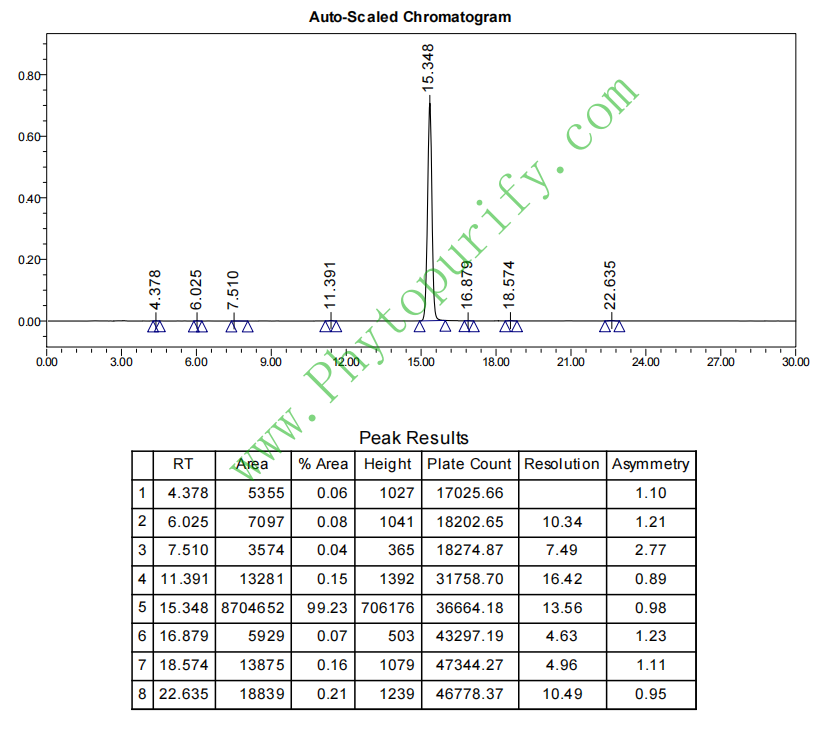
Purity: 95%~99%
Analysis Method: HPLC-DAD or/and HPLC-ELSD
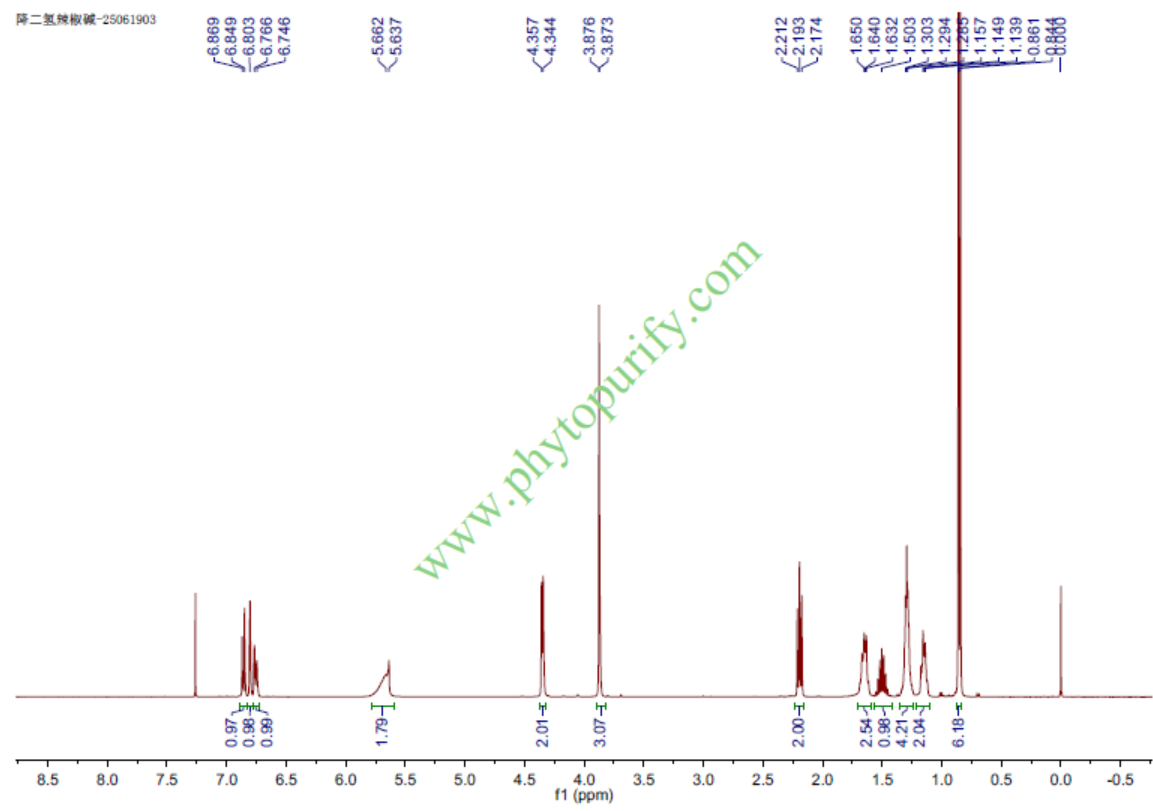
Identification Method: Mass, NMR
Packing: Brown vial or HDPE plastic bottle
Can be supplied from milligrams to grams.
For Reference Standard and R&D, Not for Human Use Directly.
Inquire for bulk scale.
HPLC of Nordihydrocapsaicin
HNMR of Nordihydrocapsaicin
Storage conditions:Short-term storage at 2~8℃, long-term storage at -20 ~ -80℃
Nordihydrocapsaicin (CAS number: 28789-35-7), as an important analogue of capsaicin, has received widespread attention in the field of natural product pharmacology in recent years due to its unique chemical structure and significant biological activity. Dihydrocapsaicin is mainly present in fresh and processed chili peppers, with oral activity that can cause a typical burning sensation, while exhibiting good analgesic and anticancer potential. Capsaicin compounds have shown significant pharmacological value in pain regulation, inflammatory response, and tumor treatment due to their interactions with various ion channels and receptors. This article aims to systematically review the chemical structure, physicochemical properties, plant sources, extraction methods, pharmacological activity, mechanism of action, pharmacological evaluation, and clinical application prospects of dihydrocapsaicin. It is expected to provide a theoretical basis and reference for further research and development of this compound.
The molecular formula of dihydrocapsaicin is C18H27NO3, with a molecular weight of 293.4070. Structurally, it belongs to the reducing derivative of capsaicin compounds. Its core structure consists of an aromatic ring and a long-chain fatty alcohol amine side chain. Unlike capsaicin, the double bond on the side chain is reduced, hence it is called "dihydro reduction". This structural feature endows it with high lipid solubility (LogP=3.6940), which is beneficial for penetrating cell membranes and the blood-brain barrier (BBB penetration is high). Its polar surface area (TPSA) is 58.56 Å ², indicating that its molecule has moderate polarity, which helps to form stable interactions with protein targets. Low water solubility (0.0592 mg/mL) suggests the need to consider solubility enhancement strategies in formulation development. In terms of safety, dihydrocapsaicin did not exhibit hERG channel inhibitory activity, and the Ames mutagenicity test result was negative, indicating that it has a good safety basis.
Dihydrocapsaicin is mainly found in the fruits of Capsicum spp., especially in fresh and processed peppers, where it is abundant. The content of capsaicin compounds is greatly affected by variety, maturity, cultivation environment, and processing technology. Traditional extraction methods often use organic solvents such as ethanol, methanol, or ethyl acetate for extraction, combined with ultrasound assisted extraction or Soxhlet extraction to improve extraction efficiency. Subsequently, purification and separation were carried out through liquid-liquid distribution, silica gel column chromatography, and high performance liquid chromatography (HPLC) to obtain high-purity dihydrocapsaicin. In recent years, supercritical CO2 extraction technology has been gradually applied to the extraction of capsaicin compounds due to its environmentally friendly and efficient characteristics, showing good application prospects.
Dihydrocapsaicin, as a capsaicin analogue, exhibits significant analgesic activity. Its analgesic effect is mainly reflected in the relief of acute pain and chronic neuropathic pain. In vitro and in vivo studies have shown that dihydrocapsaicin participates in the transmission and regulation of pain signals by activating and regulating various pain related receptors and ion channels. Similar to capsaicin, dihydrocapsaicin can activate TRPV1 receptors, induce calcium influx, and cause desensitization of sensory nerve endings, thereby achieving analgesic effects. In addition, it has regulatory effects on various neurotransmitter receptors such as CNR1 (cannabinoid receptor 1), OPRD1 (delta opioid receptor), OPRM1 (μ - opioid receptor), and OPRK1 (κ - opioid receptor), and synergistically participates in the process of pain relief.
In addition to its analgesic effect, dihydrocapsaicin has shown potential in the field of anti-tumor therapy. In vitro cell experiments have shown that dihydrocapsaicin can induce apoptosis in various cancer cell lines, inhibit cell proliferation and migration. Its anti-cancer mechanism involves regulating the cell cycle, inducing mitochondrial dependent apoptosis pathways, and inhibiting the expression of inflammation related enzyme PTGS2 (COX-2), weakening pro-inflammatory signals in the tumor microenvironment. In addition, dihydrocapsaicin may exert anti-tumor effects by regulating TRPA1 channels and dopamine receptor DRD2, which may affect the metabolism and signal transduction of tumor cells.
Dihydrocapsaicin also exhibits certain anti-inflammatory, antioxidant, and neuroprotective activities. It reduces prostaglandin synthesis and alleviates inflammatory reactions by inhibiting the enzymatic activity of PTGS1 (COX-1) and PTGS2 (COX-2). The regulatory effect of SLC6A4 (5-hydroxytryptamine transporter) suggests that it may affect the neurotransmitter balance in the central nervous system and has potential antidepressant and anxiety effects.
The pharmacological effects of dihydrocapsaicin depend on its interactions with multiple molecular targets, particularly key receptors and ion channels in the pain signaling pathway.
TRPV1 (transient receptor potential vanillic acid receptor 1) is a classic target of capsaicin compounds, mainly distributed at the terminals of sensory neurons. Dihydrocapsaicin activates TRPV1, induces calcium influx, leading to depolarization of nerve endings and release of neurotransmitters, resulting in initial burning sensation. However, sustained activation of TRPV1 can lead to desensitization of nerve endings and inhibition of pain signal transduction, exerting analgesic effects.
Dihydrocapsaicin exhibits regulatory effects on μ (OPRM1), δ (OPRD1), and κ (OPRK1) opioid receptors, synergistically relieving pain by enhancing endogenous analgesic signals in the opioid system. In addition, the activation of opioid receptors is also involved in regulating neuroinflammation and emotional states.
CNR1 receptors are widely expressed in the central nervous system and are involved in pain regulation, inflammatory response, and neuroprotection. The effect of dihydrocapsaicin on CNR1 may enhance its analgesic and anti-inflammatory effects.
Dihydrocapsaicin inhibits cyclooxygenase-1 and cyclooxygenase-2 (COX-1 and COX-2), reduces prostaglandin synthesis, alleviates inflammatory response, indirectly alleviates pain, and suppresses tumor associated inflammation.
The TRPA1 channel is involved in the transmission of inflammatory pain and neuropathic pain, and the regulatory effect of dihydrocapsaicin on it can help alleviate complex pain states. The regulation of SLC6A4 suggests that it may affect the reuptake of neurotransmitter serotonin, thereby regulating emotions and pain perception. The regulation of DRD2 dopamine receptors may affect neuronal excitability and tumor cell metabolism.
Dihydrocapsaicin has good pharmacological properties. Its molecular weight is moderate (293.4 Da) and conforms to Lipinski's rule. The LogP value (3.694) shows that it has suitable lipid solubility, which is beneficial for oral absorption and blood-brain barrier penetration. The TPSA value of 58.56 Å ² indicates that its polarity is moderate, which is conducive to binding to the target and cell membrane permeability. Low water solubility suggests the need to improve bioavailability through formulation optimization.
In terms of safety, dihydrocapsaicin did not exhibit hERG channel inhibitory activity, reducing the risk of cardiac toxicity. The Ames test is negative, indicating no significant mutagenicity and high safety. It has good oral activity and high blood-brain barrier penetration ability, making it suitable for developing indications related to the central nervous system.
At present, there is limited research on the pharmacokinetics (PK) of dihydrocapsaicin. However, based on its structural similarity to capsaicin, it is expected that its metabolism in vivo will mainly be mediated by the liver enzyme system through redox reactions and binding metabolism. Further research on in vivo absorption, distribution, metabolism, and excretion (ADME) is needed in the future to clarify its pharmacokinetic characteristics and dosage adjustment plans.
Dihydrocapsaicin, as a natural derivative compound, has shown great potential for clinical applications due to its significant analgesic and anticancer activities.
At present, there are still significant challenges in the treatment of chronic pain and neuropathic pain in clinical practice, and the dependence and side effects of traditional opioid drugs limit their application. Dihydrocapsaicin provides a potential new non opioid analgesic strategy through a multi-target mechanism, particularly the synergistic regulation of TRPV1 and opioid receptors. Its oral activity and good blood-brain barrier penetration ability make it suitable for development as a central analgesic drug. In addition, the local application of dihydrocapsaicin can also be used to alleviate local pain and inflammation.
The ability of dihydrocapsaicin to induce cancer cell apoptosis and inhibit tumor growth provides a theoretical basis for its use as an adjuvant anticancer drug. In the future, chemotherapy drugs can be combined to explore their roles in regulating the tumor microenvironment and enhancing chemotherapy sensitivity. Based on its anti-inflammatory and immune regulatory properties, the potential of dihydrocapsaicin in tumor immunotherapy is also worth further exploration.
The regulatory effects of dihydrocapsaicin on neuroprotection, antidepressant, and anti anxiety suggest its potential for development in the field of neurological and psychiatric disorders. In addition, its anti-inflammatory and antioxidant activities make its application prospects in chronic inflammatory diseases worthy of attention.
Although dihydrocapsaicin exhibits good pharmacological activity and drug properties, its low water solubility and oral bioavailability remain challenges in formulation development. In the future, it is necessary to improve its pharmacokinetic properties through technologies such as nanocarriers and solid dispersions. The toxicological evaluation and preclinical research of the system are also key to promoting its clinical translation. The multi-target and multi mechanism characteristics provide the possibility for precision medicine and personalized treatment.
Dihydrocapsaicin, as an important member of the capsaicin class of natural products, has shown broad application prospects in pain relief, anti-cancer, and neurological diseases due to its unique chemical structure and multi-target pharmacological activity. Its good pharmacological parameters and safety foundation have laid a solid foundation for subsequent drug development. In the future, through in-depth mechanism research, pharmacokinetic optimization, and clinical evaluation, dihydrocapsaicin is expected to become a star compound in the field of natural product pharmacology, providing new strategies and choices for the treatment of related diseases.
