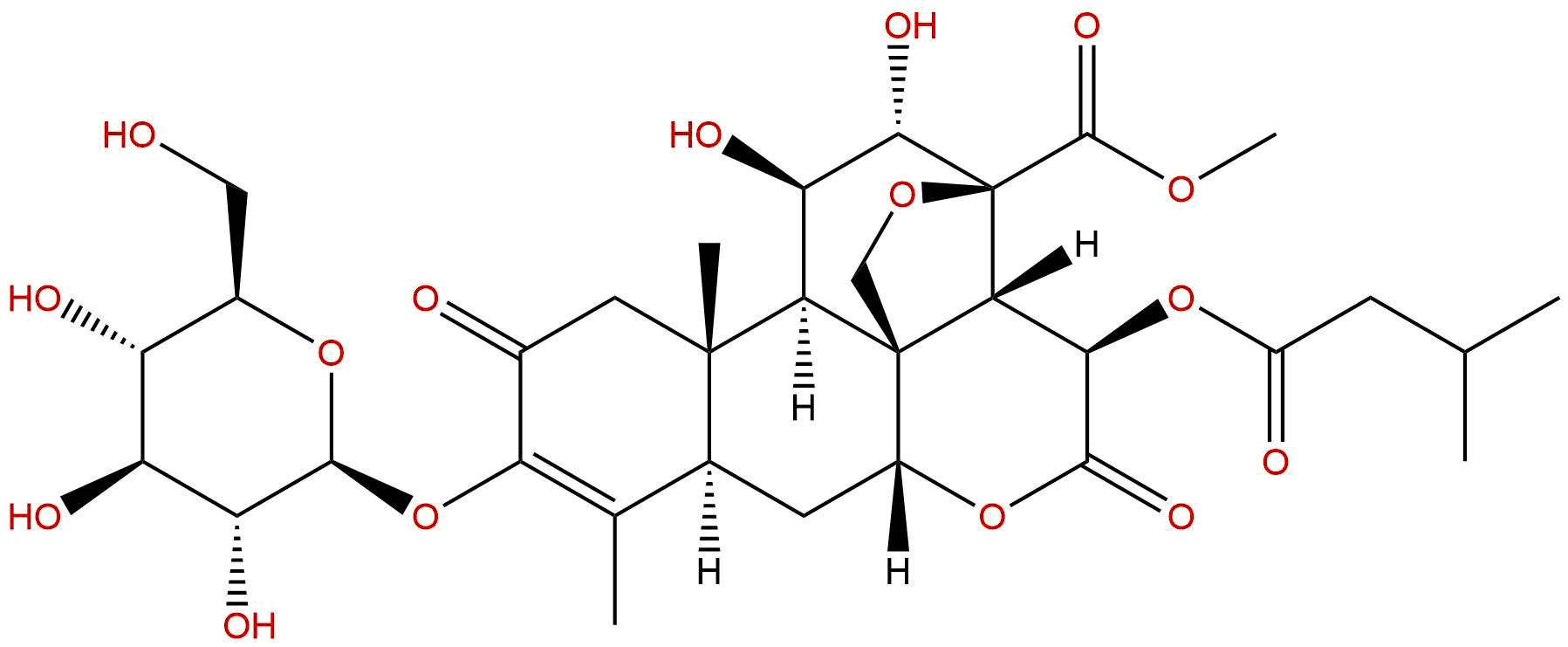


Product name: Yadanzioside B
Synonym name:
Catalogue No.: BP5337
Cas No.: 106387-01-3
Formula: C32H44O16
Mol Weight: 684.688
Botanical Source:
Type of Compound: Diterpenoids
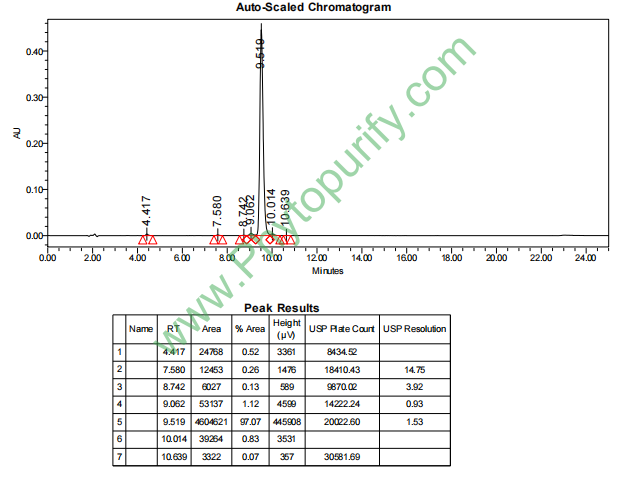
Purity: 95%~99%
Analysis Method: HPLC-DAD or/and HPLC-ELSD
Identification Method: Mass, NMR
Packing: Brown vial or HDPE plastic bottle
Storage: Store in a well closed container, protected from air and light. Put into refrigerate or freeze for long term storage.
Whenever possible, you should prepare and use solutions on the same day. However, if you need to make up stock solutions in advance, we recommend that you store the solution as aliquots in tightly sealed vials at -20℃. Generally, these will be useable for up to two weeks.
The product could be supplied from milligrams to grams
Inquire for bulk scale.
For Reference Standard and R&D, Not for Human Use Directly.
HPLC of Yadanzioside B
Storage conditions:Short-term storage at 2~8℃, long-term storage at -20 ~ -80℃
245.0400
.0405
.0408
1.5720
.5551
.5785
Low
58.9419
6.9045
Yes
No
No
No
Yes
No
0.0
Yes
No
No
Yes
Natural products, as an important source of drug discovery, play an irreplaceable role in the long history of human fight against diseases. Among them, it comes from the genus Brucea in the family Simaroubacheae(Brucea)The chemical composition of plants has attracted much attention due to their significant anti-tumor, anti malaria, antiviral, and anti-inflammatory activities. Brucea Javanese(Brucea javanica As a traditional Chinese medicinal herb, (L.) Merr. is used in clinical practice to treat dysentery, malaria, and certain growths such as warts and corns. Modern pharmacological research has revealed that the main active ingredients in brucea are a class of structurally unique quassinoids, among which the Yadanzioside series compounds have become a research hotspot due to their complex chemical structure and significant biological activity.
Yadanzioside B (Y-B) is an important member of the Yadanzioside family. As a C-20 type bitter lignin glycoside compound, Y-B has a tetracyclic triterpenoid skeleton unique to the bitter lignin mother nucleus in its structure, and is distinguished from its prototype compound bruce acid glycoside B by the reduction of the C-1 and C-2 double bonds. Since its isolation and identification in the 1980s, the anti-tumor activity of Y-B has gradually been revealed, and its mechanism of action involves the regulation of multiple key signaling pathways and targets, exhibiting pharmacological characteristics of multi-target and multi pathway. In recent years, with the deepening understanding of tumor biology and advances in medicinal chemistry and molecular pharmacology techniques, research on Y-B has evolved from simple cytotoxicity evaluation to systematic exploration of its molecular mechanisms, target networks, and drug potential. This article aims to comprehensively review the chemical structure, physicochemical properties, plant origin, pharmacological activity, mechanism of action, pharmacological evaluation, and clinical application prospects of Y-B, in order to provide a systematic academic reference for the in-depth development and transformation research of this natural product.
Dihydrobrucea Javanese Glycoside B belongs to the class of bitter lignin compounds, with its core skeleton being a quassinoid structure. Bitter lignin compounds are a class of highly oxidized nortriterpenoids, whose basic carbon skeleton consists of 20 carbon atoms (C-20 type), distinct from classical C-30 triterpenoids. The chemical structure of Y-B is characterized by its fused four ring system (A/B/C/D ring), where A ring is a lactone ring, C ring is a cyclohexenone structure, and D ring is a hexagonal lactone ring. Compared with bruce acid glycoside B, Y-B has a single bond (i.e. hydrogenation) between the C-1 and C-2 positions of the A ring, which makes its A ring conformation more flexible. In addition, Y-B molecules are connected to multiple hydroxyl groups (- OH) and a β - D-glucose group, which is typically linked to the C-21 position to form an oxygen glycosidic bond.
From the perspective of physical and chemical properties, the molecular formula of Y-B is C ∝₄ H ₄₄ O ₁₅, with a molecular weight of 684.6880 g/mol. Its lipophilic water partition coefficient (LogP) is 0.0405, indicating that the compound has an extremely low n-octanol/water partition coefficient and is much more hydrophilic than lipophilic. This characteristic is closely related to the presence of multiple hydroxyl groups and one sugar group in its molecule. The polar surface area (TPSA) is as high as 245.04 Å ², further confirming its strong polarity and a large number of hydrogen bond donor/acceptor sites. The water solubility parameter is 1.5720 (usually logS value, representing molar solubility), indicating that Y-B has good solubility in water, which provides favorable conditions for its absorption and distribution in organisms. However, its high polarity and high molecular weight also limit its transmembrane ability, especially in terms of penetrating the blood-brain barrier, with predictions showing a "low" blood-brain barrier permeability. In addition, based on the early toxicology prediction model, the inhibitory risk of Y-B on hERG potassium ion channels is "no", and the Ames test result is 0.0, indicating a low genetic toxicity risk. These physicochemical properties and preliminary toxicological data provide important reference for the subsequent drug development of Y-B.
Y-B mainly comes from plants of the genus Brucea in the family Sapindaceae, among which Brucea is the main source(Brucea javanica (L.) Merr. is the most abundant in fruit and seeds. Brucea is native to Southeast Asia and southern China (such as Guangdong, Guangxi, Fujian, Yunnan, etc.). Its fruit is long oval shaped, black when ripe, and has a strong bitter taste. Other plants belonging to the same genus, such as the large fruited Brucea, are included in the same genus(Brucea mollis Wall. and Soft haired Brucea Javanese(Brucea sumatrana Roxb. may also contain Y-B or its analogues, but there are relatively few research reports.
The extraction and separation of Y-B usually follow the classic process of natural product chemistry. Due to Y-B being a highly polar glycoside compound, traditional extraction methods often use polar solvents for extraction. Specifically, after crushing the dried fruit or seeds of brucea, they are often subjected to cold soaking or hot reflux extraction using methanol or ethanol (70% -95%). After the extraction solution is concentrated under reduced pressure, the total extract is obtained. Subsequently, the total extract was dispersed in water and subjected to liquid-liquid extraction using petroleum ether, ethyl acetate, and n-butanol in sequence. Due to the high polarity of Y-B, it is mainly enriched in the n-butanol extraction layer. After the n-butanol layer is concentrated, it is repeatedly separated and purified by silica gel column chromatography (gradient elution with chloroform methanol water system or ethyl acetate methanol system), ODS reverse phase column chromatography (elution with methanol water system) and Sephadex LH-20 gel column chromatography (elution with methanol or methanol water system). Finally, high purity Y-B monomer can be obtained through preparation by high-performance liquid chromatography (HPLC). In recent years, modern separation techniques such as high-speed counter current chromatography (HSCCC) have also been applied to the efficient separation of components of brucea Javanese glycosides, significantly improving separation efficiency and purity. The structural identification of Y-B mainly relies on nuclear magnetic resonance spectroscopy (NMR, including ¹ H-NMR, ¹ ³ C-NMR, DEPT, HSQC, HMBC, etc.) and high-resolution mass spectrometry (HR-ESI-MS) techniques, which confirm its structure by comparing with literature data.
The pharmacological activity research of Y-B mainly focuses on its anti-tumor effect, and there are also a few studies involving its anti-inflammatory, antiviral, and immune regulatory activities.
Antitumor activity It is the most essential pharmacological action of Y-B. A large number of in vitro experiments have shown that Y-B has significant proliferation inhibition and cytotoxicity effects on various human tumor cell lines. The types of tumors involved are diverse, including but not limited to:
- Lung cancer It exhibits inhibitory activity against non-small cell lung cancer cell lines such as A549, H1299, and NCI-H460.
- liver cancer Has a cytotoxic effect on liver cancer cell lines such as HepG2, Huh-7, and SMMC-7721.
- breast cancer: It is effective for breast cancer cell lines such as MCF-7 (ER positive) and MDA-MB-231 (triple negative).
- prostate cancer Has inhibitory effects on prostate cancer cell lines such as PC-3 and DU-145.
- colorectal cancer Has anti proliferative activity against HT-29, HCT-116 and other cell lines.
- leukemia Inducing apoptosis in leukemia cell lines such as HL-60 and K562.
- Ovarian cancer, cervical cancer, gastric cancer There are also related reports.
The half maximal inhibitory concentration (IC ₅₀) of Y-B on tumor cells is usually in the micromolar range (1-20 μ M), and the specific value varies depending on the cell line type and treatment time. It is worth noting that Y-B has relatively low toxicity to certain normal cells (such as human normal liver cell L02), demonstrating a certain degree of selectivity, which provides an important advantage as an anti-tumor candidate drug.
In terms of its mode of action, Y-B mainly works through Inducing cell apoptosis and Inhibit cell proliferation Unleash anti-tumor effects. Morphological observation shows that tumor cells treated with Y-B exhibit typical apoptotic features, such as cell shrinkage, chromatin condensation, nuclear fragmentation, and formation of apoptotic bodies. Flow cytometry analysis confirmed that Y-B can induce cell apoptosis in a dose-dependent and time-dependent manner, often accompanied by cell cycle arrest, especially G0/G1 or G2/M arrest. In addition, Y-B can also inhibit the migration and invasion ability of tumor cells, suggesting its potential anti metastatic potential.
Other pharmacological activities In addition to anti-tumor effects, studies have reported that Y-B has certain anti-inflammatory activity and can inhibit the production of nitric oxide (NO) and pro-inflammatory cytokines (such as TNF - α, IL-6) in macrophages induced by lipopolysaccharide (LPS). In addition, Y-B also exhibits certain inhibitory effects on the replication of certain viruses (such as influenza virus and dengue virus), but its antiviral mechanism is not yet clear. In terms of immune regulation, Y-B may regulate the body's immune function by affecting the activity of T cells or NK cells, but related research is still in its preliminary stage.
The anti-tumor mechanism of Y-B is complex, involving the regulation of multiple signaling pathways and molecular targets, reflecting the typical characteristics of multi-target action of natural products. Based on existing research, its mechanism of action can be summarized as follows:
1. Regulating apoptosis related proteins (Bcl-2 family and Mcl-1)
Y-B can significantly downregulate the expression of anti apoptotic proteins Bcl-2 and Mcl-1, while upregulating the expression of pro apoptotic protein Bax, leading to an increase in the Bax/Bcl-2 ratio. This change promotes an increase in mitochondrial outer membrane permeability, releasing cytochrome c, which in turn activates Caspase-9 and Caspase-3, initiating cell apoptosis through the mitochondrial pathway. Mcl-1, as an important anti apoptotic member of the Bcl-2 family, is highly expressed in various drug-resistant tumors, and the inhibitory effect of Y-B on it is of great significance.
2. Inhibit the STAT3 signaling pathway
Signal transducer and activator of transcription factor 3 (STAT3) is continuously activated in various tumors, promoting cell proliferation, survival, angiogenesis, and immune escape. Research has shown that Y-B can inhibit the phosphorylation of STAT3 (Tyr705 site), thereby blocking its nuclear translocation and transcriptional activity. The inhibition of STAT3 activity leads to downregulation of downstream target genes such as Cyclin D1, Survivor, VEGF, Bcl xL, Mcl-1, etc., thereby inhibiting tumor cell proliferation and inducing apoptosis.
3. Inhibition of MMP2 and anti metastatic effects
Matrix metalloproteinase-2 (MMP2) is a key enzyme that degrades the extracellular matrix (ECM) and is closely related to tumor invasion and metastasis. Y-B can inhibit the activity and expression of MMP2, thereby weakening the degradation ability of tumor cells to the basement membrane and inhibiting their migration and invasion. This effect may be related to its regulation of the MAPK signaling pathway.
4. Inhibition of Topoisomerase (TOP1/TOP2A)
Topoisomerase I (TOP1) and II α (TOP2A) are essential enzymes in DNA replication and transcription processes, as well as classic targets for various chemotherapy drugs such as camptothecin and etoposide. Y-B has been found to inhibit the activity of TOP1 and TOP2A, leading to DNA breakage and replication stress, thereby exerting cytotoxic effects. This suggests that Y-B may have anti-tumor mechanisms similar to topoisomerase inhibitors.
5. Regulating HIF-1 α and hypoxia signaling
Hypoxia inducible factor 1 alpha (HIF-1 alpha) is a key transcription factor for tumors to adapt to the hypoxic microenvironment, promoting angiogenesis, glycolysis, and metastasis. Y-B can inhibit the protein accumulation and transcriptional activity of HIF-1 α, thereby downregulating the expression of its target genes VEGF, GLUT1, etc., inhibiting tumor angiogenesis and energy metabolism reprogramming.
6. Affects the MAPK and ER signaling pathways
Y-B has a regulatory effect on the mitogen activated protein kinase (MAPK) pathway, which may affect cell proliferation and differentiation by inhibiting the phosphorylation of ERK1/2 (MAPK1). In addition, in hormone dependent tumors (such as breast cancer), Y-B can down regulate the expression of estrogen receptor α (ESR1) and inhibit the activity of aromatase (CYP19A1), thereby reducing the synthesis of estrogen and playing the role of anti hormone dependent tumors.
In summary, Y-B forms a complex regulatory network by simultaneously acting on multiple targets such as MCL1, BCL2, STAT3, MMP2, TOP1, HIF1A, TOP2A, MAPK1, ESR1, CYP19A1, etc., synergistically exerting anti-tumor effects. This multi-target mechanism of action gives Y-B potential advantages in overcoming tumor heterogeneity and drug resistance.
The conversion of natural products into clinical drugs requires a systematic evaluation of their drug lethality and pharmacokinetic (ADME) properties. Based on the physicochemical parameters and preliminary research of Y-B, the following analysis can be conducted on its medicinal properties:
1. Physical and chemical properties and drug like properties
The molecular weight of Y-B (684.69 Da) exceeds the traditional Lipinski's Rule of Five limit of molecular weight<500. Its LogP value (0.04) is much lower than 5, and its TPSA (245 Å ²) is much higher than 140 Å ², indicating that its oral absorption may be poor. However, these rules are not absolute limitations for anti-tumor drugs, especially those targeting extracellular or membrane targets, or drugs administered through injection routes. The good water solubility (1.57) of Y-B provides convenience for the development of its injectable form.
2. Pharmacokinetic characteristics
At present, there is insufficient systematic research on the pharmacokinetics of Y-B in vivo, but reasonable inferences can be made based on its structural characteristics:
- absorb Due to its high molecular weight and polarity, the oral bioavailability of Y-B is expected to be very low. Therefore, intravenous or intraperitoneal injection may be a more effective route of administration.
- distribution Y-B is mainly distributed in blood and extracellular fluid. Its low blood-brain barrier permeability indicates a lower risk of central nervous system toxicity, which is advantageous for the treatment of non central nervous system tumors.
- Metabolism Y-B, as a glycoside compound, may be hydrolyzed by glycosidases in the intestine or liver to produce aglycones (dihydrobrucine B) and glucose. Glycosides may further undergo phase I (oxidation, reduction) and phase II (glucuronidation, sulfation) metabolism. The CYP450 enzyme system may be involved in its metabolism.
- excretion Due to its high polarity, Y-B and its metabolites may be mainly excreted through the kidneys (urine) and bile (feces).
3. Safety evaluation
Preliminary toxicology predictions indicate that Y-B has no hERG inhibitory activity (low risk of cardiac toxicity) and negative Ames test (low risk of genetic toxicity). However, as a compound with significant cytotoxicity, Y-B may cause certain toxicity to rapidly proliferating normal tissues (such as bone marrow and gastrointestinal mucosa) in vivo, leading to common side effects such as bone marrow suppression and gastrointestinal reactions. The therapeutic window needs to be determined through systematic in vivo toxicology studies.
4. Optimization strategy for drug properties
Considering the poor oral absorption of Y-B, its pharmacological optimization can be considered from the following aspects:
- Prodrug design Esterify or phosphorylate the hydroxyl group of Y-B to enhance its lipophilicity or targeting ability.
- nano-formulation By utilizing delivery systems such as liposomes, polymer micelles, and albumin nanoparticles, the solubility, stability, and tumor targeting of Y-B can be improved while reducing systemic toxicity.
- Simplified structure Retain the pharmacophore, modify or replace the sugar moiety, and search for derivatives with lower molecular weight and higher oral bioavailability.
As a natural product with multi-target anti-tumor activity, Y-B has broad clinical application prospects, but also faces many challenges.
Potential indications Based on its pharmacological activity, Y-B may be suitable for the treatment of various solid tumors and hematological tumors, especially in lung cancer, liver cancer, breast cancer, prostate cancer and leukemia. Its inhibitory effect on key signaling pathways such as STAT3 and HIF-1 α makes it uniquely valuable in the treatment of refractory, metastatic, and drug-resistant tumors. In addition, Y-B's inhibitory effect on CYP19A1 suggests that it may become a lead compound of aromatase inhibitors for the treatment of hormone dependent breast cancer.
Combination therapy strategy Given the multi-target nature of Y-B, its combination with conventional chemotherapy drugs (such as cisplatin, paclitaxel, 5-fluorouracil), targeted drugs (such as tyrosine kinase inhibitors), or immune checkpoint inhibitors (such as PD-1/PD-L1 antibodies) may produce synergistic effects and reduce toxic side effects. For example, Y-B may enhance the sensitivity of tumor cells to chemotherapy drugs and reverse drug resistance by inhibiting STAT3 and Mcl-1.
Challenges and unresolved issues:
1. Pharmacokinetic defects Low oral bioavailability is the biggest obstacle to the clinical translation of Y-B. Developing efficient injectable or novel delivery systems is an urgent task.
2. In vivo efficacy and toxicity At present, research on Y-B mainly focuses on in vitro experiments, and there is insufficient data on in vivo anti-tumor activity and systemic toxicity. Systematic animal model studies are needed to clarify the maximum tolerated dose, dose limiting toxicity, and anti-tumor efficacy.
3. Target specificity and off target effects The multi-target effect of Y-B is both an advantage and a risk. It is necessary to use omics techniques such as proteomics and transcriptomics to comprehensively analyze its target network, distinguish treatment-related targets and off target effects, in order to guide structural optimization.
4. Large scale preparation and quality control Extracting Y-B from natural plants has high cost and low yield. Developing biosynthetic pathways (such as yeast or plant cell factories) or total synthetic routes, as well as establishing strict quality control standards (such as HPLC fingerprinting and content determination), are key to achieving industrialization.
Future research directions:
-Thoroughly elucidate the interaction modes between Y-B and various targets (such as MCL1, STAT3, TOP1), including molecular docking and eutectic structure analysis.
-Using medicinal chemistry methods, design and synthesize a series of Y-B derivatives, conduct structure-activity relationship (SAR) studies, and search for candidate compounds with stronger activity, higher selectivity, and better pharmacokinetic properties.
-Explore the regulatory role of Y-B in the tumor immune microenvironment, such as its impact on tumor associated macrophages (TAMs), myeloid derived suppressor cells (MDSCs), and T cell function.
-Conduct collaborative anti-tumor research between Y-B and other natural products or clinical drugs to provide scientific basis for combination therapy regimens.
Dihydrobrucea Javanese Glycoside B (Y-B), as a bitter lignin glycoside derived from the traditional Chinese medicine Brucea Javanese, has become a new star in the field of natural product drug research due to its unique chemical structure and multi-target anti-tumor activity. It exhibits comprehensive advantages in inhibiting tumor cell proliferation, inducing apoptosis, anti metastasis, and anti angiogenesis by regulating a series of key molecules such as MCL1, BCL2, STAT3, MMP2, TOP1, HIF1A, TOP2A, MAPK1, ESR1, CYP19A1, etc. Its good water solubility, low blood-brain barrier permeability, and initially demonstrated low genetic toxicity provide a favorable basis for its drug development. However, bottlenecks such as low oral bioavailability, lack of in vivo efficacy and toxicity data, and difficulty in large-scale preparation remain the main obstacles to its clinical application. In the future, through structural optimization, development of new formulations, in-depth mechanism research, and systematic preclinical evaluation, Y-B is expected to become a new candidate drug for the treatment of various malignant tumors, contributing the wisdom and power of natural products to the human anti-cancer cause. The in-depth study of Y-B not only helps to reveal the modern scientific connotation of the traditional efficacy of Brucea asiatica, but also provides valuable examples for discovering innovative drugs from traditional Chinese medicine.
