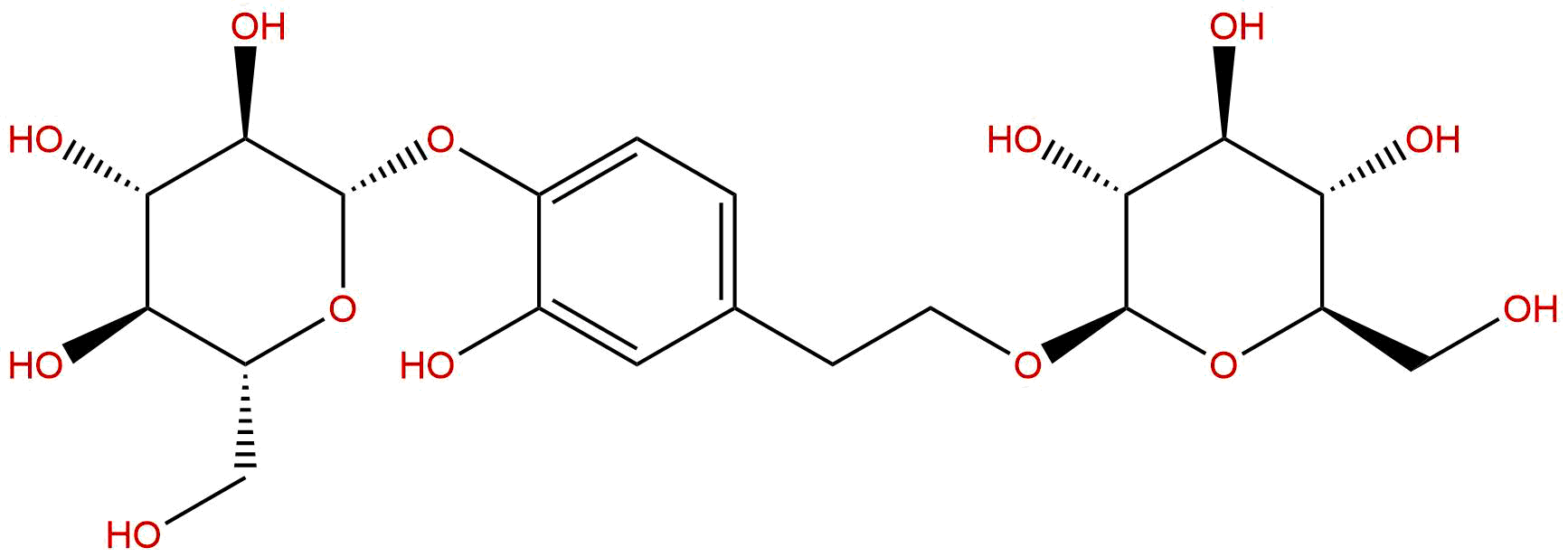


Product name: 3-Hydroxysalidroside-4-O-glucopyranoside
Synonym name: Hydroxytyrosol-1,4-O-β-diglucopyranoside
Catalogue No.: BP2388
Cas No.:
Formula: C20H30O13
Mol Weight: 478.447
Botanical Source:
Type of Compound: Phenols
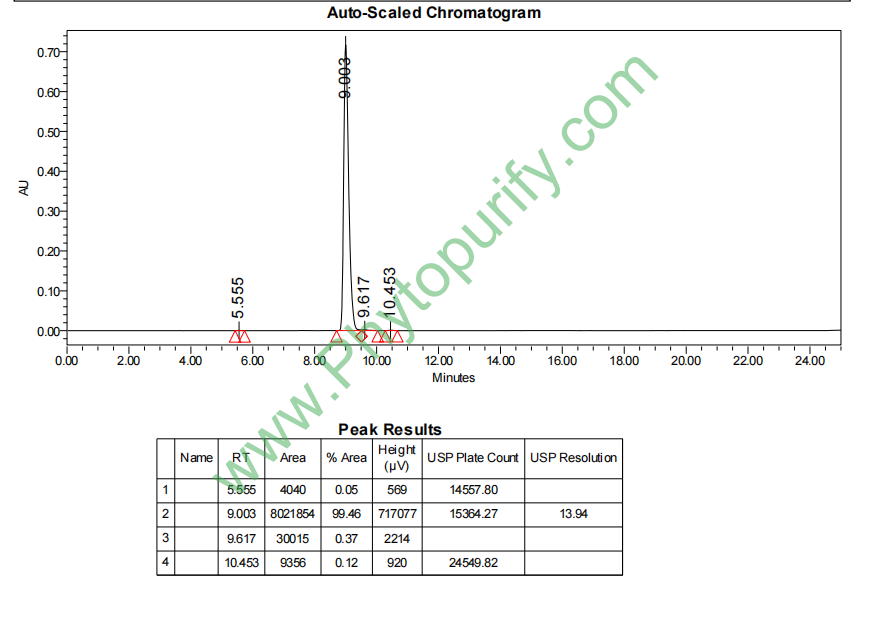
Purity: 95%~99%
Analysis Method: HPLC-DAD or/and HPLC-ELSD
Identification Method: Mass, NMR
Packing: Brown vial or HDPE plastic bottle
Storage: Store in a well closed container, protected from air and light. Put into refrigerate or freeze for long term storage.
Whenever possible, you should prepare and use solutions on the same day. However, if you need to make up stock solutions in advance, we recommend that you store the solution as aliquots in tightly sealed vials at -20℃. Generally, these will be useable for up to two weeks.
The product could be supplied from milligrams to grams
Inquire for bulk scale.
For Reference Standard and R&D, Not for Human Use Directly.
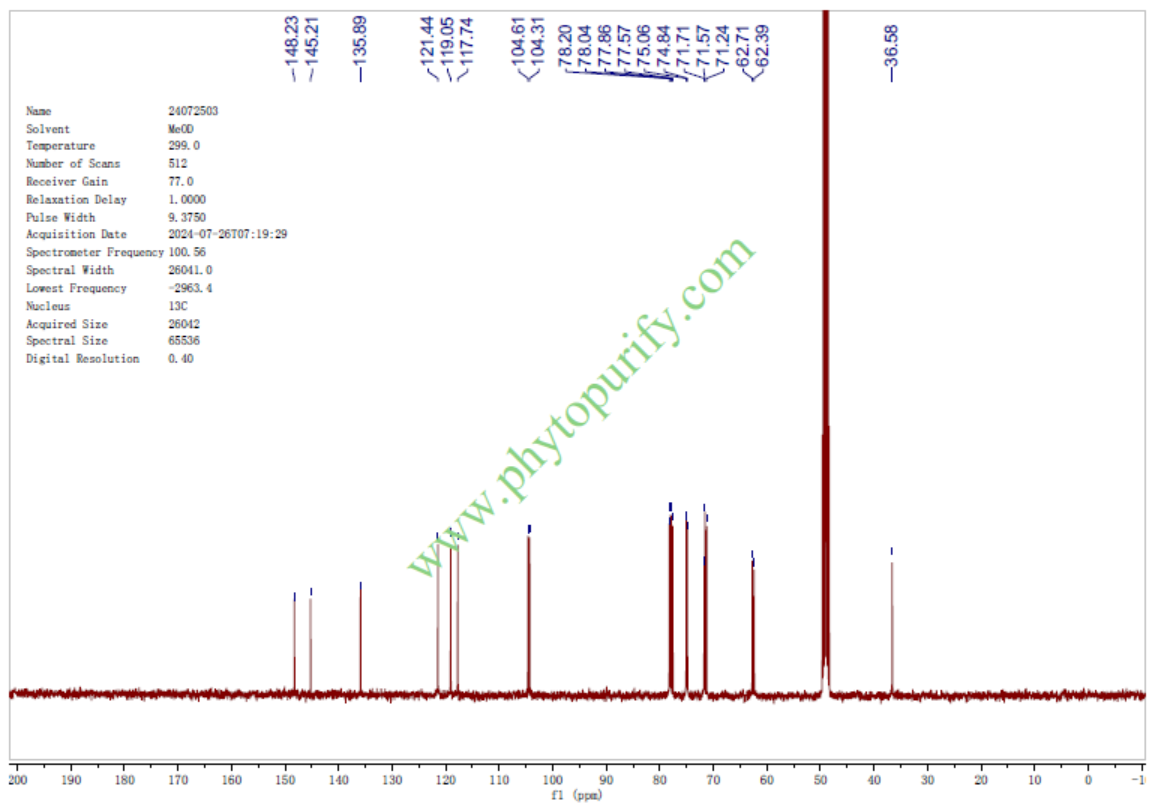
NMR of 3-Hydroxysalidroside-4-O-glucopyranoside
HPLC of 3-Hydroxysalidroside-4-O-glucopyranoside
Storage conditions:Short-term storage at 2~8℃, long-term storage at -20 ~ -80℃
238.3000
-1.2000
-2.5000
No
.1500
No
Negative
3-Hydroxysalidroside-4-O-glucopyranoside is a traditional medicinal plant derived from Rhodiola rosea Rhodiola rosea(Rhodiola rosea)Natural products of phenylethanoid glycosides obtained through separation. As a structural analogue of salidroside, this compound introduces a hydroxyl group at position 3 of the phenylethanolic glycoside nucleus and connects an additional glucose group through a glycosidic bond at position 4, forming a unique dual glycosidic structure. This structural modification may not only significantly alter its physicochemical properties, but also endow it with unique biological activity distinct from salidroside. Rhodiola, as a famous "adaptogen" herb, has been used in traditional medicine for hundreds of years for anti fatigue, anti hypoxia, enhancing immunity and neuroprotection. The research on its core active ingredient, salidroside, has been relatively in-depth. However, the research on derivative glycosides such as 3-hydroxysalidrosin-4-O-glucoside is still in its infancy and belongs to a promising "new member" in the complex chemical composition system of Rhodiola rosea. At present, systematic research data on this compound, including its precise molecular formula, molecular weight, detailed pharmacological targets, and preclinical drug parameters, are still scarce in public databases (such as CAS number, target information, etc. are not clear), which not only indicates its novelty, but also suggests huge exploration space. This article aims to systematically review and prospectively analyze the structural characteristics, potential mechanisms of action, potential drug applications, and future research directions of this compound based on the existing knowledge framework of natural product chemistry and pharmacology.
3-hydroxysalidrosin-4-O-glucoside belongs to the phenylethanoid glycoside class of compounds. Its basic skeleton consists of three parts:Phenylethanolic glycoside(Tyrol derivatives), one Glucose based And an additional one 4-O-linked glucose group The key structural features are:
1. 3-hydroxylation Introducing a phenolic hydroxyl group at position 3 of the benzene ring enhances its ability to act as a hydrogen bond donor and may improve its antioxidant activity, as the phenolic hydroxyl group is a key functional group for scavenging free radicals.
2. 4-O-glucosylation A disaccharide chain is formed by connecting a second pyranose glucose group through an oxygen glycosidic bond at position 4 of the benzene ring. This greatly increases the molecular weight Polarity and Water solubility。
Although the exact molecular formula and molecular weight of the compound have not been disclosed yet, we can make reasonable speculations based on its parent nucleus structure. The molecular weight of salidroside (C14H20O7) is 300.30. 3-hydroxysalidrosin-4-O-glucoside adds one hydroxyl group (+16 Da) and one glucose group (C6H10O5,+162.14 Da) to salidroside. Therefore, it Speculation on molecular formula Perhaps for C20H30O13,Speculation on molecular weight approximately 478.45 Da。
Physical and chemical property analysis:
- solubility Due to the presence of two highly hydrophilic glucose groups and multiple hydroxyl groups, this compound is expected to have Extremely high water solubility Has poor solubility in fat soluble solvents.
- LogP (Fat Water Partition Coefficient)This is a key parameter for measuring the lipophilicity of compounds. The measured LogP value of salidroside is approximately -1.0 to -0.5, indicating that it belongs to hydrophilic compounds. 3-hydroxysalidrosin-4-O-glucoside has added more polar groups, which Speculation that the LogP value will be lower (possibly<-2.0)This indicates that its ability to cross the lipid bilayer membrane of cells will be weaker.
- Topological Polarity Surface Area (TPSA)TPSA is closely related to the membrane permeability and bioavailability of compounds. The TPSA of salidroside is approximately 120 Å ². The additional glucose and hydroxyl groups will significantly increase the number of hydrogen bond acceptors and donors Speculation that TPSA may exceed 200 Å ²This is usually not conducive to passive transmembrane diffusion, especially through the blood-brain barrier (BBB).
- Stability As an O-glycoside, it may undergo hydrolysis in acidic environments and may also undergo deglycosylation metabolism under the action of gut microbiota.
The only known plant source of 3-hydroxysalidrosin-4-O-glucoside is Rhodiola rosea(Rhodiola rosea L.)It belongs to the Crassulaceae family. Rhodiola mainly grows in extreme environments with high altitude, oxygen deficiency, and strong ultraviolet radiation, such as near the Arctic Circle, high-altitude mountain ranges in Asia and Europe (such as the Himalayas and Alps). This harsh growth environment forces plants to synthesize a series of secondary metabolites with strong stress protection effects, among which phenylethanolic glycosides are an important class.
The medicinal history of Rhodiola rosea dates back to ancient times. In the traditional medical system, its application has significant "adaptogen" characteristics:
- Traditional Chinese Medicine Rhodiola rosea (also known as "Rose Rhodiola rosea") is used for medicinal purposes in its roots and rhizomes. It is sweet, astringent, and cold in nature, and belongs to the lung and heart meridians. Commonly used in Tonifying Qi and Promoting Blood Circulation, Tonifying Meridians and Relieving Asthma It is mainly used for treating diseases such as qi deficiency and blood stasis, fatigue and asthma, chest tightness and heartache, and is highly consistent with modern research on anti fatigue, anti hypoxia, and cardiovascular protection effects.
- Nordic and Russian Traditional Medicine Long term use for enhancing Physical strength, endurance, and fatigue resistance To help the body adapt to cold and high altitude environment, and to treat neurasthenia, depression and infectious diseases.
- Tibetan medicine Rhodiola rosea is regarded as a precious medicinal herb, used to treat "lung" disease (equivalent to traditional Chinese medicine's qi and blood imbalance, neurasthenia) and "chiba" disease (heat syndrome), emphasizing its role in balancing the body and enhancing adaptability.
Although traditional applications do not directly target the single component of 3-hydroxysalidrosin-4-O-glucoside, they provide a profound empirical medical background and clear direction for its pharmacological activity research - that is, this compound is likely to participate in mediating the overall anti stress, neuroprotective, and cardiovascular protective effects of salidroside.
Although there is a lack of direct target research data for 3-hydroxysalidrosin-4-O-glucoside, we can start from the common pharmacological mechanisms of its parent compounds salidroside and phenylethanoid glycosides, combined with their unique chemical structures, to make reasonable activity predictions and mechanism deductions.
4.1 Prediction of core potential pharmacological activity
Strong antioxidant and anti-inflammatory activity:
Neuroprotection and antidepressant/anti anxiety potential:
Cardiovascular protective effect:
Anti fatigue and enhanced energy metabolism:
4.2 Scientific explanation of the association between potential targets and diseases
Although there is currently no direct target data, based on similar studies, the following molecular targets may be related to it:
- Kinases and signaling proteins AMPK (main regulator of energy metabolism), Akt (key protein in cell survival pathway), ERK1/2 (signal of cell proliferation and differentiation).
- transcription factor Nrf2 (antioxidant response master factor), NF - κ B (inflammatory response master factor), CREB (related to neuroplasticity and memory).
- enzyme Monoamine oxidase (MAO, neurotransmitter metabolizing enzyme) and acetylcholinesterase (AChE, related to cognitive function).
- receptor May indirectly regulate the sensitivity of glucocorticoid receptors (GR) and affect the HPA axis.
Related diseases Its potential pharmacological activity points to a range of chronic diseases associated with oxidative stress, inflammation, and metabolic disorders
- Neurological disorders Depression, anxiety disorder, Alzheimer's disease, Parkinson's disease, cerebral ischemia/stroke injury.
- Cardiovascular metabolic diseases Atherosclerosis, hypertension, myocardial ischemia, type 2 diabetes and its complications.
- Other Chronic fatigue syndrome, weakened immune function, and altitude sickness.
Based on classic pharmacological criteria such as Lipinski's Rule of Five (Ro5) and our speculation on the physicochemical properties of 3-hydroxysalidrosin-4-O-glucoside, a preliminary evaluation of its potential for drug development is conducted
Lipinski's Five Rules Compliance Analysis:
Evaluation of other key pharmacological parameters:
Comprehensive potential and optimization direction of traditional Chinese medicine:
Current research status:
At present, there is extremely limited public research literature on 3-hydroxysalidrosin-4-O-glucoside. It is mainly mentioned as a chromatographic peak or mass spectrometry characteristic ion in the chemical fingerprint of Rhodiola rosea plants, and its separation and purification, structural confirmation, and systematic biological function screening work still need to be further carried out. This puts it in the realm of natural product research Early detection stage The known information mainly comes from the natural product compound library (such as product number BP2388), indicating that it has been isolated and preliminarily characterized, but deep data mining has not yet been completed.
Future research directions and prospects:
1. Deepening basic research:
- At the chemical level The primary task is to complete precise molecular structure analysis (including absolute configuration), comprehensive physical and chemical property determination, and establish efficient chemical or biosynthetic methods, providing a material basis for subsequent research.
- Pharmacological aspect: Carry out extensive In vitro activity screening Covering multiple models including antioxidant, anti-inflammatory, neuroprotective, cardiovascular protective, and metabolic regulation, to clarify its core activities. Furthermore, by utilizing techniques such as gene knockout, RNA interference, and molecular docking, we aim to explore its potential Direct target action Clarify the precise molecular mechanism.
- Pharmacokinetic study: It is crucial. It is necessary to clarify its absorption, distribution, metabolism (especially the hydrolysis process of glycosidic bonds) and excretion characteristics under different administration routes, and identify its true in vivo active form.
Conclusion:
3-Hydroxy salidrosin-4-O-glucoside is an untapped chemical entity in the treasure trove of Rhodiola rosea, a "medicinal food homology". It inherits the basic activity framework of phenylethanoid glycosides, but is also variable due to unique hydroxylation and glycosylation modifications. Currently, it is standing at the threshold of transitioning from basic research to application development. Faced with challenges in drug development, modern drug research and development technologies such as prodrug strategies and novel drug delivery systems provide multiple solutions. Future research requires close collaboration among multiple disciplines such as chemistry, pharmacology, and pharmacy to comprehensively promote target discovery, mechanism elucidation, and formulation innovation. Only then can this natural molecule originating from high mountains and polar regions be transformed into potential drugs or functional products that benefit human health, continuing the medicinal legend of Rhodiola rosea for thousands of years.
