


Synonym name: 4',5,7,8-Tetrahydroxyflavonol; Isoarticulatidin; 8-Hydroxykaempferol
Catalogue No.: BP0720
Cas No.: 527-95-7
Formula: C15H10O7
Mol Weight: 302.238
Botanical Source: Gossypium, Equisetum, Eupatorium and other plant genera
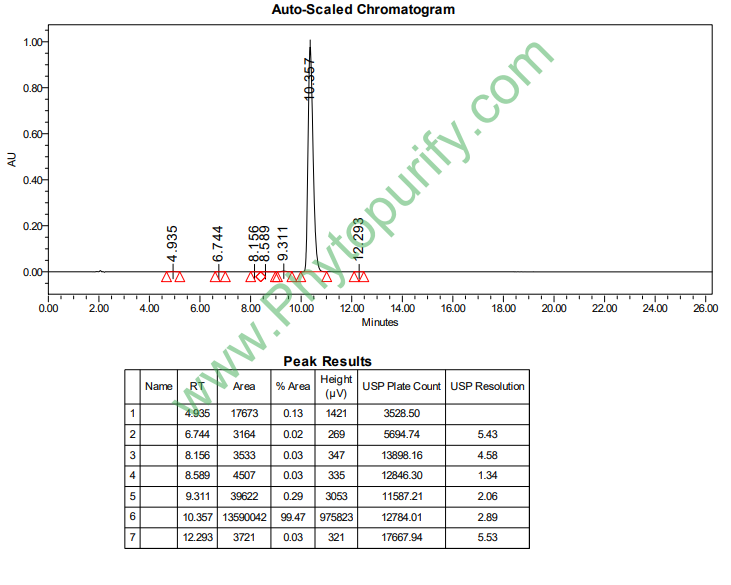
Purity: 95%~99%
Analysis Method: HPLC-DAD or/and HPLC-ELSD
Identification Method: Mass, NMR
Packing: Brown vial or HDPE plastic bottle
Can be supplied from milligrams to grams.
For Reference Standard and R&D, Not for Human Use Directly.
Inquire for bulk scale.
HPLC of Herbacetin
Storage conditions:Short-term storage at 2~8℃, long-term storage at -20 ~ -80℃
131.3600
1.6738
.8823
.0982
2.3999
10.2493
Low
87.9322
2.5655
Yes
No
No
No
Yes
No
0.6
Yes
No
Yes
No
Herbachetin (CAS number: 527-95-7) is a natural flavonoid compound mainly found in plants such as flaxseed (Linum usitatissimum). As an important member of the flavonoid family, coumarin has attracted widespread attention in the field of natural product pharmacology in recent years due to its unique chemical structure and biological activity. A large number of studies have shown that grass extract has significant pharmacological activities such as antioxidant, anti-inflammatory, and anticancer effects, especially showing good potential in regulating inflammatory responses and tumor cell proliferation. Its mechanism of action involves multiple signaling pathways and key molecular targets, especially the allosteric inhibition of ornithine decarboxylase (ODC), providing a new perspective on its anti-tumor mechanism.
This article aims to provide a systematic review of the chemical structure and physicochemical properties, plant sources and extraction methods, pharmacological activity and mechanism of action, drug evaluation and pharmacokinetic characteristics of glyphosate, combined with its clinical application prospects, comprehensively evaluate the research progress and development trends of glyphosate as a potential natural medicine, and provide theoretical basis and reference for subsequent basic research and clinical translation.
Curcumin belongs to the flavonoid class of flavonoids, with a molecular formula of C15H10O7 and a molecular weight of 302.2380. Its structural feature is a typical flavonoid skeleton, containing multiple hydroxyl substituents, endowing it with strong polarity and biological activity. The LogP value of grass quality is 1.6738, indicating that it has moderate lipid solubility, which is beneficial for cell membrane penetration but not excessively hydrophobic. Its topological polar surface area (TPSA) is 131.3600, reflecting strong polarity and hydrogen bond donor/acceptor ability, which facilitates binding to protein targets.
Low water solubility (0.0982 mg/mL) suggests limited solubility in aqueous phase, which may affect oral absorption and bioavailability. Grass like substances have low blood-brain barrier permeability, indicating that they mainly act on peripheral tissues and reduce the risk of central nervous system side effects. The negative result of hERG channel inhibition experiment indicates a low risk of cardiac toxicity. The Ames mutagenicity test score is 0.6, indicating that grass quality has good genetic toxicity safety.
The chemical structural formula of grass quality is as follows:
Its multiple hydroxyl groups endow it with excellent antioxidant capacity and provide a molecular basis for its binding to various protein targets.
Grass quality is widely present in various plants, especially flax seeds (Linum usitatissimum) as the main source. Flaxseed, as a traditional food and medicinal plant rich in phytoestrogens and polyphenolic substances, has a relatively high content of grassy substances in its seeds. In addition, grassy substances can also be detected in some tea, vegetables, and other plants rich in flavonoids.
The extraction of grass extract is usually carried out by combining organic solvent extraction with chromatographic separation. Common extraction processes include:
Solvent selection A polar organic solvent mainly composed of methanol, ethanol, or ethyl acetate, which can effectively dissolve flavonoids and cause minimal damage to plant substrates.
Extraction technology Modern extraction techniques such as traditional immersion extraction, ultrasound assisted extraction (UAE), and microwave-assisted extraction (MAE) have been applied to the extraction of grass extract. Ultrasound and microwave-assisted techniques can significantly improve extraction efficiency and purity.
Purification and Separation The crude extract was further purified by techniques such as silica gel column chromatography and reverse phase high performance liquid chromatography (RP-HPLC) to obtain high-purity grass extract.
Identification and quantification Mass spectrometry (MS), nuclear magnetic resonance (NMR), and ultraviolet visible spectroscopy (UV Vis) were used to confirm the structure and determine the content of glyphosate.
In recent years, the application of green extraction technology has gradually increased, such as supercritical CO2 extraction and ionic liquid assisted extraction, aiming to improve extraction efficiency, reduce environmental pollution, and promote large-scale production of grass quality.
Grass extract has significant free radical scavenging ability, which can effectively inhibit the production of reactive oxygen species (ROS) and reactive nitrogen species (RNS), and alleviate oxidative stress damage to cells. In vitro experiments have shown that grass extract can exert a protective effect by directly capturing free radicals and regulating the activity of endogenous antioxidant enzymes such as superoxide dismutase (SOD) and glutathione peroxidase (GSH Px).
Grass extract has shown good anti-inflammatory effects in various inflammatory models. Its targets include various inflammation related factors and signaling pathways, including:
Animal model studies have shown that grass extract can alleviate symptoms of various inflammatory diseases such as arthritis and inflammatory bowel disease, and has potential clinical application value.
Grass extract exhibits inhibitory effects on proliferation, induces apoptosis, and blocks cell cycle in various tumor cells. Its anti-cancer mechanism mainly includes:
Several in vitro and in vivo experiments support the anticancer potential of oxaliplatin in breast cancer, colorectal cancer, lung cancer and other tumors.
The pharmacological activity of grass quality depends on its interactions with multiple molecular targets, mainly involving the following aspects:
ODC is the rate limiting enzyme in the polyamine synthesis pathway, catalyzing the decarboxylation of ornithine to produce putrescine and promoting cell proliferation. Grass quality induces enzyme conformational changes, reduces enzyme activity, blocks polyamine synthesis, and inhibits tumor cell proliferation by binding to key amino acid residues of ODC (Asp44, Asp243, Glu384). This mechanism provides a molecular basis for the anticancer effect of grass extract.
Grass quality reduces oxidative stress and protects cells from oxidative damage by directly capturing free radicals and activating endogenous antioxidant enzymes. In addition, its hydroxyl group structure helps to stabilize free radicals and enhance antioxidant capacity.
The pharmacological parameters of grass quality indicate that it has good potential for drug development:
In terms of pharmacokinetics, the absorption of glyphosate after oral administration is slow, and its bioavailability is limited by its water solubility and first pass effect. Metabolism in the body is mainly carried out through the liver's phase I and phase II enzyme systems, including hydroxylation, methylation, and glucuronic acid binding. The main excretion pathways are bile and urine.
At present, there is relatively little systematic pharmacokinetic research on grass quality. In the future, further studies on in vivo kinetics, metabolic pathways, and drug interactions are needed to guide clinical applications and formulation development.
Grass extract, as a natural flavonoid, has shown broad application prospects in the fields of anti-inflammatory and anti-cancer due to its multi-target and multi mechanism pharmacological activities. Its specific inhibitory effect on ODC provides a new target for tumor therapy, while its ability to regulate inflammatory signaling pathways makes it potentially therapeutic in inflammatory diseases.
The key to future clinical applications lies in:
In addition, the potential role of grass extract in neuroprotection, metabolic diseases, and other fields is also worth exploring and expanding its application scope.
Grass extract, as a natural flavonoid, has become a hot topic in natural product pharmacology research due to its unique chemical structure and diverse pharmacological activities. Its antioxidant, anti-inflammatory, and anticancer mechanisms are clear, especially showing unique advantages in ODC inhibition and inflammation signaling pathway regulation. The evaluation of drug properties shows that it has good potential for drug development, but issues such as water solubility and bioavailability still need to be overcome.
In the future, by combining modern medicinal chemistry, pharmacokinetics, and clinical research, Caoshen is expected to develop into a new type of natural medicine, providing new strategies and choices for the treatment of inflammatory diseases and tumors. The in-depth research of the system will promote the transition of grass quality from laboratory to clinical application, benefit patients, and promote the development of natural product pharmacology.

