


Product name: Rosiridin
Synonym name:
Catalogue No.: BP1223
Cas No.: 100462-37-1
Formula: C16H28O7
Mol Weight: 332.393
Botanical Source: Rhodiolae Crenulatae Radixet Rhizoma
Physical Description:
Type of Compound: Monoterpenoids
Purity: 95%~99%
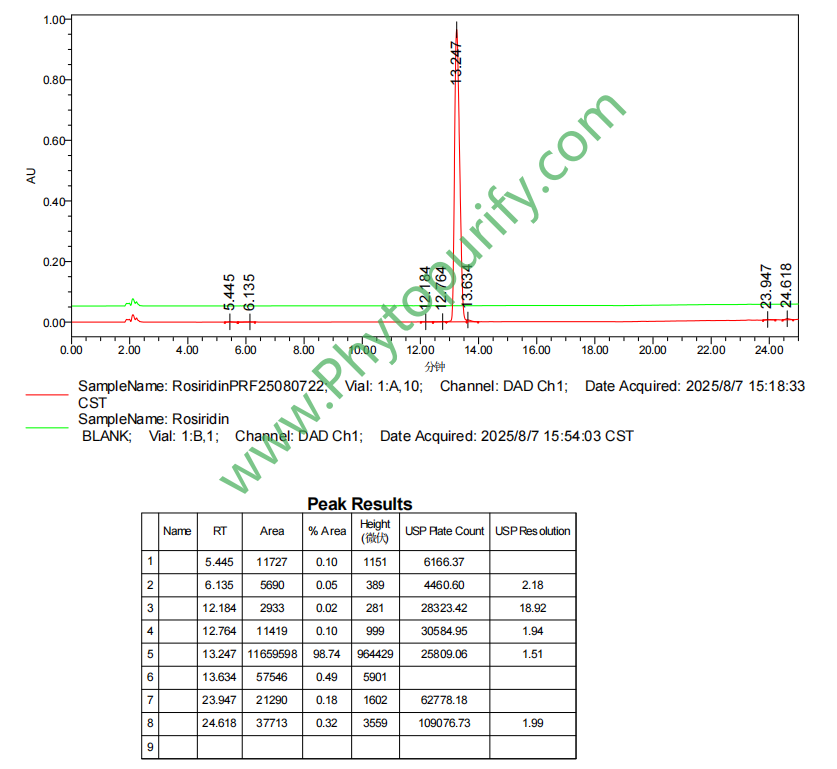
Analysis Method: HPLC-DAD or/and HPLC-ELSD
Identification Method: Mass, NMR
Packing: Brown vial or HDPE plastic bottle
Storage: Store in a well closed container, protected from air and light. Put into refrigerate or freeze for long term storage.
Whenever possible, you should prepare and use solutions on the same day. However, if you need to make up stock solutions in advance, we recommend that you store the solution as aliquots in tightly sealed vials at -20℃. Generally, these will be useable for up to two weeks.
The product could be supplied from milligrams to grams
Inquire for bulk scale.
Description:
Rosiridin has cardioprotective activity.
References:
Journal of Xinjiang Medical University,2007, 30(2):127-9.
The determination of rosiridin in effect extracts of anti-coronary atherosclerotic heart disease of Rhodiola rosea by HPLC
To develop an assay method for determining the concentrations of Rosiridin in effect extracts of anti-coronary atherosclerotic heart disease of Rhodiola rosea.
METHODS AND RESULTS:
High performance liquid chromatography detection (HPLC) was used, using a ODS C18 column (250 mm×4.6 mm, 5 μm) set at 35℃, methanol-water (35∶65) as mobile phase with flowing rate 0.8 ml/min and detected at 210 nm. The linear range of Rosiridin was 5.5~550 μg/ml (r=0.999 6), and the average recovery (n=9) was 98.5%, RSD=1.3%.
CONCLUSIONS:
This method is simple, accurate and reproducible. It provides a basis for the quality evaluation for effect extracts of anti-coronary atherosclerotic heart disease of Rhodiola rosea.
HPLC of Rosiridin
Storage conditions:Short-term storage at 2~8℃, long-term storage at -20 ~ -80℃
119.6100
.0160
.0160
28.8734
.4670
.4516
Low
27.1925
4.3067
Yes
No
No
No
No
No
0.0
Yes
Yes
No
Yes
Depression and neurodegenerative diseases, especially Alzheimer's disease, are increasingly severe public health challenges worldwide today. Monoamine oxidase (MAO) is a key enzyme that degrades key neurotransmitters in the brain, such as serotonin, dopamine, and norepinephrine. Its high activity is closely related to the pathophysiology of depression; The activity of MAO-B is upregulated with age, and the catalytic production of reactive oxygen species such as hydrogen peroxide is considered an important factor in promoting oxidative stress and neurodegenerative processes. Therefore, MAO inhibitors have always been an important direction in the development of neuropsychiatric drugs. However, traditional synthetic MAO inhibitors often come with side effects such as "cheese effect" and liver toxicity, prompting researchers to turn their attention to natural products in order to discover safer and more efficient lead compounds.
Rosiridin, a monotherapy compound isolated from traditional medicinal plants, is entering the research field with its unique dual MAO inhibitory activity. Preliminary pharmacological data shows that it can effectively inhibit MAO-A and MAO-B at micromolar concentrations, especially with a significant inhibition rate on MAO-B, indicating its dual potential in antidepressant and neuroprotective effects. What's even more interesting is that recent studies have expanded the biological significance of Loxadine, discovering that it may exhibit anti-tumor activity in solid tumors such as liver cancer by regulating multiple key signaling nodes such as BCL2, STAT3, and HIF1A. This multi-target and multi activity characteristic makes it a highly valuable natural product molecule for research. This article aims to systematically review the chemical properties, plant sources, pharmacological activities, mechanisms of action, and medicinal properties of Loxadine, and to explore its future research and application prospects.
Loxadine (CAS number: 100462-37-1), molecular formula C17H24O7, molecular weight 332.3930 g/mol. From a chemical structure perspective, Loxadine belongs to the class of iridoid glycosides. Its core structure is a cyclohexene ether terpene element with a decahydronaphthalene skeleton, connected to a glucose unit through a glycosidic bond. This structural feature gives it both hydrophilicity and a certain degree of lipophilicity. Its glycosidic moiety contains multiple hydroxyl groups, which are its main hydrophilic groups.
The physical and chemical parameters calculated based on its chemical structure provide preliminary judgment basis for its biological activity and drug properties. Its lipid water partition coefficient (LogP) is about 0.0160, indicating that the molecule is at the equilibrium point of hydrophilicity and lipophilicity, and theoretically has a good membrane permeability basis. The topological polar surface area (TPSA) is 119.61 Å ², which is relatively high and mainly attributed to the multiple oxygen atoms (hydroxyl and ether bonds) in the molecule, which may affect its efficiency in passive diffusion across the cell membrane. The theoretically calculated water solubility value is 28.8734mg/L, indicating that it belongs to the range of slightly soluble to soluble, which is beneficial for its dissolution and distribution in living organisms. Taking into account these parameters, Loxadine exhibits a natural product characteristic with certain "drug like properties", but its high polar surface area suggests that its oral bioavailability may face challenges and needs to be optimized through formulation or structural modification.
Loxadine mainly comes from plants in the Rubiaceae family, particularly Uncaria Uncaria rhynchhophylla (Miq.) Miq. ex Havil Hooked stems and branches. Gouteng, as a traditional Chinese medicine, has the effects of calming the wind, calming the nerves, clearing heat, and calming the liver. It is commonly used to treat symptoms such as headache, dizziness, seizures, and convulsions. Modern pharmacological studies have also confirmed its activity in the nervous and cardiovascular systems. Loxadine is one of the important active ingredients in Gouteng that exert pharmacological effects.
In addition, plants of the same genus Uncaria macrophylla Wall It has also been reported to contain Loxadine. Its biosynthetic pathway is speculated to originate from the mevalonate pathway in plants, which undergoes a series of enzymatic reactions such as cyclization, oxidation, and glycosylation.
Extracting and isolating Loxadine from plant materials usually follows the conventional process of natural product chemistry. Firstly, the dried Gouteng medicinal herbs are crushed and subjected to heating reflux or ultrasound assisted extraction using alcohol solvents (such as methanol, ethanol) or alcohol water mixed solvents to fully extract the polar components. The crude extract was obtained by vacuum concentration of the extraction solution. Subsequently, preliminary enrichment and purification were carried out using macroporous adsorption resin column chromatography, commonly using a water ethanol gradient elution. Loxadine usually appears in the medium polarity elution site. Further purification requires the use of modern chromatographic techniques such as silica gel column chromatography, reverse phase silica gel column chromatography (such as ODS-C18), and high performance liquid chromatography (HPLC). By using techniques such as nuclear magnetic resonance (NMR) and mass spectrometry (MS) for structural identification, high-purity Loser monomers were ultimately obtained. Optimizing the extraction process, such as using supercritical fluid extraction or microwave-assisted extraction, is expected to improve the extraction efficiency and yield of the target compound.
The pharmacological activity research of Loxadine mainly focuses on its neurological and anti-tumor effects, demonstrating various biological activities.
1. Neuropsychiatric system activity
The most significant feature of Loxadine is its inhibitory activity on monoamine oxidase (MAO). Research has shown that at a concentration of 10 μ M, the inhibitory rate of Loxadine on MAO-B is as high as 83.8%, with a pIC50 value of 5.38 (IC50 of approximately 4.17 μ M). At the same time, it also exhibits inhibitory ability towards MAO-A, making it a dual MAO inhibitor, but with relatively higher selectivity towards MAO-B. The strong inhibition of MAO-B means that Loxadine can increase dopamine levels in the brain and reduce neurotoxic oxidative products catalyzed by MAO-B, providing direct evidence for its neuroprotective effects in Parkinson's and Alzheimer's diseases. And its inhibition of MAO-A activity suggests its potential antidepressant effect, as MAO-A is the main subtype that degrades serotonin and norepinephrine. Further animal model experiments are needed to verify its in vivo antidepressant and cognitive improvement effects.
2. Antitumor activity
In recent years, studies have revealed the anti proliferative activity of Loxadine in tumor models such as liver cancer. Its effect is not a single target, but manifested as multi pathway inhibition. Experiments have shown that Loxadine can inhibit the proliferation, migration, and invasion of liver cancer cells, and induce cell apoptosis. This anti-tumor effect is closely related to its regulation of a series of cancer-related targets, and the specific mechanism will be described in detail in the next section. In addition to liver cancer, its effects on other tumor cell lines also need to be explored.
3. Other potential activities
Based on the traditional use of its source plant, Gouteng, and the activity of its chemical structure analogues, it is speculated that Loxadine may also have potential anti-inflammatory, antioxidant, and antihypertensive activities. For example, the phenolic hydroxyl groups in its structure may contribute to free radical scavenging ability. Research in these areas is still in its infancy and requires more experimental data support.
The pleiotropic pharmacological effects of Loxadine stem from its regulation of multiple key signaling pathways and molecular targets.
1. Mechanism of action of the nervous system
The core mechanism is to reversibly inhibit the activity of MAO-A and MAO-B. By interacting with the flavin adenine dinucleotide (FAD) cofactor or surrounding amino acid residues in the active center of MAO enzyme, Loxadine inhibits the oxidative deamination process of monoamine neurotransmitters, thereby increasing the neurotransmitter concentration in synaptic cleft and exerting antidepressant effects. Meanwhile, reducing MAO-B mediated oxidative stress and protecting dopaminergic neurons and other nerve cells from oxidative damage is the cornerstone of its neuroprotective effect.
2. Mechanism of anti liver cancer action
In liver cancer, the mechanism network of action of Loxadine is more complex, involving multiple aspects such as apoptosis, proliferation, hypoxia response, and inflammation:
* Inducing apoptosis and inhibiting survival signals Rosedale is capable of Upregulation of pro apoptotic proteins (such as BAX) and downregulation of anti apoptotic protein BCL2 The expression of caspase can reduce mitochondrial membrane potential, promote cytochrome C release, activate caspase cascade reaction, and ultimately lead to cell apoptosis. In addition, it can inhibit PIK3CA The activity of it hinders the downstream Akt/mTOR survival signaling pathway.
* Inhibition of transcription factors and inflammatory pathways Loxadine can inhibit STAT3 Phosphorylation and nuclear translocation of cells block the transcription of genes related to cell proliferation, survival, and angiogenesis driven by them. It can also inhibit the nuclear factor kappa B (NF - κ B) signaling pathway, possibly by affecting IKBKB The activity of IKK β inhibits the degradation of inhibitory protein I κ B, thereby suppressing RELA Activation of the (p65) subunit reduces the expression of pro-inflammatory and pro survival factors.
* Interference with DNA replication and telomere maintenance Luosai Ding is correct TOP1 and TOP2A The potential inhibitory effect may interfere with the topological structure and replication process of DNA, leading to DNA damage. Correct TERT Inhibition of telomerase reverse transcriptase may accelerate the replicative aging of tumor cells.
* Regulating hypoxia and growth signals: By influencing HIF1A The stability or transcriptional activity of hypoxia inducible factor-1 alpha may impair the ability of tumor cells to adapt to the hypoxic microenvironment. Correct MAPK1 The inhibition of the ERK2 signaling pathway further suppresses cell proliferation and differentiation signals.
These targets do not exist in isolation, but form a complex network of interactions. Loxadine may act as a multi-target regulator, synergistically acting on different nodes of this network to achieve multidimensional and efficient inhibition of liver cancer cells.
Based on the provided pharmacological parameters and existing knowledge, a preliminary evaluation of the pharmacological properties of Loxadine is conducted
Advantages:
1. Security potential The Ames test result is 0.0, indicating that it has no mutagenicity and a low risk of genetic toxicity. Not displayed hERG The inhibition of potassium channel activity indicates that it has a lower risk of inducing QT interval prolongation and apical torsion ventricular tachycardia in the heart, which is an important cardiac safety advantage.
2. Appropriate molecular weight and LogP The molecular weight of 332.4 is within the common range of drug like molecules (<500). LogP is close to 0, indicating its balanced lipid water distribution, which is beneficial for penetrating biofilms.
3. Clear activity and target Has clear MAO inhibitory activity and anti-tumor cell activity, with relatively clear targets of action.
Challenges and unknowns:
1. Blood-brain barrier permeability The parameter indicates that its blood-brain barrier permeability is "low". This is a major obstacle for its treatment of central nervous system diseases such as depression and Alzheimer's disease. Although its MAO inhibitory activity is clear in vitro, it is questionable whether it can effectively reach the brain target in vivo. It may be necessary to improve its brain entry ability through structural modifications (such as preparing prodrugs) or the use of drug delivery systems (such as nanoparticles, liposomes).
2. Higher polar surface area (TPSA)The TPSA value of 119.61 Å ² is relatively high, which is usually an important factor limiting oral absorption and passive transmembrane transport, and may affect its oral bioavailability.
3. Lack of pharmacokinetic data Currently, there is very limited public research on the pharmacokinetics of Loxadine in vivo. The key information regarding its oral absorption rate, distribution characteristics (excluding BBB), metabolic pathway (whether it is metabolized by gut microbiota or hepatic enzymes), half-life, and excretion mode is still blank. These data are crucial for evaluating its dosing regimen and potential drug interactions.
4. Solubility and formulation development Theoretical water solubility is acceptable, but actual dissolution behavior requires experimental verification. Developing suitable formulations, such as solid dispersions and cyclodextrin inclusion complexes, may be a necessary step in improving their bioavailability.
Loxadine, as a natural compound with dual MAO inhibition and multiple anti-tumor targeting potential, has broad clinical application prospects, but the road ahead is long.
Potential application directions:
1. Assistive treatment for neurological and psychiatric disorders As a novel MAO inhibitor, especially one with high selectivity for MAO-B, Loxadine is expected to be developed for the treatment of Parkinson's disease (in combination or alone with levodopa), Alzheimer's disease (improving cognition and neuroprotection), and certain types of depression. Its natural source may bring better tolerance.
2. Antitumor therapy, especially for liver cancer Its multi-target anti liver cancer mechanism suggests that it may be used as an adjuvant therapy for liver cancer or in combination with existing chemotherapy/targeted drugs to enhance efficacy and overcome drug resistance. Given its regulatory effect on difficult to drug targets such as STAT3 and HIF1A, it has unique value.
3. Structural optimization of lead compounds Given the challenges in its pharmacological properties, such as BBB permeability, a more realistic short-term prospect for Loxadine is as a lead compound. Pharmaceutical chemists can modify its structure, such as modifying the sugar moiety, synthesizing glycoside derivatives, or preparing prodrugs, in order to significantly improve its pharmacokinetic properties, especially oral bioavailability and blood-brain barrier penetration ability, while retaining or enhancing its activity.
Future research prospects:
1. In depth mechanism research It is necessary to use techniques such as gene knockout/knockdown, eutectic structure analysis, and chemical biology probes to accurately elucidate the direct interaction mode and binding sites of Loxadine with key targets such as MAO, STAT3, and PIK3CA.
2. Systematic pharmacodynamic evaluation Establish in vivo animal models for depression, Alzheimer's disease, liver cancer, and other diseases to comprehensively evaluate the therapeutic efficacy, dose-response relationship, and long-term administration safety of Loxadine.
3. Comprehensive pharmacokinetic study Conduct systematic ADME (absorption, distribution, metabolism, excretion) research to clarify its in vivo processes and provide a basis for dosage form design and clinical dosing regimens.
4. Exploration of combination therapy Exploring the combined use of Loxadine with existing antidepressants, anti dementia drugs, or anti liver cancer drugs, studying their synergistic effects, and potentially discovering better treatment strategies.
Luosai Ding is a cyclic iridoid glycoside compound with important biological activity discovered from the traditional Chinese medicine Gouteng. It not only exhibits potent dual MAO inhibitory activity in vitro, providing a new candidate molecule for the treatment of depression and neurodegenerative diseases, but also demonstrates the potential for multi pathway anti liver cancer by regulating key cancer targets such as BCL2, STAT3, PIK3CA, and HIF1A. Its preliminary pharmacological parameters show certain advantages (such as cardiac safety) and clear challenges (such as low blood-brain barrier permeability). At present, research on Loxadine is still in the preclinical stage, and its in-depth molecular mechanism, in vivo efficacy, and complete pharmacokinetic characteristics urgently need to be systematically elucidated. In the future, optimizing the structure with Loxadine as a guide or developing new drug delivery systems to overcome its shortcomings will be an important direction for promoting its clinical translation. In summary, as a bridging molecule between traditional medical wisdom and modern multi-target therapy concepts, Lospidem deserves sustained and in-depth attention in the fields of pharmacology and medicinal chemistry.
