Introduction/Overview
Natural products, as an important treasure trove for drug discovery and development, play an irreplaceable role in the history of human disease prevention and treatment. Among them, the medicinal fungus Ganoderma lucidum (and its related species) has always been a hot topic in modern pharmacological research due to its long history of application and rich bioactive ingredients. The medicinal value of Ganoderma lucidum is mainly attributed to its active substances such as triterpenoids and polysaccharides. Triterpenoids, especially the unique structure of lanolin sterane triterpenes, are considered as one of the key components for Ganoderma lucidum to exert various pharmacological effects. Ganolactone B (CAS number: 1028449-53-7) is a lanolin steroid triterpenoid compound with significant biological activity isolated from Ganoderma fungi in recent years. Its unique chemical structure endows it with the potential to regulate multiple key signaling pathways and molecular targets, especially in the field of immune inflammation related diseases, showing remarkable application prospects. Psoriasis, as a common chronic, recurrent, and inflammatory skin disease, involves the pathological process of excessive proliferation and abnormal differentiation of keratinocytes, as well as complex immune inflammatory network dysregulation. Although there are many current treatment methods, long-term efficacy, safety, and recurrence issues are still challenges facing clinical practice. Therefore, the search for novel therapeutic drugs that can intervene in the pathological process of psoriasis with multiple targets has important scientific significance and clinical value. This article aims to systematically review the chemical properties, plant sources, pharmacological activities of Ganoderma lucidum lactone B, and focus on its potential mechanism of action, molecular targets, and pharmacological properties in the treatment of psoriasis, in order to provide comprehensive scientific references for the in-depth research and development of this compound.
Chemical structure and physicochemical properties
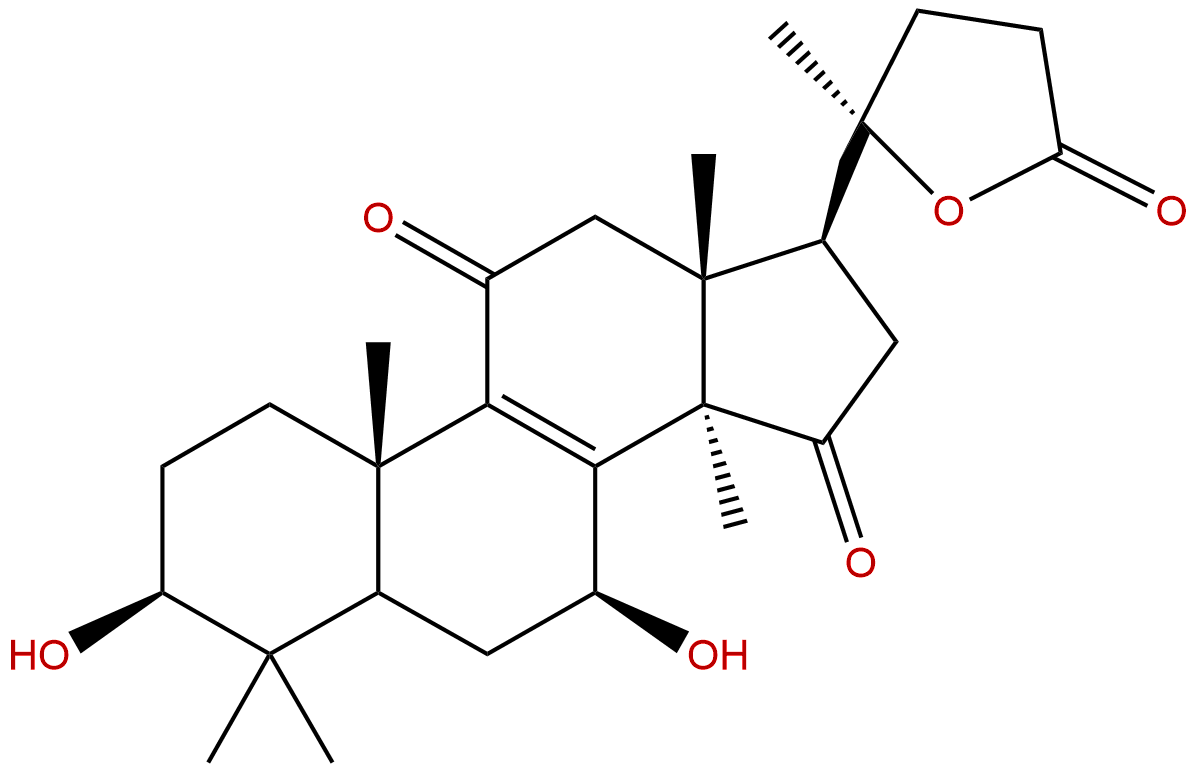
Lingzhi lactone B is a lanolin sterane type tetracyclic triterpenoid compound. Its molecular formula is C28H34O6 and its molecular weight is 458.5950. The core structure of this compound is a highly oxidized lanolin sterane skeleton, characterized by the introduction of multiple oxygen-containing functional groups on the steroid nucleus, including hydroxyl, carbonyl, and key lactone ring structures. The formation of lactone rings is the origin of its name and an important indicator of its structural differentiation from other triterpenoids in Ganoderma lucidum. This structure may be closely related to its specific biological activity and reactivity.
From the analysis of physical and chemical properties, the lipid water partition coefficient (LogP) of Ganoderma lucidum lactone B is 2.7261, indicating that the compound has moderate lipophilicity, which is beneficial for its penetration of cell membranes and interaction with intracellular targets. Its topological polar surface area (TPSA) is 100.9000 Å ², reflecting the presence of multiple hydrogen bond acceptors and donors (such as hydroxyl and carbonyl oxygen) in the molecule, which can affect its solubility and transmembrane transport ability. The water solubility data shows that its solubility is low (0.0097 mg/mL), indicating that it is a poorly soluble compound. This suggests that solubilization techniques (such as cyclodextrin inclusion, nanocrystals, liposomes, etc.) may need to be used in the formulation development process to improve its bioavailability. It is worth noting that its blood-brain barrier permeability is predicted to be "high", suggesting that the compound may have the potential to enter the central nervous system, providing a structural basis for its application in neuroinflammatory related diseases. In early safety screening, Ganoderma lucidum lactone B did not show significant hERG potassium channel inhibitory activity (hERG inhibition: no), reducing the risk of causing QT interval prolongation and apical torsion type ventricular tachycardia. In addition, the Ames test result was 0.0, which preliminarily indicates that there is no mutagenicity under this testing system, providing a preliminary positive signal for its safety.
Plant sources and extraction methods
Lingzhi lactone B was originally derived from the Ganoderma genus fungi Purple Zhi Separated and identified from the dried fruiting body (fruit) of Ganoderma sinense. Purple Ganoderma lucidum and red Ganoderma lucidum are both traditional precious Chinese medicinal herbs, but their chemical composition spectra differ to some extent, making them important resources for discovering new structures of triterpenoid compounds.
Obtaining Ganoderma lucidum lactone B from natural raw materials usually follows the classic process of natural product chemistry. Firstly, the dried Ganoderma lucidum fruiting body is crushed and subjected to extraction or reflux extraction using highly polar organic solvents (such as methanol, ethanol, or aqueous ethanol) to maximize the extraction of moderately polar to non-polar components, including triterpenes. After vacuum concentration, the crude extract obtained was preliminarily separated using solvent partitioning method (usually using ethyl acetate water system), and ganoderide B was mainly enriched in the acetate layer. Further purification relies on various chromatographic techniques. Usually, silica gel column chromatography is used first, with different ratios of petroleum ether ethyl acetate or chloroform methanol gradient elution for preliminary grouping. The fraction containing the target compound is then finely separated and purified by reverse phase silica gel column chromatography (such as ODS, using methanol water or acetonitrile water as mobile phase), high performance liquid chromatography (HPLC), or preparative thin layer chromatography (PTLC). The entire process requires real-time monitoring and identification using thin-layer chromatography (TLC) or high-performance liquid chromatography-mass spectrometry (HPLC-MS). With the development of synthetic biology, by analyzing its biosynthetic pathway, it is also possible to use microbial cell factories (such as yeast) for heterologous biosynthesis in the future, providing a sustainable alternative pathway for the large-scale production of Ganoderma lucidum lactone B.
Pharmacological activity research
The pharmacological activity research of Ganoderma lucidum lactone B is currently in the preclinical stage, but its outstanding potential in anti-inflammatory, immune regulation, anti proliferation and other aspects has been revealed. These activities are highly related to its therapeutic application in diseases such as psoriasis.
1. Anti inflammatory and immune regulatory activity: Inflammation is the common pathological basis of many diseases such as psoriasis. Research has shown that Ganoderma lucidum lactone B can significantly inhibit the production of nitric oxide (NO), prostaglandin E2 (PGE2), and key pro-inflammatory cytokines such as tumor necrosis factor - α, interleukin-6, and interleukin-1 β in macrophages induced by stimuli such as lipopolysaccharide (LPS). This broad anti-inflammatory effect suggests that it may act on upstream key nodes of the inflammatory signaling pathway. In terms of adaptive immunity, preliminary studies have shown that it can affect the activation and differentiation of T lymphocytes, which is crucial for correcting the imbalance of immune cells such as Th17 cells in psoriasis.
2. Anti excessive proliferation and regulation of differentiation of keratinocytes: Abnormal proliferation and differentiation disorders of epidermal keratinocytes are typical histological features of psoriasis. Cell experiments have confirmed that Ganoderma lucidum lactone B can dose dependently inhibit the proliferation of human immortalized keratinocytes (such as HaCaT cells) or psoriasis like model cells, and induce their return to normal differentiation direction. The ability to directly act on epidermal cells is the direct pharmacological basis for its treatment of psoriasis skin lesions.
3. Pharmacodynamic evidence in vivo: In the mouse psoriasis like dermatitis model induced by imiquimod (IMQ), local or systemic administration of ganoderide B can significantly improve skin symptoms in mice, including reducing erythema, scales, and skin thickening (spinous layer hypertrophy). Histopathological analysis further confirms that treatment can reduce excessive epidermal hyperplasia and infiltration of inflammatory cells in the dermis. These in vivo experimental results provide strong direct evidence for the anti psoriasis activity of Ganoderma lucidum lactone B.
In addition, based on its structural characteristics, there have been sporadic reports on the activity of Ganoderma lucidum lactone B in other fields such as anti-tumor and neuroprotective effects, but pharmacological research around psoriasis is currently the most concentrated and in-depth field.
Mechanism of action and molecular targets
The therapeutic potential of Ganoderma lucidum lactone B for psoriasis stems from its multi-target and multi pathway characteristics. Existing research (including computational simulations and partial experimental validation) suggests that it may exert its effects by intervening in the following key targets and signal networks:
1. Regulating the AMPK signaling pathway: AMP activated protein kinase (AMPK, composed of subunits such as PRKAA1) is a core regulator of cellular energy metabolism and inflammatory response. Activation of AMPK can inhibit the production of pro-inflammatory cytokines and abnormal cell proliferation. Lingzhi lactone B has been predicted and experimentally validated to activate AMPK, thereby inhibiting its downstream mammalian rapamycin target protein (mTOR) and nuclear factor kappa B (NF - κ B) pathways, which may be one of the core mechanisms of its anti-inflammatory and anti proliferative effects.
2. Intervention of nuclear receptor signaling: Retinoic acid receptors (RAR α/RARA, RAR γ/RARG) and retinoic acid related orphan receptors (ROR γ t/RORC) are key nuclear receptors that regulate cell differentiation (especially keratinocyte differentiation) and immune cell function (such as Th17 cells). Lingzhi lactone B may act as a regulator to affect the activity of these receptors. By regulating RAR/RXR signaling, promote normal differentiation of keratinocytes; By inhibiting ROR γ t (a key transcription factor in Th17 cells), the production of pathogenic cytokines such as interleukin-17 is reduced.
3. Inhibit STAT3 inflammatory signaling: Signal transducer and activator of transcription factor 3 (STAT3) is continuously activated in psoriasis, driving the expression of inflammatory factors and cell survival and proliferation. Lingzhi lactone B can inhibit the phosphorylation (activation) of STAT3 and its downstream gene transcription, thereby breaking the inflammatory cycle of psoriasis.
4. Adjust other key targets:
* Protein kinase C alpha (PKC alpha/PRKCA): PKC α is involved in cell proliferation and inflammatory signaling. Inhibiting its activity helps control excessive proliferation of keratinocytes.
* Caspase-1/ASP1: As a key effector protein of inflammasomes, it is responsible for the maturation of interleukin-1 β and other cytokines. Inhibiting Caspase-1 can alleviate the inflammatory response mediated by inflammasomes.
* Transient receptor potential vanillic acid subtype 1 (TRPV1): A non selective cation channel involved in neurogenic inflammation and itch signaling. Regulating TRPV1 may help alleviate psoriasis related itching symptoms.
* Nuclear factor kappa B p65 subunit (RelA/RELA): The core transcription factors of the NF - κ B pathway. Lingzhi lactone B can reduce the expression of numerous pro-inflammatory genes by inhibiting I κ B degradation or RelA nuclear translocation.
* Topoisomerase II alpha (TOP2A): Highly expressed in rapidly proliferating cells. Inhibition of TOP2A may contribute to its anti proliferative effect, but attention should be paid to potential cytotoxicity risks.
In summary, the mechanism network of action of Ganoderma lucidum lactone B can be summarized as: activating anti-inflammatory pathways such as AMPK, while inhibiting pro-inflammatory and pro proliferative pathways such as STAT3, NF - κ B, PKC α, and regulating nuclear receptor functions such as RAR and ROR γ t, synergistically exerting anti psoriasis effects from multiple levels such as energy metabolism, inflammatory response, immune cell differentiation, and epidermal cell dynamics.
Evaluation of drug properties and pharmacokinetics
Based on its physicochemical properties and preliminary biological data, a preliminary evaluation of the pharmacological properties of Ganoderma lucidum lactone B is conducted
Advantage:
1. Clear activity, multi-target effect: Targeting the complex pathological network of psoriasis, multi-target intervention may bring better therapeutic effects and reduce the risk of drug resistance.
2. Preliminary safety is good: The absence of hERG inhibition and Ames mutagenicity alert laid the foundation for its safety development.
3. Novel structure: As a natural product, its lanolin sterol lactone structure has the potential to become a novel lead compound.
Challenges and unknowns:
1. Solubility and permeability: The low water solubility and high TPSA pose a "biopharmaceutical challenge" for its oral absorption. Although its high blood-brain barrier permeability prediction is advantageous for central diseases, it also requires attention to possible neurological side effects.
2. Lack of pharmacokinetic data: At present, there is almost no systematic pharmacokinetic research on Ganoderma lucidum lactone B. Key parameters such as oral bioavailability, in vivo distribution (especially the enrichment ability of skin target tissues), metabolic pathways (whether easily metabolized by CYP450 enzymes), major metabolites and their activities, elimination half-life, etc. urgently need to be elucidated through in vivo experiments. These data are the core for evaluating its dosing regimen and clinical feasibility.
3. Formulation development requirements: To overcome the problem of poor solubility, it is necessary to conduct pharmaceutical research. The development of delivery systems such as gel, cream, nano emulsion suitable for local administration or solid dispersion, self microemulsion suitable for oral administration is the key step to promote its application.
4. Lack of comprehensive toxicological evaluation: Systematic preclinical toxicology studies are needed, including acute toxicity, long-term repeated administration toxicity, reproductive toxicity, etc., to comprehensively evaluate their safety window.
Clinical application prospects and prospects
Lingzhi lactone B has shown unique application prospects in the treatment of psoriasis. Its multi-target mechanism of action is expected to achieve synergistic inhibition of the "inflammation proliferation" core link in psoriasis, which may be applicable to moderate to severe plaque psoriasis. Considering its potential for local administration and regulatory effect on itch related targets (TRPV1), developing topical formulations for the treatment of mild to moderate psoriasis, or as an adjunct to systemic therapy, is an attractive research and development direction.
Future research should focus on the following aspects:
1. Deepening mechanism of action: Using chemical biology methods (such as designing probe molecules) to identify their direct targets and draw more accurate signal regulation maps.
2. Pharmacokinetic and formulation studies: Prioritize the in vivo ADME research of the system and simultaneously initiate the development of new drug delivery systems to improve their bioavailability and skin targeting.
3. Indications expansion: Based on its core anti-inflammatory and immunomodulatory activities, evaluate its potential therapeutic efficacy in other autoimmune diseases (such as atopic dermatitis, rheumatoid arthritis) or inflammation related diseases (such as metabolic syndrome, neuroinflammation).
4. Structural optimization: Using Ganoderma lucidum lactone B as the lead compound, structural modification and structure-activity relationship studies were conducted to improve its activity, selectivity, and drug properties, and to discover better candidate drugs.
5. Clinical translational exploration: After completing sufficient preclinical pharmacological and safety evaluations, gradually advance the application for new drug clinical research (IND) and clinical trials that comply with regulations.
Conclusion
Lingzhi lactone B, as a lanolin sterane triterpenoid discovered from the traditional medicinal fungus Ganoderma lucidum, has become a promising natural lead compound in the development of psoriasis treatment drugs due to its novel chemical structure and multi-target pharmacological effects. It demonstrates comprehensive benefits in inhibiting inflammation, regulating immunity, and restoring normal epidermal function by regulating multiple key signaling pathways and molecular targets such as AMPK, STAT3, NF - κ B, RAR/COR. Although it faces challenges such as poor solubility and unclear pharmacokinetics in drug development, these challenges are expected to be overcome through modern medicinal chemistry and formulation methods. The current research has laid a solid foundation for a deeper understanding of its mechanism of action and development value. With the continuous deepening of future research, especially the improvement of pharmacokinetics, formulation development, and systemic toxicology, Ganoderma lucidum lactone B is expected to move from the laboratory to clinical practice, providing a new treatment option for psoriasis patients and other immune inflammatory disease patients, and also setting another example for exploring modern drugs from the treasure trove of traditional Chinese medicine.