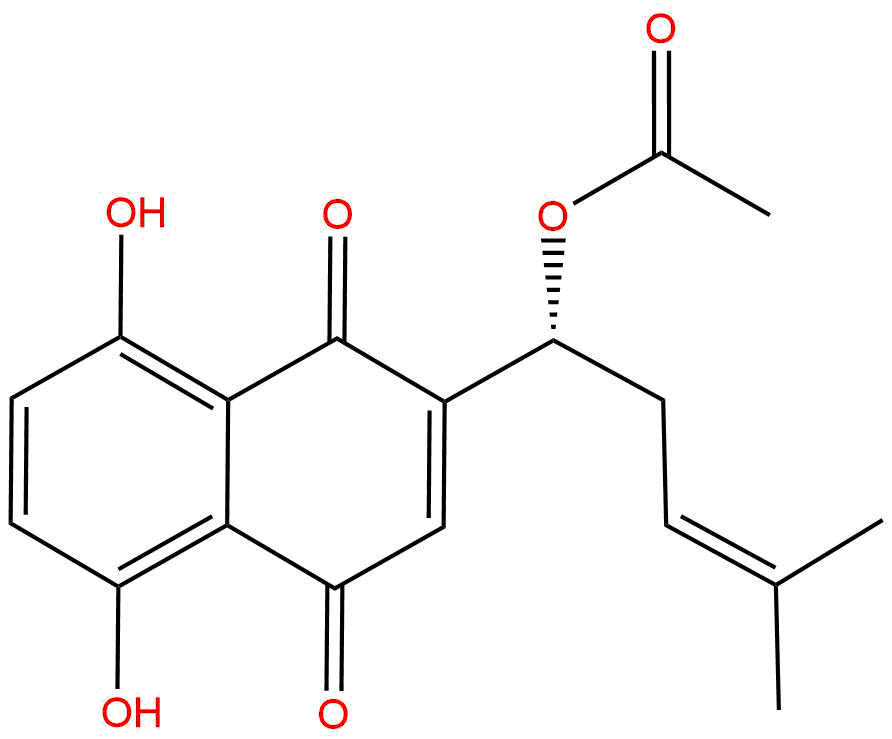


Synonym name: Shikonin acetate
Catalogue No.: BP0118
Cas No.: 24502-78-1
Formula: C18H18O6
Mol Weight: 330.336
Botanical Source: Lithospermum erythrorhizon, Lithospermum euchromum, Jatropha glandulifera, Arnebia decumbens, Arnebia euchroma and Echium vulgare
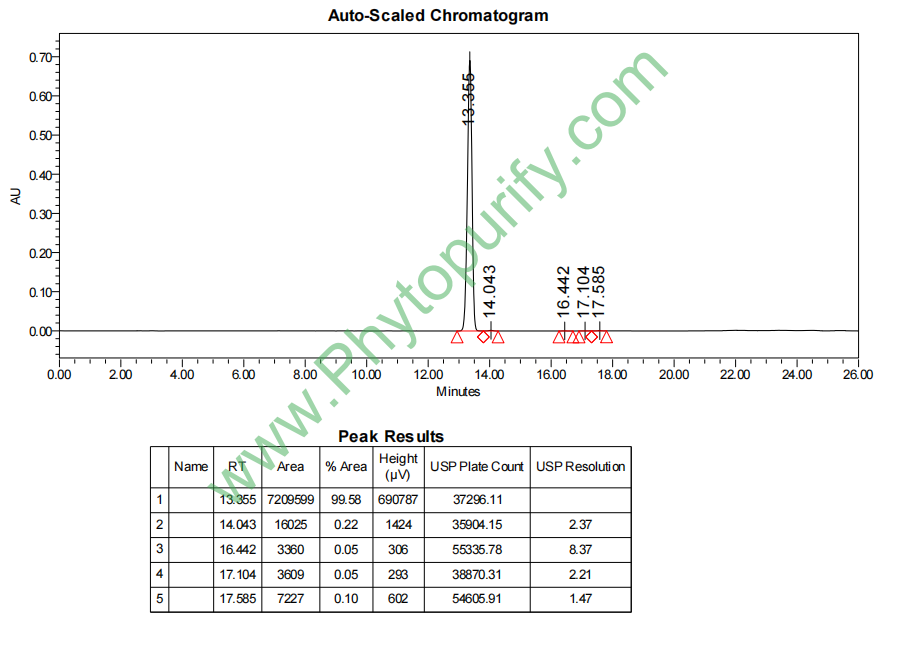
Purity: 95%~99%
Analysis Method: HPLC-DAD or/and HPLC-ELSD
Identification Method: Mass, NMR
Packing: Brown vial or HDPE plastic bottle
Can be supplied from milligrams to grams.
For Reference Standard and R&D, Not for Human Use Directly.
Inquire for bulk scale.
HPLC of Acetylshikonin
Storage conditions:Short-term storage at 2~8℃, long-term storage at -20 ~ -80℃
96.6500
3.0100
3.0100
High
No
No
No
No
No
Negative
Acetylshikonin (CAS number: 24502-78-1) is a natural naphthoquinone compound derived from plants of the purple grass genus, which has attracted much attention due to its diverse biological activities. As an important active ingredient in traditional Chinese medicine, Lithospermum erythrorhizon, shikonin and its derivatives have always been used to treat diseases such as inflammation, trauma, and tumors. Acetyl purpurin, as an acetylated derivative of purpurin, exhibits more significant pharmacological activity, especially in the fields of anti-tumor, anti-inflammatory, antioxidant, and neuroprotective effects, showing broad application potential.
In recent years, with the deepening development of molecular pharmacology and natural product chemistry, the mechanism of action of acetyl shikonin has gradually been elucidated, involving multiple levels such as cell apoptosis, autophagy regulation, inhibition of inflammatory signaling pathways, and metabolic regulation. In addition, the unique mechanism of action of this compound in the treatment of hepatitis B virus (HBV) - related hepatocellular carcinoma (HCC), especially by inducing HBV oncogene ER stress and inhibiting tumor cell proliferation, has become a research hotspot. This article will provide a systematic review of the chemical structure, plant origin, pharmacological activity, mechanism of action, pharmacological evaluation, and clinical application prospects of acetyl shikonin, aiming to provide theoretical basis and research direction for its further development and application.
The molecular formula of acetyl purpurin is C17H18O5, with a molecular weight of 330.33, and it belongs to the naphthoquinone class of compounds. Its structure is based on the naphthoquinone skeleton of purpurin, which is modified by acetylation of hydroxyl groups to form acetyl purpurin. This structure endows it with good lipid solubility (LogP of approximately 3.01), which is beneficial for membrane penetration and increased bioavailability. Its topological polar surface area (TPSA) is 96.65, and it contains 6 hydrogen bond acceptors, indicating that it has a certain polarity and can form hydrogen bonds with various biomolecules.
Acetyl purpurin has high blood-brain barrier permeability, indicating its potential application value in neurological diseases. The safety evaluation shows that it has no significant hepatotoxicity or cardiotoxicity, and the hERG channel inhibition and Ames mutagenicity tests are negative, indicating its high safety and good potential for drug development.
Acetyl purpurin is mainly found in plants of the genus Verbena, with abundant content in the roots of Lithospermum erythrorhizon. As a traditional Chinese medicinal herb, purple grass is widely distributed in East Asia, including China, Japan, and South Korea. Its roots contain various active ingredients, including naphthoquinone compounds such as shikonin, acetyl shikonin, and methoxyshikonin.
The common methods for extracting acetyl purpurin include organic solvent extraction, ultrasound assisted extraction, and high-performance liquid chromatography (HPLC) separation technology. Ethanol or methanol is usually used as the extraction solvent, which is then concentrated, separated, and purified by column chromatography. Finally, its purity and structure are confirmed by HPLC or mass spectrometry. In recent years, green extraction techniques such as supercritical CO2 extraction and microwave-assisted extraction have also been applied to improve the extraction efficiency and purity of acetyl purpurin.
Acetyl purpurin has shown significant inhibitory effects in various tumor cell lines, especially selective cytotoxicity against hepatocellular carcinoma cells expressing hepatitis B virus X protein (HBX). Its anti-tumor mechanism mainly induces endoplasmic reticulum (ER) stress response, activates apoptosis signaling pathway, promotes tumor cell apoptosis and autophagy. In addition, acetyl purpurin can inhibit the production of leukotrienes and reduce the promoting effect of inflammatory microenvironment on tumors.
Acetylshikonin significantly reduces the production of inflammatory mediators and exerts anti-inflammatory effects by inhibiting the membrane recruitment of cytoplasmic phospholipase A2 (cPLA2) and blocking the activity of cyclooxygenase (COX) and 5-lipoxygenase (5-LOX). Meanwhile, its antioxidant activity reduces oxidative stress damage and protects cellular function by clearing free radicals and regulating the endogenous antioxidant enzyme system.
Acetyl purpurin, as an acetylcholinesterase (AChE) inhibitor (IC50=34.6 μ M), exhibits neuroprotective effects in neurodegenerative disease models, possibly by improving neurotransmission and reducing neuroinflammation. In addition, it showed antibacterial activity against a variety of bacteria, suggesting its potential application in infectious diseases.
Studies have shown that acetylshikonin can regulate blood glucose levels, improve liver fat metabolism, and alleviate pathological changes of renal fibrosis, indicating its therapeutic potential in diabetes, diabetes nephropathy (DN), obesity, and nonalcoholic fatty liver disease (NAFLD).
The multi-target mechanism of action of acetyl purpurin is the basis of its pharmacological activity. Its main targets and signaling pathways include:
The molecular weight of acetyl purpurin is moderate (330.33), with a LogP value of 3.01, which conforms to Lipinski's rule and has good drug similarity. Its TPSA value (96.65) and hydrogen bond receptor number (6) indicate that it has moderate polarity, which is conducive to oral absorption and cell membrane penetration. The high blood-brain barrier permeability supports its potential application in central nervous system diseases.
In terms of safety, acetyl purpurin has no hepatotoxicity or cardiotoxicity, no inhibitory effect on hERG channel, and a negative Ames mutagenicity test, demonstrating good safety. Pharmacokinetic studies in vivo have shown that acetyl shikonin has high oral bioavailability, wide distribution, stable metabolism, and mainly excreted through liver metabolism and bile excretion.
Acetylshikonin, with its multi-target and multi mechanism pharmacological properties, has shown broad clinical application prospects in anti-tumor, anti-inflammatory, neuroprotective, and metabolic disease treatment. Especially in the treatment of HBV related hepatocellular carcinoma, inducing ER stress pathway to achieve selective apoptosis of tumor cells provides a new approach for precise treatment of liver cancer.
In addition, the potential efficacy of acetylshikonin in metabolic diseases such as diabetes and its complications (such as diabetes nephropathy), nonalcoholic fatty liver and obesity suggests that acetylshikonin may be a new drug candidate for the treatment of metabolic syndrome. Its neuroprotective effect also provides possibilities for the treatment of neurodegenerative diseases such as Alzheimer's disease.
Future research should focus on preclinical pharmacokinetic optimization, formulation development, and clinical trial validation of acetyl shikonin, combined with modern drug design techniques to improve its targeting and bioavailability. At the same time, in-depth analysis of its molecular network and exploration of more potential targets and indications will promote its clinical translation process.
Acetyl purpurin, as a natural product derived from traditional Chinese medicine purple grass, exhibits excellent anti-tumor, anti-inflammatory, antioxidant, and metabolic regulatory abilities due to its unique chemical structure and diverse pharmacological activities. Its mechanism of action covers multiple aspects such as cell apoptosis, autophagy, inhibition of inflammatory mediator synthesis, and neuroprotection, and has good drug efficacy and safety.
With the development of modern pharmacology and molecular biology techniques, the research on acetyl shikonin continues to deepen, and its clinical application potential is increasingly prominent. In the future, through systematic pharmacokinetic studies and clinical validation, it is expected that acetyl purpurin will be developed into an innovative drug for the treatment of liver cancer, metabolic diseases, and neurological disorders, contributing significantly to the field of natural product pharmacology.
