


Synonym name: dimethylacrylalkannin; β,β′-dimethylacrylalkannin
Catalogue No.: BP0260
Cas No.: 24502-79-2
Formula: C21H22O6
Mol Weight: 370.401
Botanical Source: Lithospermum erythrospermum, Lithospermum euchromum, Alkanna tinctoria, Alkanna hirsutissima and Jatropha glandulifera
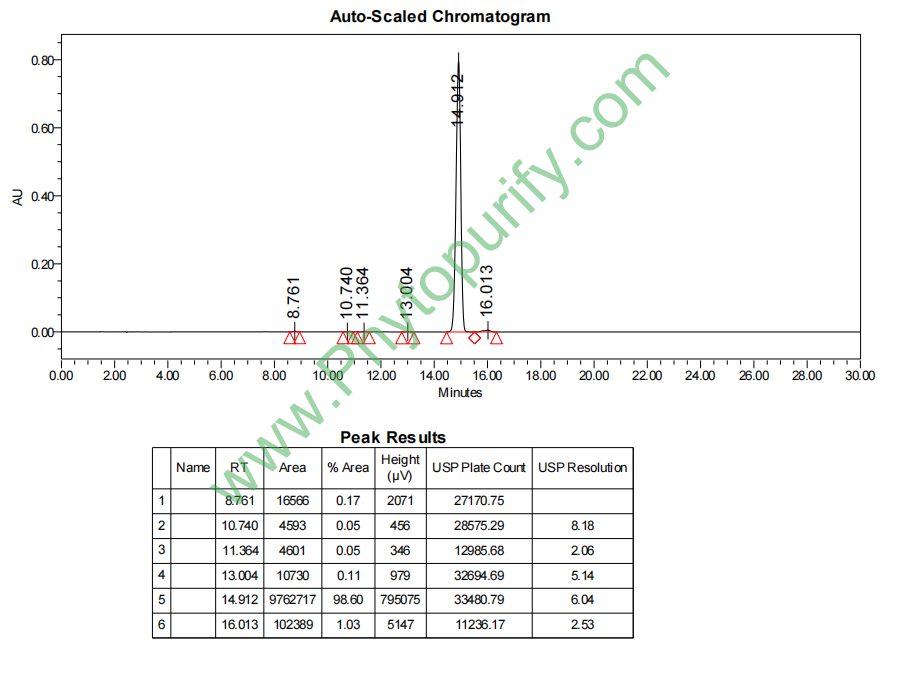
Purity: 95%~99%
Analysis Method: HPLC-DAD or/and HPLC-ELSD
Identification Method: Mass, NMR
Packing: Brown vial or HDPE plastic bottle
Can be supplied from milligrams to grams.
For Reference Standard and R&D, Not for Human Use Directly.
Inquire for bulk scale.
HPLC of Beta,beta-Dimethylacrylshikonin
Storage conditions:Short-term storage at 2~8℃, long-term storage at -20 ~ -80℃
Beta, beta dimethylacrylshikonin (hereinafter referred to as "dimethylacrylshikonin") is a natural product with significant biological activity, belonging to the hydroxy-1,4-naphthoquinone class of compounds. This type of compound has received widespread attention in the field of natural product pharmacology in recent years due to its unique structure and diverse pharmacological activities. Dimethylacryloyl purpurin is mainly extracted from plants of the purple grass genus. Due to its potential in anti-tumor, anti-inflammatory, antibacterial and other aspects, it has become a hot topic in tumor treatment, especially in melanoma research. Melanoma, as a highly malignant skin tumor with poor prognosis, is difficult to treat and urgently requires the development of new effective drugs. Dimethylacryloyl purpurin has shown the ability to inhibit melanoma cell proliferation and induce apoptosis by regulating multiple key molecular targets, and has good prospects for drug development.
This article will provide a systematic review of the chemical structure and physicochemical properties, plant sources and extraction processes, pharmacological activity and mechanism of action, pharmacological evaluation and pharmacokinetic characteristics of dimethylacryloyl shikonin. Combined with its potential application in the treatment of melanoma, it will explore its future clinical development direction.
The chemical structure of dimethylacryloyl shikonin belongs to the hydroxy-1,4-naphthoquinone class, with a molecular formula of C22H26O5 and a molecular weight of 370.39. Its structural features include a 1,4-naphthoquinone core with hydroxyl and β, β - dimethylacryloyl side chains. The presence of this side chain endows the molecule with strong hydrophobicity and a certain steric hindrance effect, which may affect its binding affinity with biological targets.
In terms of physical and chemical properties, the LogP value of dimethylacryloyl purpurin is about 3.8, indicating its good lipid solubility, which is beneficial for cell membrane penetration, but may also affect its water solubility and bioavailability. The molecular polar surface area (TPSA) is 103.7 Å ², indicating its moderate polarity and ability to form hydrogen bonds with biomolecules. The molecule contains six hydrogen bond receptors, indicating that it may form multi-point interactions when binding to protein targets. The low permeability of the blood-brain barrier suggests a lower risk of central nervous system side effects.
At present, there are no clear reports on its safety indicators such as liver toxicity, cardiac toxicity (including hERG channel inhibition), and genotoxicity (Ames test), and further systematic evaluation is needed.
Dimethylacryloyl purpurin is mainly found in the roots of plants in the genus Verbenaceae, such as Lithospermum erythrorhizon. The purple grass plant is widely used in traditional Chinese medicine to treat diseases such as inflammation, burns, and tumors. Its roots are rich in various naphthoquinone natural products, among which dimethylacryloyl purple grass is one of the main active ingredients.
The extraction method usually uses organic solvent extraction combined with chromatographic separation technology. Common extraction solvents include ethanol, methanol, and ethyl acetate. The extraction process requires temperature and time control to avoid degradation of active ingredients. After concentration, the extract was purified using methods such as silica gel column chromatography and reverse phase high performance liquid chromatography (RP-HPLC) to obtain high-purity dimethylacryloyl purpurin.
In recent years, green and efficient technologies such as supercritical CO2 extraction and microwave-assisted extraction have also been applied to the extraction of this compound, significantly improving extraction efficiency and purity, reducing the use of organic solvents, and meeting the environmental requirements of modern drug development.
The pharmacological activity research of dimethylacryloyl purpurin mainly focuses on its anti-tumor effect, especially in melanoma cell lines. In vitro experiments have shown that the compound can significantly inhibit the proliferation of melanoma cells, induce cell cycle arrest and apoptosis. Its anti-tumor activity is closely related to the regulation of apoptosis related protein expression.
In addition, dimethylacryloyl purpurin has anti-inflammatory and antioxidant activities, which can reduce the activity of inflammatory factors such as NF - κ B, alleviate the inflammatory response in the tumor microenvironment, and indirectly inhibit tumor progression. Some studies also indicate that it has inhibitory effects on the migration and invasion ability of tumor cells, suggesting that it may block the process of tumor metastasis.
There is limited research on animal models, but preliminary data supports its inhibitory effect on melanoma growth in vivo, with low toxicity, demonstrating a good balance of safety and efficacy.
Dimethylacryloyl purpurin exerts anti melanoma effects through multiple targets and pathways. Its main targets include:
In summary, dimethylacryloyl purpurin exerts its comprehensive anti melanoma effect through the synergistic regulation of multiple signaling pathways, demonstrating its potential as a multi-target anti-tumor drug.
From the perspective of pharmacological parameters, the molecular weight (370.39) and LogP (3.8) of dimethylacryloyl shikonin meet the basic requirements for drug affinity in Lipinski's rules, indicating its good oral bioavailability potential. The TPSA is 103.7 Å ², slightly higher than the ideal range (generally less than 90 Å ²), which may affect its cell membrane permeability, but still within an acceptable range.
The number of hydrogen bond receptors is 6, indicating that the molecule has moderate polarity, which is conducive to stable binding with the target protein. The low permeability of the blood-brain barrier reduces the risk of central nervous system toxicity and side effects.
At present, there is a lack of systematic research on its pharmacokinetic parameters such as liver metabolic pathways, half-life, and plasma protein binding rate. Data on liver toxicity, cardiac toxicity, and genotoxicity are also unclear, and further improvement is needed through in vitro and in vivo toxicology and pharmacokinetic studies.
Given its structural characteristics, dimethylacryloyl shikonin may be metabolized by the liver cytochrome P450 enzyme system, posing risks of metabolite activity or toxicity. Future research should focus on its metabolic stability and safety evaluation.
Dimethylacryloyl purpurin, as a natural naphthoquinone compound, has demonstrated promising clinical development potential due to its multi-target anti melanoma activity. The current treatment of melanoma faces challenges such as targeted drug resistance and immune therapy side effects, and natural products provide new sources of drug molecules and mechanisms of action.
In the future, dimethylacryloyl purpurin can be used as a monotherapy or in combination with existing targeted drugs (such as BRAF inhibitors) and as an adjuvant therapy for immunotherapy, enhancing efficacy and reducing the risk of drug resistance. In addition, its anti-inflammatory and antioxidant effects help improve the tumor microenvironment and promote therapeutic efficacy.
During the clinical translation process, the following issues need to be addressed:
In addition, based on its multi-target properties, dimethylacryloyl purpurin may also be extended to the treatment of other malignant tumors and inflammation related diseases, which is worth further exploration.
Beta, beta-dimethacryloyl-shikonin, as a natural product of hydroxy-1,4-naphthoquinone derived from the purple grass genus, has become an important object of pharmacological research in natural products due to its unique chemical structure and multi-target anti melanoma activity. It exerts inhibitory effects on tumor cell proliferation and induces apoptosis by regulating key molecules such as BCL2, MAPK pathway, TP53, and NF - κ B, demonstrating promising potential for drug development.
Although its safety and pharmacokinetic data are not yet complete, based on existing research, dimethylacryloyl purpurin has the potential to become a novel anti melanoma drug. In the future, it is necessary to combine modern medicinal chemistry, pharmacokinetics, and clinical research to promote the systematic development of this compound, providing new strategies and choices for the treatment of melanoma and related diseases.
