


Synonym name: Arnebin IV; Anchusaic acid; Anchusin; Alkanna red; Alkhanin; Shikalkin; Extra Cas, 54952-43-1
Catalogue No.: BP0140
Cas No.: 517-88-4
Formula: C16H16O5
Mol Weight: 288.299
Botanical Source: alkanet Alkanna tinctoria and Lithospermum arvense.
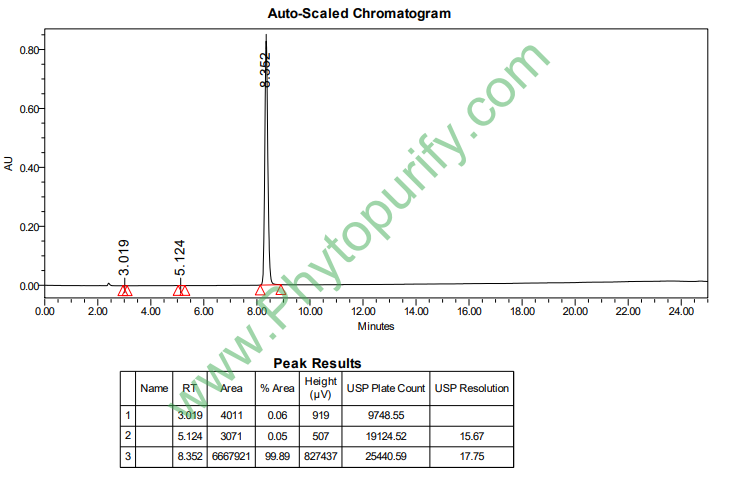
Purity: 90%~99%
Analysis Method: HPLC-DAD
Identification Method: Mass, NMR
Packing: Brown vial or HDPE plastic bottle
Can be supplied from milligrams to grams, up to kgs.
Inquire for bulk scale.
Biopurify supply high quality Shikonin for Cosmatic, Nutrition and Dietary Supplement with competitive price and good services.
Shikonin, a component of Chinese Herbal Medicine ... eliminates the human
immunodeficiency virus type 1.
Storage conditions:Short-term storage at 2~8℃, long-term storage at -20 ~ -80℃
94.8300
2.6308
2.3743
.5999
3.2271
9.6623
Low
84.6466
3.4095
Yes
No
No
No
Yes
Yes
0.6
Yes
Yes
Yes
Yes
Alkanin (CAS number: 517-88-4), as a naturally occurring hydroxy-1,4-naphthoquinone compound, has long been recognized and applied by humans due to its unique deep purple color. Its name comes from its main plant source - Eucommia ulmoides(Alkanna tinctoria Also known as dye purple grass, it was mainly used as a natural coloring agent in food, textiles, and cosmetics throughout history. However, with the deepening of modern research in natural product chemistry and pharmacology, the powerful biological activity of l-shikonin beyond its dye properties has gradually been revealed, making it a highly anticipated star molecule in the field of drug development.
In recent years, a large number of studies have confirmed that levopurpurin and its derivatives exhibit a wide range of pharmacological activities, especially in anti-tumor, anti-inflammatory, antioxidant, antibacterial, and wound healing promotion. Its anti-tumor activity is particularly noteworthy, as studies have shown that it can inhibit the proliferation of various cancer cells through multiple pathways and targets, induce cell cycle arrest and programmed cell death. In addition, its potential therapeutic value in areas such as cardiovascular disease and liver inflammation is also beginning to emerge. For example, in the complex pathological network of cardiovascular events such as acute coronary syndrome, resveratrol may exert a protective effect by regulating key targets such as MCL1, ALOX5, HIF1A, EGFR, SOAT1, etc.
This article aims to provide a systematic review of the chemical properties, plant sources, pharmacological activities, molecular mechanisms of action, pharmacological evaluation, and clinical application prospects of levonorgestrel, in order to provide comprehensive scientific references for the deep development and transformation research of this natural product.
Levothyronine is a naphthoquinone compound with a chiral center, and its chemical name is (R) -5,8-dihydroxy-2- [(1R) -1-hydroxy-4-methylpent-3-en-1-yl] -1,4-naphthoquinone. Its molecular formula is C ₁₆ H ₁₆ O ₅, and its molecular weight is 288.2990. Its core structure is a 1,4-naphthoquinone mother nucleus, with one hydroxyl group attached to each of the 5th and 8th positions, and a chiral hydroxyisohexene group on the side chain. The chiral center is crucial for its biological activity, and its optical isomer, Shikonin, also exists in plants of the purple grass genus. The two often coexist as enantiomers, with similar biological activities but differences in certain aspects.
The physical and chemical properties of L-shikonin are closely related to its pharmacological activity and medicinal properties. The calculated lipid water partition coefficient (LogP) is 2.6308, indicating that the compound has moderate lipophilicity, which is beneficial for its penetration of cell membranes, but may also affect its water solubility and in vivo distribution. Its topological polar surface area (TPSA) is 94.83 Å ², reflecting the characteristics of hydrogen bond donors (three hydroxyl groups) and acceptors (quinone and hydroxyl groups) in the molecule. The water solubility measured in the experiment is about 0.5999 mg/mL, belonging to the category of slightly soluble to poorly soluble, which is usually one of the key challenges that need to be overcome in the development of its formulations. Its blood-brain barrier permeability is predicted to be "low", indicating that it may not easily enter the central nervous system, which may reduce central side effects for the treatment of peripheral diseases, but also limits its potential for use in brain related diseases.
The main source of L-shikonin is from the Boraginaceae family, specifically the genus Boraginaceae(Alkanna)HeDian purple grass genus(Onosma)Various plants, including Eucommia ulmoides(Alkanna tinctoria)The most famous and commonly used. This compound is mainly enriched in the roots of plants, especially in the root bark, and is a secondary metabolite of plants that may participate in plant defense responses.
The traditional extraction method is mainly based on its lipid solubility characteristics, often using organic solvents such as petroleum ether, ethyl acetate, ethanol, methanol, etc. for cold soaking or hot reflux extraction. Modern extraction technology is dedicated to improving efficiency, reducing solvent consumption, and protecting thermosensitive components, mainly including:
1. Ultrasound assisted extraction Utilizing ultrasonic cavitation effect to destroy plant cell walls, accelerate solvent permeation and solute release, significantly shorten extraction time, and improve yield.
2. Microwave assisted extraction Microwaves can selectively heat plant tissues and solvents, causing a sudden increase in intracellular pressure, rapidly rupturing cells, and efficiently extracting target components.
3. Supercritical fluid extraction Supercritical CO ₂ is commonly used as an extractant, which has the advantages of strong solubility, fast mass transfer rate, low operating temperature, and no solvent residue. It is particularly suitable for extracting thermally unstable and easily oxidizable naphthoquinone compounds, and selective extraction can be achieved by adjusting pressure and temperature.
4. Enzyme assisted extraction Using cellulases, pectinases, and other enzymes to disrupt the structure of plant cell walls, promoting the release of l-shikonin under mild conditions and environmentally friendly conditions.
The crude extract is usually further separated and purified by chromatographic techniques such as silica gel column chromatography and preparative high-performance liquid chromatography to obtain high-purity L-shikonin monomer for research.
Leftover purpurin has diverse pharmacological activities, and its research has extended from in vitro cell experiments to animal models.
Levofloxacin exerts pharmacological effects, especially anti-tumor and anti-inflammatory effects, involving complex molecular networks and multiple key targets. Its mechanism of action has the characteristics of multiple pathways and targets.
1. Inducing cell apoptosis and regulating apoptosis related proteins:
* Mitochondrial pathway Leftover purpurin can induce a decrease in mitochondrial membrane potential, release cytochrome C, and activate caspase-9 and caspase-3, leading to apoptosis.
* Death receptor pathway It can upregulate the expression of death receptors (such as Fas, DR5) and activate caspase-8.
* Regulating Bcl-2 family proteins Downregulation of anti apoptotic protein Bcl-2 and MCL1 Upregulate the expression of pro apoptotic proteins Bax and Bak, and disrupt the balance of apoptosis. MCL1 is a key regulatory factor for cell survival in diseases such as acute coronary syndrome, and inhibition of MCL1 by resveratrol may help clear abnormal cells in pathological conditions.
2. Inhibit cell cycle L - shikonin can block cancer cells at the G1/S or G2/M checkpoint, which is closely related to its regulation of the expression of cyclins (such as Cyclin D1, Cyclin B1), cyclin dependent kinases (CDKs), and CDK inhibitors (such as p21).
3. Inhibit metastasis and angiogenesis By inhibiting the expression and activity of matrix metalloproteinases (MMPs), the invasion and migration ability of cancer cells can be reduced. Meanwhile, it can inhibit the expression of vascular endothelial growth factor (VEGF) and its downstream signals, hindering tumor angiogenesis.
4. Interference with cellular metabolism and signaling pathways:
* EGFR signaling pathway The epidermal growth factor receptor (EGFR) is overexpressed or abnormally activated in various tumors. L - shikonin can inhibit the phosphorylation of EGFR and its downstream PI3K/Akt and MAPK/ERK signaling pathways, thereby suppressing cell proliferation and survival.
* HIF-1 α signaling pathway Hypoxia inducible factor-1 alpha (HIF1A) is a core transcription factor for tumors to adapt to the hypoxic microenvironment, promote angiogenesis, and reprogram metabolism. Leftover shikonin can inhibit the stability and transcriptional activity of HIF-1 α, cutting off the "nutrient supply" and "adaptation signal" of tumors.
* ALOX5 pathway: 5-lipoxygenase (ALOX5) is a key enzyme for arachidonic acid metabolism to produce leukotriene, and plays an important role in inflammation and atherosclerosis. Inhibition of ALOX5 can alleviate inflammatory response and platelet aggregation, which may be one of the mechanisms by which resveratrol intervenes in acute coronary syndrome.
* SOAT1 target Sterol O-acyltransferase 1 (SOAT1, also known as ACAT1) is responsible for intracellular cholesterol esterification and is directly related to the formation of foam cells in atherosclerotic plaques. Inhibition of SOAT1 can reduce the accumulation of cholesterol esters and has the potential of anti atherosclerosis.
5. Inducing non apoptotic cell death Under high concentrations or specific conditions, levopurpurin can induce necrotic apoptosis or autophagic death in cancer cells, providing a new approach for overcoming tumor cell apoptosis resistance.
Despite its significant pharmacological activity, the drug like and pharmacokinetic (PK) properties of L-shikonin are obstacles that must be overcome for its clinical application.
Analysis of drug properties parameters:
* Five rules for classifying drugs Its molecular weight (288.30) is less than 500, and the number of hydrogen bond donors (3) and acceptors (5) conforms to the rules. The LogP value (2.63) is within the ideal range, indicating that it basically possesses the structural characteristics of a drug like molecule.
* Preliminary safety warning The Ames test result is 0.6 (usually positive with a mutagenic index MI ≥ 2), indicating a low risk of mutagenicity. The inhibition of hERG is' no ', indicating that its potential risk of causing QT interval prolongation in the heart is relatively small, which is an important cardiac safety advantage. Low blood-brain barrier permeability limits central application, but may also reduce the risk of central neurotoxicity.
* Main challenges:Poor water solubility It is the primary issue that constrains its bioavailability and formulation development. In addition, its quinone structure may undergo complex metabolic transformations in vivo and may cause certain oxidative stress, which requires attention to its therapeutic window and potential toxicity.
Pharmacokinetic study:
At present, there is relatively limited pharmacokinetic research on the levocarnitine system, mostly consisting of preclinical animal experiments. The existing data indicates that:
* absorb After oral administration, absorption is faster, but absolute bioavailability may be lower due to first pass effects and solubility limitations.
* distribution Due to its lipophilicity, it is widely distributed in the body, but its concentration is higher in organs with abundant blood flow such as the heart, liver, and kidneys. The plasma protein binding rate is expected to be high.
* Metabolism The liver is its main metabolic site, which may be metabolized through phase I and phase II reactions such as glucuronidation, sulfation, and reduction. Its naphthoquinone structure may participate in the redox cycle, and binding with glutathione is an important detoxification pathway.
* excretion Metabolites are mainly excreted through bile and urine.
To enhance its medicinal properties, current strategies include:Structural modification(Synthesize derivatives or prodrugs with higher water solubility)Develop a new delivery system(such as nanoparticles, liposomes, micelles, cyclodextrin inclusion complexes, etc. to improve solubility, stability, and targeting), and Explore appropriate routes of administration(such as topical treatment of skin diseases, or development of injectable preparations).
The transformation of L-shikonin from a traditional dye to a modern candidate drug demonstrates broad and challenging application prospects.
1. In the field of tumor treatment As a multi-target anti-tumor lead compound, its prospects are the most promising. Possible future development directions include:
* Single drug development Develop levopurpurin or its optimized derivatives as new chemotherapy drugs for certain tumor types that are insensitive or resistant to existing chemotherapy drugs.
* combination therapy By utilizing its unique mechanism of action (such as inducing necrotic apoptosis) and combining it with conventional chemotherapy drugs, targeted drugs, or immune checkpoint inhibitors, a synergistic effect can be achieved to overcome drug resistance.
* Targeted delivery system Constructing nanocarriers modified with folic acid, antibodies, or peptides to achieve specific enrichment at tumor sites, improve therapeutic efficacy, and reduce systemic toxicity.
2. Inflammatory and metabolic diseases:
* cardiovascular disease: Based on its role in key atherosclerosis targets such as ALOX5 and SOAT1, as well as its strong anti-inflammatory and antioxidant capacity, L-shikonin is expected to be developed as a drug or functional food additive to prevent or treat acute coronary syndrome and stabilize atherosclerotic plaque.
* liver disease Its protective effect in liver fibrosis and inflammation models provides new ideas for the treatment of non-alcoholic fatty liver disease, drug-induced liver injury, and other conditions.
* skin disease: Its activity of promoting wound healing, anti-bacterial and anti-inflammatory makes it have direct transformation potential in the treatment of chronic ulcers, burns, eczema and acne, such as topical plasters, gel and dressings.
3. Challenges faced and future research directions:
* In depth mechanism research The regulatory effects and interrelationships of key targets (such as MCL1, HIF1A, EGFR) need to be validated in more complex animal models of diseases and more complete signal networks.
* Optimization of drug properties in the system It is necessary to systematically address its water solubility, metabolic stability, in vivo distribution, and potential toxicity issues through rational optimization using medicinal chemistry and pharmacology methods.
* Preclinical and clinical research It is necessary to complete a standardized preclinical safety assessment (GLP toxicology) and gradually advance clinical trials to confirm its effectiveness and safety in humans.
* Biosynthesis and Sustainable Production Exploring the use of synthetic biology techniques to efficiently produce l-shikonin in microorganisms or plant cells, in order to solve the problems of limited plant resources and high extraction costs, and achieve green and sustainable supply.
Levothyronine, a hydroxynaphthoquinone compound derived from ancient dye plants, has undergone magnificent transformations from color to pharmacology, and has become a shining pearl in the treasure trove of natural product drug research and development. Its broad-spectrum and powerful pharmacological activity, especially through the regulation of multiple key targets such as MCL1, ALOX5, HIF1A, EGFR, SOAT1, demonstrates its potential for anti-tumor, anti-inflammatory, and cardiovascular protection, revealing its enormous value as a multi-target therapeutic drug. Despite facing challenges such as poor water solubility in drug formulation, the rapid development of modern medicinal chemistry, pharmacy, and nanotechnology provides powerful tools to overcome these obstacles. In the future, through in-depth exploration of mechanisms, rational structural modification, innovative delivery system development, and rigorous clinical validation, it is highly likely that levopurpurin will move from the laboratory to clinical practice, bringing new treatment options to fields such as tumors, inflammation, and cardiovascular diseases, and continuing its modern scientific legend from a natural pigment to a guardian of life.
