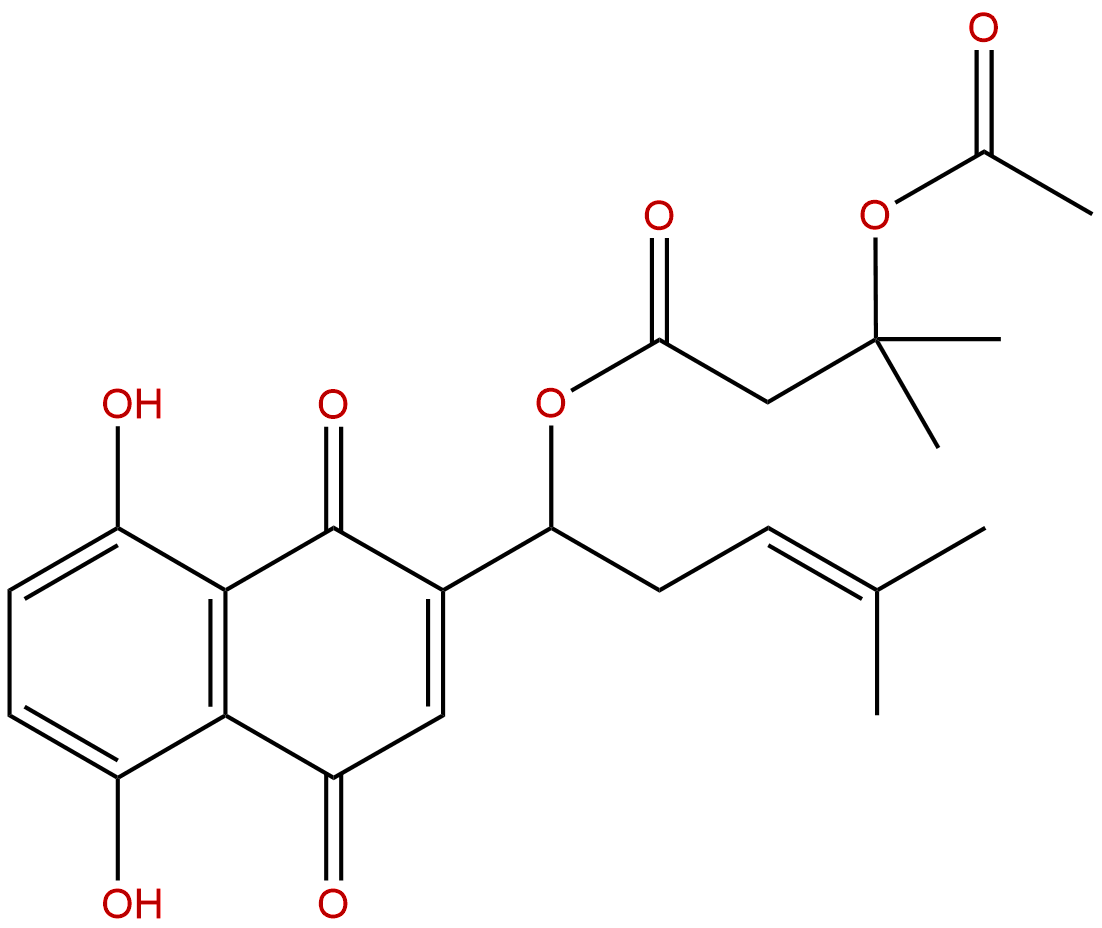
β - acetoxyisovalerylacanin: a natural anti-tumor product in purple grass
1. Overview
β - acetoxyisovalerylalakannin (CAS number: 69091-17-4) is a traditional medicinal plant derived from purple grass(Lithospermum erythrorhizon)Natural products of naphthoquinone obtained through separation. As an important member of a series of bioactive naphthoquinone derivatives in purple grass, this compound has attracted widespread attention in the field of natural product pharmacy research due to its significant anti-tumor activity. Its molecular formula is C23H26O8, with a molecular weight of 430.4530 g/mol, and it belongs to a structurally complex acylated naphthoquinone derivative.
In traditional medicine, purple grass is famous for its effects of clearing heat and detoxifying, cooling blood and promoting blood circulation, and promoting wound healing. Modern pharmacological research has revealed that the main active ingredients in purple grass, naphthoquinone compounds, have a wide range of biological activities, including anti-inflammatory, antibacterial, antiviral, and most importantly, anti-tumor effects. β - acetoxyisovalerylacanin is one of the representative active molecules among them. In recent years, with the rise of molecular targeted therapy and natural product drug development, research on this compound has progressed from early extraction, isolation, and activity screening to its precise molecular mechanism of action, structure-activity relationship, and drug efficacy evaluation. Especially its role involves multiple key tumor related targets such as TP53, CASP3, MYC, etc., which demonstrates its unique potential in the development of lead compounds for anti-tumor drugs. This article will provide a systematic professional popularization of this natural product from its chemical structure, plant origin, pharmacological mechanism, medicinal properties, and research prospects.
2. Chemical structure and physicochemical properties
The chemical structure of β - acetoxyisovalerylacanin is based on the parent nucleus of acanin and introduces acetoxy and isovalerylic groups on its side chains. The SMILES string (CC (=O) OC (C) (C) CC (=O) OC (CC=C (C) C) C1=CC (=O) c2c (O) ccc (O) c2C1=O) clearly depicts its structural features: a naphthoquinone core (C1=CC (=O) c2c (O) ccc (O) c2C1=O) is connected to a side chain (CC=C (C) C) containing an unsaturated alkene bond, and the hydroxyl group on the side chain is acylated by isovaleric acid (CC (=O) OC (C) (C) C), while the isovaleric group itself is further acylated. Acetylation (CC (=O) O -). This polyacylated structure enhances its lipophilicity and may also affect its interaction with biomolecules.
According to the analysis of drug forming parameters, its molecular weight (MW) is 430.45 g/mol, slightly higher than the recommended upper limit of 500 Da in the Lipinski Five Rules ("Five Principles of Drug like Substances"), but still within an acceptable range, especially for compounds derived from natural products. The lipid water partition coefficient (LogP) of the compound is 3.87, and the LogD is 3.56, indicating that the compound has moderate to high lipophilicity, which is consistent with the presence of multiple non-polar groups (such as isopropyl and acetyl) in its structure. A higher lipophilicity is beneficial for its penetration through cell membranes, but it may also lead to poor water solubility. Its water solubility parameter is 0.1509 (usually measured in mg/mL or log mol/L, indicating low solubility), which confirms its lipophilic properties.
The topological polar surface area (TPSA) is 127.2 Å ², which reflects the degree to which polar atoms (such as oxygen atoms) in the molecule are exposed to the solvent. Typically, compounds with TPSA values greater than 140 Å ² exhibit a significant decrease in cell membrane permeability. The TPSA value of this compound is slightly lower than this threshold, and combined with its higher LogP value, it is theoretically predicted that it has a certain membrane permeability. The high permeability data of Caco-2 cells (16.70 × 10 ⁻⁶ cm/s) further supports its good intestinal absorption potential (Peff value of 2.67, indicating moderate permeability). However, its blood-brain barrier (BBB) penetration is predicted to be "low", which may be due to the combined effect of its high molecular weight, high polar surface area, and high plasma protein binding rate (PPB of 89.43%), limiting its direct use in the treatment of central nervous system tumors.
3. Plant sources and traditional applications
β - acetoxyisovalerylakanin is mainly derived from the Boraginaceae plant Boraginaceae(Lithospermum erythrorhizon Sieb. et Zucc.)。 Purple grass is a perennial herbaceous plant widely distributed in East Asia, with a long history of medicinal use in China, Japan, and Korea. Its dry roots are purple red in color and rich in various naphthoquinone pigments, which are the main source of its active ingredients.
In the traditional Chinese medicine system, purple grass (usually referring to hard purple grass)Lithospermum erythrorhizon Or soft purple grass Arnebia euchroma)It is included in the "Shennong Bencao Jing" and listed as a medium grade. It is cold in nature, sweet and salty in taste, and belongs to the heart and liver meridians. The main efficacy is to cool blood, promote blood circulation, detoxify and clear rashes. Clinically, it is commonly used to treat conditions such as rash, purple black, measles opacity, ulcers, eczema, water fire burns, and vomiting and bleeding caused by excessive blood heat and toxicity. For external use, it is mostly used to treat wounds, ulcers, and skin inflammation, often made into ointments or extracts for use, utilizing its antibacterial, anti-inflammatory, and tissue regeneration promoting effects.
Modern pharmacognostic research has shown that the naphthoquinone components in the roots of purple grass, including shikonin, alkanin, and various ester derivatives (such as β - acetoxyisovalerylacanin), are the material basis for exerting the above-mentioned pharmacological effects. The traditional application of "cooling blood and detoxifying" has an inherent scientific connection with the anti-inflammatory, antimicrobial, and anti-tumor activities revealed by modern research. Systematically isolating and identifying these naphthoquinone compounds from purple grass, and studying their specific biological activities, is an important way to transform traditional medicinal experience into modern precision drug development. The discovery of the activity of β - acetoxyisovalerylacanin, as one of its specific derivatives, is the result of this transformation research.
4. Pharmacological activity and mechanism of action
The most noteworthy pharmacological activity of β - acetoxyisovalerylacanin is its anti-tumor effect. The existing target information suggests that this compound may interfere with the survival and proliferation of tumor cells, induce apoptosis or cell cycle arrest through multiple signaling pathways by acting on key targets such as TP53, CASP3, MYC, BAX, and CDKN1A.
Core target and mechanism analysis:
-
TP53 (tumor protein p53)P53 is a well-known tumor suppressor known as the "guardian of the genome". Under stress conditions such as DNA damage and oncogene activation, p53 is activated, which in turn regulates the transcription of a series of downstream genes, leading to cell cycle arrest (such as by activating CDKN1A/p21), DNA repair, or cell apoptosis (such as by activating BAX). Many tumor cells exhibit p53 dysfunction or mutation. If β - acetoxyisovalerylacanin can stabilize or activate the function of p53 protein, it may restore the apoptosis program of tumor cells and inhibit their growth.
-
CASP3 (cysteine protease-3)CASP3 is a key effector protease in the execution stage of cell apoptosis. After being activated by upstream apoptotic signals (such as caspase-9 activated by cytochrome C release mediated by BAX/BAK in the mitochondrial pathway), it cleaves various cytoskeletal and nuclear proteins, leading to irreversible morphological changes and cell death. If the compound can directly or indirectly activate CASP3, it indicates its strong ability to promote apoptosis.
-
MYC (oncogene c-Myc)MYC is an important transcription factor that regulates approximately 15% of human gene expression and is involved in cell proliferation, metabolism, differentiation, and apoptosis. The abnormally high expression of MYC is closely related to the occurrence and development of various tumors. Targeting MYC or its downstream pathways is a hot topic in anti-tumor research. If this compound can inhibit the expression or activity of MYC, it can effectively suppress the abnormal proliferation and metabolic reprogramming of tumor cells.
-
BAX (Bcl-2 related X protein)BAX is a pro apoptotic member of the Bcl-2 protein family. Under the stimulation of apoptotic signals, BAX undergoes conformational changes and oligomerizes on the outer membrane of mitochondria, forming pores that lead to loss of mitochondrial membrane potential and release of cytochrome C, thereby initiating the intrinsic apoptotic pathway. This compound upregulates BAX expression, which is one of the direct mechanisms promoting tumor cell apoptosis.
-
CDKN1A (cyclin dependent kinase inhibitor 1A, also known as p21)P21 is one of the important downstream target genes of p53. It achieves cell cycle arrest by inhibiting the activity of the Cyclin CDK complex, preventing cells from entering the S phase from the G1 phase. This provides a time window for cells to undergo DNA repair or move towards apoptosis. Activation of CDKN1A is the molecular basis for this compound to induce tumor cell cycle arrest.
Integration of mechanism of action:
Based on the above target information, a possible multi-target anti-tumor mechanism network of β - acetoxyisovalerylacanin can be outlined: this compound may activate or stabilize the tumor suppressor factor TP53 in some way (such as causing DNA damage or oxidative stress). Activated p53 upregulates the expression of CDKN1A, leading to cell cycle arrest in the G1 phase; On the other hand, upregulating the expression of pro apoptotic protein BAX may also downregulate anti apoptotic proteins (such as Bcl-2), disrupting the balance of mitochondrial apoptosis pathways. The activation of BAX leads to an increase in mitochondrial membrane permeability, the release of cytochrome C, which in turn activates CASP9 and ultimately activates the apoptotic executor CASP3, resulting in cell apoptosis. At the same time, the compound may also inhibit the activity of the oncogene MYC, weakening the proliferation and survival signals of tumor cells from the source. This dual attack on the cell cycle (via p21) and apoptosis (via p53/BAX/CASP3), combined with synergistic inhibition of the oncogene MYC, constitutes the multidimensional mechanism basis for its potent anti-tumor activity. Of course, the interaction network between these targets is very complex, and further experimental verification is needed to determine which pathway is dominant or whether there are other unknown direct targets.
5. Evaluation of drug properties
Drug efficacy assessment aims to predict the likelihood of an active compound developing into a clinically available drug. Based on Lipinski's five rules, Veber's rules, and the specific parameters provided, we conducted a preliminary evaluation of β - acetoxyisovaleric acanin
Summaryβ - acetoxyisovaleric acanin exhibits good oral absorption potential, conforms to basic drug class rules, and has no significant genetic toxicity or cardiotoxicity risks, which is its advantage as a lead compound. The main challenges lie in its high plasma protein binding rate, potential phototoxicity and sensitization, and possible liver enzyme effects. In the subsequent optimization of medicinal chemistry, it may be necessary to improve its solubility, reduce protein binding rate and toxicity risk while maintaining its activity through structural modification.
6. Research Status and Application Prospects
At present, research on β - acetoxyisovalerylacanin is still in the preclinical stage, mainly focusing on activity screening, preliminary mechanism of action exploration, and being studied as one of the active ingredients in total extracts of purple grass or naphthoquinone mixtures. Compared to its parent compounds shikonin and acanin, there is relatively less in-depth and systematic research on the monomeric compounds of β - acetoxyisovalerylacanin. The existing data reveals the enormous potential of its multi-target anti-tumor effect, but the precise molecular targets (whether directly bound or indirectly regulated), detailed signaling pathways, in vivo pharmacodynamics, pharmacokinetics, and toxicological characteristics all need to be fully elucidated.
Future research directions may include:
- Deepening the mechanism of action Using chemical biology methods such as affinity fishing, molecular docking, gene knockout/knockdown techniques, verify its direct interaction with targets such as TP53 and MYC, and draw a complete upstream and downstream signal network map.
- Structure Activity Relationship (SAR) Study Systematically synthesize a series of derivatives or analogues of β - acetoxyisovalerylacanin, and investigate the effects of their side chain acyl structures and naphthoquinone parent nucleus modifications on activity, selectivity, and drug properties. The goal is to find candidate molecules with stronger activity, lower toxicity, and better physicochemical properties.
- Pharmacokinetic and Formulation Research Conduct comprehensive in vivo ADME (absorption, distribution, metabolism, excretion) research to clarify its bioavailability, tissue distribution, metabolites, and excretion pathways. Develop new drug delivery systems, such as nanoparticles, liposomes, polymer micelles, etc., to address the issues of poor water solubility and phototoxicity, in order to improve efficacy and reduce side effects.
- Exploration of combination therapy Given its multi-target nature, this study aims to investigate the combined application of β - acetoxyisovalerylacanin with existing chemotherapy drugs, targeted drugs, or immune checkpoint inhibitors, and explore the possibility of synergistic enhancement and overcoming drug resistance.
- Indications expansion: In addition to anti-tumor, based on the anti-inflammatory, antioxidant and antibacterial properties of naphthoquinones, evaluate their application potential in inflammatory diseases, infectious diseases or skin diseases.
Application Prospects As a structurally unique natural product, β - acetoxyisovalerylacanin provides a valuable multi-target lead compound for the development of anti-tumor drugs. Despite facing challenges in toxicity optimization and delivery, its clear multi-channel anti-tumor mechanism and good drug like basis make it an attractive prospect for developing novel multi-target anti-tumor drugs, especially for the treatment of p53 functional or MYC driven tumors. With the advancement of precision drug design and delivery technology, the deep development and utilization of this compound are expected to transform the medicinal value of traditional purple grass into innovative drugs with modern medical significance.