Introduction/Overview
As an important natural product, naphthoquinone compounds are widely distributed in plants such as the purple grass family, peach family, and purple clover family. Due to their unique chemical structure and diverse biological activities, they have long been of great concern to pharmacology and medicinal chemistry researchers. Among them, β, β - dimethylacrylkannin (β, β -, CAS: 34539-65-6), as a typical hydroxy-1,4-naphthoquinone derivative, is one of the main active ingredients in traditional medicinal plants such as Lithospermum erythrorhizon Sieb. et Zucc. Zicao is commonly used in traditional Chinese medicine for clearing heat and cooling blood, promoting blood circulation and detoxification, treating eczema, burns, inflammatory skin diseases, etc. Its modern pharmacological basis is closely related to the naphthoquinone substances contained in it.
In recent years, with the development of molecular biology and systems pharmacology, the anti-inflammatory activity and complex network of action of β, β - dimethylacryloyl acanin have gradually been revealed. Research has shown that this compound exhibits significant anti-inflammatory potential by intervening in multiple key inflammation related targets, including interleukin-6 (IL-6), signal transduction and transcription activator 3 (STAT3), tumor necrosis factor (TNF), nuclear factor kappa B (NF - κ B, key subunit RELA/p65), and inducible nitric oxide synthase (NOS2). In addition, its regulatory effects on pain sensing channels such as transient receptor potential vanillic acid subtype 1 (TRPV1) and anchored protein subtype 1 (TRPA1) also suggest its potential application in the management of inflammatory pain.
This article aims to provide a systematic review of the chemical properties, plant sources, pharmacological activities, mechanisms of action, medicinal properties, and clinical application prospects of β, β - dimethylacryloyl acanin, in order to provide comprehensive scientific references for the in-depth research and development of this natural product.
Chemical structure and physicochemical properties
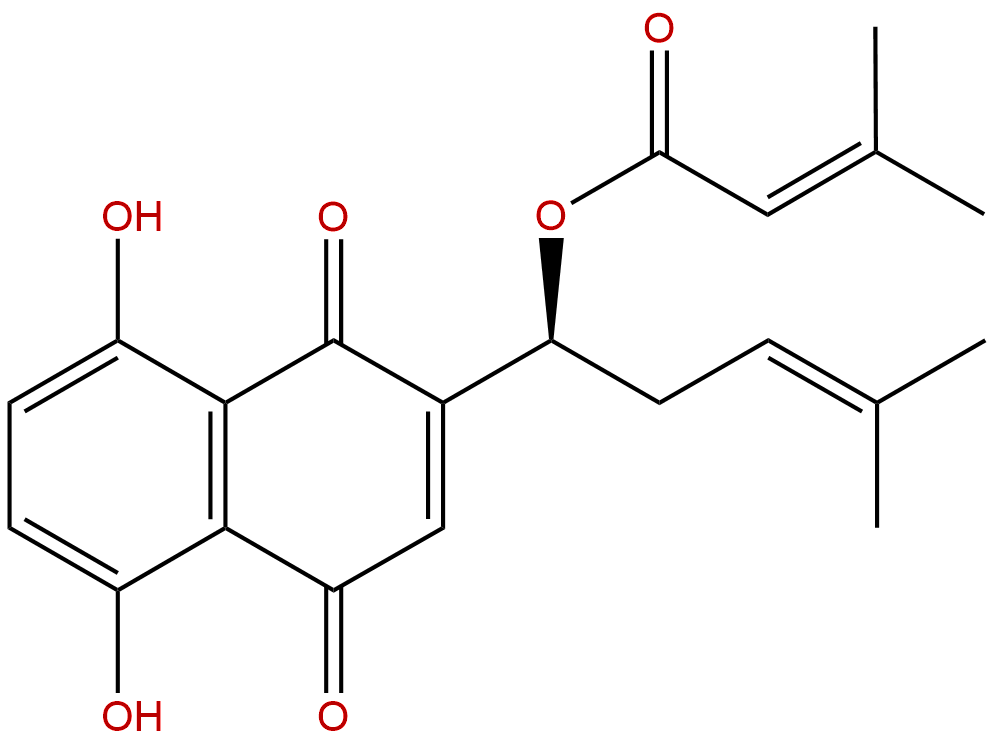
β. The chemical name of β - dimethylacryloyl acanin is 5,8-dihydroxy-2- (1-hydroxy-4-methylpent-3-en-1-yl) -1,4-naphthoquinone-6-yl-3-methylbut-2-enoic acid ester. Its molecular formula is C21H22O6 and its molecular weight is 370.4010. Structurally, the parent nucleus of this compound is 1,4-naphthoquinone, with two phenolic hydroxyl groups at positions 5 and 8. The hydroxyl group at position 6 is esterified by a β, β - dimethylacryloyl group (i.e. 3-methylbut-2-enoyl), which is the origin of its name. The side chain is an isohexenyl structure containing a hydroxyl group. This molecular feature, which combines quinone structure, phenolic hydroxyl group, and hydrophobic ester group, determines its unique physicochemical properties and biological activity.
According to the provided pharmacological parameters, its lipophilic water partition coefficient (LogP) is 3.9767, indicating that the compound has moderate to high lipophilicity, which is consistent with the presence of hydrophobic isopentenyl side chains and ester groups in its structure. The topological polar surface area (TPSA) is 100.9000 Å ², reflecting the presence of multiple hydrogen bond acceptors (carbonyl oxygen, hydroxyl oxygen) in the molecule. The water solubility value is 0.1356 (usually measured in mg/mL or mol/L, not specified here, usually referring to lower solubility), confirming its lipophilic properties, which may affect its oral bioavailability. Molecular weight less than 500, meeting the basic requirements of Lipinski's Rule of Five. The prediction of blood-brain barrier permeability as' low 'suggests that it may not easily enter the central nervous system, which can sometimes be seen as a safety advantage for anti-inflammatory drugs that mainly act on the peripheral system. The prediction of hERG inhibition is' no ', indicating a low potential risk of cardiac toxicity. The Ames test predicted a value of 0.0, indicating that it may not be mutagenic, but further experimental verification is needed.
Plant sources and extraction methods
β. β - dimethylacryloyl acanin mainly comes from Boraginaceae plants, especially various plants in the Lithospermum and Arnebia genera. The purple grassland plants included in the Chinese Pharmacopoeia are mainly Xinjiang purple grass(Arnebia euchroma (Royle) Johnston.) or Inner Mongolia purple grass(Arnebia guttata Bunge), Its dried roots are rich in various naphthoquinone pigments, including β, β - dimethylacryloyl acanin, such as acanin, acetyl acanin, deoxy purpurin, etc. In addition, traditional Chinese medicine Lithospermum The root of Lithospermum erythrorhizon is also one of the main sources of this compound.
The extraction method is usually based on the lipid solubility and phenolic hydroxyl properties of naphthoquinone compounds. Traditional methods include:
1. Organic solvent extraction method The most commonly used method. Usually, solvents such as petroleum ether, ethyl acetate, acetone, methanol, etc. are used for cold soaking, reflux, or ultrasound assisted extraction. Due to the moderate polarity of the target compound, ethyl acetate is a commonly used solvent for effective extraction and preliminary enrichment.
2. Supercritical fluid extraction method Using supercritical CO ₂ as the extractant, it has the advantages of high efficiency, no residual organic solvents, and is friendly to thermally unstable components. It is particularly suitable for extracting naphthoquinone lipid soluble components from plant materials such as purple grass roots.
3. Column chromatography separation and purification: The crude extract is further separated and purified by silica gel column chromatography, gel column chromatography (such as Sephadex LH-20) or preparative high performance liquid chromatography (HPLC) to obtain high-purity β, β - dimethylacryloyl acarnin monomer. Gradient elution systems such as petroleum ether ethyl acetate or chloroform methanol are commonly used.
The optimization of extraction processes usually focuses on factors such as solvent type, solid-liquid ratio, extraction temperature, time, and frequency to maximize the yield and purity of the target compound.
Pharmacological activity research
β. The core pharmacological activity of β - dimethylacryloyl acanin is concentrated in anti-inflammatory The field has demonstrated multiple effects in related research.
- In vitro anti-inflammatory activity In various cell models, such as lipopolysaccharide (LPS) - stimulated macrophage RAW264.7, mouse microglial BV2, human synovial cells, etc., β, β - dimethylacryloyl acanin can significantly inhibit the production of inflammatory mediators. Research has shown that it can dose dependently reduce the levels of key inflammatory factors such as nitric oxide (NO), prostaglandin E2 (PGE2), IL-6, TNF - α, IL-1 β, etc.
- In vivo anti-inflammatory activity In animal models, this compound has shown good improvement effects on various acute and chronic inflammation models. For example, in mouse ear xylene induced inflammation models, carrageenan induced rat paw swelling models, and cotton ball induced granuloma models, oral or local administration of β, β - dimethylacryloyl acanin can effectively reduce tissue swelling and inflammatory cell infiltration. In autoimmune disease models such as collagen induced arthritis (CIA) mouse models, this compound can also alleviate joint redness, swelling, pathological damage, and bone destruction.
- Analgesic activity Its anti-inflammatory effect is often accompanied by analgesic effects. In addition to indirectly relieving pain by inhibiting inflammatory mediators such as PGE2, studies suggest that it may directly act on pain perception related ion channels, such as TRPV1 and TRPA1, which play a key role in inflammatory pain.
- Other potential activities Based on the commonality of naphthoquinone compounds, β, β - dimethylacryloyl acanin may also exhibit antioxidant, antibacterial, and anti-tumor activities, but these activities are not fully studied compared to its prominent anti-inflammatory effects, which is a potential direction for further research.
Mechanism of action and molecular targets
β. The anti-inflammatory effect of β - dimethylacryloyl acanin is not achieved through a single pathway, but through a complex signaling network involving multiple key targets and pathways:
- NF - κ B signaling pathway This is one of the core mechanisms of its anti-inflammatory effect. NF - κ B is a key transcription factor that regulates the expression of numerous inflammatory cytokine genes. β. β - dimethylacetamide can inhibit the activity of I κ B kinase (IKK, the catalytic subunit encoded by IKBKB), prevent the phosphorylation and degradation of I κ B α, thereby inhibiting the nuclear translocation of NF - κ B (mainly p65/RELA subunit) and its binding ability to DNA, ultimately downregulating the expression of genes such as TNF - α, IL-6, IL-1 β, NOS2, etc.
- STAT3 signaling pathway STAT3 is another important pro-inflammatory and pro survival signaling pathway. Cytokines such as IL-6 activate the JAK-STAT pathway, leading to the phosphorylation and dimerization of STAT3 and its incorporation into nuclear promoter gene transcription. Research has shown that this compound can inhibit the phosphorylation activation of STAT3 and block the downstream transmission of pro-inflammatory and pro proliferative signals.
- Inflammasome pathway The activation of inflammasomes (such as NLRP3) leads to the activation of caspase-1 (CASP1), which then cleaves pro-IL-1 β and pro-IL-18, producing mature and highly pro-inflammatory IL-1 β and IL-18. β. β - dimethylacetamide has been shown to inhibit the activation of caspase-1, thereby reducing the maturation and release of IL-1 β.
- Cyclooxygenase and nitric oxide synthase This compound can inhibit the expression and activity of inducible cyclooxygenase (COX-2/PTGS2) and inducible nitric oxide synthase (iNOS/NOS2). COX-2 is a key enzyme for synthesizing PGE2, while iNOS is responsible for producing a large amount of NO, both of which are important mediators in the inflammatory process.
- Ion channel regulation As members of the transient receptor potential (TRP) channel family, TRPV1 and TRPA1 are key molecules that sense nociceptive stimuli (such as heat and chemical stimuli) and mediate inflammatory pain. β. β - dimethylacryloyl acanin may act as a regulator of these channels, exerting anti-inflammatory and analgesic effects by inhibiting their excessive activation.
- Directly regulate inflammatory factors This compound can also directly inhibit the production or biological effects of cytokines such as TNF - α and IL-6.
In summary, β, β - dimethylacryloyl acanin has a strong anti-inflammatory pharmacological basis through multi-target and multi pathway synergistic effects.
Evaluation of drug properties and pharmacokinetics
Based on the calculation parameters provided in the previous text and existing research, a preliminary evaluation of the pharmacological properties of β, β - dimethylacryloyl acanin is conducted
- Absorption and distribution The moderate LogP value and low water solubility suggest that its oral absorption may be limited by solubility and dissolution rate. Formulation strategies, such as making nanocrystals, solid dispersions, liposomes, or encapsulating with cyclodextrin, may help improve their bioavailability. Low blood-brain barrier permeability prediction reduces the risk of central nervous system side effects and is suitable for peripheral inflammatory diseases.
- Metabolism and excretion As a naphthoquinone compound, its metabolic pathway deserves attention. The quinone structure may undergo reactions such as reduction (to produce hydroquinone), glucuronidation, and sulfation in vivo. Ester bonds may be hydrolyzed by esterases to produce deacetylated products (such as acanin), which may have different activities and toxicity. At present, there is a lack of publicly available research data on its detailed in vivo metabolites, metabolic enzymes, and excretion pathways, which will be the focus of future pharmacokinetic studies.
- Preliminary Safety Assessment The calculated prediction shows no risk of hERG inhibition and Ames mutagenicity, which is a positive signal. However, the potential cytotoxicity (possibly related to the production of reactive oxygen species in the redox cycle) and phototoxicity (under UVA irradiation) of naphthoquinone compounds need to be rigorously evaluated through systematic preclinical toxicology studies (such as acute toxicity, long-term toxicity, and phototoxicity tests). The therapeutic window (ratio of effective dose to toxic dose) needs to be confirmed in animal models.
- Potential for drug interactions Due to its potential impact on the CYP450 enzyme system or high binding to plasma proteins, potential drug interactions also need to be investigated.
Overall, β, β - dimethylacryloyl acanin has a class like structure and clear core anti-inflammatory activity, but systematic pharmacokinetic and toxicological studies are needed to comprehensively evaluate its development potential.
Clinical application prospects and prospects
β. The clinical application prospects of β - dimethylacetamide are mainly based on its powerful multi-target anti-inflammatory properties, and it is expected to be developed in the following fields:
- Inflammatory skin disease This is the most direct application direction. It can be developed as external preparation (such as cream, gel, liniment) for the treatment of atopic dermatitis, eczema, psoriasis, acne, etc. Its multiple effects of anti-inflammatory, potential antibacterial, and promoting wound healing (traditional use of purple grass) may bring synergistic therapeutic effects.
- Arthritis related diseases For rheumatoid arthritis, osteoarthritis, etc., oral or local injection preparations can be explored and developed. Its inhibitory effects on IL-6, TNF - α, PGE2, and osteoclast activation have a positive significance in alleviating joint inflammation and delaying bone destruction.
- Inflammatory pain management By regulating the TRPV1/TRPA1 channel and inhibiting inflammatory mediators, it can be developed into a novel analgesic drug, especially for the treatment of neuropathic pain or inflammation related chronic pain.
- Other chronic inflammatory diseases There may also be intervention potential for intestinal inflammation (such as colitis), neurological inflammation (such as neuroinflammation in Alzheimer's disease), etc., but this requires further basic research verification.
The challenges and future prospects faced include:
* structural optimization Using it as a lead compound, structural modifications can be made (such as modifying ester groups, side chains, or introducing water-soluble groups) to improve its pharmacokinetic properties, enhance selectivity, and reduce potential toxicity.
* Formulation innovation Using new drug delivery systems (such as nano targeted formulations and transdermal drug delivery systems) to overcome issues such as poor water solubility and stability, and improve efficacy and patient compliance.
* Deepening mechanism Using omics techniques (proteomics, metabolomics) and network pharmacology methods, to more systematically and accurately elucidate the cross dialogue of its target network and signaling pathways.
* Preclinical and clinical research Carry out preclinical efficacy, pharmacokinetics, and toxicology evaluations that comply with regulations as soon as possible, and promote clinical trials to translate laboratory results into actual drugs.
* Source guarantee Given that it originates from specific medicinal plants, it is necessary to pay attention to the sustainable utilization of resources, develop green production methods such as plant cell culture and synthetic biology, and ensure the supply of raw materials.
Conclusion
β. β - dimethylacetamide, as a natural hydroxynaphthoquinone compound derived from traditional Chinese medicine purple grass, has shown significant research value and development potential in the field of anti-inflammatory due to its unique chemical structure and multi-target mechanism of action. It exerts a wide range of anti-inflammatory and analgesic effects by intervening in multiple key inflammatory signaling pathways such as NF - κ B, STAT3, inflammasomes, and regulating TRP channels. Despite facing challenges in drug formulation such as water solubility, systemic metabolism, and potential toxicity, these challenges are expected to be gradually overcome through the intervention of modern medicinal chemistry, pharmacology, and pharmacology. In the future, with deeper analysis and systematic development of its mechanism of action, β, β - dimethylacryloyl acanin is expected to evolve from a traditional active ingredient into a novel drug or lead compound for treating various inflammatory diseases, providing strong evidence for the modernization and internationalization of natural products.