Introduction/Overview
Natural products, as an important source of drug discovery, play an irreplaceable role in the long history of human fight against diseases. Shikonin and its derivatives, as a natural naphthoquinone pigment isolated from plants in the family Verbenaceae, have attracted much attention due to their significant biological activity. Isobutylshikonin, as an important member of the shikonin family, has become a research hotspot in the field of natural product pharmacology due to its unique chemical structure and pharmacological activity. Isobutyrylshikonin (CAS number: 52438-12-7) is a lipid soluble shikonin pigment, which was first introduced in Lithospermum canescens Found in hairy root cultures. In recent years, studies have revealed that isobutyrylshikonin can significantly reduce cell viability and induce morphological changes such as nuclear condensation and swelling in lipopolysaccharide (LPS) - stimulated inflammation models, suggesting its potential anti-inflammatory activity. This article aims to systematically review the chemical structure, plant origin, pharmacological activity, mechanism of action, and medicinal properties of isobutyrylshikonin, in order to provide comprehensive scientific basis for the in-depth research and development of this natural product.
Chemical structure and physicochemical properties
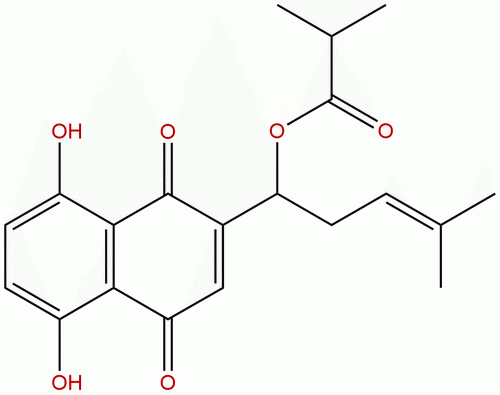
The chemical name of isobutyrylshikonin is isobutyrylshikonin, with a molecular formula of C ₂₀ H ₂₂ O ₆ and a molecular weight of 358.3900 g/mol. Its chemical structure belongs to the shikonin class compounds, with the core skeleton being the naphthoquinone nucleus. Hydroxyl groups are connected to the C-5 and C-8 positions of the naphthoquinone ring, and an isobutyryloxy side chain is connected to the C-1 position. The presence of this side chain endows isobutyrylshikonin with unique physicochemical properties and biological activities that distinguish it from other shikonin derivatives such as acetyl shikonin and β - hydroxyisovalerylshikonin.
From the perspective of physical and chemical properties, isobutyrylshikonin exhibits typical lipid solubility characteristics. Its oil-water partition coefficient (LogP) is 3.7564, indicating that it has strong lipophilicity and is easy to penetrate biofilms, but this also leads to poor water solubility, only 0.1507 mg/mL. This low water solubility to some extent limits its bioavailability, but also provides possibilities for its distribution in the lipid environment and interaction with membrane proteins. The topological polar surface area (TPSA) is 100.9000 Å ², indicating that the molecule contains multiple polar groups (such as hydroxyl and ester groups) and has certain hydrogen bond donor and acceptor abilities, which help to form specific interactions with target proteins. In addition, the blood-brain barrier permeability of isobutyrylshikonin is low, indicating its limited potential for application in central nervous system diseases, but it also reduces the potential risk of neurotoxicity. Preliminary toxicological evaluation shows that the compound has no inhibitory activity on hERG potassium channels, and the Ames test result is negative (0.0), indicating that it does not have significant genetic toxicity, which provides an important safety basis for its use as a candidate drug.
Plant sources and extraction methods
Isobutyrylshikonin mainly comes from Boraginaceae plants, especially Lithospermum Belonging to Arnebia Belonging and Onosma Belonging to others. among which,Lithospermum canescens The hairy root culture is an important source for the discovery of isobutyrylshikonin. Purple grass plants are widely distributed worldwide, especially in Asia and the Mediterranean region, where they have a long history of medicinal use. Purple Grass in Traditional Chinese Medicine(Lithospermum erythrorhizon or Arnebia euchroma)The root bark is rich in various shikonin compounds, but the content of isobutyrylshikonin is usually low and is significantly affected by factors such as plant variety, growth environment, and harvest season.
In order to obtain sufficient amounts of isobutyrylshikonin to meet research and development needs, researchers have developed various extraction and purification methods. The traditional extraction method mainly adopts organic solvent extraction method, utilizing the lipophilic characteristics of isobutyrylshikonin. Methanol, ethanol, ethyl acetate or chloroform are often used as solvents for cold soaking or hot reflux extraction of dried plant root bark. After being concentrated, the extract can be separated and purified by silica gel column chromatography, Sephadex LH-20 gel column chromatography and preparative high-performance liquid chromatography (Prep HPLC). Due to the similar structure of shikonin compounds, separation is difficult, and multiple chromatographic techniques are usually required to obtain high-purity isobutyrylshikonin.
In recent years, with the development of biotechnology, plant cell culture technology, especially the hairy root culture system, has provided a new approach for the sustainable production of isobutyrylshikonin. Through Agrobacterium tumefaciens(Agrobacterium rhizogenes)Inducing Lithospermum canescens When plants form hairy roots, they can be cultured on a large scale under controlled laboratory conditions, and the production of isobutyrylshikonin can be significantly increased by optimizing the composition of the culture medium, adding precursor substances or inducers (such as fungal extracts, heavy metal ions, etc.). This method not only avoids excessive exploitation of wild plant resources, but also ensures the stability of product quality and yield, making it an important development direction for future natural product acquisition.
Pharmacological activity research
The pharmacological activity research of isobutyrylshikonin mainly focuses on its anti-inflammatory effect, while there are also a few studies involving its anti-tumor and antibacterial activities. Existing studies have shown that isobutyrylshikonin exhibits significant intervention effects in various inflammatory models.
At the cellular level, isobutyrylshikonin can effectively inhibit the inflammatory response induced by lipopolysaccharide (LPS). LPS is the main component of the cell wall of Gram negative bacteria, which can activate immune cells such as macrophages and monocytes, and release a large amount of pro-inflammatory cytokines. Research has found that in the LPS stimulated JA-4 cell model (a type of macrophage cell line), treatment with isobutyrylshikonin can significantly reduce cell viability and induce typical nuclear condensation and cell swelling. This cellular morphological change suggests that isobutyrylshikonin may exert anti-inflammatory effects by inducing cell apoptosis or inhibiting cell proliferation. Further experiments have shown that isobutyrylshikonin can significantly reduce the production of inflammatory mediators such as nitric oxide (NO) and prostaglandin E ₂ (PGE ₂), and inhibit the release of pro-inflammatory cytokines such as tumor necrosis factor - α (TNF - α), interleukin-6 (IL-6), and interleukin-1 β (IL-1 β).
In animal models, the anti-inflammatory activity of isobutyrylshikonin has also been preliminarily validated. For example, in the carrageenan induced rat paw swelling model, local or systemic administration of isobutyrylshikonin can significantly reduce the degree of swelling, and its effect is comparable to that of the positive control drug. In the mouse ear swelling model, isobutyrylshikonin also showed good anti-inflammatory activity. In addition, studies have reported that isobutyrylshikonin also has a certain improvement effect on chronic inflammatory diseases such as arthritis and colitis, and can reduce inflammatory cell infiltration and tissue damage.
In addition to anti-inflammatory activity, isobutyrylshikonin also exhibits certain anti-tumor potential. In vitro experiments showed that isobutyrylshikonin had cytotoxic effects on many tumor cell lines (such as liver cancer cells, breast cancer cells, melanoma cells, etc.), and could inhibit cell proliferation and induce apoptosis. However, its anti-tumor activity is usually weaker than that of the parent compound of shikonin, and its selectivity needs to be improved. In terms of antibacterial activity, isobutyrylshikonin exhibits inhibitory effects on certain Gram positive bacteria and fungi, but its activity is relatively weak.
Mechanism of action and molecular targets
The pharmacological activity of isobutyrylshikonin is closely related to its regulation of multiple key signaling pathways and molecular targets. Based on existing research, its anti-inflammatory mechanism mainly involves the following aspects:
Firstly, isobutyrylshikonin can directly or indirectly inhibit the nuclear factor kappa B (NF - κ B) signaling pathway. NF - κ B is the core transcription factor of inflammatory response, regulating the expression of various pro-inflammatory cytokines, chemokines, and adhesion molecules. In the resting state, NF - κ B binds to its inhibitory protein I κ B and exists in an inactive form in the cytoplasm. When cells are stimulated by LPS, TNF - α, etc., I κ B kinase (IKK, such as IKBKB) is activated, leading to phosphorylation and degradation of I κ B, thereby releasing NF - κ B (such as RELA/p65 subunit) into the nucleus and initiating target gene transcription. Research has shown that isobutyrylshikonin can inhibit the activity of IKK, reduce the phosphorylation of I κ B, thereby blocking the nuclear translocation and transcriptional activity of NF - κ B, and ultimately downregulating the expression of inflammation related genes such as TNF - α, IL-6, NOS2 (inducible nitric oxide synthase), and PTGS1/2 (cyclooxygenase).
Secondly, isobutyrylshikonin has a regulatory effect on the signal transduction and transcription activator 3 (STAT3) signaling pathway. STAT3 is a key member of the JAK/STAT signaling pathway, involved in cell proliferation, differentiation, and immune regulation. STAT3 is often abnormally activated in inflammation and tumors. Isobutyrylshikonin can inhibit the phosphorylation of STAT3, thereby blocking the expression of downstream target genes such as IL-6 and anti apoptotic protein Bcl-2. This may be one of the important mechanisms by which it exerts anti-inflammatory and anti-tumor activities.
In addition, isobutyrylshikonin also affects the activation of inflammasomes. CASP1 (cysteine protease-1) is a key effector enzyme for inflammasome activation, responsible for cleaving pro-IL-1 β and pro-IL-18 into mature forms. Research has found that isobutyrylshikonin can inhibit the assembly of NLRP3 inflammasomes and the activation of CASP1, thereby reducing the release of IL-1 β and IL-18, consistent with its anti-inflammatory effects in LPS induced cell models.
It is worth noting that isobutyrylshikonin also has a regulatory effect on members of the transient receptor potential (TRP) channel family, such as TRPV1 and TRPA1. TRPV1 and TRPA1 are non selective cation channels expressed on sensory neurons, involved in the transmission of pain, itching, and neurogenic inflammation. Isobutyrylshikonin may exert analgesic and anti-inflammatory effects by antagonizing or desensitizing these channels, providing a molecular basis for explaining its therapeutic efficacy in inflammation related pain models.
In summary, isobutyrylshikonin exerts its anti-inflammatory activity through the synergistic action of multiple targets and pathways, involving multiple key nodes such as NF - κ B, STAT3, inflammasomes, and TRP channels. This multi-target mode of action is not only its pharmacological advantage, but also brings complexity to its clinical application.
Evaluation of drug properties and pharmacokinetics
The evaluation of drug properties is a crucial step in determining whether natural products can be transported from the laboratory to clinical applications. The pharmacological parameters of isobutyrylshikonin show that it has some advantageous features, but also faces significant challenges.
According to Lipinski's Rule of Five, the molecular weight of isobutyrylshikonin (358.39 Da) is less than 500 Da, the LogP (3.7564) is less than 5, the number of hydrogen bond donors (phenolic hydroxyl groups) is 2, and the number of hydrogen bond acceptors (oxygen atoms) is 6, which meets the basic requirements of drug molecules. Its TPSA (100.9 Å ²) is slightly higher than the recommended upper limit of 140 Å ², but still within an acceptable range, indicating that its oral absorption may be acceptable. However, its extremely poor water solubility (0.1507 mg/mL) severely limits its oral bioavailability and administration route. Low water solubility is a common problem in many natural products, which usually requires improvement through formulation techniques such as liposomes, nanoparticles, cyclodextrin inclusion complexes, etc.
In terms of pharmacokinetics, there is currently insufficient research on the in vivo absorption, distribution, metabolism, and excretion (ADME) of isobutyrylshikonin. Based on its high LogP value, it can be inferred that this compound is easily bound to plasma proteins in vivo, has a large distribution volume, and tends to accumulate in lipid rich tissues such as liver and adipose tissue. Its low blood-brain barrier permeability is beneficial for reducing central nervous system side effects. In terms of metabolism, isobutyrylshikonin may mainly undergo oxidative metabolism through the cytochrome P450 enzyme system in the liver, and its ester bonds may also be hydrolyzed by esterases to produce shikonin and isobutyric acid. The main excretion pathways may be bile and feces.
Safety evaluation is an important component of drug development. The preliminary toxicological data is optimistic: the hERG inhibition test is negative, reducing the risk of cardiac toxicity; The Ames test result is 0.0, indicating that it has no mutagenicity. However, these data are only from preliminary screening and require more comprehensive in vitro and in vivo toxicological studies, including acute toxicity, chronic toxicity, reproductive toxicity, and immunotoxicity.
Overall, isobutyrylshikonin has certain potential as a drug, but its low water solubility and unclear pharmacokinetic characteristics are the main bottlenecks restricting its development. Future research should focus on developing novel drug delivery systems and systematically elucidating their in vivo ADME processes, laying the foundation for clinical translation.
Clinical application prospects and prospects
Based on the significant anti-inflammatory activity and preliminary safety data of isobutyrylshikonin, it has shown broad application prospects in the treatment of various inflammation related diseases.
Firstly, isobutyrylshikonin is expected to be developed as a novel drug for the treatment of acute or chronic inflammatory diseases. For example, in diseases such as rheumatoid arthritis, osteoarthritis, inflammatory bowel disease (such as Crohn's disease, ulcerative colitis), and dermatitis, isobutyrylshikonin may play a disease modifying role by inhibiting the NF - κ B and STAT3 pathways and reducing the release of pro-inflammatory cytokines. Its local administration preparations (such as ointment and gel) can be used to treat skin inflammation and wound healing, while systemic administration preparations may be used for systemic inflammatory diseases.
Secondly, the regulatory effect of isobutyrylshikonin on TRPV1 and TRPA1 channels makes it potentially valuable in the field of pain management. Chronic pain is often accompanied by neurogenic inflammation, and isobutyrylshikonin may be developed as a novel analgesic drug by blocking the transmission of pain signals, especially for inflammatory pain and neuropathic pain.
In addition, although the anti-tumor activity of isobutyrylshikonin is relatively weak, its therapeutic index may be improved through structural modification or combination with other anti-tumor drugs. For example, combining isobutyrylshikonin with chemotherapy drugs or immune checkpoint inhibitors may enhance anti-tumor immune responses by inhibiting inflammatory responses in the tumor microenvironment.
However, the clinical application of isobutyrylshikonin still faces many challenges. Firstly, its low water solubility and unclear pharmacokinetic characteristics in vivo need to be improved through advanced formulation technologies such as nanocrystals, lipid nanoparticles, phospholipid complexes, etc. Secondly, it is necessary to establish more efficient and environmentally friendly synthetic or biosynthetic methods to meet the needs of large-scale production. Thirdly, in-depth toxicological research is needed, especially for the safety assessment of long-term medication. Finally, based on its multi-target mechanism of action, it is necessary to use systems pharmacology and network pharmacology methods to comprehensively reveal its action network and predict potential off target effects and drug interactions.
Conclusion
Isobutyrylshikonin, as an important member of the shikonin family, occupies a place in the field of natural product pharmacology due to its unique chemical structure and significant anti-inflammatory activity. This article systematically reviews its chemical structure, physicochemical properties, plant origin, pharmacological activity, mechanism of action, and medicinal properties, revealing its molecular mechanism of exerting anti-inflammatory effects by regulating multiple targets such as NF - κ B, STAT3, inflammasomes, and TRP channels. Despite challenges such as poor water solubility in drug development, the good preliminary safety data and multi-target advantages of isobutyrylshikonin make it of significant development value in the fields of inflammatory diseases and pain management. Future research should focus on overcoming its pharmacokinetic barriers, delving into its in vivo mechanism of action, and using modern medicinal chemistry and formulation methods to promote the transition of this natural product from laboratory research to clinical applications, contributing to human health.