


Synonym name:
Catalogue No.: BP1212
Cas No.: 85571-15-9
Formula: C21H20O11
Mol Weight: 448.38
Botanical Source: Rhodiola rosea
Purity: 95%~99%
Analysis Method: HPLC-DAD or/and HPLC-ELSD
Identification Method: Mass, NMR
Packing: Brown vial or HDPE plastic bottle
Can be supplied from milligrams to grams.
For Reference Standard and R&D, Not for Human Use Directly.
Inquire for bulk scale.
HPLC of Rhodionin
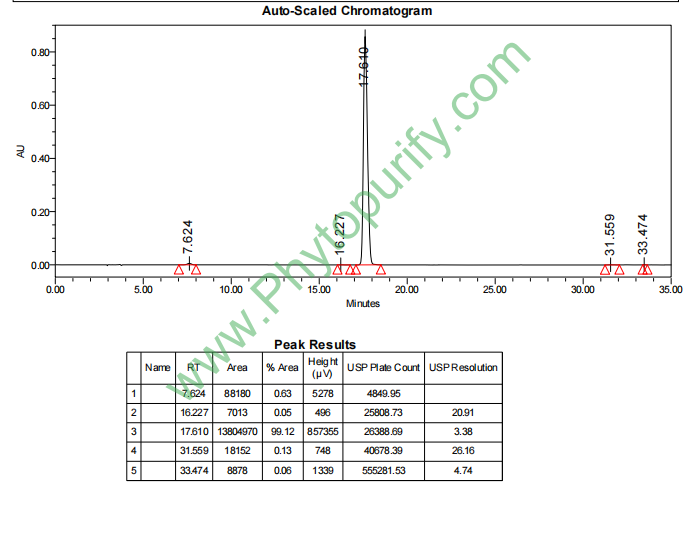
Storage conditions:Short-term storage at 2~8℃, long-term storage at -20 ~ -80℃
190.2800
.7119
.5777
.7794
.6868
.3859
Low
80.3280
4.0585
Yes
No
No
No
Yes
No
0.6
Yes
No
Yes
No
Natural products, as an important source of drug discovery, play an irreplaceable role in the history of human disease prevention and treatment. Rhodiola plants, especially the large flowered Rhodiola, as one of the original plants of the traditional Tibetan medicine "Solomabao", have long been used for anti fatigue, anti hypoxia, and enhancing body adaptability. Modern pharmacological research has revealed their multi-target and multi pathway characteristics. Grass glycoside is a flavonoid glycoside compound isolated from the rhizome of Rhodiola rosea, which has attracted much attention in recent years due to its unique biological activity. Research has shown that glyphosate is not only a specific non competitive inhibitor of cytochrome P450 2D6, but also exhibits significant acetylcholinesterase inhibitory activity and strong free radical scavenging ability. These characteristics demonstrate enormous research potential in the fields of neurodegenerative diseases, oxidative stress-related diseases, and drug interaction regulation. This article aims to provide a systematic review of the chemical properties, plant sources, pharmacological activities, mechanisms of action, and medicinal properties of glyphosate, in order to provide comprehensive scientific references for the in-depth research and development of this compound.
The chemical name of salidroside is kaempferol-7-O - α - L-rhamnoside, and its CAS number is 85571-15-9. Structurally, it belongs to the flavonol glycoside class, with kaempferol as its aglycone and α - L-rhamnose as its sugar moiety. It is connected to the hydroxyl group at position 7 of the aglycone through a glycosidic bond. This specific glycosylation modification has a decisive impact on its solubility, stability, and biological activity.
Its molecular formula is C21H20O11 and its molecular weight is 448.3800. The calculated lipid water partition coefficient LogP value is 0.7119, indicating that the compound has a certain degree of lipophilicity, but overall it still leans towards hydrophilicity. Its topological polar surface area is as high as 190.2800 Å ², which is mainly attributed to the numerous hydroxyl groups and oxygen atoms on the sugar ring in the molecule. This characteristic indicates its strong hydrogen bonding ability, but may also affect its transmembrane permeability. The theoretically calculated water solubility value is 0.7794 mg/mL, which belongs to the range of slightly soluble to soluble. This is consistent with its glycoside structure and is beneficial for dispersion in aqueous media. Based on its physical and chemical parameters, grass glycoside conforms to the five rules of generic drugs, indicating that it has a good basis for generic drug properties.
Grass quality glycosides mainly come from plants in the Sedum genus of the Sedum family, with the rhizome of Sedum grandiflorum being more abundant. Rhodiola grows in extreme environments such as high altitude, hypoxia, and strong ultraviolet radiation, which may promote the synthesis and accumulation of its secondary metabolites (such as grass glycosides) to cope with oxidative stress and other stresses.
Solvent extraction is commonly used to extract glycosides from plant materials. The common process includes crushing the dried rhizomes of Rhodiola rosea and using methanol, ethanol, or their aqueous solutions for reflux extraction or ultrasound assisted extraction. The alcohol extraction method can effectively extract flavonoid glycosides. Subsequently, the extract was concentrated under reduced pressure to obtain a paste, which was then purified using a series of chromatographic separation techniques such as macroporous adsorption resin column chromatography, silica gel column chromatography, polyamide column chromatography, and high-performance liquid chromatography. The separation process is often monitored using the UV absorption characteristics of coumarin glycosides (flavonoids have characteristic absorption at 250-280 nm and 300-380 nm). Optimizing the extraction process (such as solvent concentration, solid-liquid ratio, temperature, and time) is crucial for improving the yield and purity of glyphosate.
The pharmacological activity research of grass glycoside reveals its multifaceted biological effects, mainly focusing on enzyme inhibition, antioxidant and potential neuroprotective fields.
1. Cytochrome P450 2D6 inhibitory activity:
Curcumin glycoside is a specific non competitive inhibitor of CYP2D6, with an IC50 value of 0.761 μ M and an inhibition constant Ki of 0.769 μ M. CYP2D6 is an important drug metabolizing enzyme in the human liver, involved in approximately 25% of clinical drug metabolism. The potent inhibition of CYP2D6 by grass glycoside suggests two points: firstly, it may serve as a tool for studying CYP2D6 enzyme kinetics; Secondly, when used in combination with drugs metabolized by CYP2D6 (such as certain antiarrhythmic drugs, antipsychotic drugs, beta blockers, etc.), potential drug drug interaction risks should be monitored, leading to increased blood drug concentrations, enhanced efficacy, or increased toxicity of the latter.
2. Acetylcholinesterase inhibitory activity:
Curcumin glycoside exhibits dose-dependent and effective inhibition of acetylcholinesterase, with IC50 values ranging from 2.43 to 57.50 μ g/mL. AChE is a key enzyme that hydrolyzes the neurotransmitter acetylcholine, and its inhibition can increase the level of acetylcholine in synaptic cleft, which is the main strategy for improving cholinergic defects in cognitive disorders such as Alzheimer's disease. The AChE inhibitory activity of glyphosate provides direct evidence for its neuroprotective effect, suggesting its potential application value in anti dementia.
3. Antioxidant activity:
Glyphosate has significant direct free radical scavenging ability. In the DPPH radical scavenging experiment, its IC50 was 19.49 μ M, indicating strong antioxidant activity. In addition, based on its structural characteristics, it may also exert antioxidant effects through chelation of metal ions and inhibition of lipid peroxidation. This powerful antioxidant activity is one of the core pharmacological bases of its anti oxidative stress injury related diseases (such as ischemia reperfusion injury, atherosclerosis, neurodegeneration, etc.).
The multiple pharmacological activities of glyphosate stem from its regulation of multiple molecular targets and signaling pathways.
1. Antioxidant stress and activation of Nrf2/ARE pathway:
One of the core mechanisms of action of glyphosate is by activating the key pathway of cell defense against oxidative stress - the nuclear factor E2 related factor 2/antioxidant response element pathway. Under oxidative stress conditions, glyphosate may modify the cysteine residues of Keap1 protein, promoting the dissociation and translocation of Nrf2 and Keap1 to the nucleus. In the nucleus, Nrf2 binds to ARE, initiating the transcriptional expression of a series of downstream phase II detoxifying enzymes and antioxidant proteins. The relevant targets include:
* NRF2 (NFE2L2)The central transcription factor of this pathway.
* HMOX1 Heme oxygenase-1 catalyzes the breakdown of heme to produce biliverdin and carbon monoxide, which have antioxidant and anti-inflammatory effects.
* SOD1, SOD2 Superoxide dismutase catalyzes the conversion of superoxide anions into hydrogen peroxide.
* CAT Catalase breaks down hydrogen peroxide into water and oxygen.
* GPX1 Glutathione peroxidase uses reduced glutathione to reduce hydrogen peroxide and lipid peroxides.
By upregulating these proteins, grass glycoside can systematically enhance the antioxidant capacity of cells and protect biomolecules from oxidative damage.
2. Direct molecular interactions of enzyme inhibition:
* Regarding CYP2D6 As a non competitive inhibitor, glyphosate does not compete with the substrate for the same active site of the enzyme, but binds to other sites (conformational sites) of the enzyme, changing its conformation and reducing its catalytic efficiency. This inhibitory effect is independent of substrate concentration and has specificity.
* Regarding AChE Grass glycosides may interact with amino acid residues in the AChE active site "canyon" (such as Trp86, Phe338, Tyr337, etc.) through π - π stacking, hydrogen bonding, and other interactions between their aromatic rings and hydroxyl groups, thereby hindering the entry of substrate acetylcholine and binding with the catalytic triad.
3. Potential multi-target synergistic effects:
In addition to the clear targets mentioned above, the flavonoid glycoside structure of grass glycoside suggests that it may also have anti-inflammatory effects (such as inhibiting the NF - κ B pathway), regulating mitochondrial function, and affecting cell apoptosis pathways. Its AChE inhibition and antioxidant effects may have a synergistic effect in neuroprotection: on the one hand, it enhances cholinergic neurotransmission, and on the other hand, it reduces oxidative stress damage to neurons.
Preliminary pharmacological evaluation of glyphosate can help determine its potential for development as a drug.
1. Physical and chemical properties and ADMET properties:
As mentioned earlier, its molecular weight, LogP, TPSA and other parameters basically meet the requirements of small molecule oral drugs. However, its high TPSA may lead to low oral bioavailability, as passive diffusion across intestinal epithelial cell membranes may be limited. Predicting its blood-brain barrier permeability as' low 'may limit its direct efficacy in central nervous system diseases, but given its ability to activate endogenous antioxidant pathways (Nrf2), peripheral administration may also indirectly exert neuroprotective effects through systemic effects. The inhibitory prediction of hERG channel is' no ', which is a positive signal that reduces the risk of causing QT interval prolongation and apical torsion ventricular tachycardia. The Ames test value is 0.6 (usually set at a threshold of 1.0 or 1.5, below which the risk of mutagenicity is low), indicating a low risk of genetic toxicity, but further in vitro and in vivo experiments are needed to confirm.
2. Pharmacokinetic prediction and challenges:
As flavonoid glycosides, the pharmacokinetic behavior of grass glycoside in vivo may have typical characteristics. After oral administration, it may undergo hydrolysis under the action of glycosidase secreted by gut microbiota, producing glycosides such as kaempferol and rhamnose. The absorption rate of aglycones may be higher than that of the original glycoside, but the metabolism of aglycones (such as glucuronidation and sulfation) is very rapid, resulting in lower bioavailability. There is a lack of systematic experimental data on the distribution, metabolism, and excretion of prototype glycosides and their metabolites in the body. The characteristic of it as a strong inhibitor of CYP2D6 is the most important aspect to pay attention to in its pharmacokinetics, which may significantly affect the metabolism of co administered drugs. Future research needs to comprehensively elucidate its ADME characteristics through in vitro liver microsomal metabolism, Caco-2 cell transport, and in vivo animal pharmacokinetic experiments.
The multiple biological activities of glyphosate bring potential application prospects in multiple therapeutic fields, but also face challenges.
1. Potential application directions:
* Adjuvant therapy for neurodegenerative diseases Combining its dual effects of AChE inhibition and potent antioxidant (activating the Nrf2 pathway), glyphosate may serve as a potential multi-target therapeutic or adjuvant therapy for diseases such as Alzheimer's and Parkinson's, aiming to improve symptoms and delay disease progression simultaneously.
* Oxidative stress-related diseases: In the pathological processes closely related to oxidative stress, such as cardiovascular diseases (such as atherosclerosis, myocardial ischemia-reperfusion injury), metabolic diseases (such as diabetes and its complications), and liver injury, oxaloside can play a protective role by activating Nrf2 pathway.
* As a drug metabolism regulator In the context of precision medicine, its specific CYP2D6 inhibitory activity can be used to design drug combination regimens, for example, in combination with certain drugs that are metabolized too quickly by CYP2D6 and have insufficient efficacy, in order to improve the bioavailability and efficacy of the latter. But this application requires extreme caution and must be carried out under close monitoring.
* Functional foods and health products Based on its plant origin and antioxidant properties, salidroside can be used as a key functional ingredient in Rhodiola extract to develop health products that resist fatigue and enhance hypoxia tolerance.
2. Challenges and future research directions:
* Improved bioavailability This is a major challenge for its development into a drug. Future research can explore new drug delivery systems, such as nano formulations (liposomes, polymer nanoparticles), phospholipid complexes, cyclodextrin inclusion complexes, etc., to improve their solubility, stability, and membrane permeability.
* Deep analysis of the mechanism of action Molecular docking, surface plasmon resonance, gene knockout/knockdown and other techniques are needed to more accurately elucidate the interaction details with targets such as CYP2D6, AChE, and Keap1. Meanwhile, utilizing omics techniques (transcriptomics, proteomics, metabolomics) to comprehensively reveal its network pharmacology effects.
* Preclinical and clinical evaluation of the system Standardized in vivo pharmacological experiments must be conducted to validate its efficacy in animal models such as Alzheimer's disease and cerebral ischemia. And conduct a comprehensive toxicological evaluation (acute toxicity, long-term toxicity, reproductive toxicity, etc.) to clarify its safe dose range. Ultimately, gradually advance clinical trials to verify its safety and effectiveness in humans.
* Structural optimization and derivative development Based on its parent nucleus structure, reasonable chemical modifications are carried out, such as modifying sugar and hydroxyl groups, in order to obtain derivatives with stronger activity, higher selectivity, and better pharmacokinetic properties.
As a characteristic flavonoid glycoside in Rhodiola rosea, coumarin has become a highlight compound in natural product pharmacology research due to its unique CYP2D6 inhibition, AChE inhibition, and strong antioxidant activity. It exerts antioxidant effects by directly clearing free radicals and activating the endogenous Nrf2 defense pathway, which constitutes one of the core mechanisms of its multi effect pharmacological activity. Although it still faces challenges in terms of bioavailability and blood-brain barrier permeability on the path of traditional Chinese medicine, its clear molecular targets and diverse biological activities have laid a solid scientific foundation for its application in fields such as neuroprotection and antioxidant therapy. Future research should focus on using modern pharmaceutical technology to improve its delivery efficiency, and conduct in-depth studies on the pharmacodynamics, toxicology, and mechanism of action of this traditional medicinal plant, in order to transform the active molecules in this plant into modern drugs or functional factors with clear clinical application value, benefiting human health.
