


Product name: Silydianin
Synonym name: Silidianin
Catalogue No.: BP1307
Cas No.: 29782-68-1
Formula: C25H22O10
Mol Weight: 482.441
Botanical Source: Silybum mariamum (L.)Gaertrn.
Physical Description:
Type of Compound: Flavonoids
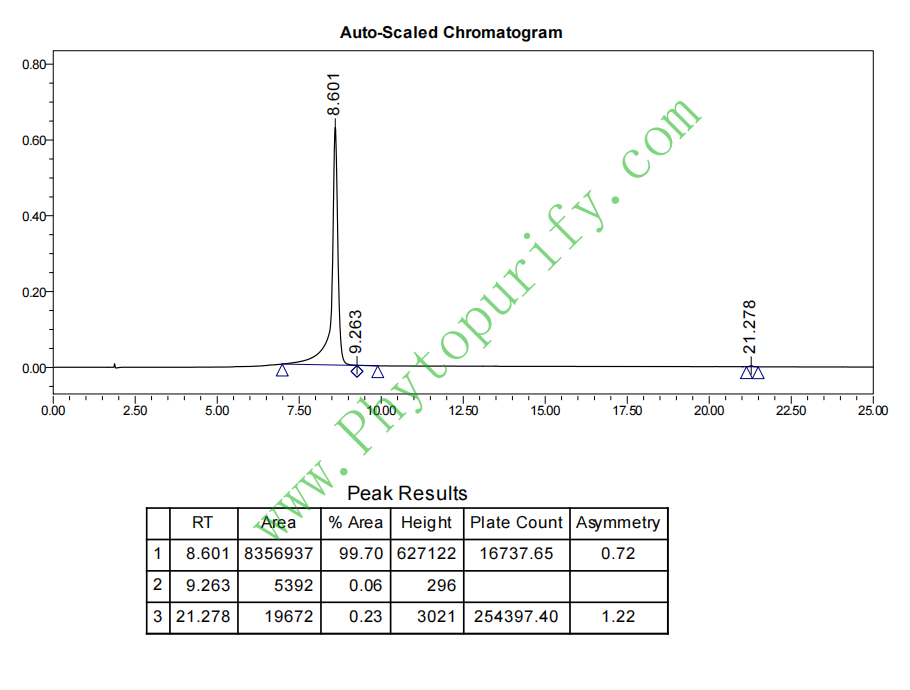
Purity: 95%~99%
Analysis Method: HPLC-DAD or/and HPLC-ELSD
Identification Method: Mass, NMR
Packing: Brown vial or HDPE plastic bottle
Storage: Store in a well closed container, protected from air and light. Put into refrigerate or freeze for long term storage.
Whenever possible, you should prepare and use solutions on the same day. However, if you need to make up stock solutions in advance, we recommend that you store the solution as aliquots in tightly sealed vials at -20℃. Generally, these will be useable for up to two weeks.
The product could be supplied from milligrams to grams
Inquire for bulk scale.
Description:
Silydianin, an active constituent of Silybium marianum, has inhibitory effect on on the in vitro production and release of oxidative products. Silydianin has possible antiinflammatory activity, which regulates caspase-3 activation, affects cell membranes and acts as a free radical scavenger.
References:
Phytother Res. 2006 Feb;20(2):115-9.
An in vitro study of the protective effect of the flavonoid silydianin against reactive oxygen species.
The inhibitory effect of Silydianin, an active constituent of Silybium marianum, on the in vitro production and release of oxidative products has been examined. Polymorphonuclear neutrophils (PMNs) play a primary role in the initiation and propagation of inflammatory responses. Their apoptosis is a major mechanism associated with the resolution of inflammatory reactions. Neutrophils were assessed for caspase-3 activity, the rst step in the execution phase of apoptosis.
METHODS AND RESULTS:
When cells were cultured with 100 microM Silydianin for 24 h, caspase-3 was activated. Induction of apoptosis by Silydianin was accompanied by a decrease in luminol-enhanced chemiluminescence as well as superoxide radical (O2*-) release in freshly isolated cells and lipid peroxidation in mouse spleen microsomes. No significant effect of Silydianin on PMN hydrogen peroxide production evaluated by a flow cytometric dichlorofluorescin oxidation assay was found.
CONCLUSIONS:
Such results indicate a possible antiinflammatory activity for Silydianin, which regulates caspase-3 activation, affects cell membranes and acts as a free radical scavenger.
HPLC of Silydianin
Storage conditions:Short-term storage at 2~8℃, long-term storage at -20 ~ -80℃
162.9800
1.5354
1.3976
.3138
1.5136
2.4381
Low
87.8389
5.9139
No
No
No
No
Yes
No
0.6
Yes
No
Yes
No
Silydianin, CAS number 29782-68-1, is a natural flavonoid lignan derived from Silybum marianum. As an important component of total flavonoids in Silymarin, Silymarin has been widely studied in traditional herbal medicine due to its significant liver protective effects. In recent years, with the deepening development of natural product pharmacology, Silymarin has not only shown unique biological activity in the field of liver protection, but also demonstrated multi-target and multi mechanism pharmacological potential, including antioxidant, immune regulation, anti-tumor, and tyrosinase inhibition functions.
This article aims to systematically review the chemical structure and physicochemical properties, plant sources, and extraction methods of Silymarin, deeply analyze its pharmacological activity and mechanism of action, evaluate its pharmacological and pharmacokinetic characteristics, and explore its clinical application prospects. It is expected to provide theoretical basis and research direction for the further development and application of this natural product.
Silymarin belongs to the flavonoid lignans class, with a molecular formula of C25H30O10 and a molecular weight of 482.4410. Its structural characteristics include the typical combination of flavonoid skeleton and lignin structure, with multiple hydroxyl and methoxy substituents, endowing it with strong polarity and biological activity. The topological polar surface area (TPSA) of Silymarin is 162.98 Å ², indicating that its molecule has high polarity and is conducive to binding to various biological targets.
In terms of physical and chemical properties, the LogP value of Silymarin is 1.5354, indicating its moderate lipid solubility, which ensures its certain penetration ability in the cell membrane and maintains good water solubility (0.3138 mg/mL). In addition, the blood-brain barrier penetration ability of Silymarin is relatively low, indicating its limited distribution in the central nervous system. The hERG channel inhibition experiment showed a negative result, indicating a low risk of cardiac toxicity. The Ames test result is 0.6, indicating a low risk of genotoxicity.
Silymarin is mainly extracted from Silybum marianum. Milk thistle is a traditional herbaceous plant widely distributed in the Mediterranean and other temperate regions. Its fruit and seeds are the main accumulation sites of silymarin, with abundant content and easy extraction.
The extraction process usually uses organic solvent extraction combined with column chromatography separation technology. The specific steps include:
In recent years, the application of ultrasound assisted extraction and microwave-assisted extraction technologies has improved the extraction efficiency and purity of Silymarin, reduced production costs, and promoted its large-scale production.
Silymarin exhibits significant antioxidant activity, capable of clearing free radicals and reducing cellular damage caused by oxidative stress. Its antioxidant mechanism mainly activates the intracellular antioxidant enzyme system, including superoxide dismutase (SOD1, SOD2), catalase (CAT), glutathione peroxidase (GPX1), and induces the Nrf2/ARE signaling pathway to enhance the cell's antioxidant defense ability. In addition, Silymarin can upregulate the expression of antioxidant related genes such as NQO1 and HMOX1, protecting liver cells from toxin invasion.
As one of the active ingredients of total flavonoids in Silymarin, Silymarin has been extensively studied in the field of liver protection. It regulates liver injury related molecules such as matrix metalloproteinase 9 (MMP9), transforming growth factor beta 1 (TGFB1), and actin alpha 2 (ACTA2) through multiple targets, inhibiting the progression of liver fibrosis, reducing hepatocyte necrosis and inflammatory response. Animal experiments have shown that Silymarin can significantly reduce liver enzyme levels, improve liver function indicators, and promote liver tissue repair.
Silymarin has potent inhibitory activity against tyrosinase, with IC50 values of 2.6 μ M and 16.5 μ M for monophenolase and diphenolase, respectively. This activity makes it potentially valuable in the fields of skin whitening and anti melanin production. Tyrosinase is a key enzyme in melanin synthesis, and silymarin has a good skin protective effect by inhibiting its activity and reducing melanin formation.
Silymarin can regulate immune cell function and reduce the expression of inflammatory factors. Research has shown that Silymarin significantly reduces the secretion of pro-inflammatory cytokines IL-4 and IL-5, inhibits airway inflammation in allergic asthma models, and reduces airway hyperresponsiveness. In addition, its ability to induce cell apoptosis helps to clear abnormal immune cells and maintain immune homeostasis.
Silymarin exhibits anti proliferative and pro apoptotic effects in various tumor models. Especially in prostate cancer cells, silymarin can induce cell cycle arrest, activate apoptotic signaling pathways, and inhibit tumor cell growth. Its anti-tumor mechanism involves the regulation of multiple signaling pathways, including PI3K/Akt, MAPK, and NF - κ B, indicating its potential development value as an anti-cancer drug.
The multi-target mechanism of action of Silymarin is the basis of its multiple pharmacological effects. The main targets and related mechanisms include:
PTP1B inhibition Silymarin has an inhibitory effect on protein tyrosine phosphatase 1B (PTP1B) with an IC50 of 17.38 μ M. PTP1B is a negative regulator of the insulin signaling pathway, and its inhibition helps improve insulin resistance, suggesting the potential application of silymarin in metabolic diseases.
Tyrosinase inhibition By directly inhibiting tyrosinase activity, Silymarin reduces melanin synthesis and exerts a protective effect on the skin.
Antioxidant related targets Activate the Nrf2 signaling pathway, promote the expression of downstream antioxidant enzymes (SOD1, SOD2, CAT, GPX1, NQO1, HMOX1), enhance cellular antioxidant capacity, and alleviate oxidative damage.
Anti fibrotic related targets Regulating MMP9, TGFB1, and ACTA2 to inhibit the progression of liver fibrosis.
Immune regulatory targets Reduce the expression of pro-inflammatory cytokines such as IL-4 and IL-5, and alleviate allergic inflammatory reactions.
Mechanism of promoting apoptosis Activate the intracellular apoptotic signaling pathway, induce abnormal programmed cell death, and inhibit tumor cell proliferation.
These multi-target and multi pathway mechanisms of action enable Silymarin to exhibit broad pharmacological potential in various disease fields such as liver disease, metabolic diseases, skin diseases, and tumors.
The pharmacological parameters of Silymarin indicate that it has certain potential for drug development. The molecular weight is 482.44, slightly higher than the Lipinski rule recommendation of 500 or less, but still within an acceptable range. The LogP value of 1.5354 indicates moderate lipid solubility, which is beneficial for in vivo distribution. A higher TPSA (162.98 Å ²) suggests strong polarity, which may limit oral absorption and blood-brain barrier penetration.
The water solubility of Silymarin is 0.3138 mg/mL, which belongs to moderate solubility and is beneficial for formulation development. Low blood-brain barrier permeability reduces the risk of central nervous system side effects. HERG channel inhibition is negative, indicating good cardiac safety. The Ames test results show that its genotoxicity risk is low and its safety is high.
At present, there is limited pharmacokinetic research on Silymarin, and preliminary data suggests that its oral bioavailability is limited, possibly due to its high polarity and intestinal metabolism. In the future, it is necessary to conduct systematic ADME (absorption, distribution, metabolism, excretion) research, optimize the administration route and formulation design, and improve its in vivo stability and bioavailability.
Silymarin, as a multifunctional natural product, has broad clinical application potential, mainly reflected in the following aspects:
Liver disease treatment The liver protective effect of Silymarin has been extensively validated through in vitro and in vivo experiments, and it can be used as an adjuvant therapy for hepatitis, liver fibrosis, and liver injury in the future, especially in the management of chronic liver disease, which has important value.
Metabolic disease intervention By inhibiting PTP1B, silymarin is expected to improve insulin resistance and become a potential therapeutic agent for diabetes and metabolic syndrome.
Skin diseases and beauty field Its tyrosinase inhibitory activity makes it promising for application in whitening, anti melanin production, and sunscreen products.
Immune regulation and allergic diseases Silymarin reduces the expression of IL-4 and IL-5, alleviates inflammation in asthma and other allergic diseases, and can be developed as an immunomodulatory agent in the future.
Development of anti-tumor drugs Its anti proliferative and pro apoptotic effects in prostate cancer and other tumor cells provide new ideas for the research of natural anti-cancer drugs.
Although Silymarin exhibits multiple biological activities, its clinical translation still faces many challenges, such as in vivo stability, oral bioavailability, and targeting. Future research needs to focus on pharmacokinetic optimization, dosage form innovation, and clinical safety evaluation to promote its clinical application.
Silymarin, as an important flavonoid lignan in milk thistle, has shown extensive pharmacological potential due to its unique chemical structure and rich biological activity. Its multi-target effects in liver protection, antioxidant, immune regulation, tyrosinase inhibition, and anti-tumor properties provide valuable examples for the pharmacological research of natural products. The drug efficacy evaluation shows that it has good safety and development potential, but further pharmacokinetic and clinical research support is still needed.
In the future, combining modern medicinal chemistry, molecular biology, and pharmaceutical technology, silymarin is expected to become an effective natural medicine or new drug lead compound for treating various diseases. The mechanism research and clinical translation of the system will be the key to promoting its industrial application, and we look forward to Silymarin playing a greater role in the development of natural product drugs.
