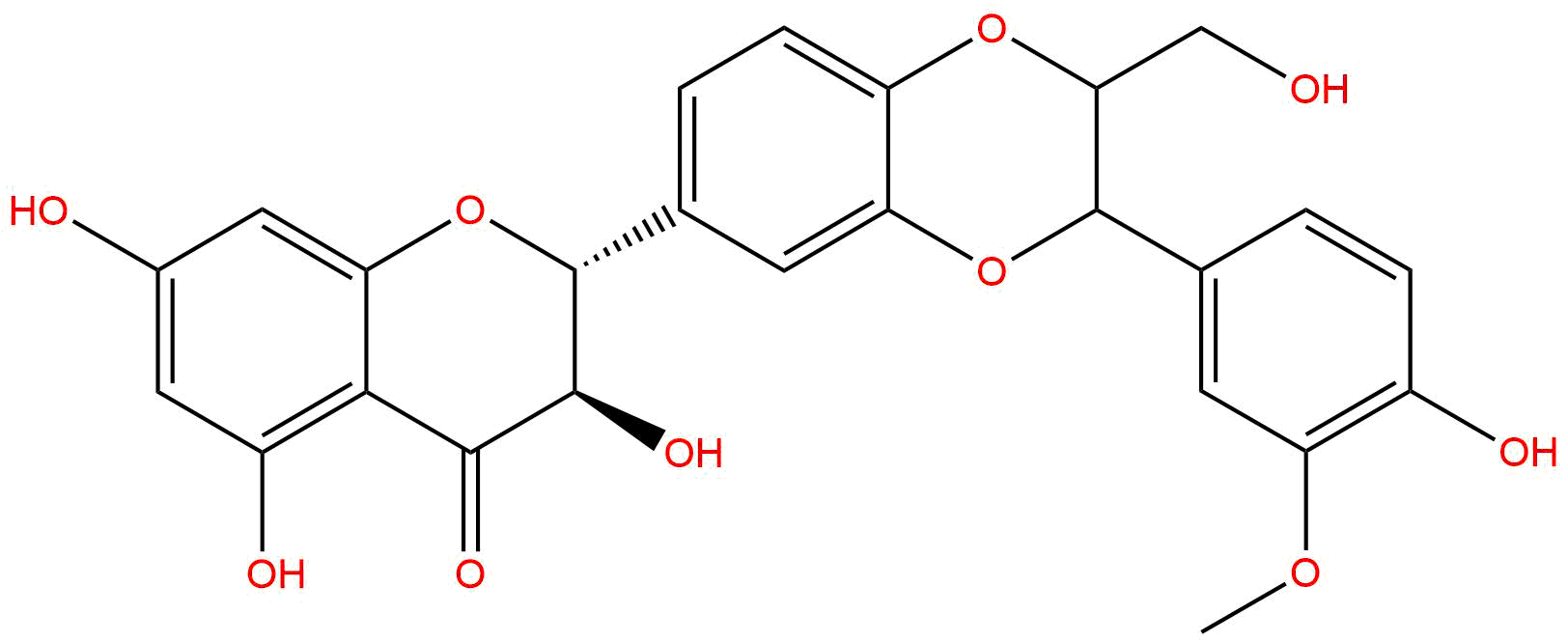


Product name: Silybin(Mixture A&B)
Synonym name: Silibinin; Silymarin; 802918-57-6
Catalogue No.: BP1305
Cas No.: 802918-57-6
Formula: C25H22O10
Mol Weight: 482.441
Botanical Source:
Physical Description: White powder
Type of Compound: Flavonoids
Purity: 95%~99%
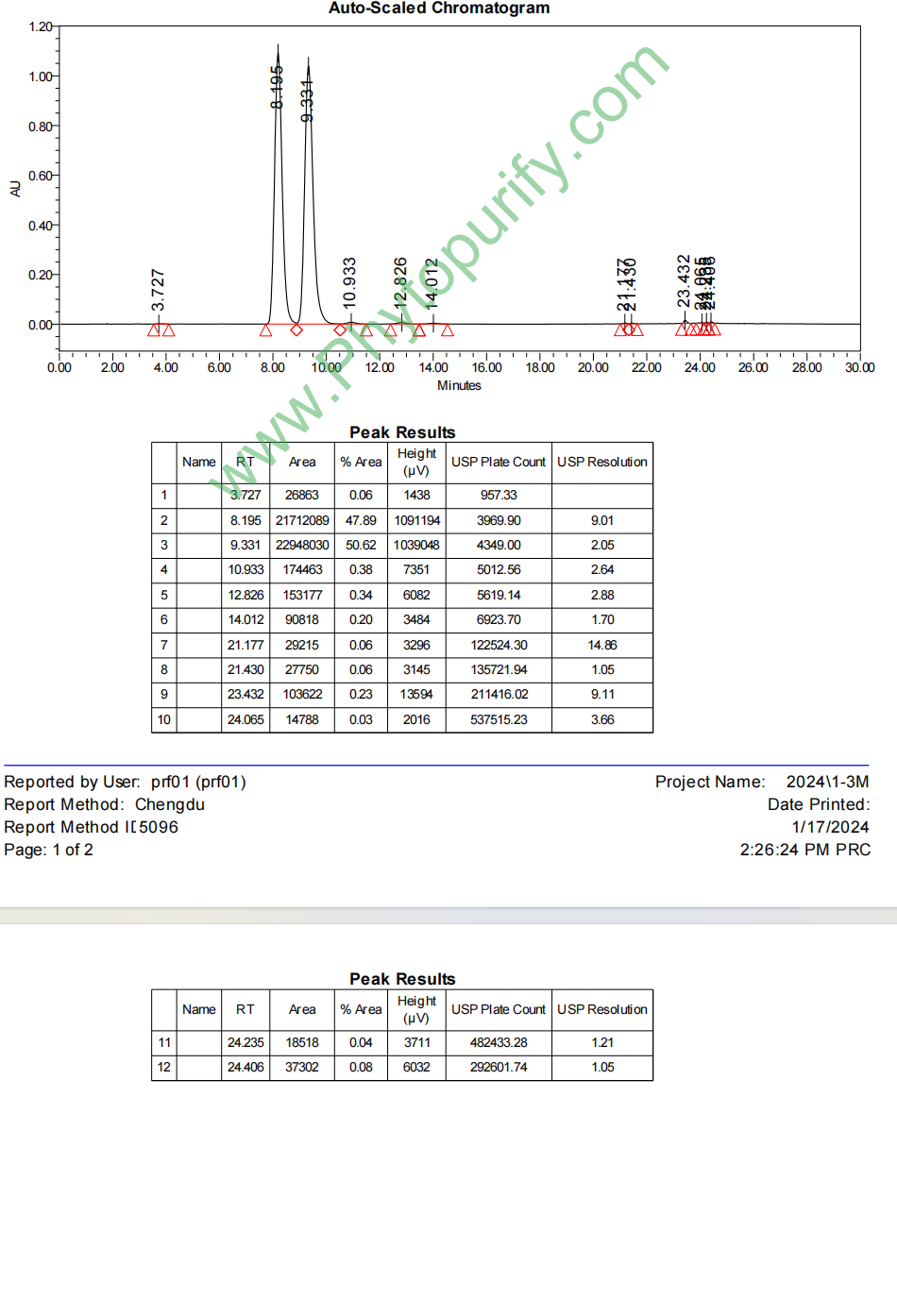
Analysis Method: HPLC-DAD or/and HPLC-ELSD
Identification Method: Mass, NMR
Packing: Brown vial or HDPE plastic bottle
Storage: Store in a well closed container, protected from air and light. Put into refrigerate or freeze for long term storage.
Whenever possible, you should prepare and use solutions on the same day. However, if you need to make up stock solutions in advance, we recommend that you store the solution as aliquots in tightly sealed vials at -20℃. Generally, these will be useable for up to two weeks.
The product could be supplied from milligrams to grams, up to kilograms
Inquire for bulk scale.
Descriptions:
Silymarin (SIL), a standardized plant extract containing about 60% polyphenole silibinin, is used as a hepatoprotective agent, it retards collagen accumulation in early and advanced biliary fibrosis secondary to complete bile duct obliteration in rats, it also may play a role in the therapy of (alcoholic) liver cirrhosis.[1,2]
Silymarin modulates imbalance between cell survival and apoptosis through interference with the expressions of cell cycle regulators and proteins involved in apoptosis; it also shows anti-inflammatory as well as anti-metastatic activity; it has the protective effects in various tissues, suggest a clinical application in cancer patients as an adjunct to established therapies, to prevent or reduce chemotherapy as well as radiotherapy-induced toxicity.[3]
Silymarin possesses antioxidant, anti-inflammatory and immunomodulatory properties which may lead to the prevention of skin cancer in in vivo animal models, suggests that it is a promising chemopreventive and pharmacologically safe agent which can be exploited or tested against skin cancer in human system, moreover, it may favorably supplement sunscreen protection and provide additional anti-photocarcinogenic protection.[4]
Silymarin induces apoptosis primarily through a p53-dependent pathway involving Bcl-2/Bax, cytochrome c release, and caspase activation.[5]
Silymarin and silibinin cause G1 and G2–M cell cycle arrest via distinct circuitries in human prostate cancer PC3 cells.[6]
References:
[1] Boigk G, Stroedter L, Herbst H, et al. Hepatology, 1997, 26(3):643-9.
[2] Saller R, Meier R, Brignoli R. Drugs, 2001, 61(14):2035-63.
[3] Ramasamy K, Agarwal R. Cancer Lett, 2008, 269(269):352-62.
[4] Katiyar S K. Int J Oncol, 2005, 26(1):169-76.
[5] Katiyar S K, Roy A M, Baliga M S. Mol Cancer Ther, 2005, 4(2):207-16.
[6] Deep G, Singh R P, Agarwal C, et al. Oncogene, 2006, 25(7):1053-69.
[7] Korany M A, Haggag R S, Ragab M A A, et al. Arab J Chem, 2013, 06.021.
HPLC of Silybin
Storage conditions:Short-term storage at 2~8℃, long-term storage at -20 ~ -80℃
Silybin (CAS number: 802918-57-6) is a flavonoid compound isolated from the seeds of Cirsium marianum, belonging to the flavonoid oligosaccharide family. As the main active ingredient in Silymarin mixtures, silibinin has become a hot topic in natural product pharmacology research in recent years due to its significant biological activity, especially in liver protection, antioxidant, anti-inflammatory, and anti-tumor potential. Silymarin not only induces cell apoptosis, but also exhibits multi-target regulatory ability, involving multiple signaling pathways and enzyme systems, demonstrating good pharmacological activity and safety. This article aims to systematically review the chemical structure and physicochemical properties, plant sources and extraction methods, pharmacological activity and mechanism of action, pharmacological evaluation and pharmacokinetic characteristics of silibinin, and explore its clinical application prospects and future development directions.
The chemical structure of silibinin is a flavonoid compound with a molecular formula of C25H22O10 and a molecular weight of 482.4410. Its structural features include a typical flavonoid skeleton, combined with multiple hydroxyl and sugar groups, giving it strong polarity and biological activity. The topological polar surface area (TPSA) of silibinin is 155.1400, indicating its high polarity, which facilitates the formation of hydrogen bonds and van der Waals interactions with various biological targets.
In terms of physicochemical properties, the LogP value of silibinin is 1.8482, indicating that it has moderate lipid solubility and a certain degree of water solubility (solubility of approximately 0.2082 mg/mL), which has a positive impact on oral absorption and in vivo distribution. Its blood-brain barrier permeability is low, indicating limited distribution of silybin in the central nervous system, which may reduce adverse reactions related to the central nervous system. The negative result of hERG channel inhibition experiment indicates a low risk of cardiac toxicity. The Ames test result is 0.0, supporting its lack of significant mutagenicity and good safety.
Silymarin mainly comes from the mature seeds of the Asteraceae plant Silybum marianum. The thistle is native to the Mediterranean region and is now widely cultivated in multiple parts of the world. Its seeds contain abundant flavonoids, especially silymarin complex, of which silibinin accounts for the main proportion.
There are various methods for extracting silibinin, including solvent extraction, ultrasound assisted extraction, microwave-assisted extraction, and supercritical fluid extraction. Traditional solvent extraction usually uses ethanol or methanol as solvents, combined with hot reflux or impregnation techniques, resulting in higher extraction efficiency. Modern technologies such as ultrasound and microwave-assisted extraction can significantly shorten extraction time, improve extraction efficiency, while reducing solvent usage and environmental pollution. After extraction, it is usually purified and separated by chromatographic techniques such as high-performance liquid chromatography (HPLC) to obtain high-purity silibinin.
Silymarin is known for its significant liver protective effects, which can effectively resist liver cell damage and functional impairment caused by various liver injury factors. Its mechanism of action mainly involves antioxidant, anti-inflammatory, anti fibrotic, and promoting liver cell regeneration. Multiple in vitro and in vivo experiments have shown that silibinin can upregulate antioxidant enzymes (such as SOD1, SOD2, CAT, GPX1) and detoxifying enzymes (NQO1, HMOX1), reduce reactive oxygen species (ROS) generation, alleviate oxidative stress, and protect the integrity of liver cell membrane structure. In addition, silibinin can regulate the expression of transforming growth factor beta 1 (TGFB1) and actin alpha 2 (ACTA2), inhibit the activation of hepatic stellate cells, and alleviate the process of liver fibrosis.
Silymarin activates the nuclear factor erythroid 2-related factor 2 (NRF2) signaling pathway, induces downstream antioxidant gene expression, and enhances cellular antioxidant defense ability. The activation of NRF2 promotes the expression of antioxidant enzymes such as NQO1 and HMOX1, significantly reducing oxidative damage and alleviating inflammatory reactions. This mechanism plays an important role in liver protection, neuroprotection, and prevention and treatment of cardiovascular diseases.
Silymarin has significant anti-inflammatory activity and can inhibit the release of various inflammatory mediators, such as tumor necrosis factor alpha (TNF - α), interleukin-6 (IL-6), and cyclooxygenase-2 (COX-2). Its anti-inflammatory effect is mainly achieved by regulating the nuclear factor kappa B (NF - κ B) signaling pathway, inhibiting the transcription of inflammatory genes, reducing inflammatory responses, and protecting tissues from inflammatory damage.
In recent years, the research on silibinin in the field of anti-cancer has gradually increased. It exerts anti-tumor effects through multiple mechanisms such as inducing cancer cell apoptosis, inhibiting cell proliferation, blocking cell cycle, and suppressing tumor invasion and metastasis. Silymarin can regulate multiple signaling pathways, including PI3K/Akt, MAPK, and Wnt/β - catenin, promoting cancer cell apoptosis and inhibiting tumor growth. In addition, silibinin can enhance the sensitivity of chemotherapy drugs, alleviate chemotherapy related toxic side effects, and demonstrate good potential for adjuvant therapy.
The multi-target mechanism of action of silibinin is the basis for the realization of its various pharmacological activities. Its main targets and mechanisms of action include:
In summary, silibinin achieves a wide range of pharmacological activities through synergistic regulation of multiple targets and pathways.
The pharmacological parameters of silibinin indicate that it has good potential for drug development. Moderate molecular weight (482.4410) and LogP value (1.8482) are beneficial for the membrane permeability and in vivo distribution of drugs. A higher TPSA (155.1400) suggests stronger polarity, which may affect oral bioavailability, but at the same time facilitates high affinity binding to the target.
The low water solubility of silibinin (0.2082 mg/mL) limits its oral absorption, prompting researchers to develop various formulation techniques (such as nanoparticles, liposomes, solid dispersions) to improve its bioavailability. Its blood-brain barrier permeability is low, reducing the risk of central nervous system toxicity. The negative inhibition and non mutagenicity of hERG channel (Ames test 0.0) further support its safety.
Pharmacokinetic studies have shown that silibinin is mainly metabolized by the liver in vivo, and its metabolites are mainly excreted through bile, with a moderate half-life. Its oral bioavailability is limited by intestinal absorption and first pass effects, but through formulation optimization and combination therapy, bioavailability can be significantly improved.
As a natural product with multiple pharmacological activities, silibinin has broad prospects for clinical application. Its most mature application field is the adjuvant treatment of liver diseases, especially viral hepatitis, alcoholic liver disease, non-alcoholic fatty liver disease, and drug-induced liver injury. Multiple clinical trials have shown that silibinin can improve liver function indicators, alleviate liver inflammation and fibrosis, and improve patients' quality of life.
In addition, the potential of silibinin in antioxidant and anti-inflammatory fields makes it a potential therapeutic candidate for cardiovascular disease, metabolic syndrome, and neurodegenerative diseases. Its anti-cancer activity has also attracted widespread attention and is expected to be used as an adjuvant therapy for tumors in the future, enhancing chemotherapy efficacy and reducing side effects.
However, the clinical promotion of silibinin still faces challenges such as low bioavailability, unsatisfactory pharmacokinetics, and insufficient formulation development. Future research needs to focus on innovative formulation technology, in-depth analysis of the mechanism of action, and large-scale clinical validation to promote the clinical translation of silibinin.
Silymarin, as a flavonoid natural product derived from thistle seeds, has demonstrated significant pharmacological potential due to its significant liver protective, antioxidant, anti-inflammatory, and anticancer activities. Its multi-target mechanism of action provides a theoretical basis for the development of new multifunctional drugs. Despite limitations in bioavailability and pharmacokinetics, with advances in formulation technology and deeper clinical research, silibinin is expected to become an important member in the development of natural product drugs. In the future, efforts should be made to strengthen research on its pharmacological mechanisms, optimize drug formulations, and conduct systematic clinical evaluations to promote the widespread use of silybin in the treatment of liver disease and other related diseases.
