


Product name: Silychristin
Synonym name: Silicristin, Silymarin II
Catalogue No.: BP1306
Cas No.: 33889-69-9
Formula: C25H22O10
Mol Weight: 482.441
Botanical Source: Silybum mariamum (L.)Gaertrn.
Physical Description:
Type of Compound: Flavonoids
Purity: 95%~99%
Analysis Method: HPLC-DAD or/and HPLC-ELSD
Identification Method: Mass, NMR
Packing: Brown vial or HDPE plastic bottle
Storage: Store in a well closed container, protected from air and light. Put into refrigerate or freeze for long term storage.
Whenever possible, you should prepare and use solutions on the same day. However, if you need to make up stock solutions in advance, we recommend that you store the solution as aliquots in tightly sealed vials at -20℃. Generally, these will be useable for up to two weeks.
The product could be supplied from milligrams to grams
Inquire for bulk scale.
Description:
Silychristin is a plant growth regulator, is an anti-hepatotoxic agent, is also an inhibitor of horseradish peroxidases and lipoxygenase.
References:
ongress of the Turkish Toxicology Society. 2015,10.
In vitro assessment of human CYP1A1 inhibition potential of Resveratrol and Silychristin
Flavonoids are phenolic compounds with low molecule weight, which are found most plants in nature. They are so important for human health due to their biological activities such as anti-inflammatory and anti-carcinogenic effects. Cancer protective effects of flavonoids have been attributed to wide variety of mechanisms such as free radical scavenging and modifying Phase I and Phase II enzymes that activate or detoxify carcinogens. Resveratrol and Silychristin are phenolic compounds that may have roles in the reduction of cancer susceptibility. One of the possible mechanism by which resveratrol and Silychristin may exert their anti-carcinogenic effects is through an interaction by certain CYP450s.
METHODS AND RESULTS:
In this respect, the focus of this study is to determine the mechanisms of inhibition of CYP1A1, that is known to be involved in the activation of procarcinogens by resveratrol and Silychristin. Bistronic expression system that coexpress human CYP1A1 and NADPH CYP450 Reductase were used to investigate this effect. Co-expression plasmid was transformed into E. coli DH5alpha. Single colony was selected and grown in overnight culture at 30°C in LB medium. Membrane fractions were prepared and used for enzyme source. Resveratrol inhibited ethoxyresorufin O-deethylation (EROD) activity in human P450 1A1 in a dose-dependent manner with IC50 of 21 μM. Moreover, resveratrol inhibited human P450 1A1 activity in a mixed-type inhibition. In the case of Silychristin, the inhibition of human P450 1A1 by this phenolic compound was stronger than resveratrol. (IC50 15.83 μM for EROD). Similiarly, it showed mixed type inhibition.
CONCLUSIONS:
This study indicated that these phenolics were strong and selective inhibitors of CYP1A1 associated EROD activity and may be considered for use as a strong cancer chemopreventive agent in humans by the preventing malignant transformation and reducing the activations of carcinogens through inhibition of CYP1A1.
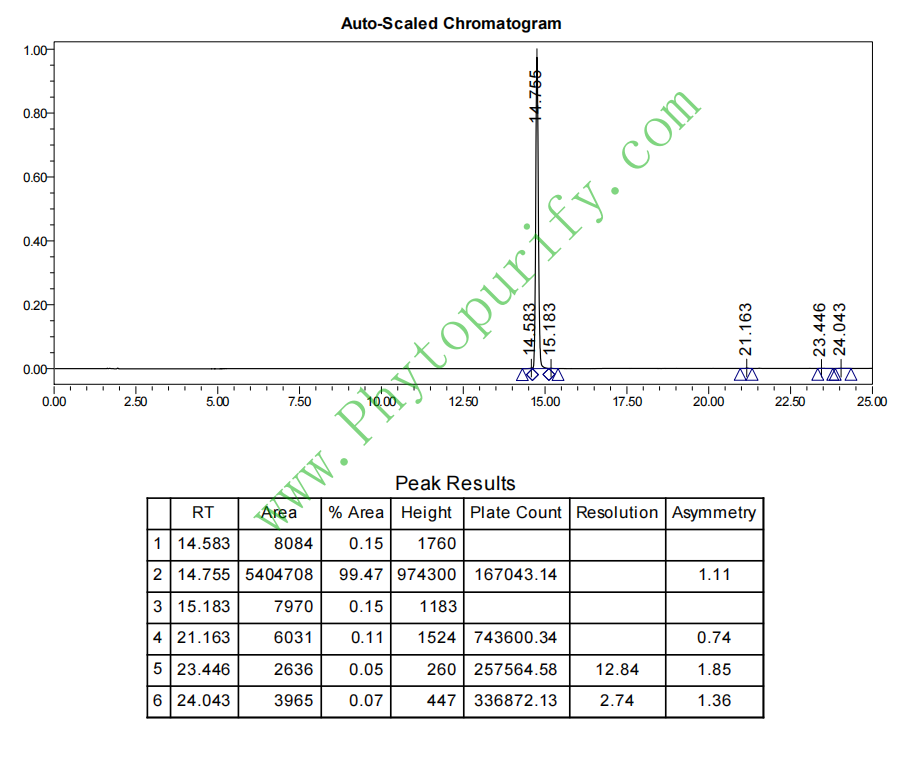
HPLC of Silychristin
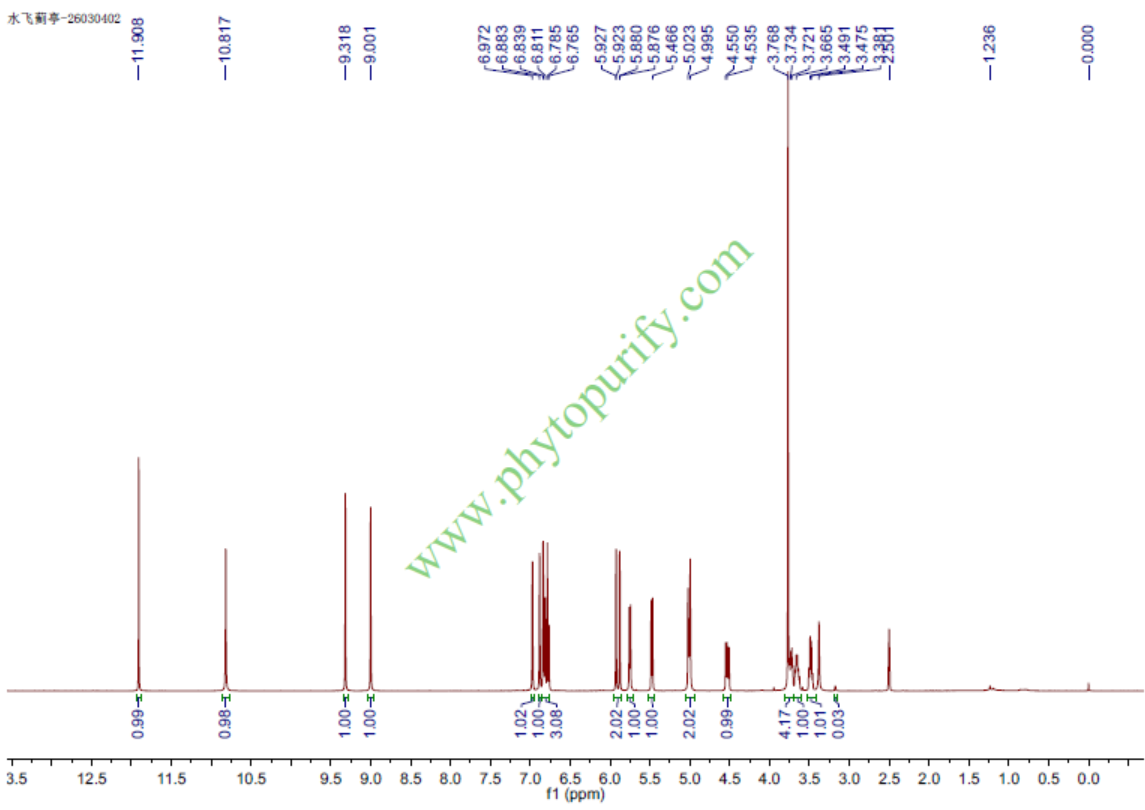
HNMR of Silychristin
HNMR of Silychristin
Storage conditions:Short-term storage at 2~8℃, long-term storage at -20 ~ -80℃
Silychristin, as one of the important flavonoids in the fruit of Silybum marianum, has attracted widespread attention in the field of natural product pharmacology in recent years. Silymarin not only has significant antioxidant activity, but has also been found to be an effective inhibitor of thyroid hormone transporter MCT8 (Monocarboxylate Transporter 8), which can strongly inhibit the uptake of triiodothyronine (T3), demonstrating potential biological functions and clinical application value. This article provides a systematic review of the chemical structure and physicochemical properties, plant sources and extraction methods, pharmacological activity, mechanism of action, pharmacological evaluation, and clinical application prospects of Silymarin, aiming to provide theoretical basis and reference for subsequent basic research and drug development.
The molecular formula of Silymarin is C25H22O10, with a molecular weight of 482.4410, and it belongs to the class of flavonolignan compounds. Its chemical structure contains a typical flavonoid skeleton, supplemented by multiple hydroxyl and methoxy substituents, endowing it with excellent antioxidant properties. The topological polar surface area (TPSA) of Silymarin is 166.14 Å ², indicating that its molecules have strong polarity, which facilitates the formation of hydrogen bonds and polar interactions with biomolecules. The LogP value is 1.692, indicating that it has moderate lipid solubility, which is conducive to membrane penetration but not excessively hydrophobic. The water solubility is 0.3492, indicating limited solubility in water, but sufficient to support distribution and absorption within living organisms. Its blood-brain barrier permeability is low, indicating limited distribution of silymarin in the central nervous system. In addition, Silymarin does not exhibit hERG channel inhibitory activity, and its Ames mutagenicity test is negative, indicating its high safety and good pharmacological basis.
Silymarin is mainly found in the fruit of Silymarin, a traditional herb widely distributed in the Mediterranean region and multiple temperate regions around the world. The fruit of Silymarin contains various flavonoids and flavones, among which Silymarin is one of the components with high content and significant biological activity.
The extraction of Silymarin is usually carried out using organic solvent extraction method, with commonly used solvents including ethanol, methanol, and their aqueous solutions. The extraction process generally includes the following steps: first, the dried milk thistle fruit is crushed, and then refluxed with a certain proportion of ethanol water solution for extraction. After concentration, separation, and purification of the extraction solution, the components are identified and purity is detected by high performance liquid chromatography (HPLC) and other techniques. In recent years, ultrasound assisted extraction and supercritical fluid extraction techniques have also been applied to improve the extraction efficiency and purity of Silymarin. In addition, countercurrent chromatography and column chromatography techniques are commonly used for the separation and purification of Silymarin to ensure its structural integrity and biological activity.
Silymarin, as a typical flavonoid compound, exhibits strong antioxidant activity. Its multi hydroxyl structure can effectively eliminate free radicals and alleviate oxidative stress damage to cells. In vitro experiments have shown that Silymarin can significantly increase the activity of antioxidant enzymes such as superoxide dismutase (SOD), catalase (CAT), and glutathione peroxidase 1 (GPX1), reduce the generation of lipid peroxidation products, and protect cell membranes and DNA from oxidative damage.
The research on Silymarin in the field of liver protection is particularly prominent. It exerts anti-inflammatory, anti fibrotic, and antioxidant effects by regulating various molecular targets associated with liver injury, such as matrix metalloproteinase 9 (MMP9), ribulose-5-phosphate dehydrogenase (NQO1), nuclear factor erythroid 2-related factor 2 (NRF2), heme oxygenase 1 (HMOX1), etc. Animal model studies have shown that silymarin can alleviate liver cell damage induced by alcohol, drugs, or toxins, reduce the degree of liver fibrosis, and promote liver tissue repair.
In recent years, silymarin has been found to be an effective inhibitor of thyroid hormone transporter MCT8. MCT8 is an important transporter of thyroid hormone T3, regulating its entry into cells. Silymarin strongly inhibits T3 uptake at a concentration of approximately 110 nM IC50, indicating its potential regulatory role in regulating the thyroid hormone signaling pathway. This discovery provides new ideas and targets for studying thyroid dysfunction and related diseases.
The biological activity of Silymarin is based on its ability to regulate various molecular targets, mainly involving the regulation of antioxidant, anti-inflammatory, and signal transduction pathways.
Antioxidant related targets
Silymarin enhances the antioxidant defense ability of cells by activating the NRF2 signaling pathway, promoting the expression of downstream antioxidant enzymes such as NQO1, SOD1, SOD2, CAT, and GPX1. Meanwhile, Silymarin can induce HMOX1 expression, exert cellular protective effects, and alleviate oxidative stress-induced damage.
Liver fibrosis related targets
Silymarin inhibits the activity of MMP9 and transforming growth factor beta 1 (TGFB1), blocks excessive deposition of extracellular matrix and activation of hepatic stellate cells during liver fibrosis, and alleviates the progression of liver fibrosis. In addition, the regulation of actin alpha 2 (ACTA2) expression by silymarin helps to inhibit the contraction and migration of fibrosis related cells.
Thyroid hormone transport inhibition
Silymarin, as an inhibitor of MCT8, blocks the cellular uptake of T3 and may affect the intracellular signaling and metabolism of thyroid hormones. This mechanism of action provides a potential pharmacological basis for the treatment of certain thyroid hormone related diseases such as MCT8 deficiency.
Silymarin has good medicinal properties. Its molecular weight is moderate (482.44 Da), with a LogP value of 1.692, which meets the requirements of Lipinski rule for lipid solubility and molecular size, and is conducive to oral absorption. A high TPSA (166.14 Å ²) suggests strong polarity, which may limit its passive diffusion but is beneficial for binding to target proteins. The low water solubility of Silymarin (0.3492) suggests that appropriate formulation strategies may be needed in vivo to improve bioavailability.
Low blood-brain barrier permeability reduces the risk of central nervous system side effects. The hERG channel inhibition experiment was negative, reducing the potential risk of cardiac toxicity. The Ames test showed no mutagenicity, indicating a low risk of genetic toxicity.
At present, there is limited pharmacokinetic data on Silymarin. Preliminary studies have shown that it is metabolically stable in vivo and mainly undergoes biotransformation through liver metabolic enzymes. In the future, systematic in vivo pharmacokinetic and toxicological studies are needed to clarify its absorption, distribution, metabolism, and excretion (ADME) characteristics, providing a basis for clinical development.
As a natural product, Silymarin has shown great potential for clinical applications due to its multi-target and multi mechanism pharmacological activities. Its application in the field of liver protection is particularly prominent, and it is expected to become an auxiliary or dominant drug for the treatment of hepatitis, liver fibrosis, and liver injury in the future. Based on its antioxidant and anti-inflammatory effects, Silymarin may also play a protective role in cardiovascular disease, metabolic syndrome, and neurodegenerative diseases.
In addition, the inhibitory effect of Silymarin on thyroid hormone transporter MCT8 provides a new therapeutic target for thyroid hormone related diseases such as MCT8 deficiency (Allan Herndon Dudley syndrome). In the future, through structural optimization and drug design, Silymarin and its derivatives are expected to develop innovative drugs targeting thyroid hormone metabolism abnormalities.
However, the clinical translation of Silymarin still faces many challenges, including its bioavailability, in vivo stability, and safety evaluation. Systematic preclinical and clinical studies are needed to clarify its pharmacological, pharmacokinetic, and toxicological characteristics, optimize dosing regimens, and design dosage forms.
As an important flavonoid active ingredient in Silymarin, Silymarin exhibits multiple pharmacological activities and good medicinal properties due to its significant antioxidant, hepatoprotective, and thyroid hormone transport inhibitory effects. Its mechanism of action involves multiple signaling pathways and molecular targets, and has potential clinical application value. In the future, through in-depth mechanism research and clinical validation, silymarin is expected to become an important candidate molecule in the development of natural product drugs, providing new strategies and means for the treatment of related diseases.
