


Product name: Rehmannioside D
Synonym name:
Catalogue No.: BP1202
Cas No.: 81720-08-3
Formula: C27H42O20
Mol Weight: 686.613
Botanical Source: Rehmanniae Radix
Physical Description:
Type of Compound: Iridoids
Purity: 95%~99%
Analysis Method: HPLC-DAD or/and HPLC-ELSD
Identification Method: Mass, NMR
Packing: Brown vial or HDPE plastic bottle
Storage: Store in a well closed container, protected from air and light. Put into refrigerate or freeze for long term storage.
Whenever possible, you should prepare and use solutions on the same day. However, if you need to make up stock solutions in advance, we recommend that you store the solution as aliquots in tightly sealed vials at -20℃. Generally, these will be useable for up to two weeks.
The product could be supplied from milligrams to grams
Inquire for bulk scale.
Chengdu Biopurify Phytochemicals Ltd. is a leading company in the research, development, manufacture and marketing of High Quality Phytochemicals and Extracts(especially Active Ingredients from Traditional Chinese Medicine,TCM), Natural Active Pharmaceutical Ingredients worldwide.
The main services:
A. Supply active ingredients and reference standards of TCM, from mgs to kgs scale
B. Custom extraction and purification, target Herb Active Ingredients
C. Custom synthesis and semi-synthesis for Natural Active Ingredients
D. CR(contract research), CM(contract manufacture) and PD(process development) services from lab scale, pilot scale to commercial scale(GMP is also available)
E. TCM compounds library for drug screen,more than 3000 compounds available, many of them are rare and unique.
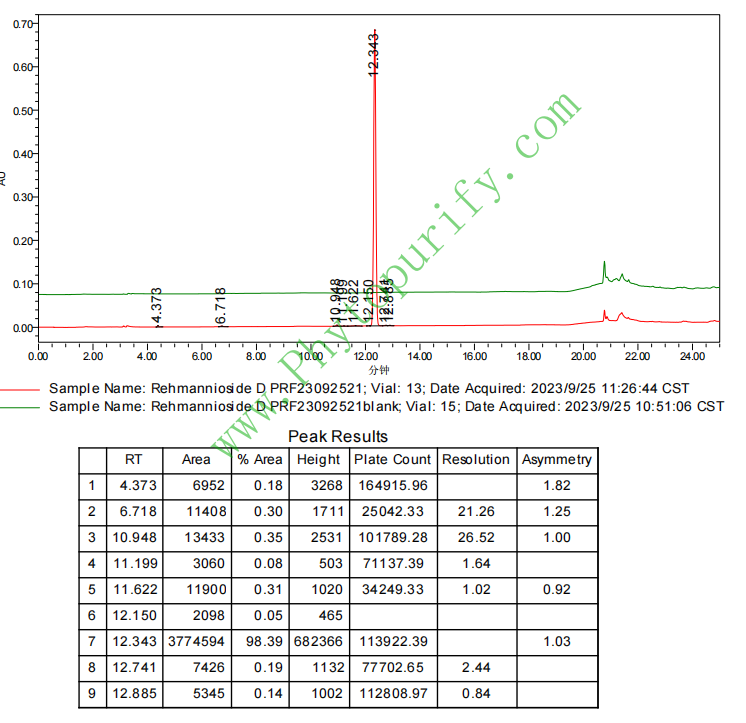
HPLC of Rehmannioside D
Storage conditions:Short-term storage at 2~8℃, long-term storage at -20 ~ -80℃
327.6000
-3.0804
-3.0810
40.2162
.4282
.3360
Low
36.8693
5.8421
Yes
No
No
No
No
No
0.0
Yes
Yes
Yes
Yes
In the treasure trove of traditional Chinese medicine, Rehmannia glutinosa(Rehmannia glutinosa Libosch, as one of the "Four Great Huai Medicines", has a long history of medicinal use and is commonly used for clearing heat, cooling blood, nourishing yin, and generating fluids. Its pharmacological activity is extensive, especially showing great potential in cardiovascular, neurological, and immune system diseases. With the advancement of modern separation and identification techniques, numerous chemical components in Rehmannia glutinosa have been elucidated, among which iridoid glycosides and carotenoid glycosides are the two main active ingredients. Rehmannianoside D, as a unique carotenoid glycoside, has gradually emerged from the numerous components of Rehmannia glutinosa in recent years and become a research hotspot. Its CAS number is 81720-08-3, mainly isolated from Rehmannia root. Preliminary studies have shown that digoxin D has significant antioxidant activity, which lays a theoretical foundation for its prevention and treatment of oxidative stress-related diseases, especially cardiovascular diseases. This article aims to systematically review the chemical structure, plant origin, pharmacological activity, mechanism of action, medicinal properties, and clinical application prospects of Dihuang glycoside D, in order to provide comprehensive scientific references for the in-depth research and development of this natural product.
Dihuang glycoside D is a type of carotenoid glycoside compound. Its molecular formula is C ∝₀ H ₄₆ O ₁₉, and its molecular weight is 686.6130. Structurally, it is composed of a carotenoid glycoside linked to multiple glycosides. Carotenoids themselves are potent natural antioxidants, and glycosylation significantly alters their hydrophilic and lipophilic balance, thereby affecting their bioavailability and biological activity.
The key physicochemical property parameters are as follows:
* Lipid water partition coefficient (LogP)-3.0804. This value is negative and has a large absolute value, indicating that digoxin D has a high degree of hydrophilicity and is distributed very little in the lipid phase. This is mainly attributed to the polyhydroxy sugar groups connected in its molecular structure.
* Topological Polarity Surface Area (TPSA): 327.6000 Å ². The extremely high TPSA value further confirms the presence of a large number of polar regions (such as hydroxyl groups) on its molecular surface, which is the structural basis of its strong hydrophilicity.
* Water solubility:40.2162 mg/L。 Good water solubility is beneficial for its dissolution and transport in aqueous media such as body fluids.
* Blood-brain barrier permeability Predicted as low. Due to its extremely high polarity and molecular weight, digoxin D has a weak ability to passively cross the blood-brain barrier, and its direct action in the central nervous system may be limited or dependent on specific transporters.
* HERG inhibition Predicted as no. This indicates that at conventional doses, the risk of cardiac toxicity such as QT interval prolongation and apical torsion ventricular tachycardia caused by digoxin D is low, providing preliminary support for its cardiovascular safety.
* Ames test The predicted value is 0.0, indicating that it may not have direct genetic toxicity and has good safety.
In summary, Dihuang glycoside D is a highly polar, water-soluble, and high molecular weight glycoside compound. Its physicochemical properties determine that its pharmacokinetic behavior may be characterized by a small distribution volume and difficulty in penetrating biofilms.
Dihuang glycoside D is mainly derived from the plant Dihuang in the family Scrophulariaceae(Rehmannia glutinosa)Dry root tubers. Rehmannia glutinosa is divided into fresh Rehmannia glutinosa, raw Rehmannia glutinosa, and cooked Rehmannia glutinosa according to different processing methods, among which raw Rehmannia glutinosa and cooked Rehmannia glutinosa are its main medicinal forms. Research has shown that the content of Dihuang glycoside D is relatively low in Dihuang root and belongs to trace components. Its content is significantly affected by the place of origin, cultivation variety, harvest season, and processing methods.
At present, the extraction and separation of D-glucoside from Rehmannia glutinosa mainly follow the following process:
1. Extract Solvent extraction method is usually used. Due to the strong hydrophilicity of Dihuang glycoside D, water, methanol or ethanol aqueous solutions of different concentrations are commonly used as extraction solvents. Ultrasound assisted extraction and heating reflux extraction are commonly used techniques to improve extraction efficiency.
2. Enrichment and Coarse Separation After the extraction solution is concentrated under reduced pressure, the resulting extract is often subjected to gradient extraction using organic solvents such as petroleum ether, ethyl acetate, and n-butanol in sequence. Dihuang glycoside D is mainly enriched in the n-butanol extraction site and aqueous layer due to its strong polarity.
3. Separation and purification Further chromatographic separation of the parts rich in digoxin D is the key to obtaining pure products. Macroporous adsorption resin column chromatography (such as D101, AB-8) is often used for preliminary decolorization and impurity removal, and then repeated separation is performed by silica gel column chromatography, reverse phase silica gel column chromatography (such as ODS-C18), dextran gel column chromatography (such as Sephadex LH-20), etc. Ultimately, high-performance liquid chromatography (HPLC), especially preparative HPLC, is the most effective means of obtaining high-purity digoxin D monomers. Its identification mainly relies on spectroscopic techniques such as mass spectrometry (MS) and nuclear magnetic resonance (NMR, including ¹ H-NMR and ¹ ³ C-NMR).
In the future, developing efficient and environmentally friendly extraction and separation processes, such as high-speed countercurrent chromatography technology, is of great significance for achieving large-scale preparation of D-glucoside.
A large number of in vitro and in vivo studies have revealed the multifaceted pharmacological activities of Rehmannia glutinosa D. Its core revolves around antioxidant activity and extends to multiple fields such as cardiovascular protection.
antioxidant activity This is the most basic and clear activity of Dihuang glycoside D. In chemical systems, it can effectively scavenge DPPH radicals, ABTS ⁺ radicals, and superoxide anions, demonstrating strong free radical scavenging ability. In cell models, digoxin D can significantly alleviate oxidative stress induced by hydrogen peroxide (H ₂ O ₂), high glucose, or other stimuli, reduce intracellular reactive oxygen species levels, increase the activity of endogenous antioxidant enzymes such as superoxide dismutase, catalase, glutathione peroxidase, etc., and protect cells from oxidative damage.
Cardiovascular protective effect:
Other potential activities Based on its antioxidant properties, rehmannin D also shows potential research value in diabetes complications (such as diabetes nephropathy, retinopathy), neurodegenerative diseases and liver protection, but there are relatively few relevant reports, which need further exploration.
The cardiovascular protective effect of Dihuang glycoside D is not achieved through a single pathway, but through a complex network of target systems, whose core mechanism is closely related to antioxidant stress and involves multiple key signaling pathways and molecular targets.
Core pathway: Nrf2/ARE antioxidant pathway Nuclear factor E2 related factor 2 (Nrf2) is the overall switch for cellular antioxidant defense. Under oxidative stress, digoxin D may promote the translocation of Nrf2 from the cytoplasm to the nucleus, binding to antioxidant response elements, thereby initiating the transcriptional expression of a series of downstream phase II detoxifying enzymes and antioxidant proteins (such as HO-1, NQO1), which is one of the core molecular mechanisms for its cell protective effect.
Key molecular target analysis:
In summary, Dihuang glycoside D forms the "network pharmacology" basis for its cardiovascular protection through multi-target and multi pathway synergistic effects.
Although the pharmacological activity of Dihuang glycoside D is clear, its drug like properties face certain challenges, mainly due to its unique physicochemical properties.
Improvement strategy To improve its medicinal properties, the following strategies can be considered: ① Prodrug design Esterification and other modifications are carried out on the hydroxyl groups on the sugar group to temporarily increase lipid solubility, improve absorption, and then hydrolyze into the active form in vivo. ② New drug delivery system Develop delivery systems such as liposomes, nanoparticles, and self microemulsions to encapsulate digoxin D and enhance its membrane permeability and stability. ③ Simplification and Modification of Structure Simplify or modify the sugar chain while retaining the pharmacophore, and search for derivatives with similar activity but better drug properties.
At present, there is a severe lack of pharmacokinetic research data on the D-system of Rehmannia glutinosa, which is a key direction for future research.
The research and application prospects of Dihuang glycoside D are broad, but also full of challenges.
Dihuang glycoside D, as a representative carotenoid glycoside in Rehmannia glutinosa, is based on its significant antioxidant activity and exhibits clear cardiovascular protective potential by acting on multiple cardiovascular related targets such as NOS3, ICAM1, PPARG, AKT1, etc. Its natural source and predicted good safety add advantages to its application. However, the oral absorption and bioavailability challenges posed by its highly hydrophilic physicochemical properties are the key bottlenecks restricting its conversion into drugs. Future research needs to clarify its precise molecular mechanism, improve its pharmacokinetics and safety evaluation system, and actively use modern pharmaceutical and medicinal chemistry methods to improve its drug properties. With the deepening of interdisciplinary research, Dihuang glycoside D is expected to develop from an active ingredient in traditional Chinese medicine into an innovative drug or high-performance health product for the prevention and treatment of oxidative stress-related cardiovascular diseases, achieving a leap from traditional wisdom to modern medical applications.
