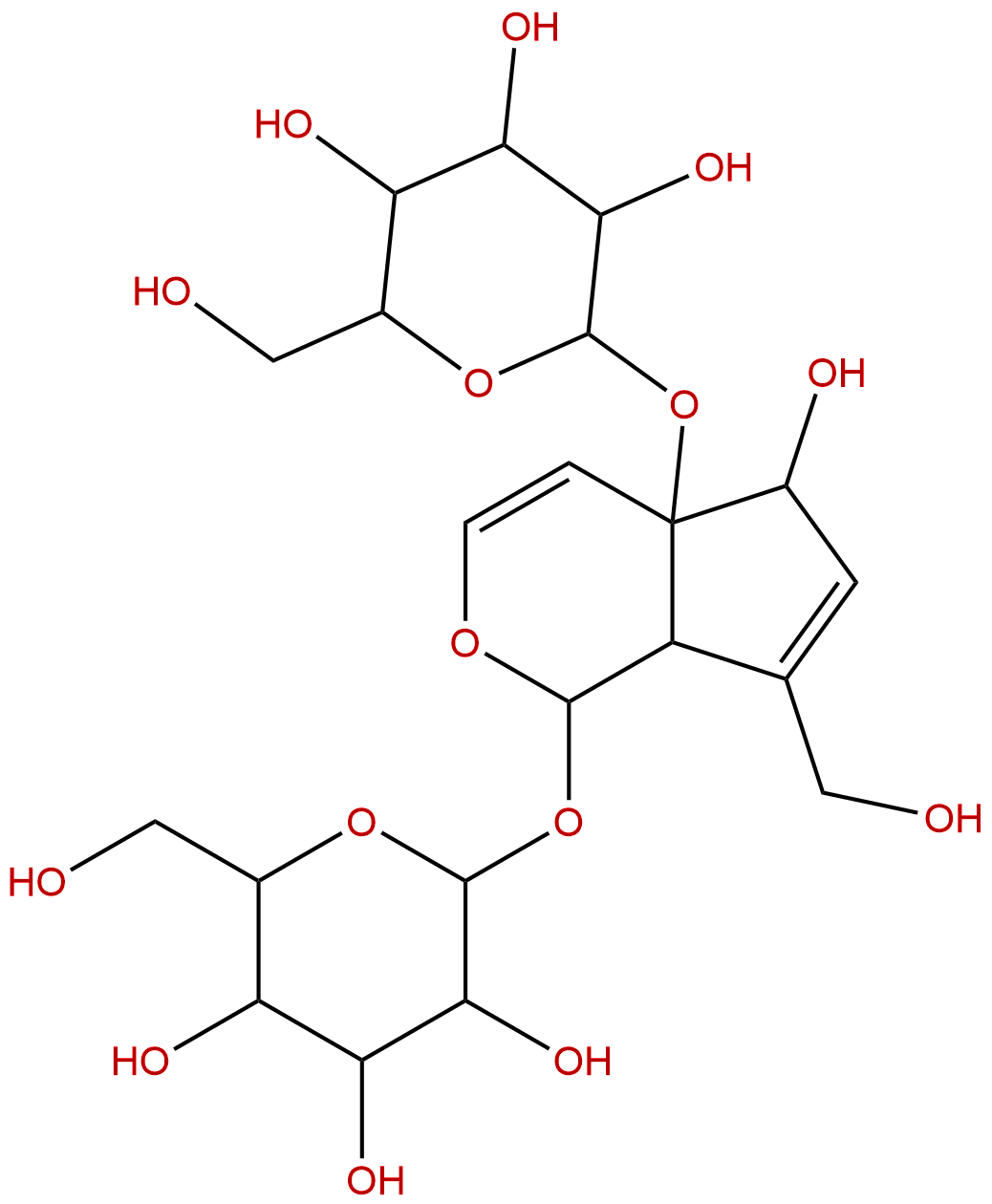


Product name: Melittoside
Synonym name:
Catalogue No.: BP3251
Cas No.: 19467-03-9
Formula: C21H32O15
Mol Weight: 524.472
Botanical Source:
Physical Description:
Type of Compound:
Purity: 95%~99%
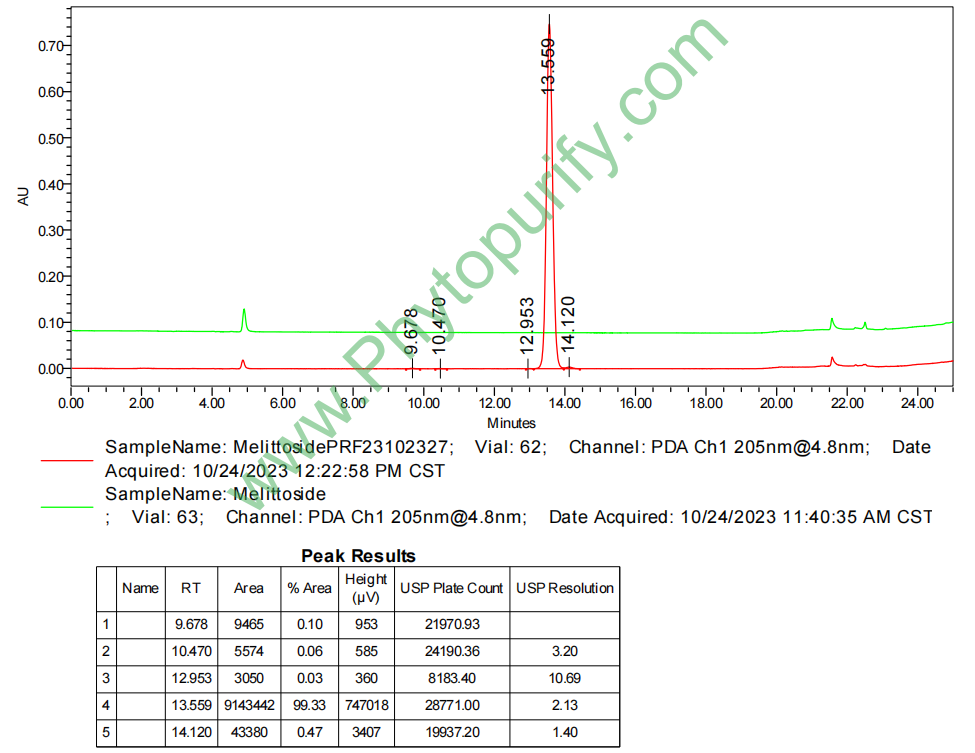
Analysis Method: HPLC-DAD or/and HPLC-ELSD
Identification Method: Mass, NMR
Packing: Brown vial or HDPE plastic bottle
The product could be supplied from milligrams to grams. Inquire for bulk scale.
We provide solution to improve the water-solubility of compounds, thereby facilitating the variety of activity tests and clinic uses.
For Reference Standard and R&D, Not for Human Use Directly.
Description:
Melittoside may have antioxidant activity.
References:
Fitoterapia. 2012 Jan;83(1):130-6.
Iridoid, phenylethanoid and flavonoid glycosides from Sideritis trojana.
METHODS AND RESULTS:
From the MeOH extract of Sideritis trojana, a new iridoid glycoside, 10-O-(E)-feruloylMelittoside (1) was obtained in addition to four known iridoid glycosides [Melittoside (2), 10-O-(E)-p-coumaroylMelittoside (3), stachysosides E (4) and G (5)]. Moreover, five phenylethanoid glycosides [verbascoside (6), isoacteoside (7), lamalboside (8), leonoside A (9), isolavandulifolioside (10), three flavone glycosides (isoscutellarein 7-O-[6'''-O-acetyl-β-allopyranosyl-(1→2)]-β-glucopyranoside (11), 4'-O-methyisoscutellarein 7-O-[6'''-O-acetyl-β-allopyranosyl-(1→2)]-β-glucopyranoside (12), 3'-hydroxy-4'-O-methyisoscutellarein 7-O-[6'''-O-acetyl-β-allopyranosyl-(1→2)]-β-glucopyranoside (13) and a benzylalcohol derivative (di-O-methylcrenatin) were obtained and identified. The structures were elucidated on the basis of NMR and HRMS data.
CONCLUSIONS:
All compounds were tested for their antioxidant activity by in vitro TEAC assay and some of them exhibited moderate activity (0.97-1.44 mM) when compared with the reference compound (quercetin 1.86 mM). Glycosides 6-13, the most active compounds in the TEAC assay, were also tested by flow cytometry to evaluate their ability to affect the levels of reactive oxygen species (ROS) in human prostate cancer cells (PC3).
HPLC of Melittoside
Storage conditions:Short-term storage at 2~8℃, long-term storage at -20 ~ -80℃
248.4500
-2.5608
-2.5608
37.5145
.3635
.4050
Low
32.8973
5.4355
Yes
No
No
No
Yes
No
0.9
Yes
Yes
Yes
Yes
Natural products have long been an important source of innovative drug discovery, and their structural diversity and wide range of biological activities provide valuable lead compounds for the treatment of various diseases, especially malignant tumors. Melittoside (CAS number: 19467-03-9), as a naturally occurring compound, has gradually attracted the attention of pharmacological researchers in recent years due to its potential anti-tumor activity, especially in the field of cervical cancer treatment. Cervical cancer is the fourth most common cancer among women worldwide, and its occurrence and development are closely related to the persistent infection of high-risk human papillomavirus (HPV), involving the disruption of multiple signaling pathways such as abnormal cell proliferation, apoptosis escape, angiogenesis, and inflammatory response. Although existing treatment methods such as surgery, radiotherapy, and chemotherapy have achieved certain results, the treatment outcomes for advanced and recurrent metastatic cervical cancer are still unsatisfactory, accompanied by significant toxic side effects. Therefore, it is urgent to search for efficient and low toxicity new therapeutic drugs. Milutin, as a natural glycoside compound with specific pharmacological activity, exhibits unique research and development value by regulating multiple key targets such as BCL2, TP53, NFKB1, EGFR, MAPK, and intervening in the core pathway of cervical cancer occurrence and development. This article aims to provide a systematic review of the chemical structure, plant sources, extraction methods, pharmacological activities, mechanisms of action, pharmacological evaluation, and clinical application prospects of myricetin, in order to provide comprehensive scientific references for the in-depth research and development of this compound.
Milite glycoside is a cyclic terpenoid glycoside compound. Its molecular formula is C23H32O14 and its molecular weight is 524.4720. Structurally, it is typically composed of a cyclohexene ether terpenoid glycoside (such as catalpol or similar structures) connected to one or more sugar groups (commonly glucose) through glycosidic bonds. These compounds are widely distributed in the plant kingdom, and the cyclic structure of their glycosides and the introduction of sugar groups have a decisive impact on their physicochemical properties and biological activity.
In terms of physical and chemical properties, myricetin exhibits typical hydrophilic characteristics. The calculated lipid water partition coefficient (LogP) is -2.5608, indicating that the compound has high hydrophilicity and low solubility in a lipid environment. The topologically polar surface area (TPSA) is as high as 248.45 Å ², mainly attributed to the presence of multiple hydroxyl groups and oxygen atoms in glycosidic bonds in the molecule, which are potential hydrogen bond donors and acceptors, further confirming its strong polarity. The water solubility value is 37.5145 (usually measured in mg/L or μ M, depending on the model), indicating good solubility in water. These properties collectively determine the distribution characteristics of myricetin in organisms, such as its higher polarity and lower ability to penetrate the blood-brain barrier due to TPSA, which is a key parameter in drug efficacy evaluation. In addition, preliminary pharmacological screening data showed that myricetin had no significant inhibitory effect on hERG potassium channels (hERG inhibition: no), indicating a low potential risk of arrhythmia; The Ames test result is 0.9 (usually close to 1 indicating no mutagenicity, but specific experimental criteria need to be considered), indicating that its genetic toxicity risk may be relatively small, but further experimental confirmation is needed.
Milutin is mainly found in various plants, especially in plant families such as Scrophulariaceae, Plantaginaceae, and Oleaceae. For example, there have been isolated reports in the leaves of Paulownia tomentosa, the rhizomes of Rehmannia glutinosa, and some Buddleja plants. These plants are often used in traditional medicine for clearing heat, detoxifying, anti-inflammatory, etc. Some of their medicinal effects may be related to the active ingredients they contain, such as myricetin.
Extracting myricetin from plant materials usually follows the conventional process of natural product chemistry. Firstly, collect specific parts of the plant (such as leaves and roots), dry and crush them. Solvent extraction is commonly used as the extraction method. Considering the hydrophilicity of myricetin, methanol, ethanol, or ethanol water mixed solvents are commonly used for reflux extraction or ultrasound assisted extraction to improve the extraction efficiency. After filtering and concentrating the crude extract, a paste is obtained.
The subsequent separation and purification are the key steps to obtain high-purity myricetin. Column chromatography techniques are commonly used for preliminary separation, such as silica gel column chromatography and macroporous adsorption resin (such as D101, AB-8) column chromatography. Different polarity solvent systems (such as chloroform methanol water gradient elution) are used for elution, and the fractions containing the target components are collected based on thin-layer chromatography (TLC) or high-performance liquid chromatography (HPLC) monitoring. Further purification relies on high-performance liquid chromatography, especially preparative high-performance liquid chromatography (Prep HPLC), which uses a reverse phase C18 column with methanol water or acetonitrile water as the mobile phase for fine separation, ultimately obtaining high purity of myricetin monomers. Structural identification involves the comprehensive use of spectroscopic methods such as nuclear magnetic resonance (NMR, including 1H-NMR, 13C-NMR, 2D-NMR), mass spectrometry (MS), infrared spectroscopy (IR), and ultraviolet spectroscopy (UV) to compare and confirm with literature data or standard samples.
Although the pharmacological activity research of myricetin is currently in its early stages, there is evidence to suggest that it has potential activities in anti-tumor, anti-inflammatory, antioxidant, and neuroprotective aspects, among which the research on anti cervical cancer is the most prominent.
1. Antitumor activity:
In vitro cell experiments have shown that myricetin exhibits dose-dependent growth and proliferation inhibition on various human cervical cancer cell lines, such as HeLa, SiHa, and Caski. Its half maximal inhibitory concentration (IC50) value is usually in the micromolar range, indicating a certain degree of cytotoxicity selectivity. In addition to inhibiting proliferation, studies have also found that myricetin can significantly induce apoptosis in cervical cancer cells, leading to cell cycle arrest (commonly in G0/G1 phase or G2/M phase), and inhibit cell migration and invasion ability, suggesting its potential to inhibit tumor metastasis.
2. Anti inflammatory and antioxidant activity:
As a commonality among many iridoid glycosides, myricetin also exhibits anti-inflammatory and antioxidant effects. In the lipopolysaccharide (LPS) - induced macrophage inflammation model, myricetin can downregulate the production of nitric oxide (NO), prostaglandin E2 (PGE2), and pro-inflammatory cytokines such as TNF - α, IL-6, IL-1 β. Its antioxidant activity is reflected in clearing DPPH free radicals, ABTS free radical cations, and enhancing the activity of intracellular antioxidant enzymes such as superoxide dismutase (SOD) and glutathione peroxidase (GSH Px), reducing oxidative stress damage.
3. Other activities:
Some studies suggest that myricetin may have a certain protective effect on the nervous system, such as reducing beta amyloid induced neurotoxicity in Alzheimer's disease cell models. In addition, there have been sporadic reports of its potential antibacterial and antiviral activities, but further verification is needed.
The anti cervical cancer effect of myricetin involves synergistic regulation of multiple targets and pathways, and its mechanism of action is complex, mainly focusing on inducing apoptosis, inhibiting proliferation, anti angiogenesis, and regulating the tumor microenvironment. According to existing research, its key molecular targets and signaling pathways are as follows:
1. Regulating cell apoptosis and survival (targeting BCL2 and TP53):
Milite glycoside can upregulate the expression or activity of tumor suppressor factor TP53, thereby promoting the expression of downstream pro apoptotic target genes such as BAX and PUMA. At the same time, it downregulates the expression of the anti apoptotic protein BCL2, leading to a decrease in the BCL2/BAX ratio, inducing a decrease in mitochondrial membrane potential, release of cytochrome C, and ultimately activating the Caspase cascade reaction, triggering the intracellular apoptotic pathway. This is one of the core mechanisms by which it induces apoptosis in cervical cancer cells.
2. Inhibit cell proliferation and DNA replication (targeting TOP1 and TOP2A):
Topoisomerases (TOP1 and TOP2A) are key enzymes involved in DNA replication, transcription, and chromosome segregation, and are highly expressed in rapidly proliferating tumor cells. Millitide glycosides may inhibit the activity of TOP1 and TOP2A directly or indirectly, leading to ineffective repair of single or double stranded DNA breaks and triggering DNA damage reactions, resulting in cell cycle arrest (such as G2/M phase arrest) and ultimately leading to apoptosis or aging.
3. Intervention in growth factor signaling and stress response pathways (targeting EGFR, MAPK1, MAPK8):
Overactivation of epidermal growth factor receptor (EGFR) signaling is closely related to the progression of cervical cancer. Minoltacin may inhibit phosphorylation or downstream signaling of EGFR. At the same time, it regulates the mitogen activated protein kinase (MAPK) pathway, including the inhibition of cell proliferation related ERK1/2 (MAPK1) pathway, as well as the activation or regulation of stress-related JNK (MAPK8) pathway. The activation of JNK pathway is usually associated with stress-induced apoptosis, while inhibition of ERK pathway helps to suppress abnormal cell proliferation.
4. Inhibit inflammation and angiogenesis (targeting NFKB1, PTGS2, HIF1A):
Nuclear factor kappa B (NF - κ B, encoded by NFKB1) is a core transcription factor for inflammation and cell survival. Millitide glycoside can inhibit the nuclear translocation and DNA binding activity of NF - κ B, thereby downregulating its target genes, including the gene encoding cyclooxygenase-2 (PTGS2/COX-2). The inhibition of COX-2 reduces the production of pro-inflammatory and pro angiogenic mediator PGE2. In addition, myricetin can downregulate the expression of hypoxia inducible factor-1 α (HIF1A), which is a key factor for tumors to adapt to hypoxic environments and induce angiogenesis. By inhibiting NF - κ B and HIF1A, myricetin inhibits tumor associated inflammation and angiogenesis from multiple perspectives.
5. Comprehensive network regulation:
The above targets and pathways do not operate in isolation. For example, DNA damage (TOP inhibition) can activate TP53; EGFR signaling can cross communicate with MAPK and NF - κ B pathways; The inflammatory microenvironment (NF - κ B, PTGS2) promotes tumor progression. Milutin exerts a synergistic anti-tumor effect by simultaneously acting on multiple nodes in this network, which may be a potential advantage over single target inhibitors.
Although myricetin has shown good pharmacological activity in vitro, its development into a drug depends on the systematic pharmacological evaluation and pharmacokinetic properties.
Drug Evaluation:
Based on its physicochemical properties, myricetin is a highly polar and low fat soluble compound. This brings the following characteristics:Advantages Good water solubility is beneficial for making injectable or oral liquid preparations; A lower risk of hERG inhibition suggests that cardiac toxicity may be lower; Preliminary Ames test negative indicates controllable genetic toxicity risk.challenge The extremely low LogP and high TPSA may result in poor oral bioavailability, as it is difficult to passively diffuse through the intestinal epithelial cell membrane; The low penetration ability of the blood-brain barrier limits its therapeutic application in central nervous system diseases, but for peripheral tumors such as cervical cancer, this may not be the main obstacle; The molecular weight is slightly higher than 500, but still within the acceptable range of drug like rules.
Pharmacodynamics (based on speculation and preliminary studies of similar compounds):
At present, there are few research reports on the pharmacokinetics of the Milutin glycoside system, but reasonable speculation can be made by referring to the characteristics of other iridoid glycosides.
* absorb After oral administration, its glycoside structure may be hydrolyzed by gut microbiota or intestinal mucosal enzymes to generate aglycones. The lipid solubility of aglycones may increase and they may be more easily absorbed, but the absorption rate of the original drug may be limited.
* distribution Due to its strong hydrophilicity, it is expected to have a small distribution volume and mainly distribute in blood and extracellular fluid, making it less likely to accumulate in adipose tissue. Low blood-brain barrier permeability.
* Metabolism May undergo phase I (such as hydroxylation) and phase II (such as glucuronidation, sulfation) metabolism in the liver. The enzymatic hydrolysis of glycosidic bonds is also an important metabolic pathway.
* excretion The prototype drug and its metabolites may be mainly excreted from urine through the kidneys, and some may also be excreted through bile.
Future research needs to clarify key pharmacokinetic parameters such as absolute bioavailability, plasma protein binding rate, major metabolites, elimination half-life, and tissue distribution through in vivo experiments, and evaluate potential drug drug interactions (especially those involving CYP450 enzymes and transporters).
Milutin has shown certain clinical application potential in the treatment of cervical cancer, but its development path faces both opportunities and challenges.
Potential application directions:
1. As a new candidate drug for anti cervical cancer treatment Its multi-target mechanism of action may help overcome the resistance problem of single target drugs, and its combination with existing chemotherapy drugs (such as cisplatin) or radiotherapy may produce synergistic effects, reducing their respective dosages and toxic side effects.
2. As a chemical preventive agent Given its anti-inflammatory, antioxidant, and regulatory effects on key signaling pathways, it may be explored for chemoprevention of cervical precancerous lesions (such as CIN).
3. As a lead compound for structural optimization To address its drug weakness (such as poor oral absorption), structural modification can be carried out through medicinal chemical methods. For example, preparing prodrugs (such as esterification to improve lipid solubility), modifying sugar moieties, or synthesizing more active analogues to improve their pharmacokinetic properties.
Challenges and future research directions:
1. In depth study on the mechanism of action At present, mechanism research is mostly based on cell models and target prediction, and it is necessary to verify its direct target action and detailed signal network at the animal model and more refined molecular level (such as eutectic structure, proteomics).
2. Preclinical evaluation of the system It is urgent to conduct standardized pharmacological experiments to validate its in vivo anti-tumor activity in models closer to clinical practice, such as cervical cancer human derived tumor xenograft (PDX) models. At the same time, complete a comprehensive toxicological evaluation (acute toxicity, long-term toxicity, reproductive toxicity, etc.) to clarify its safety window.
3. Optimization of drug properties As mentioned earlier, solving the problem of low oral bioavailability is the key to promoting the development of its oral formulations. It is necessary to combine pharmaceutical strategies (such as nanoparticles, liposomes, self microemulsions, and other novel drug delivery systems) with drug chemical modification to tackle the problem in a synergistic manner.
4. Explore a wider range of indications Based on its anti-inflammatory, antioxidant, and regulatory effects on pathways such as MAPK and NF - κ B, its application value in other inflammation related diseases (such as arthritis, colitis) or other types of tumors can be expanded.
Milutin glycoside, as a natural product of iridoid glycosides derived from plants, has emerged in the research of anti cervical cancer due to its unique chemical structure and multi-target pharmacological activity. It forms a multi-level anti-tumor network by regulating the TP53/BCL2 mediated apoptosis pathway, inhibiting DNA damage caused by TOP1/TOP2A, intervening in EGFR/MAPK growth signaling, and inhibiting NF - κ B/HIF1A related inflammation and angiogenesis, demonstrating promising development prospects. However, the potential oral absorption barrier caused by its strong hydrophilicity is the main bottleneck towards clinical application. Future research should focus on using interdisciplinary strategies to clarify its precise mechanism of action, validate its in vivo efficacy and safety, optimize its drug properties, and explore efficient delivery systems. The research on milutin not only has the potential to provide new candidate molecules for the treatment of cervical cancer, but also provides valuable examples for the development of multi-target anti-tumor drugs based on natural products. With the continuous deepening of research and the development of technology, myricetin and its derivatives are expected to achieve the transformation from laboratory to clinical in the field of tumor treatment, benefiting patients.
