


Product name: Rehmannioside A
Synonym name:
Catalogue No.: BP1201
Cas No.: 81720-05-0
Formula: C21H32O15
Mol Weight: 524.472
Botanical Source: Rehmanniae Radix
Physical Description:
Type of Compound: Iridoids
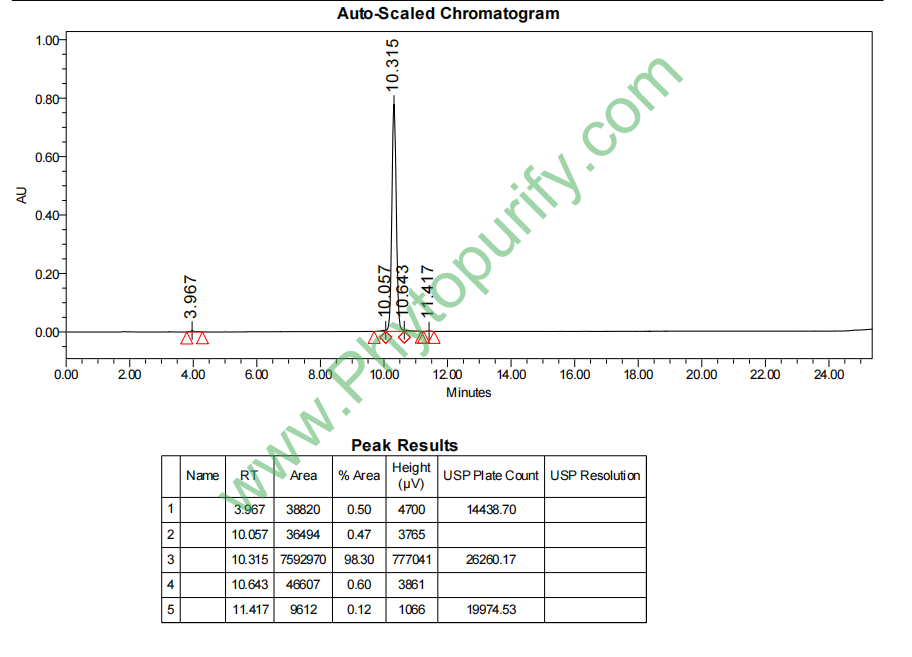
Purity: 95%~99%
Analysis Method: HPLC-DAD or/and HPLC-ELSD
Identification Method: Mass, NMR
Packing: Brown vial or HDPE plastic bottle
Storage: Store in a well closed container, protected from air and light. Put into refrigerate or freeze for long term storage.
Whenever possible, you should prepare and use solutions on the same day. However, if you need to make up stock solutions in advance, we recommend that you store the solution as aliquots in tightly sealed vials at -20℃. Generally, these will be useable for up to two weeks.
The product could be supplied from milligrams to grams
Inquire for bulk scale.
Chengdu Biopurify Phytochemicals Ltd. is a leading company in the research, development, manufacture and marketing of High Quality Phytochemicals and Extracts(especially Active Ingredients from Traditional Chinese Medicine,TCM), Natural Active Pharmaceutical Ingredients worldwide.
The main services:
A. Supply active ingredients and reference standards of TCM, from mgs to kgs scale
B. Custom extraction and purification, target Herb Active Ingredients
C. Custom synthesis and semi-synthesis for Natural Active Ingredients
D. CR(contract research), CM(contract manufacture) and PD(process development) services from lab scale, pilot scale to commercial scale(GMP is also available)
E. TCM compounds library for drug screen,more than 3000 compounds available, many of them are rare and unique.
HPLC of Rehmannioside A
Storage conditions:Short-term storage at 2~8℃, long-term storage at -20 ~ -80℃
240.7500
-2.1208
-2.1214
32.1136
.4961
.1758
Low
30.9246
5.4379
Yes
No
No
No
Yes
No
0.9
Yes
Yes
Yes
Yes
In the treasure trove of traditional Chinese medicine, Rehmanniae radix, as a classic medicinal herb with a long history, is often used to clear heat, cool blood, nourish yin and produce fluids. Modern pharmacological research has revealed that its extensive biological activity, particularly in improving neurological and inflammation related diseases, is closely related to the various active ingredients it contains. Among them, Rehmannianoside A (CAS number: 81720-05-0), as a characteristic cyclic terpenoid glycoside, has received widespread attention from researchers in recent years. Research has shown that Dihuang glycoside A not only exhibits significant pharmacological activities such as anti-inflammatory, antioxidant, anti apoptotic, and anti ferroptosis, but also shows great potential in improving cognitive function and neuroprotection. Its function involves regulating multiple key targets such as B-cell lymphoma 2 (BCL2), beta amyloid precursor protein (APP), beta secretase 1 (BACE1), microtubule associated protein tau (MAPT), silencing information regulatory factor 1 (SIRT1), mitogen activated protein kinase 1 (MAPK1), acetylcholinesterase (ACHE), caspase-3 (CASP3), alpha synuclein (SNCA), and nuclear factor E2 related factor 2 (NRF2). In addition, its inhibitory activity on cytochrome P450 enzymes (CYP3A4, 2C9, 2D6) also suggests potential drug interactions. This article aims to systematically review the chemical properties, plant sources, pharmacological activities, molecular mechanisms, medicinal properties, and application prospects of Dihuang Glycoside A in the treatment of neurological diseases, in order to provide comprehensive scientific references for the in-depth research and development of this natural product.
Dihuang glycoside A is a cyclic iridoid glycoside compound, whose chemical structure is composed of an iridoid aglycone core connected to a glycosyl moiety. Specifically, its glycoside moiety is a cyclic ether terpene with a cyclopentane pyran structure, and its sugar moiety is usually linked to monosaccharides such as glucose. This structural feature is an important basis for its water solubility and biological activity.
The parameters related to its medicinal properties are as follows: the molecular weight is 524.4720, which is a medium-sized molecule. The calculated logarithmic value of the lipid water partition coefficient (LogP) is -2.1208, indicating that the compound has a high degree of hydrophilicity, which is consistent with the properties of most glycoside compounds. The topologically polar surface area (TPSA) is as high as 240.7500 Å ², further confirming the presence of a large number of polar groups (such as hydroxyl groups) on its molecular surface, which usually favors water solubility but may affect transmembrane permeability. The water solubility data is 32.1136 mg/L, confirming its good water solubility. However, its high hydrophilicity and large polar surface area also lead to a predicted "low" blood-brain barrier (BBB) permeability, posing the primary challenge for its development for the treatment of central nervous system diseases. In terms of preliminary safety evaluation, Dihuang glycoside A has no inhibitory activity on hERG potassium channels, indicating a low risk of causing QT interval prolongation in the heart; The Ames test result is 0.9 (usually considered negative if the result is less than 2 and there is no dose dependence), indicating that it has no significant genetic toxicity. These physicochemical and pharmacological parameters provide key basis for subsequent formulation design and structural optimization.
Dihuang glycoside A mainly comes from the dried root of Rehmannia glutinosa Libosch, a plant in the Scrophulariaceae family, which is commonly known as the traditional Chinese medicine "Sheng Dihuang" or "Shu Di Huang". Its content is significantly affected by the place of origin, cultivated variety, harvest season, and processing technology (such as steaming to make Rehmannia glutinosa). Generally speaking, the content of iridoid glycosides in raw Rehmannia glutinosa is relatively high, while during the processing of Rehmannia glutinosa, some glycosides may undergo hydrolysis and transformation, and the content of Rehmannia glutinosa glycoside A may change.
The extraction of digoxin A from plant materials is usually carried out using solvent extraction method. Due to its good hydrophilicity, water, methanol, ethanol, or water alcohol mixed solutions in different proportions are commonly used extraction solvents. For example, using a 70% -80% ethanol aqueous solution for heating reflux or ultrasound assisted extraction can effectively dissolve digoxin A from plant tissues. After filtration and concentration, the extract needs to be further separated and purified using column chromatography technology. Large pore adsorption resins (such as D101 and AB-8) are commonly used for initial enrichment to remove highly polar impurities such as polysaccharides and proteins. Subsequently, fine separation was performed using methods such as silica gel column chromatography, reverse phase silica gel column chromatography (such as ODS-C18), or high-performance liquid chromatography (HPLC) to obtain high-purity digoxin A monomer compounds. Modern analytical techniques such as high-performance liquid chromatography-mass spectrometry (HPLC-MS) and nuclear magnetic resonance (NMR) are key means for identifying its chemical structure. Optimizing the extraction and purification process to improve the yield and purity of Dihuang Glycoside A is the foundation for ensuring its pharmacological research and subsequent development.
A large number of in vitro and in vivo studies have confirmed that digoxin A has various pharmacological activities, especially outstanding in the fields of cardiovascular, cerebrovascular, and neurological protection.
Anti inflammatory and antioxidant activity Dihuang glycoside A can effectively inhibit the excessive production of nitric oxide (NO), prostaglandin E2 (PGE2), and pro-inflammatory cytokines (such as TNF - α, IL-1 β, IL-6) in macrophages induced by stimuli such as lipopolysaccharide (LPS). Its antioxidant effect is manifested by significantly increasing the activity of intracellular antioxidant enzymes such as superoxide dismutase (SOD) and glutathione peroxidase (GSH Px), and reducing the levels of lipid peroxidation products such as malondialdehyde (MDA). This anti-inflammatory and antioxidant synergistic effect is the core of its ability to combat the pathological basis of various diseases.
Anti apoptotic and anti ferroptotic activity Apoptosis and ferroptosis are two important forms of neuronal damage. In cell models induced by oxidative stress or toxic substances, digoxin A can upregulate the expression of anti apoptotic protein BCL2, downregulate the expression of pro apoptotic protein Bax, and inhibit the activation of CASP3, thereby blocking the apoptotic pathway. Meanwhile, recent studies have found that digoxin A also has an inhibitory effect on ferroptosis (a novel cell death driven by iron dependent lipid peroxidation), which may protect neurons from ferroptosis damage by regulating iron metabolism related proteins and glutathione system.
Neuroprotection and improvement of cognitive activity This is the most promising pharmacological effect of Dihuang Glycoside A. In Alzheimer's disease (AD) model cells or animals, digoxin A can reduce the production of β - amyloid protein (A β) (by affecting APP processing and inhibiting BACE1 activity), decrease the excessive phosphorylation of tau protein, and improve synaptic plasticity. In Parkinson's disease (PD) related models, it may alleviate neurotoxicity mediated by alpha synuclein (SNCA) aggregation. In addition, it can counteract brain damage caused by ischemia-reperfusion, reduce brain edema and infarct size, and improve neurological deficit scores. In behavioral experiments, digoxin A treatment significantly improved the learning and memory abilities of AD and vascular dementia model animals, and performed well in tests such as water maze and avoidance experiments.
Inhibition of cytochrome P450 enzyme Dihuang glycoside A exhibits moderate inhibitory activity against CYP3A4, 2C9, and 2D6 subtypes (IC50 in the range of 10-20 μ M). This characteristic suggests that there may be a risk of drug drug interactions when the local flavonoid A is used in combination with drugs metabolized by these isoenzymes (such as many commonly used clinical drugs), which needs to be closely monitored in subsequent development.
The neuroprotective effect of Dihuang Glycoside A is not achieved through a single target, but through a multi target, multi pathway network regulatory system. The core mechanism can be summarized as follows:
Regulating apoptosis and survival pathways: Through Upregulation of BCL2 Maintaining mitochondrial membrane stability, inhibiting cytochrome c release, and thereby Inhibit CASP3 The activation of digoxin A is the direct molecular pathway through which it inhibits apoptosis. Meanwhile, it may activate SIRT1 The deacetylation of SIRT1, a NAD+- dependent deacetylase, can regulate various downstream factors such as FOXO and PGC-1 α, promoting cellular stress resistance and survival.
Intervention in core pathological processes of AD Dihuang glycoside A can act on the key nodes of A β generation: on the one hand, it may affect APP The metabolic pathway, on the other hand, directly Inhibit BACE1 The activity of A β peptide reduces the production of neurotoxic A β peptide segments. Meanwhile, it may regulate the kinase/phosphatase system (such as involving MAPK1 Pathway), reduce MAPT Abnormal phosphorylation of tau protein reduces the pathological burden of neurofibrillary tangles.
Activate endogenous antioxidant defense system Dihuang glycoside A is NRF2 Effective activators of pathways. It can promote NRF2 nuclear translocation, thereby upregulating the expression of phase II detoxifying enzymes and antioxidant proteins such as heme oxygenase-1 (HO-1) and quinone oxidoreductase 1 (NQO1), which is one of its core mechanisms in combating oxidative stress and iron death.
Regulating neurotransmitters and synaptic function Research has shown that digoxin A may have Inhibit ACHE The ability to activate, thereby reducing the hydrolysis of acetylcholine and increasing the level of acetylcholine in synaptic cleft, is of great significance for improving cholinergic neurotransmission disorders in AD patients. In addition, it has an impact on MAPK1/ERK The regulation of signaling pathways is also involved in the regulation of synaptic plasticity and long-term potentiation (LTP).
Inhibition of alpha synuclein toxicity In PD related studies, digoxin A may indirectly alleviate the effects of antioxidant and anti apoptotic mechanisms SNCA Mitochondrial dysfunction and neuronal death caused by aggregation or overexpression.
In summary, Dihuang glycoside A exerts its neuroprotective effects by acting on key targets such as BCL2, NRF2, SIRT1, BACE1, ACHE, and interweaving into a complex pharmacological network.
Although Dihuang glycoside A has significant pharmacological activity, its pharmacological properties, especially pharmacokinetic properties, have obvious shortcomings, which are the key factors restricting its conversion into drugs.
Absorption and bioavailability As a glycoside compound with high hydrophilicity and large polar surface area, digoxin A has poor lipid solubility and difficult passive transmembrane absorption. After oral administration, its bioavailability may be low. The microbial enzymes in the gut may hydrolyze its glycosidic bonds and convert them into aglycones, whose properties and activities may differ from those of the prototype drug, increasing the complexity of its in vivo processes.
Distribution and blood-brain barrier As mentioned earlier, its predicted BBB permeability is low. Although neuroprotective effects have been observed in some brain injury models, suggesting the possibility of small amounts of drugs entering the brain or indirectly acting by regulating peripheral inflammation, the core challenge in developing central nervous system drugs is how to effectively deliver sufficient amounts of digoxin A into the brain. Formulation strategies (such as nanoparticles, liposomes, prodrug design) or combined use of BBB opening agents may be potential solutions.
Metabolism and excretion Dihuang glycoside A itself is an inhibitor of CYP450 enzymes, but it may also be metabolized by these enzymes. Further in vivo pharmacokinetic studies are needed to elucidate its specific metabolites, metabolic pathways, and excretion modes (renal or biliary excretion). The inhibitory properties of CYP450 are a key drug interaction risk that needs to be evaluated in clinical combination therapy.
Preliminary evaluation of safety The existing preliminary data (no hERG inhibition, negative Ames test) suggest that it has a relatively good safety basis. However, comprehensive preclinical safety evaluation, including acute toxicity, chronic toxicity, reproductive toxicity, etc., is still a necessary path for future development.
Therefore, future research needs to focus on systematic in vivo pharmacokinetic studies and actively explore novel drug delivery strategies to improve their bioavailability and brain targeting.
The multi-target neuroprotective properties of Dihuang glycoside A provide broad prospects for its application in various neurodegenerative and damaging diseases of the nervous system.
Potential indications:
Development Strategy and Challenges:
Dihuang glycoside A, as one of the key active ingredients in traditional Chinese medicine Dihuang that exerts neuroprotective effects, has become a highlight in natural product neuropharmacology research due to its comprehensive pharmacological properties of anti-inflammatory, antioxidant, anti apoptotic, anti ferroptotic, and multi-target improvement of cognitive function. Its mechanism of action involves the regulation of multiple key targets such as NRF2, BCL2, SIRT1, BACE1, ACHE, etc., forming a synergistic network. Although it currently faces challenges in terms of drug efficacy, particularly low blood-brain barrier permeability and potentially low bioavailability, this also points the way for drug chemistry and research on novel drug delivery systems. With the continuous advancement of modern pharmaceutical technology, through structural optimization, dosage form innovation, and in-depth basic research, digoxin A is expected to gradually move from a promising lead compound to clinical practice, providing new treatment strategies or drug choices for neurological diseases such as Alzheimer's disease and Parkinson's disease that have not yet met clinical needs. Continuous and in-depth research on it will not only help to reveal the modern scientific connotation of the traditional efficacy of Rehmannia glutinosa, but also promote the development process of innovative natural product drugs.
