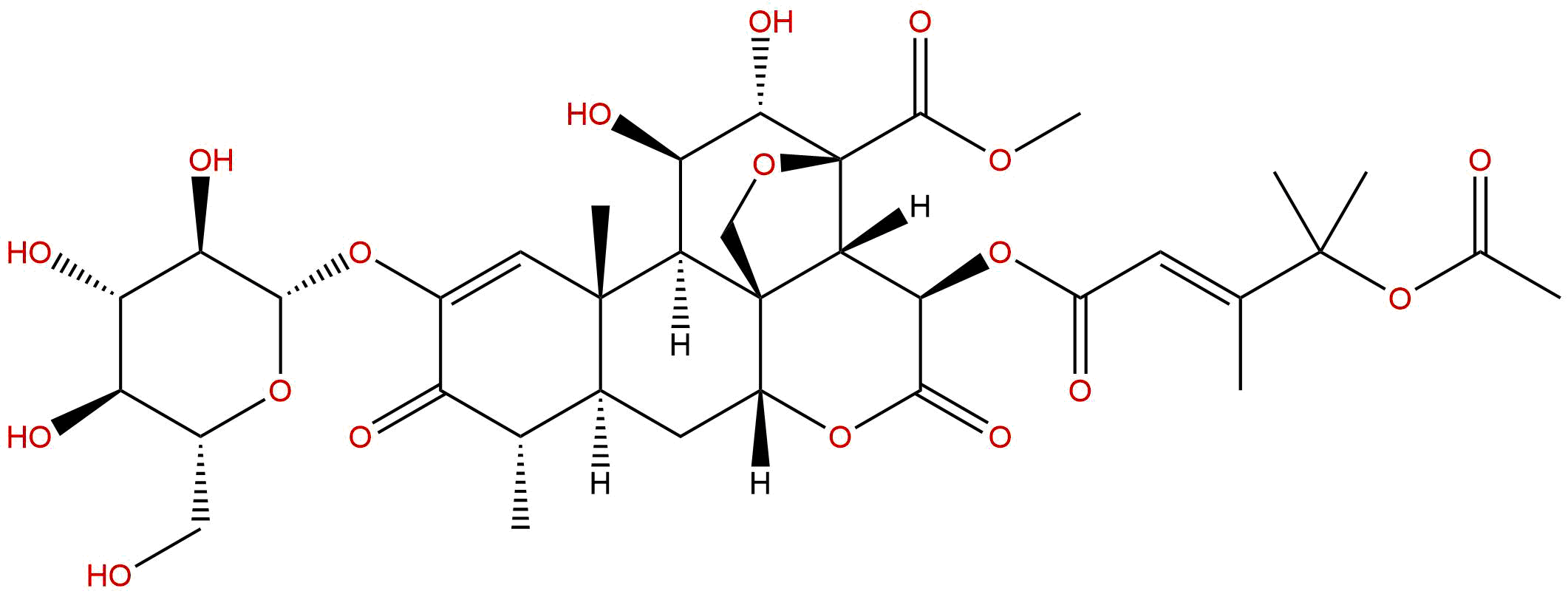


Product name: Yadanzioside G
Synonym name:
Catalogue No.: BP5356
Cas No.: 95258-17-6
Formula: C36H48O18
Mol Weight: 768.762
Botanical Source:
Type of Compound: Diterpenoids
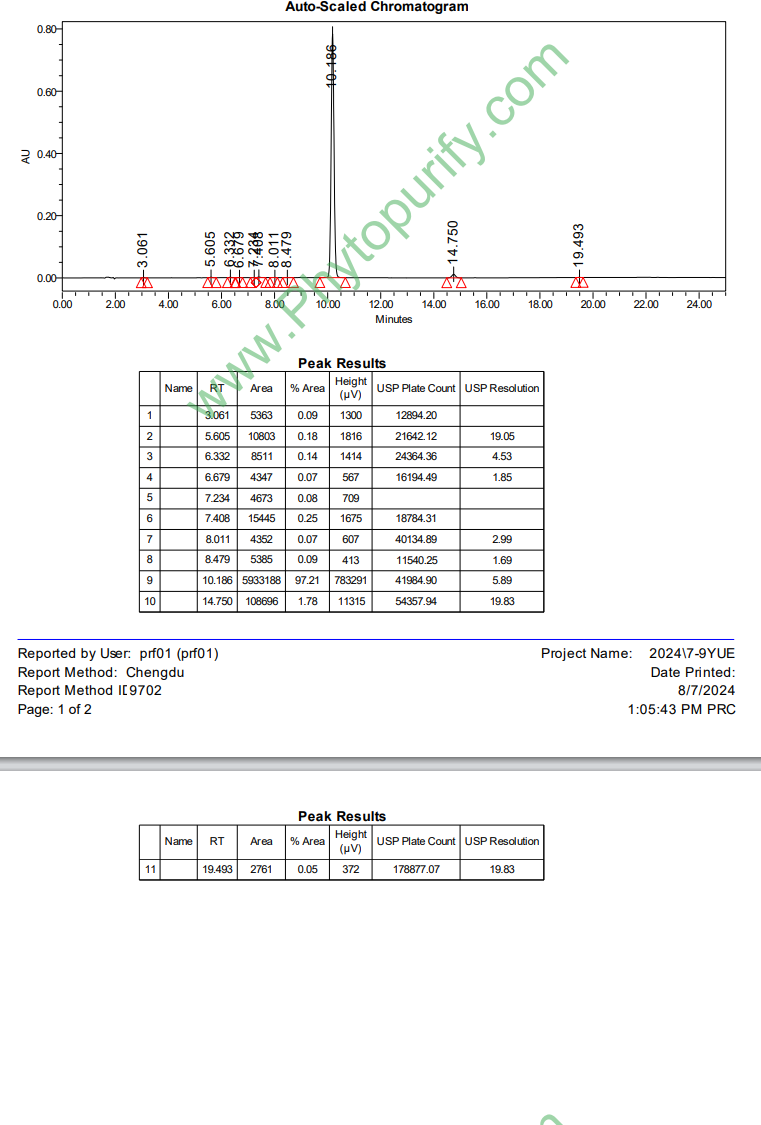
Purity: 95%~99%
Analysis Method: HPLC-DAD or/and HPLC-ELSD
Identification Method: Mass, NMR
Packing: Brown vial or HDPE plastic bottle
Storage: Store in a well closed container, protected from air and light. Put into refrigerate or freeze for long term storage.
Whenever possible, you should prepare and use solutions on the same day. However, if you need to make up stock solutions in advance, we recommend that you store the solution as aliquots in tightly sealed vials at -20℃. Generally, these will be useable for up to two weeks.
The product could be supplied from milligrams to grams
Inquire for bulk scale.
For Reference Standard and R&D, Not for Human Use Directly.
HPLC of Yadanzioside G
Storage conditions:Short-term storage at 2~8℃, long-term storage at -20 ~ -80℃
271.3400
.2308
.2307
.7116
.5413
1.0000
Low
62.9072
7.2212
Yes
No
No
No
Yes
No
0.0
Yes
Yes
Yes
Yes
Natural products, as an important source of drug discovery, play an irreplaceable role in the long history of human struggle against diseases. Especially in the field of tumor treatment, active compounds isolated from plants, such as paclitaxel, camptothecin, vinblastine, etc., have become the cornerstone of clinical chemotherapy regimens. Simaroubacheae plant, Brucea asiatica(Brucea javanica (L.) Merr.), As a traditional Chinese medicinal herb, its fruit (brucea) has a long history of application in folk medicine, mainly used to treat dysentery, malaria, warts, and certain cancers. Modern pharmacological research has confirmed that the extract of Brucea asiatica has significant biological activities such as anti-tumor, anti-inflammatory, and antiparasitic effects. Its active ingredients are mainly quassinoids, a highly oxidized triterpenoid lactone compound with unique structure and significant activity.
Yadanzioside G, as an important bitter lignin glucoside isolated from brucea, has received widespread attention for its potential anti-tumor activity since its identification. Its unique chemical structure - a complex lignin core connected to a glucose group through glycosidic bonds - endows it with physicochemical properties and biological activity spectrum that are distinct from other lignin compounds. Early research mainly focused on the anti-tumor effects of crude extracts or mixtures of Brucea Javanese, but with the advancement of separation and purification techniques, in-depth studies on single components such as Brucea Javanese Glycoside G have become possible. In recent years, a series of valuable research results have been accumulated around the anti-tumor mechanism, molecular targets, and preliminary pharmacokinetic properties of Brucea Javanese Glycoside G.
This article aims to provide a systematic review of the current research status of Brucea Javanese Glycoside G. The article will start with its chemical structure and physicochemical properties, introduce its plant origin and extraction methods, focus on its anti-tumor pharmacological activity and related molecular mechanisms, and objectively evaluate and prospect its pharmacokinetic characteristics and clinical application prospects based on its pharmacological parameters. By integrating existing literature data, this article aims to depict a complete picture of the natural product to potential drug candidates of Brucea Javanese Glycoside G, providing reference for further in-depth research and development.
Yaguzi glycoside G belongs to the class of bitter lignin compounds, and its chemical structure has typical bitter lignin skeleton characteristics. Bitter lignin compounds are a class of highly oxidized nortriterpenoid lactones, with a core skeleton typically composed of 20 carbon atoms (C20), a cis fused four ring system (A/B/C/D ring), and multiple oxygen-containing functional groups such as hydroxyl, carbonyl, internal ester, and epoxy structures. The unique feature of Yaguzi glycoside G is that its C-21 position (or corresponding position) is connected to a D-glucose group through a β - glycosidic bond, forming a glucoside. This glycosylation modification not only increases the water solubility of the molecule, but may also have a profound impact on its interaction mode with biological targets. Its molecular formula is C ∝₄ H ₄₈ O ₁₉, with an accurate molecular weight of 768.7620 Da.
From the perspective of physical and chemical properties, Brucea Javanese Glycoside G exhibits a typical coexistence of "drug like" and "non drug like" characteristics. The calculated LogP value is 0.2308, indicating that the compound has low lipid solubility and strong hydrophilicity. This characteristic is consistent with the structural features of the molecule containing multiple hydroxyl and sugar groups. The higher polar surface area (TPSA, 271.3400 Å ²) further confirms its strong polarity characteristics. The water solubility parameter is 0.7116 mg/mL, indicating that it has a certain solubility ability in water, which is a favorable factor for the development of drug formulations. However, high polarity and high molecular weight also pose challenges. Its blood-brain barrier (BBB) permeability is predicted to be low, which means that the potential of bruce acid glycoside G in the treatment of central nervous system diseases may be limited, but it may also reduce the toxic side effects of the central nervous system. In addition, the predictive model shows that it does not have hERG (human ether - à - go go related gene) potassium channel inhibitory activity (hERG inhibition: no), which reduces its risk of causing cardiac QT interval prolongation and fatal arrhythmia, and is a positive pharmacological indicator. The Ames test result is 0.0, indicating that it did not show significant mutagenicity in the bacterial recovery mutation experiment, and the preliminary safety is good.
Overall, the chemical structure of Brucea Javanese Glycoside G determines its strong hydrophilicity and high molecular weight. These properties may pose challenges for its oral absorption, but its good water solubility and preliminary safety assessment provide a basis for it as a candidate molecule for injection or local administration. The presence of glycosylation is not only a structural feature, but may also play a key role in metabolic transformation (such as deglycosylation) and targeted delivery in the body.
The main plant source of Yaguzi glycoside G is the Sapindaceae plant Yaguzi(Brucea javanica (L.) Merr.)。 This plant is mainly distributed in tropical and subtropical regions of southern China (such as Guangdong, Guangxi, Fujian, Yunnan, etc.), Southeast Asia, and India. Traditionally, dried and ripe fruits of brucea are used as medicinal herbs. In addition to the fruit, the branches, leaves, root bark, and other parts of Eucommia ulmoides also contain bitter lignin components, but the content in the fruit is usually the most abundant. The content of Yaguzi glycoside G in plants is relatively low and belongs to one of the trace components. Its accumulation may be influenced by various factors such as plant growth environment, harvesting season, and variety differences.
The extraction and purification of Yaguzi glycoside G from the fruit of Yaguzi is a complex multi-step process that typically follows the classic natural product chemical route of "extraction separation purification".
Extract Firstly, crush the dried fruit of Brucea asiatica and extract it using organic solvents. Due to the polarity of Brucea Javanese Glycoside G, commonly used extraction solvents include methanol, ethanol, or their aqueous solutions. In order to improve extraction efficiency and selectivity, different concentrations of ethanol are sometimes used for gradient extraction. Extraction methods include traditional cold soaking, hot reflux extraction, as well as more efficient ultrasound assisted extraction, microwave-assisted extraction, etc. The extract is filtered and concentrated under reduced pressure to obtain the total extract.
Preliminary separation Total extract usually contains a large amount of fat soluble impurities (such as oils, waxes) and various polar lignin compounds. Therefore, preliminary liquid-liquid extraction or macroporous adsorption resin column chromatography is required first. For example, disperse the total extract in water and extract it sequentially with solvents such as petroleum ether, ethyl acetate, and n-butanol. Due to its glycosidic structure and high polarity, Brucea Javanese Glycoside G is usually enriched in the n-butanol extraction layer. Alternatively, the aqueous solution can be loaded onto a macroporous adsorption resin (such as D101, AB-8 type) column and gradient eluted with ethanol water systems of different concentrations to remove highly polar impurities such as sugars and tannins, and to preliminarily enrich the target components.
purification After obtaining the crude extract rich in Brucella Javanese Glycoside G, multiple chromatographic techniques are required for fine purification. The most commonly used method is silica gel column chromatography, which uses solvent systems such as chloroform methanol water or dichloromethane methanol for isocratic or gradient elution. Due to the very similar polarity between Yaguzi glycoside G and other structurally similar lignin glycosides (such as Yaguzi glycoside A, B, C, D, E, F, etc.), it is often difficult to obtain high-purity products through a single silica gel column chromatography. Therefore, it is usually necessary to combine other separation methods, such as:
The yield of the entire extraction and purification process is relatively low, and only milligrams to grams of pure product can be obtained from several kilograms of dried fruit. Therefore, the development of more efficient and environmentally friendly extraction and separation technologies, as well as the exploration of obtaining bruce acid glycoside G through plant cell culture or biosynthetic pathways, are directions worth paying attention to in the future.
The pharmacological activity research of Yaguzi glycoside G mainly focuses on the field of anti-tumor, which is closely related to the traditional folk application of Yaguzi in the treatment of cancer and the known cytotoxic activity of lignin compounds. Existing research has revealed that Yaguzi glycoside G has inhibitory effects on proliferation, induces apoptosis, and suppresses migration and invasion of various types of tumor cells.
Anti tumor cell proliferation activity Multiple in vitro experiments have shown that Brucea Javanese Glycoside G exhibits significant cytotoxicity against various human tumor cell lines. These cell lines include but are not limited to: lung cancer cells (such as A549), liver cancer cells (such as HepG2, Huh7), breast cancer cells (such as MCF-7, MDA-MB-231), prostate cancer cells (such as PC-3), colon cancer cells (such as HCT-116), cervical cancer cells (such as HeLa), and leukemic cells (such as HL-60, K562). The half maximal inhibitory concentration (IC ₅₀) value is usually in the micromolar (μ M) range, and the specific value varies depending on the cell line and experimental conditions, but generally shows strong activity. It is worth noting that its toxicity to certain normal cells (such as normal liver cell L02) is relatively low, indicating that there may be some selectivity.
Inducing cell apoptosis One important mechanism by which Brucea Javanese Glycoside G inhibits tumor cell proliferation is inducing cell apoptosis. Research has confirmed that after treatment with Brucea Javanese Glycoside G, tumor cells exhibit typical morphological features of apoptosis, such as cell shrinkage, chromatin condensation, nuclear fragmentation, and the formation of apoptotic bodies. Flow cytometry analysis showed that the cell cycle was arrested in the G0/G1 or G2/M phase, accompanied by a significant hypodiploid apoptosis peak. At the molecular level, Brucea Javanese Glycoside G can upregulate the expression of pro apoptotic proteins such as Bax, Bak, cleaved Caspase-3, cleaved Caspase-9, and cleaved PARP, while downregulating the expression of anti apoptotic proteins such as Bcl-2, Bcl xL, and Mcl-1, thereby activating the mitochondrial mediated endogenous apoptosis pathway. In addition, there are also studies reporting that it may exert its effect through exogenous apoptosis pathways mediated by death receptors.
Inhibit cell migration and invasion Tumor metastasis is the main cause of treatment failure and patient death. Yaguzi glycoside G has also shown potential in inhibiting tumor cell migration and invasion. Through scratch test and Transwell chamber test, it was found that Brucea javanica glucoside G could inhibit the migration and invasion of a variety of high metastatic potential tumor cells (such as MDA-MB-231 breast cancer cells and A549 lung cancer cells) in a dose-dependent manner. This effect is closely related to the inhibition of matrix metalloproteinases (MMPs) activity, especially MMP-2 and MMP-9, which are key enzymes that degrade extracellular matrix and promote tumor cell invasion.
Anti angiogenic activity The growth and metastasis of solid tumors depend on the formation of new blood vessels. Brucea Javanese Glycoside G may exert anti angiogenic effects by inhibiting the secretion of vascular endothelial growth factor (VEGF) by tumor cells or directly acting on endothelial cells. There are studies indicating that Yaguzi glycoside G can downregulate the expression of hypoxia inducible factor-1 α (HIF-1 α), which is a key transcription factor regulating VEGF transcription and indirectly inhibiting tumor angiogenesis.
Other pharmacological activities In addition to its anti-tumor effect, Brucea Javanese Glycoside G also exhibits certain anti-inflammatory and immunomodulatory activities. For example, it may inhibit the production of inflammatory mediators such as nitric oxide (NO) and prostaglandin E2 (PGE2). However, there is relatively little research on these aspects, and their anti-tumor activity remains the absolute core of current research.
The anti-tumor effect of Brucea Javanese Glycoside G is not achieved through a single mechanism, but involves a complex network of multiple signaling pathways and molecular targets. Based on its anti-tumor activity and related target information, its mechanism of action can be summarized as follows:
Regulating apoptosis related proteins (Bcl-2 family and STAT3 signaling):
Inhibition of tumor metastasis and invasion (MMP2 and HIF1A pathways):
Interference with DNA topology and replication (TOP1 and TOP2A):
Regulating other key signaling pathways (MAPK1 and ESR1/CYP19A1):
In summary, Brucea Javanese Glycoside G exerts its anti-tumor effects through multiple targets and pathways. It can directly act on apoptosis regulatory proteins (Mcl-1, Bcl-2) and DNA topoisomerases (TOP1, TOP2A), and indirectly regulate downstream effector molecules (MMP-2, VEGF, etc.) by interfering with key signaling pathways (STAT3, MAPK1, HIF-1 α). This multi-target mode of action is the basis of its anti-tumor activity, but it also brings complexity to elucidating its exact mechanism of action.
To promote the clinical application of Brucea Javanese Glycoside G from laboratory research, a systematic evaluation of its pharmacological properties is necessary, with pharmacokinetic characteristics being a key step. Based on its physical and chemical properties and preliminary research, the following analysis can be conducted on its medicinal properties:
absorb The molecular weight of Yaguzi glycoside G (768.76 Da) far exceeds the threshold of molecular weight less than 500 in Lipinski's Rule of Five, and its LogP value (0.23) is also much lower than the rule requirement of less than 5. These parameters strongly suggest that its oral bioavailability may be low. The high polarity and high molecular weight make it difficult for it to passively diffuse through the intestinal epithelial cell membrane. In addition, the glycosidic structure may cause it to be hydrolyzed by glycosidase in the intestine or undergo metabolic transformation under the action of gut microbiota. Therefore, oral administration may not be the ideal route of administration for Brucella Javanese Glycoside G. In contrast, intravenous or intraperitoneal injection may be a more effective way of administration, as they can bypass the absorption barrier and directly deliver the drug into the systemic circulation.
distribution The high polarity and low fat solubility of Brucea Javanese Glycoside G may limit its distribution in the body mainly to plasma and extracellular fluid, making it difficult to penetrate the cell membrane and enter the cell. Its binding rate to plasma proteins is not yet clear, but highly polar molecules typically have lower protein binding rates. It is predicted that its blood-brain barrier permeability is low, which limits its application in the treatment of brain tumors, but also reduces the risk of neurotoxicity.
Metabolism The metabolism of Brucea Javanese Glycoside G may mainly occur in the liver. Its metabolic pathways may include:
excretion Due to its high water solubility, it is highly likely that Brucea Javanese Glycoside G and its metabolites are mainly excreted through the kidneys in urine. Bile excretion may also be an important pathway, especially for larger molecular weight metabolites.
Summary of Medicinal Properties The main challenges faced by the pharmacological properties of Brucea Javanese Glycoside G are poor oral absorption and potential metabolic instability. However, its good water solubility, lack of hERG inhibitory activity, and absence of Ames mutagenicity provide a foundation for its development. Future strategies for optimizing drug properties may include:
At present, there is very limited experimental data on the pharmacokinetics of Brucea Javanese Glycoside G in vivo, and most of the conclusions are based on theoretical predictions and studies of similar compounds. Conducting systematic pharmacokinetic studies in vivo to clarify its absorption, distribution, metabolism, and excretion (ADME) characteristics is a crucial step in promoting its entry into preclinical and clinical research.
Despite the significant anti-tumor activity demonstrated by Brucea Javanese Glycoside G in vitro and preliminary in vivo studies, its translation from laboratory to clinical still faces many challenges, as well as enormous opportunities.
Clinical application prospects:
As a candidate anti-tumor drug The most direct clinical application prospect of Brucea Javanese Glycoside G is as an anti-tumor drug. Its multi-target mechanism, especially the regulation of STAT3, HIF-1 α, and Bcl-2 family proteins, makes it have potential in the treatment of a variety of solid tumors (such as lung cancer, liver cancer, breast cancer, colon cancer) and hematological tumors (such as leukemia). Since it may have dual effects (cytotoxicity+anti hormone) on hormone receptor positive breast cancer, it is worth conducting in-depth research in the field of breast cancer treatment.
As a chemotherapy sensitizer Brucea Javanese Glycoside G may enhance the efficacy of traditional chemotherapy drugs (such as cisplatin, paclitaxel, doxorubicin) or targeted drugs by inhibiting survival promoting pathways such as STAT3, and may reverse multidrug resistance (MDR) in tumors. The combination of Brucea Javanese Glycoside G with existing anticancer drugs is a potential strategy to improve treatment efficacy and reduce toxic side effects.
As a lead compound The unique chemical skeleton of Brucea Javanese Glycoside G provides valuable lead compounds for medicinal chemists. By conducting a systematic structure-activity relationship (SAR) study on its structure, a series of structurally simplified, more active, and pharmacokinetic properties of Brucea Javanese Glycoside G derivatives can be designed and synthesized. For example, removing or replacing sugar groups, modifying lactone rings or hydroxyl groups, etc., may all generate new candidate drugs.
Application in the modernization of traditional medicine The elucidation of the activity of Yaguzi glycoside G, as one of the active ingredients in Yaguzi, provides a scientific basis for the modernization and standardization of traditional applications of Yaguzi. In the future, it is possible to develop a standard extract or effective part preparation of Brucea Javanese extract with the content of Brucea Javanese Glycoside G as the quality control indicator.
Future research directions:
In depth study on the mechanism of action Although multiple targets have been identified, the direct target protein (i.e., its "receptor") of Brucella Javanese Glycoside G remains unclear. Chemical biology methods such as Drug Affinity Reaction Target Stability (DARTS), Thermoproteomics (TPP), or Activity Based Proteomic Analysis (ABPP) are needed to identify and validate protein targets directly bound to them. In addition, its impact on the tumor immune microenvironment, such as regulating the function of immune cells (T cells, NK cells, macrophages), is also a new direction worth exploring.
In vivo pharmacological and toxicological evaluation of the system It is necessary to establish multiple animal tumor models (such as xenograft tumor models, in situ tumor models, and transgenic mouse models) to comprehensively evaluate the in vivo anti-tumor efficacy of single and combined use of Brucea Javanese Glycoside G. At the same time, strict toxicology studies must be conducted on acute toxicity, long-term toxicity, reproductive toxicity, etc., to clarify their safety window and potential toxic target organs.
Pharmacokinetic optimization and formulation development As mentioned earlier, solving the problem of low oral bioavailability is key. Efficient drug delivery systems such as targeted liposomes, polymer micelles, nanocrystals, etc. need to be developed to improve their therapeutic efficacy. At the same time, detailed in vivo ADME studies should be conducted to clarify its metabolic pathways and the activity and toxicity of metabolites.
Study on Structure Activity Relationship Systematically synthesize a series of derivatives of Brucea Javanese Glycoside G, establish a clear structure-activity relationship model by comparing their activity, selectivity, and pharmacokinetic properties, and guide the design of better molecules.
Exploration of Combination Medication Strategy Based on its mechanism of action, the system screens chemotherapy drugs, targeted drugs, or immune checkpoint inhibitors that have synergistic effects with Brucea Javanese Glycoside G, providing experimental evidence for future combination therapy regimens.
Yaguzi glycoside G, as a bitter lignin glucoside derived from the traditional Chinese medicine Yaguzi, has become a remarkable molecule in the field of natural product drug research due to its unique chemical structure and multi-target anti-tumor mechanism. This article systematically reviews the research progress on its chemical structure, physicochemical properties, plant origin, extraction methods, pharmacological activity, molecular mechanisms, and medicinal properties evaluation. Existing evidence suggests that Brucea Javanese Glycoside G can effectively inhibit the proliferation, induce apoptosis, migration, invasion, and angiogenesis of various tumor cells by regulating multiple key targets such as STAT3, Bcl-2 family, HIF-1 α, MMP-2, and TOP1/2A.
However, the road from basic research to clinical application is still long and challenging. The pharmacokinetic defects such as low oral bioavailability and unstable metabolism in vivo are the main bottlenecks for its drug development. Future research should focus on elucidating its direct target of action, conducting systematic in vivo efficacy and toxicity evaluations, developing efficient nano drug delivery systems to improve their delivery efficiency, and optimizing their efficacy and pharmacokinetic properties through rational structural modifications based on their skeleton.
In summary, Brucea Javanese Glycoside G is a natural anti-tumor lead compound with great potential for development. Despite the numerous challenges ahead, with the continuous advancement of modern medicinal chemistry, pharmacology, pharmacy, and chemical biology technologies, we have reason to believe that through continued in-depth research and innovation, bruce acid glycoside G and its derivatives have the potential to bring new treatment options for cancer patients in the future and provide a successful example for the modernization of traditional Chinese medicine.
