


Synonym name:
Catalogue No.: BP0704
Cas No.: 50816-24-5
Formula: C17H24O11
Mol Weight: 404.368
Botanical Source: Verbena officinalis and Penstemon nitidus
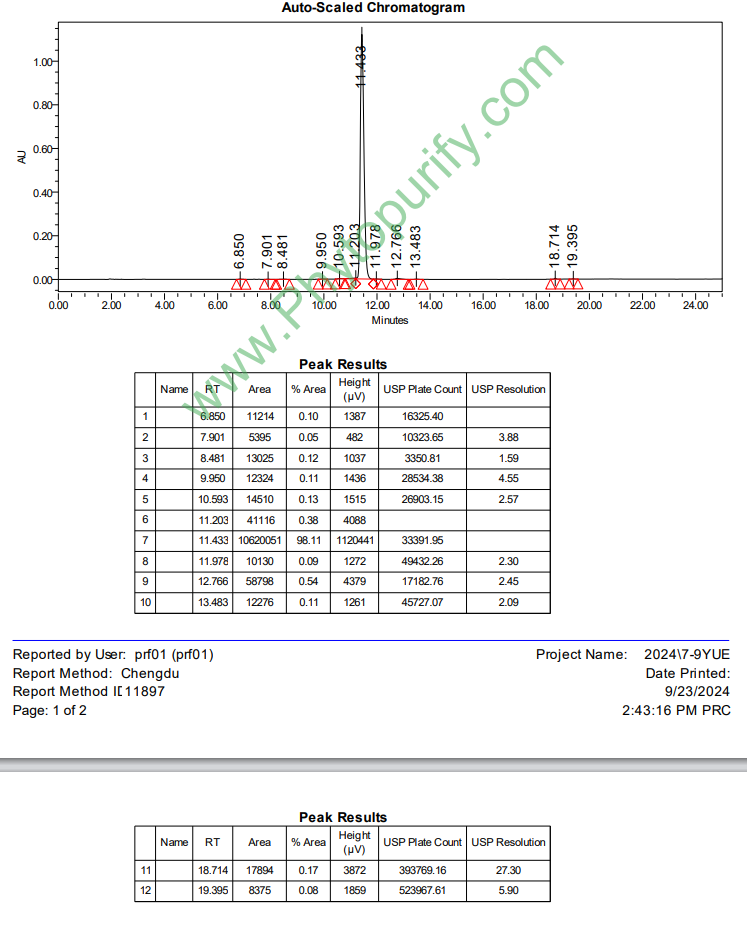
Purity: 95%~99%
Analysis Method: HPLC-DAD or/and HPLC-ELSD
Identification Method: Mass, NMR
Packing: Brown vial or HDPE plastic bottle
Can be supplied from milligrams to grams.
For Reference Standard and R&D, Not for Human Use Directly.
Inquire for bulk scale.
Description:
Hastatoside and verbenalin are major sleep-promoting components of V. officinalis. Hastatoside has anti-inflammatory activity.
References:
Phytother Res. 2000 Sep;14(6):463-5.
Antiinflammatory activity and chemical composition of extracts of Verbena officinalis.
METHODS AND RESULTS:
In an attempt to locate the biologically active fraction(s) of the plant Verbena officinalis Linn. (Verbenaceae), a preliminary screening of successive petroleum ether, chloroform and methanol extracts of aerial parts for antiinflammatory activity using carrageenan paw oedema model was carried out. All three extracts were found to exhibit antiinflammatory activity with the chloroform extract being the most active. Chemical investigations of petroleum ether and chloroform extracts led to the isolation of beta-sitosterol, ursolic acid, oleanolic acid, 3-epiursolic acid, 3-epioleanolic acid, and minor triterpenoids of derivatives of ursolic acid and oleanolic acids.
CONCLUSIONS:
Chromatographic purification of the methanol extract yielded two iridoid glucosides, verbenalin and Hastatoside, a phenylpropanoid glycoside, verbascoside and beta-sitosterol-D-glucoside.
Sleep & Biological Rhythms, 2009, 7(3):211–217.
Hastatoside and verbenalin are sleep‐promoting components in Verbena officinalis
Herbal tea made from Verbena officinalis (V. officinalis) has traditionally been used for the treatment of insomnia and other nervous conditions.
METHODS AND RESULTS:
In this study, we examined the sleep-promoting activity of Hastatoside, verbenalin, and verbascoside, which are the major iridoids (Hastatoside and verbenalin) and polyphenol (verbascoside) components responsible for the pharmacological activity of V. officinalis, by electroencephalographic analysis of rats after oral administration of the compounds. Hastatoside (0.64 mmol/kg of body weight) and verbenalin (1.28 mmol/kg of body weight) increased the total time of non-rapid eye movement sleep during a 9-h period from 23.00 to 08.00 hours by 81% and 42%, respectively, with a lag time of about 3–5 h after the administration at 20.00 hours (lights-off time). Both compounds also increased the delta activity during non-rapid eye movement sleep. However, verbascoside had no effect on the amount of sleep.
CONCLUSIONS:
Therefore, Hastatoside and verbenalin are major sleep-promoting components of V. officinalis.
HPLC of Hastatoside
Storage conditions:Short-term storage at 2~8℃, long-term storage at -20 ~ -80℃
Hastatoside, a typical natural product of iridoid glycosides, was first isolated from the genus Verbena officinalis in the Euphorbia genus. As one of the representative compounds of iridoid monoterpenes, verbascoside has attracted widespread attention in the field of natural product pharmacology in recent years due to its unique chemical structure and diverse biological activities. Its main pharmacological effects include promoting sleep, anti-inflammatory, and liver protection, demonstrating good potential for development. This article will provide a systematic review of the chemical structure, physicochemical properties, plant sources, and extraction methods of Moringa oleifera glycoside. It will delve into its pharmacological activity and mechanism of action, evaluate its pharmacological properties and pharmacokinetic characteristics, and finally look forward to its clinical application prospects.
The chemical formula of Moringa oleifera glycoside is C17H24O11, with a molecular weight of 404.3680. Its structure belongs to the monoterpene glycosides of cyclohexene ether terpenes, specifically including functional groups such as β - D-glucoside, methyl ester, cyclopyranose ring, α, β - unsaturated carboxylic acid esters, etc. This type of structure endows it with high polarity, a large molecular surface area (TPSA of approximately 172.21 Å ²), and a LogP value of -1.2342, indicating strong hydrophilicity and low lipid solubility. The water solubility is 27.7161, indicating that it has a certain solubility in water, but the blood-brain barrier permeability is low, suggesting that the central nervous system may be limited by drug delivery. The hERG channel inhibition experiment result was negative, and the Ames mutagenicity test score was only 0.3, indicating good safety and low mutagenicity risk.
From a molecular structure perspective, the cyclohexene ether terpenoid skeleton binding glycosidic part of Euphorbia lanceolata glycoside may interact with biological targets through hydrogen bonding and van der Waals forces, affecting its pharmacological activity. Its α, β - unsaturated carboxylic acid ester structure may participate in covalent binding with enzyme active sites, regulating related signaling pathways.
Euphorbia leaf verbascoside is mainly found in plants of the verbena genus, especially in Verbena officinalis. This plant is widely distributed in Europe, Asia, and North America, traditionally used to treat insomnia, anxiety, and liver disease. Euphorbia lanceolata glycoside, as one of its main active ingredients, has been extensively studied and utilized in recent years.
The extraction of verbascoside from Euphorbia lanceolata leaves is usually carried out using polar solvents such as methanol or ethanol aqueous solution for extraction. The specific steps include:
In recent years, the application of ultrasound assisted extraction and microwave-assisted extraction technologies has significantly improved the extraction efficiency and purity of verbascoside from Euphorbia lanceolata leaves, reduced solvent dosage and extraction time, and is in line with the concept of green chemistry.
The pharmacological activity research of Euphorbia lanceolata glycoside covers multiple aspects, mainly including promoting sleep, anti-inflammatory and hepatoprotective effects.
Multiple in vivo experiments have shown that verbascoside can significantly shorten sleep latency and prolong sleep duration. Its mechanism of action may be related to the regulation of gamma aminobutyric acid (GABA) receptors and 5-hydroxytryptamine (5-HT) system in the central nervous system. In animal models, verbascoside enhances GABA_A receptor-mediated inhibitory nerve conduction, reduces neural excitability, and promotes sleep. In addition, its regulatory effect on 5-HT receptors also contributes to improving sleep structure and quality.
Euphorbia lanceolata glycoside exhibits significant anti-inflammatory activity and can inhibit the expression and release of various inflammatory mediators. Both in vitro cell models and in vivo inflammation models have confirmed that it reduces inflammation by downregulating pro-inflammatory cytokines such as IL-6, TNF - α, and related signaling pathways such as NF - κ B and STAT3. It has inhibitory effects on inflammation related enzymes such as PTGS1, PTGS2 (COX-1, COX-2), and inducible nitric oxide synthase (NOS2), reducing the production of inflammatory mediators. In addition, Euphorbia lanceolata glycoside also regulates TRPV1 and TRPA1 plasma channels, reducing neuroinflammation and pain.
Euphorbia lanceolata glycoside has shown good effects in liver protection. Experimental studies have shown that it can alleviate liver cell damage, inhibit liver inflammation and fibrosis processes. Its mechanism involves antioxidant stress, inhibition of inflammatory cytokine release, and regulation of liver cell apoptosis related proteins such as CASP1. Through the synergistic effect of multiple targets, Euphorbia lanceolata glycoside effectively alleviates liver tissue inflammation and fibrosis, promoting liver function recovery.
The multiple pharmacological effects of Euphorbia lanceolata glycoside are attributed to its regulation of multiple molecular targets, mainly involving inflammatory signaling pathways and neurotransmitter systems.
The positive regulation of GABA_A receptor by Euphorbia lanceolata glycoside enhances inhibitory nerve conduction and promotes sleep. In addition, its regulatory effect on 5-HT receptors improves sleep structure, reduces anxiety and depression symptoms.
The pharmacological evaluation of Moringa oleifera glycoside shows that it has certain potential for development. Moderate molecular weight and strong hydrophilicity (LogP-12342) indicate good solubility in vivo, but may limit its ability to pass through lipid membranes, especially with low blood-brain barrier permeability, suggesting that its pivotal role may depend on specific delivery mechanisms or formulation designs.
Its high polarity (TPSA 172.21 Å ²) is consistent with the characteristics of polysaccharide natural products, which may lead to low oral bioavailability and require improvement in absorption through structural modification or nanocarrier techniques. HERG channel inhibition negative and low mutagenicity (Ames test 0.3) showed good safety and suitability for further drug development.
At present, there is limited pharmacokinetic data on Euphorbia lanceolata glycoside. Preliminary studies have shown that its absorption is slow after oral administration, and its plasma half-life is moderate. It is mainly metabolized by the liver and excreted by the kidneys. In the future, it is necessary to systematically study its metabolic pathways, in vivo distribution, and excretion characteristics in order to optimize the dosing regimen.
As a multifunctional natural product, Euphorbia lanceolata glycoside has broad clinical application prospects. Its sleep promoting effect provides natural drug candidates for the treatment of insomnia and related sleep disorders; The anti-inflammatory and hepatoprotective effects provide new ideas for the adjuvant treatment of chronic inflammatory diseases and liver diseases.
Future research directions should focus on:
As a typical natural product of iridoid glycosides, Euphorbia lanceolata glycoside has shown significant pharmacological potential in promoting sleep, anti-inflammatory and liver protection fields due to its unique chemical structure and diverse biological activities. Its excellent safety and multi-target mechanism of action provide a solid foundation for the development of new drugs. However, current research on its pharmacokinetics and clinical applications is still relatively limited, and there is an urgent need for systematic and in-depth research support. In the future, through interdisciplinary cooperation, Moringa oleifera glycoside is expected to become an important breakthrough in the development of natural product drugs, bringing new hope for the treatment of related diseases.
