Introduction/Overview
Natural products have long been an important source of innovative drug discovery, and their structural diversity and wide range of biological activities provide valuable lead compounds for the treatment of various diseases. Fraxinol, a natural coumarin compound isolated from traditional medicinal plants, has attracted the attention of pharmacological researchers in recent years due to its significant anti-inflammatory activity. The compound was initially isolated and identified from plants in the Oleaceae family, but subsequent studies have revealed its distribution in various medicinal plants, including half lotus(Lobelia chinensis)As an important source, it connects traditional applications with modern pharmacological exploration. Inflammation is the basic pathophysiological process for the body to deal with injury or infection, but uncontrolled chronic inflammation is the common pathological basis of many major diseases such as rheumatoid arthritis, atherosclerosis, neurodegenerative diseases and even cancer. Therefore, finding efficient and low toxicity new anti-inflammatory drugs has always been one of the core areas of drug development. White wax tree essence exhibits multi pathway and multi-target anti-inflammatory regulatory potential by acting on multiple key inflammatory targets such as interleukin-6 (IL-6), signal transduction and transcription activator 3 (STAT3), nuclear factor kappa B (NF - κ B) key subunit RELA (p65), and inducible nitric oxide synthase (NOS2), surpassing the traditional mode of single inhibition of cyclooxygenase (COX) by nonsteroidal anti-inflammatory drugs (NSAIDs). This article aims to systematically review the chemical properties, plant sources, pharmacological activities, molecular mechanisms of action, pharmacological characteristics, and clinical translation prospects of white wax tree essence, in order to provide comprehensive scientific basis for the further development of this compound as a lead structure for anti-inflammatory drugs.
Chemical structure and physicochemical properties
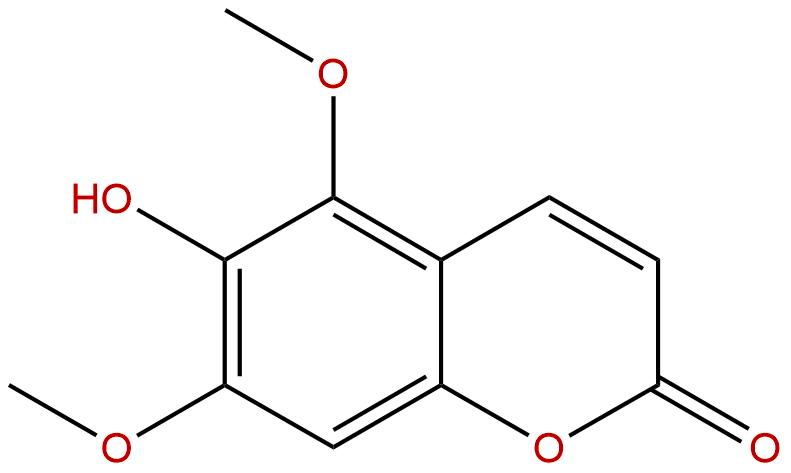
The chemical name of white wax tree essence is 7-Hydroxy-6-methoxycoumarin, and its CAS registration number is 486-28-2. Structurally, it belongs to the simple coumarin class compounds and has a core skeleton of benzo [a] - pyranone. Specifically, its benzene ring (A ring) is replaced by a methoxy group (- OCH ∝) at position 6 and a hydroxyl group (- OH) at position 7, while the pyranone ring (B ring) remains unsubstituted. The substitution mode of 6-methoxy-7-hydroxy is an important structural feature closely related to its biological activity.
Its molecular formula is C ₁₀ H ₈ O ₄, and its molecular weight is 222.1960 g/mol. The theoretical lipid water partition coefficient (LogP) is 1.5525, indicating that the compound has moderate lipophilicity and can penetrate cell membranes while maintaining a certain degree of water solubility. The topological polar surface area (TPSA) is 68.9000 Å ², reflecting the characteristics of hydrogen bond acceptors in the molecule. The water solubility measured in the experiment is about 0.3804 mg/mL, which belongs to the category of slight solubility. This suggests that solubilization strategies may need to be considered in the development of formulations to improve their bioavailability. Based on its molecular weight and physicochemical parameters, white wax tree essence conforms to Lipinski's "Rule of Five", indicating that it has good oral absorption potential. In addition, preliminary computer simulations and experimental data indicate that Atractylodes macrocephala has a high blood-brain barrier (BBB) permeability, which provides an important material basis for its application in the study of central nervous system related inflammatory diseases such as neuroinflammation.
Plant sources and extraction methods
White wax tree spirit originally originated from the genus White wax tree(Fraxinus)It was isolated from plants and named "Fraxinol". However, its distribution in the plant kingdom is not limited to this. Research has confirmed that the traditional Chinese medicine, Half Lotus, has been proven effective(Lobelia chinensis Also known as half lotus, it is an important source of white wax tree spirit. Half lotus is commonly used in traditional Chinese medicine to treat edema, sores, and insect and snake bites. It has the effects of clearing heat, detoxifying, diuresis, and reducing swelling. The substance basis of its anti-inflammatory activity may be partly derived from coumarin components such as white wax tree essence contained in it.
The extraction of white wax tree essence from plant materials is usually carried out using organic solvent extraction method. The common process is as follows: first, the dried whole plant of half lotus is crushed, and then subjected to cold soaking or hot reflux extraction with polar solvents such as methanol or ethanol. After concentration, the crude extract is obtained. Subsequently, the crude extract was preliminarily separated using solvent partitioning method (such as extraction with petroleum ether, ethyl acetate, and n-butanol in sequence), and the white wax tree essence was mainly enriched in the ethyl acetate fraction. Further purification relies on column chromatography technology, often using silica gel column chromatography with different ratios of petroleum ether ethyl acetate or chloroform methanol gradient elution. According to the polarity of the target compound, white wax tree essence is usually separated in the medium polarity elution stage. High performance liquid chromatography (HPLC) or preparative thin layer chromatography (PTLC) can be used for final purification to obtain high-purity monomer compounds. Structural identification involves the comprehensive use of techniques such as ultraviolet spectroscopy (UV), infrared spectroscopy (IR), mass spectrometry (MS), and nuclear magnetic resonance spectroscopy (NMR, including ¹ H-NMR and ¹ ³ C-NMR). Modern green extraction techniques, such as ultrasound assisted extraction and microwave-assisted extraction, have also been explored to improve extraction efficiency and reduce solvent consumption.
Pharmacological activity research
The core pharmacological activity of white wax tree essence is concentrated in anti-inflammatory effect And it has been validated in various in vitro and in vivo inflammatory models.
In cellular level studies, white wax tree essence can significantly inhibit the inflammatory response of macrophages (such as RAW 264.7 cells) induced by lipopolysaccharide (LPS) or other inflammatory stimuli (such as TNF - α). It can dose dependently reduce the production of inflammatory mediators such as nitric oxide (NO) and prostaglandin E ₂ (PGE ₂), and inhibit the mRNA expression and protein secretion of pro-inflammatory cytokines such as tumor necrosis factor - α (TNF - α), interleukin-1 β (IL-1 β), and interleukin-6 (IL-6). These effects can be observed within the micromolar concentration range, demonstrating strong in vitro anti-inflammatory efficacy.
In animal models, white wax tree essence also showed good anti-inflammatory effects. For example, in mouse ear xylene or TPA induced acute inflammation models, local or systemic administration can significantly reduce ear swelling. In the rat paw swelling model induced by carrageenan or carrageenan, pre-treatment with white wax tree essence can effectively inhibit the formation and development of edema. In addition, in more complex chronic inflammation models, such as the rat model of rheumatoid arthritis induced by Freund's complete adjuvant (CFA), treatment with white wax tree essence can improve joint swelling, reduce cartilage damage and inflammatory cell infiltration, and its effect is comparable to some clinical anti-inflammatory drugs.
In addition to its classic anti-inflammatory activity, the antioxidant and analgesic effects of white wax tree essence also complement its anti-inflammatory effects. It can eliminate free radicals and alleviate oxidative stress, which is an important amplifier in the inflammatory cascade. Its analgesic effect may be partially achieved by regulating pain sensing channels such as transient receptor potential vanillic acid subtype 1 (TRPV1) and anchor protein subtype 1 (TRPA1), which are also involved in the signaling of inflammatory pain.
Mechanism of action and molecular targets
The anti-inflammatory effect of white wax tree essence is not achieved through a single pathway, but involves a complex multi-target regulatory network, mainly revolving around the following key signaling pathways and molecular targets:
-
NF - κ B signaling pathway This pathway is the core regulator of inflammatory response. White wax tree essence can inhibit the activation of IKBKB (IKK β) in the LPS induced I κ B kinase (IKK) complex, thereby preventing the phosphorylation and degradation of inhibitory protein I κ B α. This prevents the transcription factor NF - κ B (mainly composed of RELA/p65 and p50 subunits) from being translocated into the nucleus. Therefore, the white wax tree essence effectively inhibits the binding activity between NF - κ B and DNA, thereby downregulating the expression of many pro-inflammatory genes regulated by it, including TNF - α, IL-6, IL-1 β, NOS2, and COX-2 (encoded by PTGS2, whose isoenzymes PTGS1/COX-1 are also affected to some extent).
-
JAK/STAT signaling pathway Especially the IL-6/STAT3 pathway. IL-6 is an important pro-inflammatory cytokine that activates JAK upon binding to receptors, thereby phosphorylating STAT3. Phosphorylated STAT3 forms dimers and enters the nucleus, driving the expression of genes related to inflammation and cell proliferation. Research has shown that white wax tree essence can directly or indirectly inhibit the production of IL-6 and block the phosphorylation and nuclear translocation of STAT3, thereby cutting off this important inflammation and tumor related pathway.
-
Inflammasome pathway The activation of inflammasomes (such as NLRP3 inflammasome) leads to self cleavage and activation of caspase-1 (CASP1), which in turn processes pro-IL-1 β and pro-IL-18 into mature, secreted active forms. Fraxinus chinensis has been proved to inhibit the assembly or activity of NLRP3 inflammasome, reduce the activation level of CASP1, thereby reducing the maturation and release of IL-1 β, which has potential value in the treatment of gout, type 2 diabetes and other inflammasome related diseases.
-
Regulation of enzymes and ion channels:
- NOS2 (iNOS) and PTGS1/2 (COX-1/2)White wax tree essence can significantly inhibit the expression of inducible nitric oxide synthase (NOS2) and cyclooxygenase-2 (COX-2), and reduce the excessive production of NO and PGE ₂. It may also have a mild regulatory effect on constitutive COX-1 (PTGS1), which helps explain its anti-inflammatory activity and may affect its side effect profile.
- TRPV1 and TRPA1 As cation channels involved in pain perception and neurogenic inflammation, TRPV1 and TRPA1 are important targets for analgesic drugs. White wax tree essence may act as a regulator to affect the function of these channels, thereby exerting peripheral analgesic effects.
In summary, the white wax tree essence forms a multidimensional anti-inflammatory network by synergistically acting on multiple upstream signaling nodes such as NF - κ B, STAT3, inflammasome, and regulating downstream key effector molecules such as cytokines, enzymes, and channels. This may give it an advantage in dealing with complex and multifactorial chronic inflammatory diseases.
Evaluation of drug properties and pharmacokinetics
The drug like evaluation based on calculations and preliminary experimental data shows that white wax tree essence has ideal medicinal chemical properties. Its molecular weight is moderate (222.2), and the LogP value (~1.55) is within the ideal range (1-3), which is conducive to oral absorption and cell infiltration. Moderate TPSA (68.9 Å ²) also supports good membrane permeability. It is worth noting that its predictions High blood-brain barrier permeability This presents a unique opportunity for treating brain diseases such as Alzheimer's disease, Parkinson's disease, and multiple sclerosis that are accompanied by neuroinflammation.
In terms of security warning, the key is HERG channel inhibition risk prediction is negative This implies a lower potential risk of causing QT interval prolongation in the heart, which is an important cardiac safety advantage.Ames test(Reply mutation test) is a standard method for evaluating the mutagenicity of compounds, with a result of 0.6 (usually expressed as the ratio of mutant colony count to control or a specific evaluation system). This value suggests that under the conditions of this experiment Not showing obvious mutagenicity However, a comprehensive judgment needs to be made by combining more in vitro and in vivo genetic toxicity tests.
The research on pharmacokinetics (PK) is currently relatively limited and is a gap that needs to be addressed in future development. Based on its structural characteristics, it can be inferred that after oral administration, white wax tree essence may be absorbed in the gastrointestinal tract and undergo metabolic transformation in the liver. The typical metabolic pathways of coumarin compounds include hydroxylation, demethylation, glucuronidation, and sulfation binding reactions. The 7th phenolic hydroxyl group is the main site for the II binding reaction, which may lead to first pass effects and affect its oral bioavailability. Therefore, future research needs to systematically examine its absolute bioavailability, plasma protein binding rate, tissue distribution (especially towards inflammatory sites and the central nervous system), metabolite identification, and excretion pathways in preclinical animal models such as rats and dogs. These data are crucial for determining dosing regimens, evaluating potential drug interactions, and optimizing formulations.
Clinical application prospects and prospects
White wax tree essence, as a multi-target natural anti-inflammatory lead compound, has broad clinical application prospects, but also faces a series of challenges.
Potential therapeutic areas:
1. Chronic inflammatory diseases Such as rheumatoid arthritis, inflammatory bowel disease (Crohn's disease, ulcerative colitis), psoriasis, etc. Its multi-channel inhibitory properties may have a more comprehensive therapeutic effect on such complex diseases.
2. Neuroinflammatory related diseases Thanks to its high blood-brain barrier permeability, Atractylodes macrocephala has great potential in the treatment of Alzheimer's disease, Parkinson's disease, cerebral ischemia-reperfusion injury, multiple sclerosis, and depression (inflammation hypothesis), targeting the inhibition of neuroinflammation mediated by excessive activation of microglia in the brain.
3. pain management Especially inflammatory pain and neuropathic pain. By utilizing a dual mechanism of anti-inflammatory and regulating TRPV1/TRPA1 channels, novel analgesic drugs may be developed.
4. Metabolic diseases Low degree chronic inflammation is a key feature of type 2 diabetes, non-alcoholic fatty liver disease (NAFLD) and atherosclerosis. White wax tree essence may improve insulin resistance and vascular inflammation by inhibiting pathways such as NF - κ B and inflammasomes.
Development Challenges and Prospects:
1. structural optimization Although white wax tree essence has good medicinal properties, there is still room for optimization in its water solubility and metabolic stability. Structural modification through medicinal chemical methods, such as preparing prodrugs and introducing specific functional groups, may further enhance their potency, selectivity, and pharmacokinetic properties.
2. System preclinical research It is urgent to conduct comprehensive pharmacological, pharmacokinetic, and toxicological evaluations. Including conducting long-term efficacy evaluations in animal models closer to human diseases, completing standardized GLP toxicology studies (acute toxicity, long-term toxicity, reproductive toxicity, etc.), and elucidating their specific metabolic enzymes and transporters.
3. Deep exploration of mechanisms Using chemical biology methods such as affinity fishing and molecular probes to identify their direct targets and create a more accurate target pathway network diagram. Exploring its potential for synergistic effects with existing anti-inflammatory drugs is also valuable.
4. Formulation development Based on its water-soluble characteristics, nano formulations (such as liposomes, polymer nanoparticles), cyclodextrin inclusion complexes, or solid dispersions can be developed to improve oral bioavailability or achieve targeted delivery.
5. clinical translation After obtaining sufficient preclinical safety and efficacy data, clinical trials can be planned to first explore its dosage, safety, and initial efficacy in a certain indication (such as mild to moderate active rheumatoid arthritis).
Conclusion
White wax tree essence is a natural coumarin compound with a clear chemical structure and multi-target anti-inflammatory activity isolated from the traditional medicinal plant Half lotus. It exhibits strong anti-inflammatory, antioxidant, and analgesic potential by synergistically inhibiting the NF - κ B, STAT3 signaling pathways, inflammasome activation, and regulating key effector molecules such as NOS2, COX-2, and TRP channels. Its excellent pharmacological characteristics, including physical and chemical properties that comply with the "five rules", high blood-brain barrier permeability, low hERG inhibition risk, and preliminary no mutagenic signals, have laid a solid foundation for its further drug development. Although further research is needed in the areas of systemic pharmacokinetics, toxicology, and in-depth mechanism of action, the white wax tree essence is undoubtedly a highly valuable anti-inflammatory drug lead molecule for development. With the continuous advancement of modern drug research and development technology, through systematic structural optimization, formulation innovation, and preclinical transformation research of white wax tree essence, it is expected to be developed into a new therapeutic drug for the treatment of major health problems such as chronic inflammatory diseases, neurodegenerative diseases, and pain, thus demonstrating the sustained vitality of natural products in innovative drug discovery.