


Product name: Fraxin
Synonym name: Paviin
Catalogue No.: BP0599
Cas No.: 524-30-1
Formula: C16H18O10
Mol Weight: 370.31
Botanical Source: Fraxinus stylosa Lingelsh.
Physical Description:
Type of Compound: Coumarins
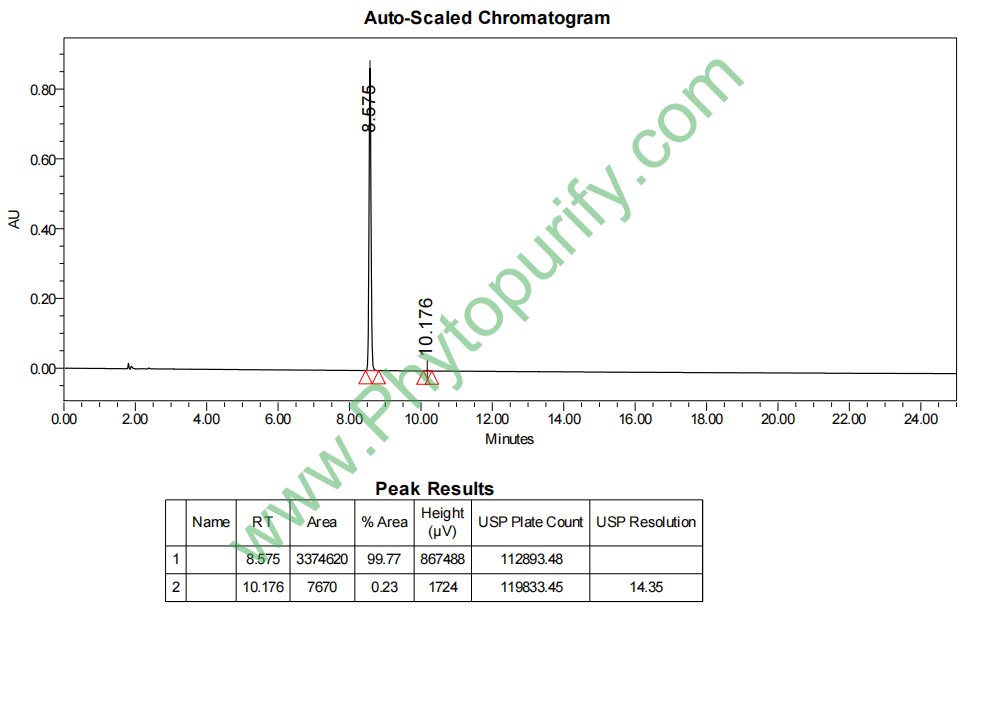
Purity: 95%~99%
Analysis Method: HPLC-DAD or/and HPLC-ELSD
Identification Method: Mass, NMR
Packing: Brown vial or HDPE plastic bottle
Storage: Store in a well closed container, protected from air and light. Put into refrigerate or freeze for long term storage.
Whenever possible, you should prepare and use solutions on the same day. However, if you need to make up stock solutions in advance, we recommend that you store the solution as aliquots in tightly sealed vials at -20℃. Generally, these will be useable for up to two weeks.
The product could be supplied from milligrams to grams
Inquire for bulk scale.
Chengdu Biopurify Phytochemicals Ltd. is a leading company in the research, development, manufacture and marketing of High Quality Phytochemicals and Extracts(especially Active Ingredients from Traditional Chinese Medicine,TCM), Natural Active Pharmaceutical Ingredients worldwide.
The main services:
A. Supply active ingredients and reference standards of TCM, from mgs to kgs scale
B. Custom extraction and purification, target Herb Active Ingredients
C. Custom synthesis and semi-synthesis for Natural Active Ingredients
D. CR(contract research), CM(contract manufacture) and PD(process development) services from lab scale, pilot scale to commercial scale(GMP is also available)
E. TCM compounds library for drug screen,more than 3000 compounds available, many of them are rare and unique.
HPLC of Fraxin
Storage conditions:Short-term storage at 2~8℃, long-term storage at -20 ~ -80℃
Fraxin (CAS number: 524-30-1) is a natural product isolated from the traditional Chinese medicinal herb Cortex Fraxini, belonging to the glycoside class of white wax tree lactones. As a natural product with multiple biological activities, quercetin has been increasingly studied in the fields of antioxidant, anti-inflammatory, antibacterial, and anti-tumor metastasis in recent years, demonstrating its potential medicinal value and development prospects. This article aims to provide a systematic review of the chemical structure, physicochemical properties, plant sources, extraction methods, pharmacological activities, and mechanisms of action of Qinpi glycoside. Combining the evaluation of drug properties and pharmacokinetic characteristics, it explores its clinical application prospects and future research directions, providing theoretical basis and reference for natural product pharmacology and new drug development.
Qinpi glycoside is a glycoside of white wax tree lactone, with a molecular formula of C17H18O10 and a molecular weight of 370.3100. Its structural features include a lactone ring and a connected glucoside moiety, endowing it with high polarity. The LogP value of quercetin is -0.4061, indicating its strong hydrophilicity and water solubility of 8.8525. It has good water solubility and is suitable for the biological activity in aqueous systems. Its topological polar surface area (TPSA) is 159.05 Å ², indicating that its molecule has a large number of polar groups, which may affect its membrane permeability and bioavailability.
In addition, the blood-brain barrier permeability of quercetin is relatively low, suggesting that its role in the central nervous system may be limited, but this also reduces its potential risk of central nervous system toxicity. The negative result of hERG channel inhibition experiment indicates that quercetin is not easy to cause QT interval prolongation in the heart and has high safety. The Ames mutagenicity test score is 0.9, indicating a low risk of genotoxicity and meeting the safety requirements for drug development.
Qinpi glycoside is mainly found in the bark of Fraxinus spp., a plant in the family Rhinoceros, and is particularly abundant in Cortex Fraxini. Qin Pi, as a traditional Chinese medicinal herb, is widely used in traditional treatments such as clearing heat and dampness, purging fire and detoxifying. The extraction of quercetin is usually carried out by water extraction and alcohol precipitation or organic solvent extraction, combined with separation and purification techniques such as column chromatography and counter current chromatography to obtain high-purity quercetin.
The specific extraction process generally includes: first, the dried Qinpi is crushed, and reflux extraction is carried out using 70% -80% ethanol or methanol. After concentration, the extract is separated and purified using a silica gel column or C18 reverse phase column. In recent years, the application of ultrasound assisted extraction and microwave-assisted extraction technologies has improved the extraction efficiency and purity of quercetin, while reducing the amount of solvent and extraction time, in line with the concept of green chemistry.
Qinpi glycoside exhibits significant antioxidant effects, capable of clearing free radicals and reducing cellular damage caused by oxidative stress. Multiple in vitro experiments have shown that quercetin can effectively scavenge DPPH radicals, superoxide anions, and hydroxyl radicals, protecting cells from oxidative damage. Its antioxidant effect is closely related to the abundant hydroxyl and lactone rings in its structure, which can neutralize free radicals through the action of electron donors.
Qinpi glycoside has shown good anti-inflammatory effects in various inflammatory models. In vitro cell experiments have shown that quercetin can inhibit the expression of pro-inflammatory factors such as TNF - α, IL-1 β, and IL-6, and alleviate inflammatory reactions. In animal models, quercetin significantly reduces tissue inflammatory damage by regulating the NF - κ B signaling pathway, inhibiting the release of inflammatory mediators.
Qinpi glycoside exhibits inhibitory effects on various bacteria and fungi. Its antibacterial targets involve key enzymes such as bacterial DNA gyrase (GYRA), cell wall synthase (FABI), and dihydrofolate reductase (DHFR), which can interfere with bacterial DNA replication and cell wall synthesis. Inhibition of fungal target ERG11 (encoding cytochrome P450 14 α - demethylase) and its homologous enzyme CYP51A1 confers antifungal activity to quercetin. In addition, quercetin can also inhibit the multidrug resistance protein CDR1 of fungi, enhancing the efficacy of antifungal drugs.
The research on the inhibitory effect of quercetin on tumor metastasis is gradually increasing. In vitro experiments have shown that quercetin can inhibit the migration and invasion of tumor cells, reduce the expression of matrix metalloproteinases (MMPs), block the interaction between tumor cells and matrix, and thus inhibit the process of tumor metastasis.
The multi-target mechanism of action of Qinpi glycoside is the basis for the realization of its various pharmacological activities. Its antioxidant effect is mainly achieved by inhibiting the activity of cyclic adenosine monophosphate phosphodiesterase (PDE), regulating intracellular cAMP levels, activating downstream antioxidant enzyme systems, and reducing the generation of reactive oxygen species (ROS). The anti-inflammatory mechanism involves inhibition of the NF - κ B signaling pathway, blocking the transcription and release of pro-inflammatory factors.
In terms of antibacterial properties, quercetin blocks the DNA replication process by binding to the bacterial DNA gyrase GYRA; Inhibiting cell wall synthase FABI and interfering with bacterial cell wall synthesis; Simultaneously inhibiting DHFR, blocking nucleotide synthesis, and suppressing bacterial proliferation. For fungi, quercetin targets ERG11 and CYP51A1, blocking ergosterol biosynthesis and disrupting cell membrane integrity. In addition, by inhibiting CDR1, quercetin weakens the drug excretion ability of fungi and increases the sensitivity of antifungal drugs.
In terms of anti metastatic effects, quercetin inhibits tumor cell matrix degradation and migration by downregulating MMPs and related signaling pathways, blocking the process of metastasis.
The physicochemical properties of Qinpi glycoside show that it has good water solubility and is suitable for oral administration. Its LogP value and TPSA indicate that quercetin has strong polarity and limited membrane permeability, especially low blood-brain barrier permeability, which may limit its pharmacological effects on the central nervous system but also reduce the risk of central toxicity. The negative inhibition of hERG channel and low genotoxicity risk provide assurance for its safety.
At present, there is limited research on the pharmacokinetics of quercetin. Preliminary data indicates that its oral absorption is relatively slow, and its bioavailability is limited by its high polarity and hydrolytic stability of glycoside structure. The metabolic pathway may involve enzymatic hydrolysis of the liver and the corresponding action of glucosidase, and further research is needed on the activity and toxicity of metabolites. The excretion pathway of quercetin may be mainly through renal excretion.
Qinpi glycoside, as a multifunctional natural product, has multiple pharmacological activities such as antioxidant, anti-inflammatory, antibacterial, and anti-tumor metastasis, demonstrating extensive clinical application potential. Its antioxidant and anti-inflammatory effects make it potentially valuable for the treatment of chronic inflammatory diseases, cardiovascular diseases, and metabolic syndrome. The antibacterial activity provides new drug candidates for its application in the field of anti infection, especially in the treatment of multidrug-resistant strains, which deserves attention.
In addition, the inhibitory effect of quercetin on tumor metastasis provides a theoretical basis for its development as an adjuvant anti-tumor drug. In the future, its bioavailability and targeting can be improved through structural modification and drug carrier technology, enhancing clinical efficacy.
However, the clinical translation of quercetin still faces many challenges, including in vivo metabolic stability, unclear pharmacokinetic characteristics, lack of systematic toxicological evaluation, and clinical trial data. Future research needs to strengthen the pharmacokinetics and safety evaluation of quercetin, conduct more mechanism studies and animal model validation, and promote its clinical application.
Qinpi glycoside, as a white wax tree lactone glycoside derived from traditional Chinese medicine Qinpi, exhibits a wide range of biological functions and good safety characteristics due to its unique chemical structure and multi-target pharmacological activity. Its various activities such as antioxidant, anti-inflammatory, antibacterial, and anti-tumor metastasis provide abundant research resources for the development of new drugs. In the future, by combining modern medicinal chemistry, molecular biology, and pharmacokinetic research, optimizing the drug properties and clinical application strategies of quercetin is expected to promote it as an important candidate molecule for natural product drug development, benefiting the clinical treatment field.
