


Synonym name:
Catalogue No.: BP0968
Cas No.: 541-91-3
Formula: C16H30O
Mol Weight: 238.415
Botanical Source:
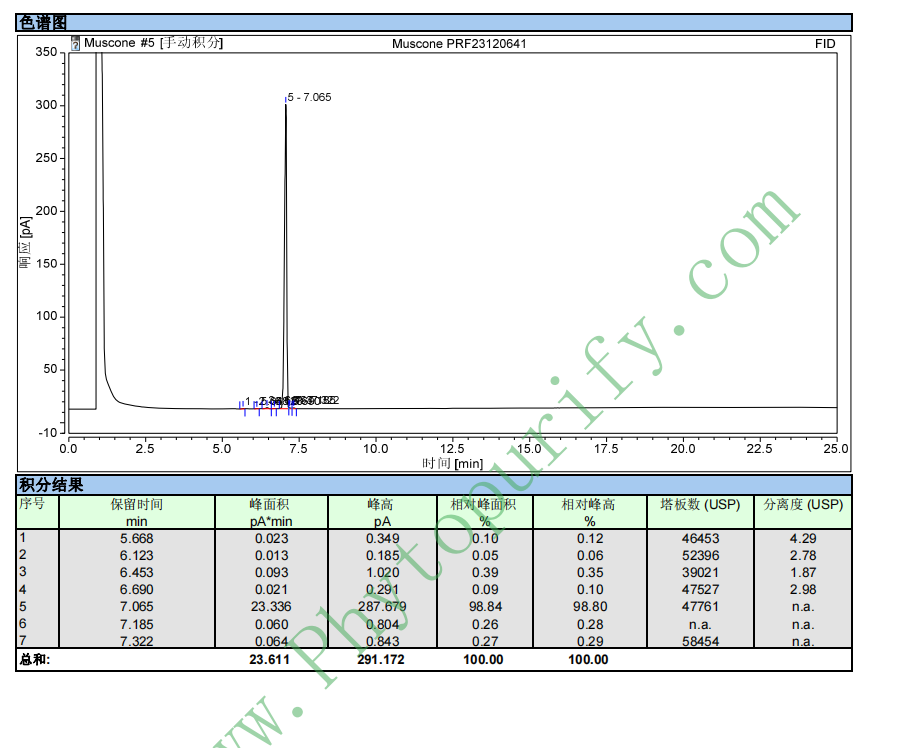
Purity: 95%~99%
Analysis Method: HPLC-DAD or/and HPLC-ELSD
Identification Method: Mass, NMR
Packing: Brown vial or HDPE plastic bottle
Can be supplied from milligrams to grams.
For Reference Standard and R&D, Not for Human Use Directly.
Inquire for bulk scale.
HPLC of Muscone
Storage conditions:Short-term storage at 2~8℃, long-term storage at -20 ~ -80℃
Musk (CAS number: 541-91-3) is the main active ingredient of traditional Chinese medicine musk. As a natural terpenoid compound, it has attracted much attention due to its unique aroma and significant biological activity. Musk has been widely used in traditional Chinese medicine since ancient times for the treatment of various diseases such as promoting blood circulation and removing blood stasis, unblocking orifices and awakening the mind, and anti-inflammatory and analgesic effects. With the development of modern pharmacology and molecular biology techniques, the pharmacological effects of muscone have gradually been revealed, especially its potential application value in inflammation regulation, neuroprotection, and cardiovascular disease is becoming increasingly prominent. This article systematically reviews the chemical structure, physicochemical properties, plant sources, and extraction methods of muscone, with a focus on exploring its pharmacological activity and mechanism of action, evaluating its pharmacological properties and pharmacokinetic characteristics, and finally looking forward to its clinical application prospects, providing theoretical basis and reference for subsequent research and development.
Musk ketone is a typical cyclopentanone terpene ketone, with a molecular formula of C16H30O and a molecular weight of 238.4150. Its chemical structure is characterized by the presence of a cyclopentanone skeleton, a ketone group in the molecule, and a relatively stable structure. The LogP value of muscone is 5.3256, indicating its strong lipophilicity, which helps it penetrate lipid membranes, especially the blood-brain barrier (BBB), and thus exert its role in the central nervous system. Its polar surface area (TPSA) is 17.0700, indicating low polarity and extremely poor water solubility (0.0062 mg/mL), which poses certain challenges to its bioavailability and administration method. The hERG channel inhibition experiment showed a negative result, indicating a low risk of cardiac toxicity. The Ames mutagenicity test result is 0.0, indicating that muscone has no significant mutagenicity and is relatively safe.
Musk ketone is mainly derived from the traditional Chinese medicinal herb musk, which is the secretion of musk sacs in the musk family and has a unique aromatic odor. Due to limited natural musk resources and animal protection regulations, modern research often uses chemical synthesis or biosynthetic techniques to obtain muscone. In addition, some plants have also been reported to contain structurally similar muscone compounds, but the content is relatively low and there is no large-scale utilization value yet.
Traditionally, the extraction of muscone mainly relies on solvent extraction and distillation separation of musk. Modern extraction methods include supercritical CO2 extraction, liquid-liquid extraction, and chromatographic purification techniques, which can effectively improve the purity and recovery rate of muscone. In terms of synthetic routes, organic synthesis methods based on the cyclopentanone skeleton are relatively mature and can meet the needs of pharmaceuticals and industry.
Musk ketone exhibits significant anti-inflammatory activity in various inflammatory models. It mainly reduces the expression of pro-inflammatory cytokines such as IL-1 β, TNF - α, and IL-6 by inhibiting the nuclear factor kappa B (NF - κ B) signaling pathway and the activation of NLRP3 inflammasome, thereby alleviating the inflammatory response. Related in vitro and in vivo experiments have shown that muscone can reduce the release of inflammatory mediators, alleviate tissue damage, and improve the pathological state of inflammation related diseases.
The research on muscone in the field of neuroprotection is increasing day by day. It exerts antioxidant, anti apoptotic, neuroinflammatory, and neuroregenerative effects by regulating various neuroprotective targets such as BCL2, APP, BACE1, MAPT, SIRT1, MAPK1, ACHE, CASP3, SNCA, and NRF2. Musk ketone can alleviate neuronal damage, delay the progression of neurodegenerative diseases, and demonstrate potential for treating neurological disorders such as Alzheimer's disease and Parkinson's disease.
Research has confirmed that muscone significantly improves cardiac function and increases survival rates by inhibiting inflammatory responses and oxidative stress. Its mechanism includes inhibiting the inflammatory pathway mediated by NF - κ B, reducing myocardial cell apoptosis, and promoting myocardial repair. Animal models have shown that muscone can alleviate myocardial ischemia-reperfusion injury and improve cardiac function indicators, indicating its application value in cardiovascular diseases.
In addition to the main functions mentioned above, muscone also exhibits certain analgesic, antibacterial, and immune regulatory activities, but related research is still in the preliminary stage and further systematic verification is urgently needed.
The multi-target mechanism of action of muscone is the basis of its pharmacological activity. Its core mechanism of action mainly includes:
Inhibition of NF - κ B signaling pathway Musk ketone inhibits the phosphorylation and degradation of I κ B α, blocks NF - κ B from entering the nucleus, reduces the transcription of inflammatory genes, and thus lowers the expression of inflammatory factors such as IL-1 β, TNF - α, and IL-6.
Inhibition of NLRP3 inflammasome activation NLRP3 inflammasome is an important regulatory factor in inflammatory response, and muscone can block its assembly and activation, reducing the maturation and release of pro-inflammatory cytokines.
Regulating neuroprotective targets:
NRF2 Activate antioxidant response and alleviate oxidative stress damage.
Antioxidant effect By activating the NRF2 pathway, the expression of intracellular antioxidant enzymes is enhanced, free radicals are cleared, and cells are protected from oxidative damage.
In summary, muscone exerts its wide-ranging pharmacological effects through the synergistic action of multiple targets and pathways.
The high lipid solubility (LogP 5.3256) and low polarity (TPSA 17.07) of muscone make it easy to penetrate cell membranes and the blood-brain barrier, and have good potential as a central nervous system drug. Its water solubility is extremely low (0.0062 mg/mL), which limits its oral bioavailability and requires optimization of drug formulations or new delivery systems to improve absorption efficiency.
In terms of safety, muscone does not inhibit hERG channels, reducing the risk of cardiac toxicity; The Ames test is negative, indicating no significant genetic toxicity and good safety.
At present, there is relatively limited research on the pharmacokinetics of muscone, but existing studies have shown that its oral absorption is fast, widely distributed, and especially effective in entering brain tissue. Its metabolism is mainly carried out through the liver enzyme system, and the metabolites still need to be further identified. The main excretion pathways are bile and urine. In the future, it is necessary to conduct systematic in vivo pharmacokinetic and toxicological studies to clarify their metabolic characteristics and safe dose ranges.
Musk ketone has demonstrated broad clinical application prospects due to its significant anti-inflammatory, neuroprotective, and cardiovascular protective effects. Especially in the treatment of neurodegenerative diseases (such as Alzheimer's disease, Parkinson's disease), cardiovascular diseases, and chronic inflammatory diseases, muscone has potential drug development value.
Future research should focus on the following aspects:
Optimization of drug formulations Overcoming the limitations of poor water solubility, developing new drug delivery systems such as nanocarriers, liposomes, and solid dispersions to improve bioavailability.
In depth mechanism research Using multi omics techniques to reveal the comprehensive network of action of muscone and clarify the relationship between its targets and signaling pathways.
System pharmacokinetics and safety evaluation Conduct long-term toxicology research to clarify safe doses and potential side effects.
Clinical trial advancement Based on sufficient preliminary pharmacological and toxicological data, design a reasonable clinical trial plan to verify its efficacy and safety.
Innovation in synthesis and biosynthetic technology Improve the production and purity of muscone to ensure its stable supply.
In summary, muscone, as a natural product with multiple pharmacological activities, has the potential to become a novel neuroprotective and anti-inflammatory drug, and is worthy of further development.
As the main active ingredient of traditional Chinese medicine musk, muscone has become a hot topic in natural product pharmacology research due to its unique chemical structure and significant biological activity. It significantly reduces the levels of inflammatory factors and exerts anti-inflammatory and cardiovascular protective effects by inhibiting the activation of NF - κ B and NLRP3 inflammasomes; Simultaneously, by regulating multiple neuroprotective targets, it demonstrates the potential for treating neurodegenerative diseases. The drug evaluation shows that it has good ability to penetrate the blood-brain barrier and high safety, but its poor water solubility limits its clinical application. In the future, with the advancement of formulation technology and the deepening of mechanism research, muscone is expected to become an important drug for treating inflammatory and neurological diseases. This article systematically reviews the research progress of muscone, aiming to provide theoretical support and research directions for its drug development, and promote its clinical translation process.
