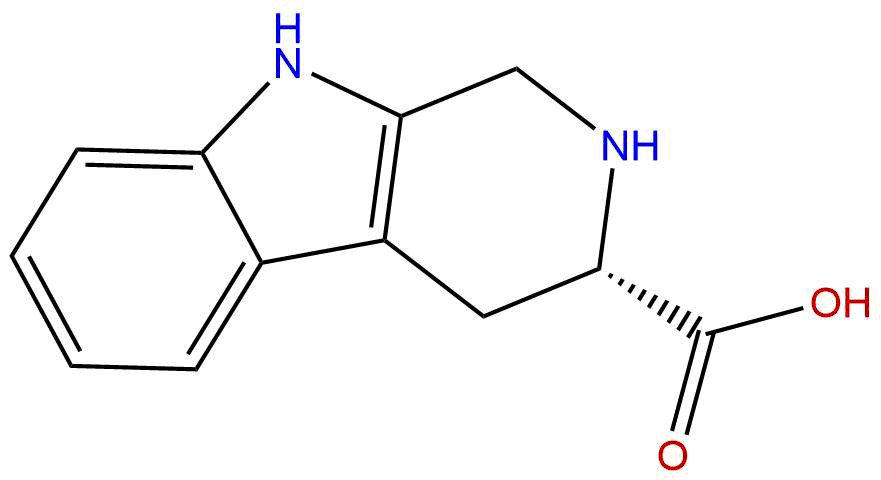


Product name: L-1,2,3,4-Tetrahydronorharman-3-carboxylic acid;TNCA
Synonym name: Lycoperodine-1; (3S)-1,2,3,4-Tetrahydro-β-carboline-3-carboxylic acid
Catalogue No.: BP2272
Cas No.: 42438-90-4
Formula: C12H12N2O2
Mol Weight: 216.24
Botanical Source:
Type of Compound: Alkaloids
Purity: 95%~99%
Analysis Method: HPLC-DAD or/and HPLC-ELSD
Identification Method: Mass, NMR
Packing: Brown vial or HDPE plastic bottle
Storage: Store in a well closed container, protected from air and light. Put into refrigerate or freeze for long term storage.
Whenever possible, you should prepare and use solutions on the same day. However, if you need to make up stock solutions in advance, we recommend that you store the solution as aliquots in tightly sealed vials at -20℃. Generally, these will be useable for up to two weeks.
The product could be supplied from milligrams to grams
Inquire for bulk scale.
For Reference Standard and R&D, Not for Human Use Directly.
Storage conditions:Short-term storage at 2~8℃, long-term storage at -20 ~ -80℃
Natural products, as an important source of drug discovery, have shown great potential in the treatment research of neurodegenerative diseases, especially Parkinson's disease (PD), due to their structural diversity and wide range of biological activities. L-1, 2,3,4-tetrahydro-2,3,4-tetrahydrorharman-3-carboxylic acid (THNHC) is a natural product derivative with unique structural characteristics, which has gradually received attention in pharmacological research related to Parkinson's disease in recent years. This article will provide a systematic review of the chemical structure and physicochemical properties, plant sources, and extraction methods of THNHC, with a focus on exploring its pharmacological activity and mechanism of action. Pharmacokinetic analysis will be conducted based on drug parameters, and its potential in clinical applications will be discussed.
The chemical structure of THNHC is based on the norharman skeleton and belongs to the β - carbene alkaloid derivatives. Its molecular formula is C12H13NO2 and its molecular weight is 216.2400. The structure contains a tetrahydroindole ring system, and the introduction of a 3-carboxylic acid group endows it with certain polarity and acidity characteristics. Its LogP value is -0.5107, indicating that the compound has strong hydrophilicity and a certain degree of water solubility (0.5191). The polar surface area (TPSA) is 65.12 Å ², indicating that its molecular polarity is moderate.
From the perspective of physicochemical properties, the low LogP and moderate TPSA of THNHC suggest that its distribution in vivo may be limited by lipophilic permeability, especially the low permeability of the blood-brain barrier (BBB), which is consistent with its blood-brain barrier permeability assessment results. In addition, THNHC does not exhibit hERG channel inhibitory activity, and the Ames gene mutation test result is 0, indicating that its potential cardiac toxicity and mutagenicity risk are low, and it has a good safety basis.
THNHC is mainly found in various traditional Chinese medicinal plants, especially those containing β - carbene alkaloids such as certain Magnoliaceae and Rubiaceae plants. Its natural source has not been widely reported, but through research on plant tissue culture and biosynthetic pathways, its possible biosynthetic pathway has been preliminarily identified.
The extraction method usually uses polar solvents such as methanol or ethanol for crude extraction, followed by liquid-liquid distribution and column chromatography techniques for separation and purification. High performance liquid chromatography (HPLC) combined with mass spectrometry (MS) technology is widely used for qualitative and quantitative analysis of THNHC. In recent years, the application of supercritical fluid extraction and molecular imprinting techniques has further improved the extraction efficiency and purity of THNHC, providing a reliable material basis for its subsequent pharmacological research.
The pharmacological activities of THNHC in Parkinson's disease models mainly manifest in neuroprotective, antioxidant, and anti-inflammatory effects. Multiple in vitro and in vivo experiments have shown that THNHC can significantly reduce damage to dopaminergic neurons and improve motor dysfunction.
Neuroprotective effect
THNHC exerts neuroprotective effects by regulating intracellular redox status and inhibiting neuronal apoptosis related signaling pathways. It can reduce ROS (reactive oxygen species) levels, enhance intracellular antioxidant enzyme activity, such as glutathione peroxidase (GPx) and superoxide dismutase (SOD), and reduce cellular damage caused by oxidative stress.
anti-inflammatory effect
Neuroinflammation is an important component of the pathogenesis of Parkinson's disease. THNHC can inhibit the release of inflammatory mediators, reduce the expression of pro-inflammatory cytokines such as TNF - α and IL-1 β, alleviate the activation status of microglia, and alleviate neuroinflammatory reactions.
Regulating neurotransmitters
Research has shown that THNHC has a certain regulatory effect on dopamine metabolism, possibly by indirectly affecting tyrosine hydroxylase (TH) activity, promoting dopamine synthesis, and improving neurotransmission function.
The mechanism of action of THNHC in the treatment of Parkinson's disease involves multiple signaling pathways and molecular targets. According to target prediction and molecular docking studies, THNHC mainly acts on the following key proteins:
BLM (Bloom Syndrome Protein)THNHC may participate in DNA repair and genome stability by regulating BLM activity, promoting DNA damage repair in nerve cells, and slowing down the process of neurodegeneration.
BACE1 (β - secretase 1)Related to the metabolism of amyloid precursor protein (APP), inhibiting BACE1 can help reduce the accumulation of neurotoxic proteins, and THNHC may reduce the burden of neurotoxicity by regulating BACE1.
PTPN1 (protein tyrosine phosphatase 1)Regulating multiple signaling pathways, participating in insulin signaling and inflammatory response, THNHC's regulation of PTPN1 may improve neurometabolism and anti-inflammatory status.
APEX1 (Base Resection Repair Enzyme)THNHC, a key DNA repair enzyme, may enhance the repair ability of nerve cells by activating APEX1.
ALOX15 and ALOX5 (lipoxygenase)THNHC participates in lipid metabolism and the generation of inflammatory mediators, and its inhibitory effect helps alleviate neuroinflammation.
AKR1B1 (aldose reductase): It is related to the complications of diabetes and regulates oxidative stress. THNHC may alleviate oxidative damage by inhibiting AKR1B1.
MMP1 (Matrix Metalloproteinase 1)THNHC participates in extracellular matrix degradation, regulates neural tissue remodeling, and may maintain neural environment stability by regulating MMP1.
LCK (lymphocyte specific tyrosine kinase)THNHC is involved in immune signal transduction, and its regulation of LCK may affect neuroimmune responses.
NFE2L2 (Nuclear Factor E2 Related Factor 2)Leading the antioxidant stress response, THNHC can activate the NFE2L2 pathway, promote antioxidant gene expression, and enhance cellular defense capabilities.
In summary, THNHC exhibits a complex and effective neuroprotective mechanism by synergistically regulating key pathological processes such as oxidative stress, inflammatory response, DNA repair, and neurometabolism through multiple targets and pathways.
From the perspective of pharmacological parameters, the molecular weight of THNHC is moderate (216.24 Da), which meets the basic requirements of Lipinski's rule. Its LogP is -0.5107, indicating good water solubility, but its blood-brain barrier permeability is low, suggesting that its bioavailability in the central nervous system (CNS) may be limited.
The hERG channel inhibition experiment result was negative, indicating a low risk of THNHC cardiac toxicity. The results of Ames test 0.0 showed no significant mutagenicity and good safety. The TPSA is 65.12 Å ², which is within the range suitable for oral absorption, but further optimization is needed to improve brain permeability.
In terms of pharmacokinetics, although specific in vivo metabolism and excretion data are still lacking, based on its physicochemical properties, it is speculated that THNHC may be metabolized through the liver metabolic enzyme system and mainly excreted through the kidneys. Its low blood-brain barrier permeability suggests the need to increase brain concentration through drug carrier systems or structural modifications to achieve better therapeutic effects.
Parkinson's disease, as a complex neurodegenerative disease, currently has no cure, and existing drugs mostly focus on symptom relief, making it difficult to effectively prevent disease progression. THNHC has the potential to become a novel neuroprotective drug due to its multi-target mechanism of action and good safety.
Future research should focus on the following directions:
Structural optimization and drug delivery
By chemical modification, the lipid solubility and blood-brain barrier permeability of THNHC can be improved, or delivery systems such as nanocarriers and liposomes can be developed to enhance its brain bioavailability.
In depth pharmacological mechanism research
Using multi omics techniques such as genomics and proteomics, further elucidate the specific role of THNHC in cellular signaling pathways and clarify its association with the pathological process of Parkinson's disease.
Animal models and preclinical evaluation
Establish a more comprehensive animal model of Parkinson's disease, systematically evaluate the pharmacological and toxicological characteristics of THNHC, and lay the foundation for clinical trials.
Combination therapy strategy
Explore the synergistic effect of THNHC with existing anti Parkinson's drugs, optimize treatment plans, improve efficacy, and reduce side effects.
In summary, THNHC, as a natural product derivative with unique structure and multi-target effects, has shown broad application prospects in the field of Parkinson's disease treatment. With further research, it is expected to become a novel drug candidate molecule for neuroprotection and disease modification.
L-1, 2,3,4-tetrahydro-2,3-tetrahydro-2,3-alkanoate (THNHC), as a natural product derivative, has shown significant value in the pharmacological treatment of Parkinson's disease due to its unique chemical structure and multi-target mechanism of action. Its good safety and multiple neuroprotective effects provide new ideas for the development of new drugs for the treatment of neurodegenerative diseases. In the future, through structural optimization, pharmacokinetic improvement, and systematic preclinical research, THNHC is expected to become a powerful candidate drug for the treatment of Parkinson's disease, promoting the application progress of natural products in the field of neuroscience.
