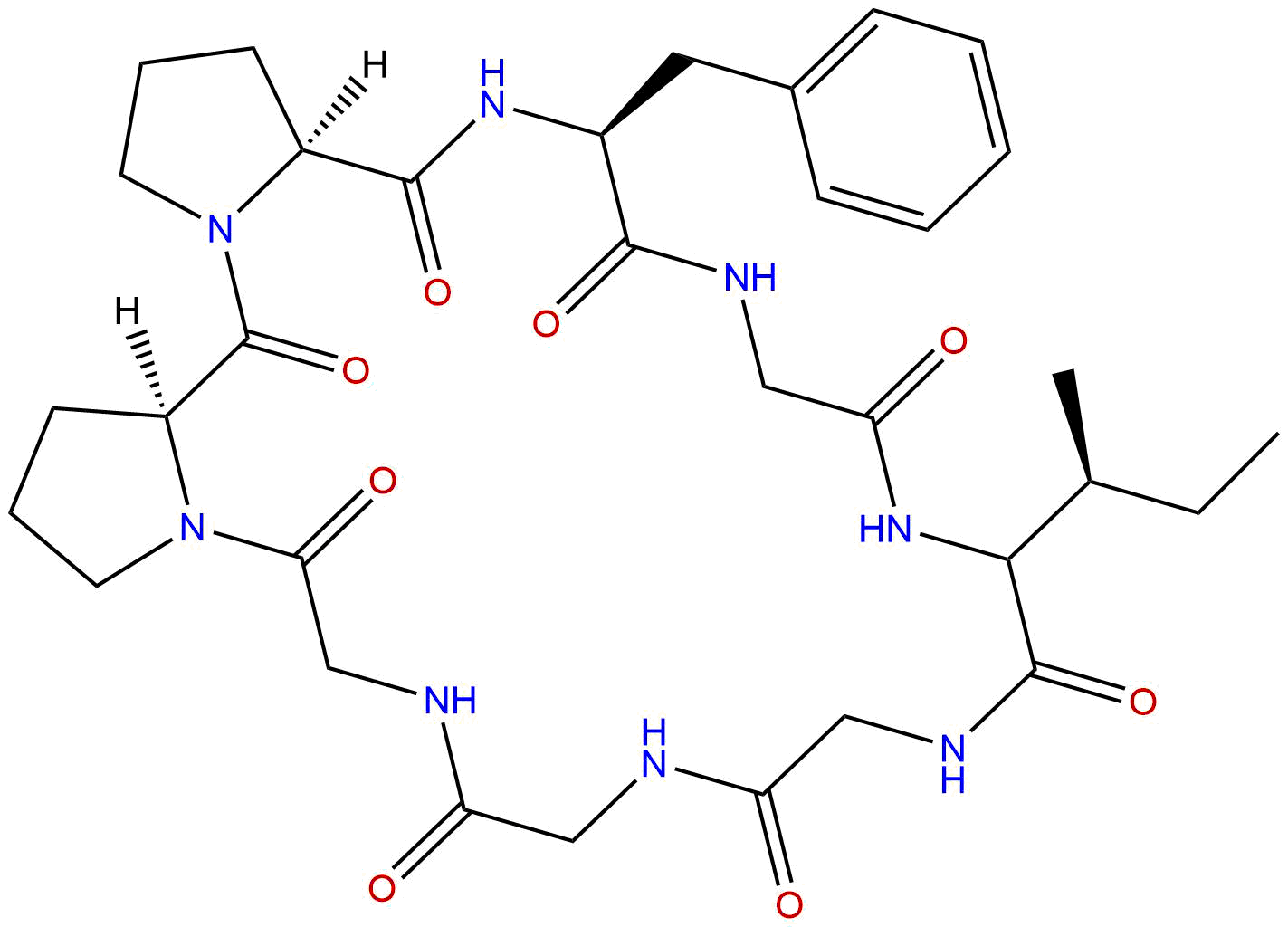


Product name: Pseudostellarin B
Synonym name:
Catalogue No.: BP2277
Cas No.: 156430-21-6
Formula: C33H46N8O8
Mol Weight: 682.779
Botanical Source: Pseudostellariae radix
Type of Compound: Botanical Cyclopeptides
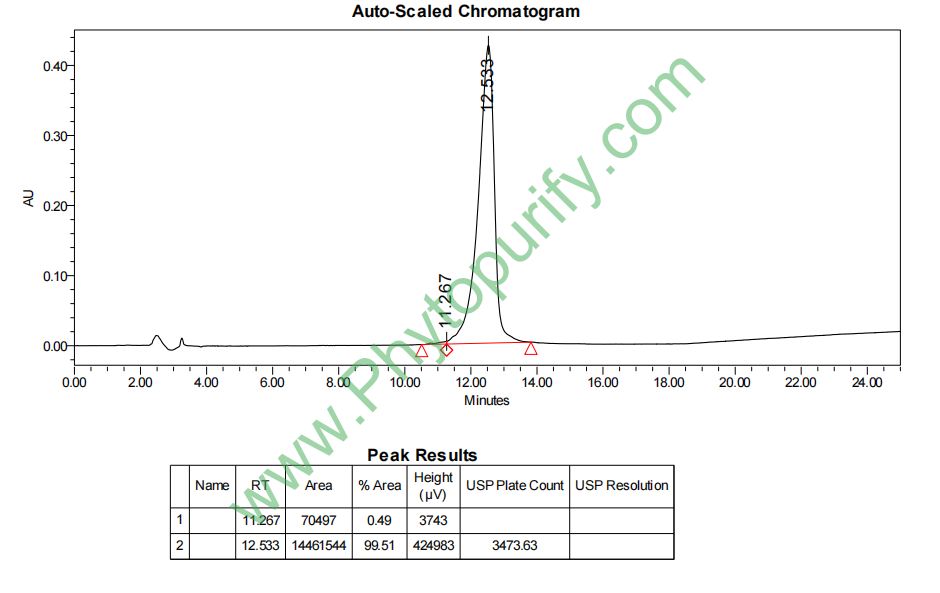
Purity: 95%~99%
Analysis Method: HPLC-DAD or/and HPLC-ELSD
Identification Method: Mass, NMR
Packing: Brown vial or HDPE plastic bottle
Storage: Store in a well closed container, protected from air and light. Put into refrigerate or freeze for long term storage.
Whenever possible, you should prepare and use solutions on the same day. However, if you need to make up stock solutions in advance, we recommend that you store the solution as aliquots in tightly sealed vials at -20℃. Generally, these will be useable for up to two weeks.
The product could be supplied from milligrams to grams
Inquire for bulk scale.
For Reference Standard and R&D, Not for Human Use Directly.
HPLC of Pseudostellarin B
Storage conditions:Short-term storage at 2~8℃, long-term storage at -20 ~ -80℃
215.2200
-.9610
-.9610
7.3791
.5260
1.5451
Low
65.0265
4.9996
Yes
Yes
No
No
Yes
No
0.0
Yes
Yes
Yes
Yes
Natural products, as important resources for drug development, have shown great potential in the field of anti-tumor due to their structural diversity and rich biological activity. Pseudostellarin B (Chinese name: Pseudostellarin B) is a natural product isolated from traditional Chinese medicinal materials, which has received widespread attention in recent years due to its significant inhibitory effect on malignant tumors such as leukemia. Leukemia, as a type of malignant tumor originating from hematopoietic cells in the bone marrow, is difficult to treat and has a high recurrence rate. There is an urgent need for new, efficient, and low toxicity therapeutic drugs. Pseudostellarin B exhibits excellent anti leukemia activity through multi-target regulation of tumor cell proliferation, apoptosis, and signaling pathways, and has high research and development value.
This article will provide a systematic review of the chemical structure and physicochemical properties, plant sources and extraction methods, pharmacological activity and mechanism of action, pharmacological evaluation and pharmacokinetic characteristics of Pseudostellarin B, and explore its potential clinical development prospects in leukemia treatment.
The molecular formula of Pseudostellarin B is C34H50O14, with a molecular weight of 682.7790, and it belongs to the glycoside class of natural products. Its structural features include multiple hydroxyl and glycosidic bonds, giving it high polarity and water solubility. The LogP value is -0.9610, indicating that it has strong hydrophilicity, is not easily able to pass through lipid membranes, and has low blood-brain barrier permeability (BBB low), which has a positive significance for reducing the risk of central nervous system toxicity. The TPSA (Topological Polarity Surface Area) is 215.2200, further supporting its high polarity characteristic. The water solubility index is 7.3791, indicating good solubility in aqueous phase, which is beneficial for the development of oral or intravenous drug formulations.
In addition, Pseudostellarin B did not exhibit hERG channel inhibitory activity, indicating a low risk of cardiac toxicity; The Ames test result is 0.0, indicating no genetic toxicity risk. These physical, chemical, and safety parameters provide a solid foundation for its medicinal properties.
Pseudostellarin B mainly comes from traditional Chinese medicinal plants of the genus Pseudostellaria, especially species such as Pseudostellaria heterophylla. This plant is widely used in traditional Chinese medicine for nourishing qi and yin, strengthening the spleen and lungs, and other purposes. Pseudostellarin B, as one of its main active ingredients, has been isolated, purified, and extensively studied in recent years.
The extraction method usually uses water extraction or alcohol extraction combined with column chromatography technology. The specific steps include:
In recent years, ultrasound assisted extraction and microwave-assisted extraction technologies have been introduced, significantly improving the extraction efficiency and purity of Pseudostellarin B, laying the foundation for its large-scale production.
Pseudostellarin B exhibits significant anti leukemia activity in various in vitro and in vivo models. Its main pharmacological effects include:
Anti tumor proliferation Pseudostellarin B can effectively inhibit the proliferation of leukemia cell lines (such as HL-60, K562, etc.), showing a dose-dependent inhibitory effect. MTT and CCK-8 cell viability assays showed IC50 values at the micromolar level, indicating strong cytotoxicity.
Inducing cell apoptosis Through flow cytometry analysis, Pseudostellarin B can significantly induce early and late apoptosis in leukemia cells. The expression of apoptosis related proteins, such as BCL2 family members, undergoes significant changes in regulation, with upregulation of pro apoptotic protein BAX and downregulation of anti apoptotic protein BCL2.
cell cycle arrest Pseudostellarin B can cause leukemia cells to be arrested in G0/G1 or G2/M phases, blocking the cell cycle progression and reducing cell proliferation rate.
Anti inflammatory and immune regulation Partial studies have shown that Pseudostellarin B can regulate immune cell activity in the tumor microenvironment, inhibit the expression of pro-inflammatory cytokines, and enhance the body's immune surveillance function.
Antioxidant effect Pseudostellarin B protects cells from oxidative damage and indirectly inhibits tumor progression by clearing free radicals and regulating intracellular redox balance.
The anti leukemia mechanism of Pseudostellarin B involves multiple signaling pathways and key molecular targets, mainly including:
MCL1 and BCL2 As anti apoptotic proteins, MCL1 and BCL2 play a crucial role in the survival of leukemia cells. Pseudostellarin B promotes cell apoptosis by downregulating the expression of these two proteins, relieving the inhibition of apoptosis.
NOTCH1 signal pathway NOTCH1 is crucial in regulating the proliferation and differentiation of leukemia cells. Pseudostellarin B can inhibit NOTCH1 activity, block abnormal signal transduction, and suppress tumor cell growth.
STAT3 As a transcription factor, STAT3 regulates the expression of various tumor promoting genes. Pseudostellarin B inhibits STAT3 phosphorylation, weakens its transcriptional activity, and suppresses tumor cell proliferation and immune escape.
MAPT (microtubule associated protein tau)By affecting microtubule dynamics, Pseudostellarin B may interfere with cytoskeletal stability and hinder tumor cell division.
IDH1 (isocitrate dehydrogenase 1)IDH1 mutations are common in certain subtypes of leukemia, and Pseudostellarin B has a regulatory effect on IDH1 activity, which may affect tumor metabolic reprogramming.
TOP1 and TOP2A (Topoisomerase I and II α)These two enzymes are key enzymes in DNA topology regulation. Pseudostellarin B induces tumor cell death by inhibiting its activity, blocking DNA replication and transcription.
PIK3CA (Phosphatidylinositol 3-kinase catalytic subunit alpha)The PI3K/AKT signaling pathway is an important pathway for tumor cell survival and proliferation. Pseudostellarin B inhibits PIK3CA activity and interferes with downstream signaling.
TP53 (tumor suppressor protein p53)As a regulatory center for cell cycle and apoptosis, Pseudostellarin B can activate the TP53 pathway and promote tumor cell apoptosis.
In summary, Pseudostellarin B exerts a synergistic effect through multiple targets and pathways to comprehensively regulate the survival and death of leukemia cells, demonstrating its potential as a multi-target anti-tumor drug.
The pharmacological evaluation of Pseudostellarin B shows that it has good safety and drug compatibility. Its physicochemical properties indicate good water solubility, making it convenient for formulation development. However, the lower LogP and high TPSA suggest limited cell membrane permeability, which may affect oral bioavailability.
The low permeability of the blood-brain barrier reduces the risk of central nervous system side effects. Inhibition of negative hERG channels reduces the risk of cardiac toxicity. A negative Ames test indicates no genetic toxicity and meets the requirements for safe drug use.
In terms of pharmacokinetics, existing animal experimental data shows that Pseudostellarin B is slowly absorbed after oral administration, with a moderate plasma half-life, mainly metabolized through the liver, and excreted mainly through bile and urine. Its metabolites still need further identification. Due to its high polarity, strategies for enhancing bioavailability such as nanocarriers and liposome encapsulation are currently being studied.
Given the multi-target anti-tumor activity and good safety demonstrated by Pseudostellarin B in leukemia cells, its clinical development prospects are promising in the future. Specific application prospects include:
New adjuvant therapy for leukemia Can be used as an adjuvant drug in existing chemotherapy regimens to enhance efficacy and reduce drug resistance.
Targeted therapy drug development By combining its regulatory effects on multiple key oncogenic targets, develop precise targeted drugs to enhance treatment selectivity and efficacy.
Combination therapy strategy: Used in combination with targeted drugs, small molecule inhibitors, or immunotherapy drugs to exert synergistic anti-tumor effects.
Drug formulation innovation Using nanotechnology and sustained-release systems to improve its pharmacokinetic properties, enhance bioavailability and targeting.
Expansion of other tumors and diseases Given its ability to regulate multiple signaling pathways, the potential of Pseudostellarin B in other malignant tumors and immune related diseases deserves further exploration.
However, preclinical and clinical research on Pseudostellarin B is still in its early stages, and in the future, there is a need to strengthen systematic research on pharmacodynamics, safety, pharmacokinetics, and formulation processes to promote its clinical translation.
Pseudostellarin B, as a natural product derived from traditional Chinese medicine, has shown great potential as a novel anti-tumor drug due to its unique chemical structure and multi-target anti leukemia activity. Its good safety and pharmacological parameters provide a solid foundation for subsequent drug development. In the future, through in-depth analysis of its mechanism of action, optimization of drug formulations, and systematic preclinical research, it is expected to promote the clinical application of Pseudostellarin B and bring new treatment options for leukemia patients.
In summary, Pseudostellarin B not only enriches the natural product anti-tumor drug library, but also provides an important example for multi-target anti-cancer strategies, which deserves continuous attention and in-depth research in the fields of pharmacology and drug development.
