Introduction/Overview
As a common and serious nervous system disease, cerebral ischemia has attracted much attention due to its high incidence rate, high disability rate and high mortality. Cerebral ischemia leads to insufficient blood supply to brain tissue, which in turn causes neuronal hypoxia, energy metabolism disorders, and inflammatory reactions, ultimately resulting in nerve damage and functional impairment. The current clinical treatment methods are limited and there are many side effects, which urgently require the development of new effective therapeutic drugs. Natural products have become an important source for exploring new drugs for the treatment of cerebral ischemia due to their structural diversity and rich biological activity.
Heterophyllin J (HJ), derived from plants, is a natural cyclic peptide with unique chemical structure and multi-target regulatory ability. In recent years, with the in-depth study of its pharmacological activity and mechanism of action, the potential therapeutic value of HJ in cerebral ischemia and related neurological diseases has gradually emerged. This article aims to systematically review the chemical structure, sources, pharmacological activity, mechanism of action, and drug evaluation of Taizi Shen cyclic peptide J, and explore its application prospects in the treatment of cerebral ischemia, in order to provide reference for related research and clinical translation.
Chemical structure and physicochemical properties
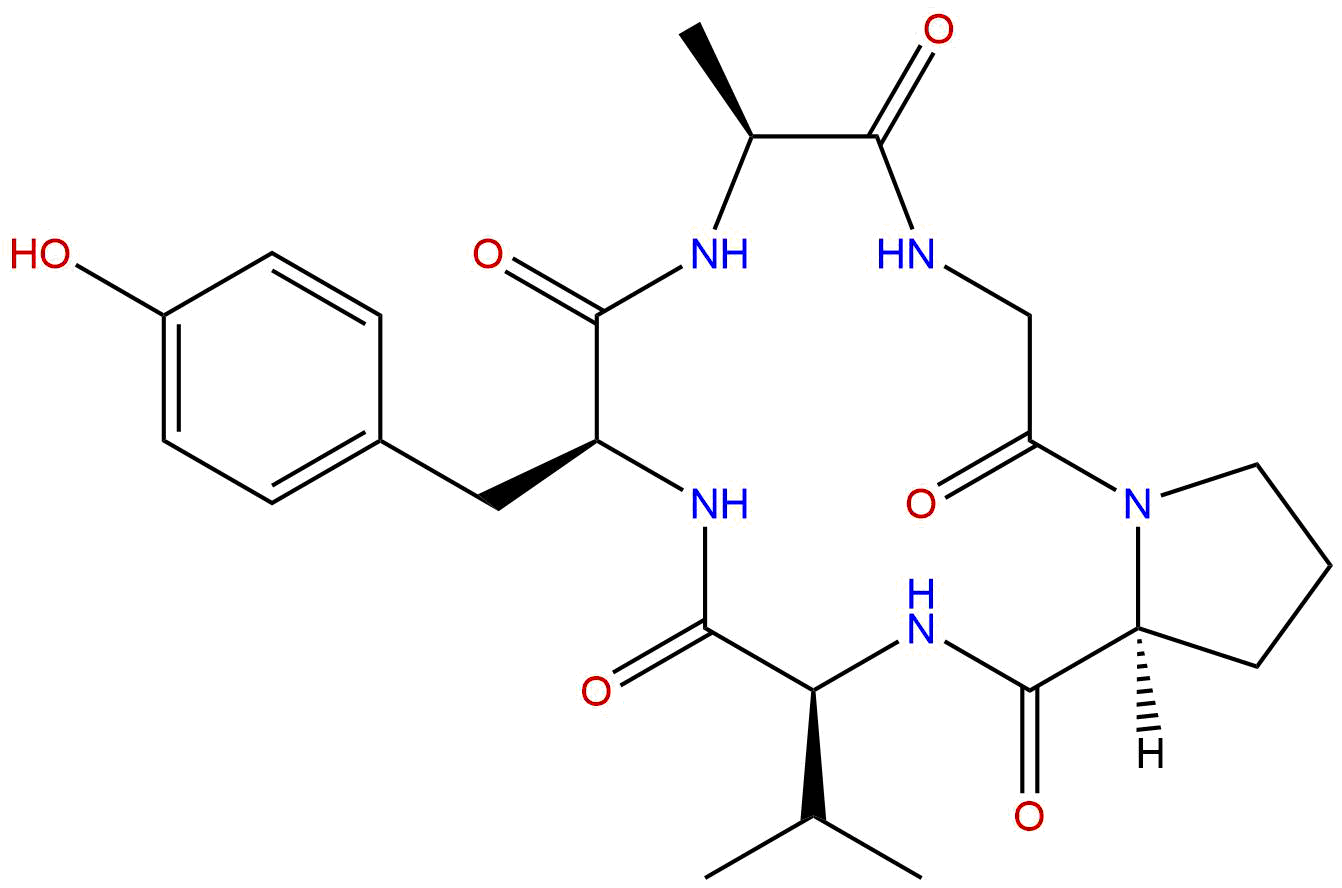
Taizishen cyclic peptide J is a cyclic peptide compound with a molecular formula of C24H34N6O6 and a molecular weight of 487.5570. Its structural characteristics include multiple amino acid residues cyclizing through peptide bonds to form a stable cyclic peptide skeleton, which has high chemical stability and biological activity. Its LogP value is -0.6534, indicating strong hydrophilicity; The topological polar surface area (TPSA) is 156.94 Å ², indicating that the molecule has a large number of polar groups, which are conducive to forming hydrogen bonds and polar interactions with biomolecules.
The water solubility of Taizishen cyclic peptide J is 3.5627, indicating its good solubility in aqueous phase, which is beneficial for absorption and distribution in vivo. The low permeability of the blood-brain barrier (BBB) suggests limited ability to directly enter the central nervous system, but this may also reduce the risk of central toxicity. The hERG channel inhibition test result was negative, indicating a low risk of cardiac toxicity. The Ames mutagenicity test showed a value of 0.0, indicating a low risk of genetic toxicity and meeting safety requirements.
Plant sources and extraction methods
The cyclic peptide J of Panax ginseng is mainly derived from Panax ginseng(Pseudostellaria heterophylla)This is a traditional Chinese medicinal herb widely distributed in the eastern and central regions of China. Taizishen has a long history of application in the field of traditional Chinese medicine due to its effects of nourishing qi and yin, strengthening the spleen and benefiting the lungs. Cyclic peptide compounds are one of the important active ingredients in Panax ginseng, and cyclic peptide J of Panax ginseng is a representative component among them.
The common methods for extracting the cyclic peptide J from Panax ginseng include organic solvent extraction, ultrasound assisted extraction, and column chromatography separation technology. The general steps are as follows: first, extract the dried ginseng powder with methanol or ethanol to obtain a crude extract; Subsequently, preliminary purification was carried out through liquid-liquid distribution and silica gel column chromatography; Finally, high performance liquid chromatography (HPLC) was used for further separation and purification to obtain high-purity Taizi ginseng cyclic peptide J. In recent years, the application of supercritical fluid extraction and membrane separation technology has improved extraction efficiency and purity, reduced solvent usage, and is in line with the concept of green chemistry.
Pharmacological activity research
Tai Zi Shen cyclic peptide J has shown significant potential in various pharmacological activities, especially in the fields of neuroprotection and anti-inflammatory. Its main pharmacological activities include:
-
Neuroprotective effect
HJ can alleviate cerebral ischemia-reperfusion injury, reduce neuronal apoptosis rate, and improve neurological deficits. In vitro experiments have shown that HJ has a protective effect on nerve cells in hypoxia ischemia models, can inhibit oxidative stress and inflammatory reactions, and maintain intracellular homeostasis.
-
anti-inflammatory effect
HJ significantly inhibits the inflammatory response after cerebral ischemia by regulating the expression of various inflammatory factors. Its mechanism of action involves downregulating pro-inflammatory cytokines such as tumor necrosis factor alpha (TNF - α), reducing the activation of microglia and astrocytes, and inhibiting the release of inflammatory mediators.
-
Antioxidant effect
Research has found that HJ can enhance intracellular antioxidant enzyme activity, reduce reactive oxygen species (ROS) generation, alleviate oxidative damage, and protect neurons from oxidative stress-induced damage.
-
Regulating neurotransmitters and signaling pathways
HJ may promote neural repair and functional recovery by regulating the protein kinase C (PRKCA) and mitogen activated protein kinase 1 (MAPK1) signaling pathways. In addition, its regulation of amyloid precursor protein (APP) and β - secretase 1 (BACE1) suggests its potential application value in neurodegenerative diseases.
Mechanism of action and molecular targets
The multi-target mechanism of action of Taizishen cyclic peptide J is the basis for its significant pharmacological activity. Through in vitro and in vivo experiments and molecular docking studies, it has been confirmed that its main targets include:
-
APP (amyloid precursor protein)
APP plays a crucial role in cerebral ischemia and neurodegenerative diseases. HJ can regulate the expression and metabolism of APP, reduce harmful β - amyloid deposition, and alleviate neurotoxicity.
-
BACE1 (β - secretase 1)
BACE1 is a key enzyme involved in APP cleavage and is involved in the generation of β - amyloid protein. HJ inhibits BACE1 activity, blocks abnormal protein accumulation, and protects neurons.
-
PTPN1 (protein tyrosine phosphatase 1)
PTPN1 is involved in cellular signal transduction, regulating inflammation and metabolic responses. HJ improves neuronal metabolism and anti-inflammatory ability by regulating PTPN1 activity.
-
ABCB1 (ATP binding cassette transporter B1)
ABCB1 plays an important role in the blood-brain barrier function, affecting the transport of drugs and metabolites. HJ may improve the stability of the brain tissue environment by regulating ABCB1.
-
APEX1 (DNA lyase)
APEX1 participates in DNA repair and antioxidant reactions. HJ activates APEX1, enhances cell self repair ability, and reduces ischemic injury.
-
PRKCA (protein kinase C alpha) and MAPK1 (mitogen activated protein kinase 1)
These two signaling pathways are crucial in cell survival, inflammation, and repair. HJ regulates its signal transduction, promoting neuroprotection and regeneration.
-
CLEC4E (C-type lectin like receptor 4E) and TNF (tumor necrosis factor)
Participate in immune inflammatory response. HJ reduces inflammatory damage and promotes neurological function recovery by inhibiting the expression of CLEC4E and TNF.
In summary, the cyclic peptide J of Panax ginseng exerts its neuroprotective and anti-inflammatory effects through multi-target and multi pathway synergistic regulation, demonstrating the advantages of natural product multi-target therapy for cerebral ischemia.
Evaluation of drug properties and pharmacokinetics
From the perspective of medicinal properties, the cyclic peptide J of Panax ginseng has certain advantages and challenges:
-
Molecular weight and physicochemical properties
The molecular weight of 487.5570 belongs to the moderate range, with a negative LogP value, indicating good water solubility and facilitating in vivo distribution and absorption. However, the high TPSA value (156.94) and low blood-brain barrier permeability limit its ability to directly enter the central nervous system, suggesting the need to improve brain delivery through drug carriers or structural modifications.
-
safety
The negative inhibition of hERG channel and the absence of mutagenicity in Ames test indicate that HJ has good safety and low risk of cardiac toxicity, laying the foundation for clinical application.
-
pharmacokinetics
At present, there is limited research on the pharmacokinetics of HJ in vivo. Preliminary data indicates that HJ is rapidly absorbed orally, but its bioavailability is limited and its half-life is moderate. Its metabolic pathway mainly involves the liver enzyme system, and excretion is mainly through the kidneys. In the future, it is necessary to strengthen research on its metabolic stability, in vivo distribution, and brain concentration, and optimize the dosing regimen.
-
Formulation development
Due to the low permeability of the blood-brain barrier, the development of nanocarriers, liposomes, and other drug delivery systems will help improve the concentration and therapeutic effect of HJ in the brain. In addition, structural modification and prodrug design are also effective strategies to enhance its pharmacological properties.
Clinical application prospects and prospects
As a natural product with multi-target neuroprotective effects, Taizishen cyclic peptide J has shown broad application prospects in the treatment of cerebral ischemia and related neurological diseases. Its ability to resist inflammation, oxidation, and regulate neural signaling pathways provides important basis for the development of new drugs for the treatment of cerebral ischemia.
Future research directions include:
-
In depth mechanism research
Using genomics, proteomics, and metabolomics techniques, further elucidate the molecular network and signaling pathways of HJ action, and clarify its specific regulatory mechanism in cerebral ischemic pathology.
-
Pharmacokinetic and pharmacodynamic studies
Systematically evaluate the in vivo metabolism, distribution, and clearance characteristics of HJ, optimize the administration route and dosage form, and improve its bioavailability and effective concentration in the brain.
-
Structural optimization and formulation development
By chemical modification and nanotechnology, the drug properties and brain delivery efficiency can be improved, enhancing the therapeutic effect.
-
Preclinical and clinical research
Carry out systematic animal model validation and safety evaluation, gradually advance to clinical trials, and evaluate its efficacy and safety in patients with cerebral ischemia.
-
Development of indications for multiple diseases
Explore the potential application of HJ in neurodegenerative diseases such as Alzheimer's disease and Parkinson's disease, and broaden its clinical indications.
Conclusion
As a natural cyclic peptide derived from the traditional Chinese medicine Taizishen, Taizishen cyclic peptide J has shown significant potential in neuroprotection and anti-inflammatory treatment of cerebral ischemia due to its unique chemical structure and multi-target regulatory ability. Its good safety and multiple pharmacological activities provide a solid foundation for the development of new drugs. However, the low permeability of the blood-brain barrier and pharmacokinetic properties remain key issues that urgently need to be addressed. In the future, through in-depth mechanism research, structural optimization, and the application of advanced formulation technology, Taizishen cyclic peptide J is expected to become an important innovative drug in the treatment of cerebral ischemia and related neurological diseases. Continuous basic and clinical research will drive it from the laboratory to clinical applications, benefiting a wide range of patients.