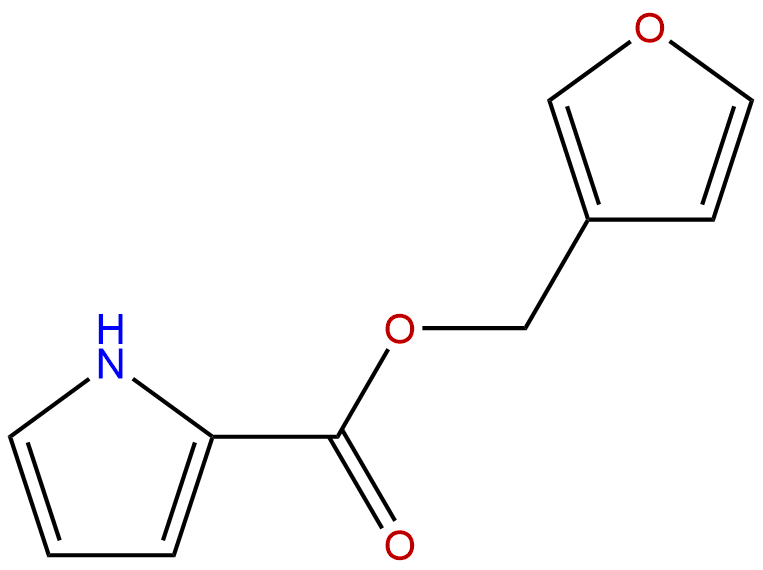


Product name: 3-Furfuryl 2-pyrrolecarboxylate
Synonym name:
Catalogue No.: BP2016
Cas No.: 119767-00-9
Formula: C10H9NO3
Mol Weight: 191.186
Botanical Source:
Physical Description: Oil
Type of Compound: Alkaloids
Purity: 95%~99%
Analysis Method: HPLC-DAD or/and HPLC-ELSD
Identification Method: Mass, NMR
Packing: Brown vial or HDPE plastic bottle
The product could be supplied from milligrams to grams. Inquire for bulk scale.
We provide solution to improve the water-solubility of compounds, thereby facilitating the variety of activity tests and clinic uses.
For Reference Standard and R&D, Not for Human Use Directly.
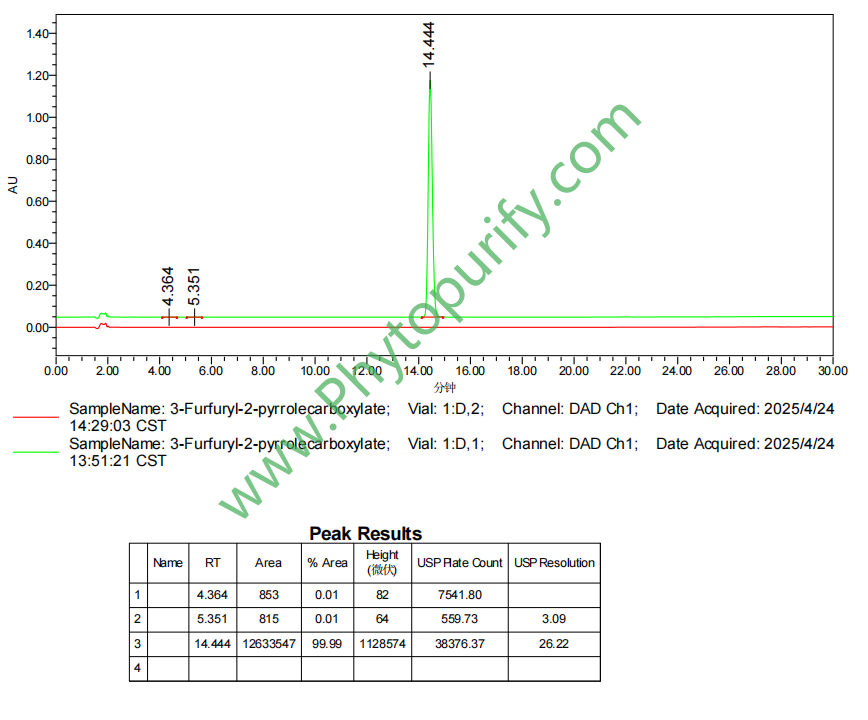
HPLC of 3-Furfuryl 2-pyrrolecarboxylate
Storage conditions:Short-term storage at 2~8℃, long-term storage at -20 ~ -80℃
55.2300
1.7875
1.7875
.2063
3.4025
11.9511
High
79.8082
2.5432
Yes
No
No
No
Yes
No
0.6
No
Yes
No
Yes
1H-pyrrole-2-carboxylic acid 3-furfuryl methyl ester (CAS: 119767-00-9) is a traditional medicinal plant derived from太子参(Pseudostellaria heterophylla)Natural nitrogen-containing heterocyclic compounds obtained from root separation. As a member of pyrrole derivatives, this compound has attracted attention in the fields of natural product chemistry and drug development in recent years due to its unique chemical structure and preliminary revealed potential antibacterial activity. As a famous traditional Chinese medicine known for its ability to nourish qi and invigorate the spleen, the study of its chemical composition has always been an important direction in revealing the material basis of its pharmacological effects. The discovery of this compound not only enriches the chemical composition spectrum of Panax ginseng, but more importantly, its potential to target multiple key enzymes (such as GYRA, DHFR, ERBB2, etc.) suggests its role in combating gram-positive bacterial infections It may have important biological activity in the field of diseases. This article will provide a systematic and professional popular science interpretation of this compound from its chemical essence, plant origin, pharmacological mechanism, medicinal evaluation, and research prospects, aiming to provide a clear and rigorous scientific cognitive framework for researchers in related fields.
The molecular formula of this compound is C10H9NO3 The molecular weight is 191.1860 g/mol It belongs to medium to small organic molecules. Its structural features are distinct, consisting of two important heterocyclic systems connected by ester bonds: one end is 1H-pyrrole-2-carboxylic acid Fragment, on the other end is 3-furylmethyl(also known as bran based) fragments. Its SMILES represents(O=C(OCc1ccoc1)c1ccc[nH]1)Accurately describing this connection method: a carboxylic acid ester(O=C(OCC...))Connected to a furan ring(c1ccoc1)And a pyrrole ring(c1ccc[nH]1). The nitrogen atom on the pyrrole ring acts as a secondary amine([nH])Form exists, which is the origin of its 1H pyrrole naming, and also means that the nitrogen atom has the potential to form hydrogen bonds.
From the analysis of physicochemical parameters related to drug properties:
- Lipid water partition coefficient (LogP/LogD): All are 1.7875 The value is within the ideal range (LogP is generally considered to be between 1-3), indicating that the compound has moderate lipophilicity, can penetrate cell membranes, and will not cause metabolic or distribution problems due to excessive lipophilicity.
- Topological Polarity Surface Area (TPSA): For 55.23 ŲThis mainly comes from the carbonyl oxygen and ether oxygen of ester bonds, as well as the nitrogen atom of pyrrole ring. This value is lower than the common high permeability threshold (about 60-70 Å ²), indicating that it may have good membrane permeability.
- Water solubility The value is 0.2063(The unit may be a numerical value at the mg/mL or log mol/L scale, usually indicating limited but acceptable solubility). Combined with its LogP value, it conforms to the typical characteristics of "moderately lipophilic" compounds.
- Molecular weight (MW)191.19, far below 500 Da, meets the basic requirements of small molecule drugs.
These basic physicochemical properties lay the foundation for its potential biological activity and preliminarily meet the structural requirements as a drug lead compound.
The only known natural source of this compound is太子参That is Pseudostellaria heterophylla (Miq.) Pax It belongs to the Caryophyllaceae family of plants. Tai Zi Shen is a traditional and precious Chinese medicinal herb, mainly produced in Fujian, Guizhou, Jiangsu and other places. Its dried root is used as medicine. In traditional Chinese medicine theory, Taizi Shen has a flat nature, a sweet and slightly bitter taste, and is associated with the spleen and lung meridians Nourishing Qi and Strengthening Spleen, Generating Fluid and Moisturizing Lungs The efficacy. It is commonly used in clinical practice to treat spleen deficiency, fatigue, loss of appetite, post illness weakness, deficiency of qi and yin, spontaneous sweating and thirst, lung dryness and dry cough, etc. It is a commonly used supplement in pediatrics and is known as "Hai'er Shen".
Modern pharmacological research has confirmed that extracts of Panax ginseng have various activities such as anti fatigue, immune enhancement, antioxidant, cough suppression, and blood glucose lowering. Its chemical composition is complex, mainly including polysaccharides, cyclic peptides, saponins, volatile oils, amino acids, fatty acids, and various trace elements.1H-pyrrole-2-carboxylic acid 3-furylmethyl ester As a volatile or moderately polar component obtained from the root of Panax ginseng, its discovery has expanded the chemical diversity of active ingredients in Panax ginseng. Although its content and direct contribution in traditional water decoction are not yet clear, as a secondary metabolite of plants, it is likely to participate in the plant's own defense system (such as antibacterial and insect resistance), which is consistent with the potential antibacterial targets revealed by modern research. From the perspective of natural product chemistry, discovering structurally novel active molecules from traditional medicinal plants is an important way to search for lead compounds for new drugs.
The database information shows that the compound has potential interactions with five specific protein targets:GYRA, GYRB, DHFR, FOLA, and ERBB2 These targets mainly target two major therapeutic areas:Antibacterial and antitumor Combined with its related disease labeling as' Gram positive bacteria ', its primary potential pharmacological activity is likely to be Antibacterial effect。
Inhibition of DNA gyrase (targets: GYRA, GYRB):
DNA gyrase is a key enzyme unique to bacteria (especially Gram positive and some Gram negative bacteria) that maintains the supercoiled structure of DNA, consisting of two subunits, GyrA and GyrB. It is a classic target of quinolone antibiotics such as ciprofloxacin. If the compound can inhibit this enzyme, it will hinder the replication, transcription, and repair of bacterial DNA, leading to bacterial death. The compound is predicted to act simultaneously with GYRA and GYRB, suggesting that it may bind or affect the function of the enzyme complex in a way different from typical quinolones, providing clues for the development of novel antibacterial drugs.
Inhibition of dihydrofolate reductase (target: DHFR):
Dihydrofolate reductase is a key enzyme in the bacterial folate synthesis pathway, responsible for reducing dihydrofolate to tetrahydrofolate. Tetrahydrofolate is an essential cofactor for the synthesis of nucleic acid precursors such as purine and thymine. Trimethoprim (TMP) is a classic bacterial DHFR inhibitor. Inhibiting DHFR will cause bacteria to become "hungry" and unable to synthesize DNA and RNA, thereby inhibiting their growth and reproduction. This compound targets DHFR, further enhancing its function as Antimicrobial agents against metabolism The potential.
Targeting folate synthase (target: FOLA):
FOLA may refer to enzymes related to folate synthesis, such as dihydropteroate synthase (DHPS), which is the target of sulfonamide drugs. The folate synthesis pathway is crucial for bacteria, and mammalian cells can directly uptake folate from food, making this pathway an ideal antibacterial target. Simultaneously targeting DHFR and FOLA related targets implies that the compound may possess Double blockade of folate metabolism The potential to generate synergistic antibacterial effects and potentially delay the development of drug resistance.
ERBB2 (also known as HER2) is a member of the human epidermal growth factor receptor family and a transmembrane protein with tyrosine kinase activity. Overexpression or activation of ERBB2 is closely related to invasive growth, metastasis and poor prognosis of many cancers (especially breast cancer and gastric cancer). Trastuzumab (Herceptin) is a monoclonal antibody drug that targets ERBB2. A natural small molecule compound was predicted to interact with ERBB2, suggesting its potential to regulate this signaling pathway and inhibit tumor cell proliferation. This provides a possible modern explanation for the traditional efficacy of Taizishen in "supporting the body and fighting cancer", although this requires strict experimental verification.
Summary of mechanism of action Overall, the most prominent potential activity of 1H-pyrrole-2-carboxylic acid 3-furylmethyl ester is its ability to target Gram positive bacteria The antibacterial effect. It may pass through Multi target collaboration The mechanism works by attacking the DNA replication machine of bacteria (inhibiting DNA gyrase) and disrupting the synthesis of essential nutrients (inhibiting folate metabolism pathway). This multi-target characteristic, if experimentally confirmed, may mean stronger antibacterial effects and the advantage of less susceptibility to drug resistance. At the same time, its potential effect on ERBB2 opens another window for its application in the field of anti-tumor.
Based on the provided pharmacokinetic parameters, we can use standards such as Lipinski's Rule of Five to preliminarily evaluate the potential of this compound as an oral drug lead structure:
Number of hydrogen bond acceptors (HBA)There are 2 oxygen atoms in the ester group and 1 ether oxygen atom in the furan ring, totaling 3 (strictly calculated as N and O atoms), so HBA=4 (N1, O3)<10, Comply with。
This compound fully complies with Lipinski's five rules, indicating its good oral absorption potential.
Absorption and distribution:
Plasma protein binding rate (PPB):79.81%It belongs to the moderate to high level. This means that in the blood, most drugs bind to plasma proteins (mainly albumin), and only about 20% of free drugs can exert pharmacological effects. This will affect the distribution volume and effective concentration of the drug, which may need attention in subsequent optimization.
Metabolism and toxicity:
Summary of Drug Evaluation This compound is present in Pharmacokinetic properties Excellent performance in terms of absorption and distribution, fully in line with the five principles of generic drugs, and without the risk of hERG inhibition. However, it Potential genetic toxicity and hepatotoxicity signals It is the main obstacle hindering its further development. In the subsequent optimization of medicinal chemistry, the primary task is to eliminate or significantly reduce these toxicities through structural modifications (such as introducing specific functional groups, altering heterocyclic systems) while preserving their multi-target antibacterial activity as much as possible.
At present, there is relatively limited public research information on 1H-pyrrole-2-carboxylic acid 3-furylmethyl ester, mainly focusing on its isolation and identification from Panax ginseng. Its rich target prediction information and preliminary pharmacological analysis mainly come from mining computational chemistry and bioinformatics databases. Therefore, the compound is currently still in Very early stage of lead compound discovery。
Future research directions and prospects:
Research on the mechanism of action Through time bactericidal curves, resistance induction experiments, synergistic studies with existing antibiotics, and the use of transcriptomics, metabolomics, and other methods, comprehensively elucidate its antibacterial mode of action.
Structural optimization and improvement of drug properties:
Property optimization Although its ADME properties are generally good, it can still be fine tuned for its high plasma protein binding rate to improve its pharmacological properties.
Expand research areas:
Application Prospects If its potent and multi-target antibacterial activity is experimentally confirmed, and the toxicity problem can be successfully solved through structural optimization, this compound is expected to develop into a promising candidate New antibiotics targeting multidrug-resistant Gram positive bacteria such as MRSA Its potential to penetrate the blood-brain barrier makes it uniquely valuable in treating central nervous system infections. In addition, as a natural product derived from traditional Chinese medicine, its research itself is also an important component of the modernization and internationalization of Chinese medicine, which helps to explain the scientific connotation of Taizishen's "tonifying qi and strengthening the body" (possibly by regulating immunity or microecology) at the molecular level.
In summary, 1H-pyrrole-2-carboxylic acid 3-furylmethyl ester is a natural lead compound with a novel structure, abundant targets, and good pharmacological basis. Despite facing toxicity challenges, it undoubtedly provides a valuable starting point for addressing the increasingly severe problem of bacterial resistance and new drug development. Future research needs to be based on rigorous scientific experiments, fully tap into its potential, avoid its risks, and promote it from a single molecule in the database to a true candidate drug.
