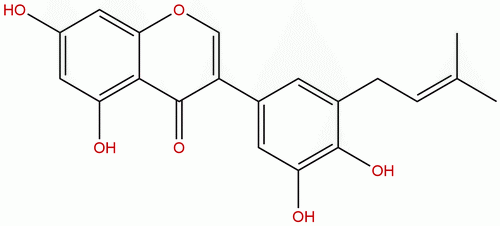


Product name: Glycyrrhisoflavone
Synonym name: Glycyrrhisoflavone
Catalogue No.: SBP03481
Cas No.: 116709-70-7
Formula: C20H18O6
Mol Weight: 354.358
Botanical Source:
Physical Description:
Type of Compound: Flavonoids
Purity: 95%~99%
Analysis Method: HPLC-DAD or/and HPLC-ELSD
Identification Method: Mass, NMR
Packing: Brown vial or HDPE plastic bottle
The product could be supplied from milligrams to grams
Inquire for bulk scale.
For Reference Standard and R&D, Not for Human Use Directly.
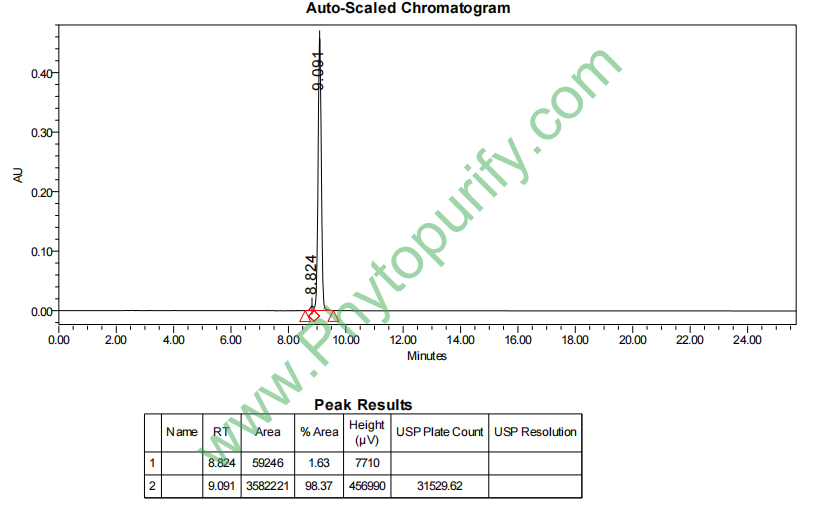
HPLC of Glycyrrhisoflavone
Storage conditions:Short-term storage at 2~8℃, long-term storage at -20 ~ -80℃
111.1300
3.2090
2.9335
.0327
2.3537
28.1188
Low
91.0378
2.8678
Yes
No
Yes
No
Yes
Yes
0.6
Yes
No
Yes
No
Natural products have always been an important treasure trove for innovative drug discovery, among which flavonoids have attracted much attention due to their broad biological activity and relatively low toxicity. Glycyrrhizinoflavone (CAS number: 116709-70-7), a type of isoprenoid substituted flavonoid isolated from the traditional medicinal plant licorice, has gradually entered the field of pharmacological researchers in recent years. Its unique chemical structure, which introduces isoprene side chains on the flavonoid skeleton, not only affects its physical and chemical properties, but may also endow it with special biological activity that distinguishes it from ordinary flavonoids. Preliminary studies showed that the isoflavones from northwest glycyrrhiza uralensis had significant α - glucosidase inhibitory activity, suggesting its potential value in the management of diabetes. More noteworthy is that this compound exhibits the potential for multi-target action in the field of anti-inflammatory, involving multiple key inflammatory signaling pathways and targets such as IL-6, STAT3, TNF - α, NF - κ B. This article aims to provide a systematic review of the chemical characteristics, plant sources, pharmacological activities, mechanisms of action, and medicinal properties of flavonoids in northwest licorice, in order to provide comprehensive scientific basis for the deep development and utilization of this natural product.
The chemical name of Northwest Licorice Isoflavones is 5,7,4 '- trihydroxy-6-isoprenyl Isoflavones. Its molecular formula is C20H18O6 and its molecular weight is 354.3580. Structurally, it has a typical isoflavone core (3-phenylchromenone) and is connected to an isoprene group (- C5H9) at the 6th position of the A ring. This isoprene modification is a significant structural feature and the key distinguishing factor from other flavonoid components in licorice, such as glycyrrhizin and isoliquiritigenin.
The introduction of isoprene groups significantly affects the physicochemical properties of compounds. Firstly, this group has strong hydrophobicity, resulting in a lipid water partition coefficient (LogP) of 3.2090 for Northwest Glycyrrhiza Isoflavones, indicating its good lipophilicity. This property facilitates its penetration through the cell membrane and interaction with intracellular targets. Secondly, its topological polar surface area (TPSA) is 111.13 Å ², reflecting the hydrogen bonding ability provided by three phenolic hydroxyl groups and one carbonyl oxygen atom in the molecule. However, its strong lipophilicity also leads to poor water solubility, with a calculated value of approximately 0.0327 mg/mL, which may be a limiting factor for its oral bioavailability. From the perspective of medicinal chemistry, this "privileged scaffold" - the combination of isoflavones and isoprene groups - often has high affinity for multiple biological targets, indicating its potential multi-target pharmacological activity.
Northwest licorice isoflavones mainly come from the legume plant licorice genus(Glycyrrhiza)Various plants, especially licorice with swollen fruit(Glycyrrhiza inflata Bat. and licorice with light fruit(Glycyrrhiza glabra L. The roots and rhizomes of. Licorice, as a traditional Chinese medicine with a long history of use, has the effects of tonifying the spleen and qi, clearing heat and detoxifying, dispelling phlegm and cough, relieving pain, and harmonizing various medicines. Modern plant chemistry research has isolated and identified hundreds of components from licorice, including triterpenoid saponins (such as glycyrrhizic acid), flavonoids, coumarins, polysaccharides, etc. Northwest licorice flavonoids are one of the biologically active isoprenoid flavonoids.
Its extraction and separation usually follow the conventional process of natural product chemistry. Firstly, the dried licorice rhizome is crushed and extracted by leaching or reflux with a suitable polar organic solvent (such as methanol, ethanol, or acetone). After concentration, the crude extract is obtained. Subsequently, various chromatographic techniques were used for separation and purification. Silica gel column chromatography is commonly used for preliminary separation, with different ratios of petroleum ether ethyl acetate or chloroform methanol gradient elution. Due to the UV absorption and fluorescence properties of Northwest licorice isoflavones, thin-layer chromatography (TLC) combined with UV lamp detection is a commonly used method to track their separation process. Further purification may involve reversed phase silica gel (such as ODS) column chromatography, dextran gel (Sephadex LH-20) column chromatography, and high performance liquid chromatography (HPLC). In recent years, preparative chromatography techniques such as high-speed counter current chromatography (HSCCC) have also been applied to rapidly and efficiently obtain high-purity Northwest licorice isoflavones. Optimization of extraction processes, such as ultrasound assisted extraction and microwave-assisted extraction, can help improve yield.
The pharmacological activity research of Northwest licorice isoflavones mainly focuses on two aspects: hypoglycemic and anti-inflammatory. Preliminary evidence shows that they have multiple biological effects.
1. α - glucosidase inhibition and hypoglycemic potential:
Alpha glucosidase is a key enzyme located at the brush border of the small intestine, responsible for breaking down dietary polysaccharides into absorbable monosaccharides. Inhibiting its activity can delay the digestion and absorption of carbohydrates and reduce the peak blood sugar after meals, which is one of the important strategies for the treatment of type II diabetes. Northwest licorice isoflavones have been proven to be effective alpha glucosidase inhibitors. In vitro enzyme activity inhibition experiments have shown that its inhibitory effect is significant, with IC50 values typically in the micromolar range. Its strength of action may be comparable or even better than the clinical drug acarbose. The isoprene side chain may bind to the active pocket of the enzyme through hydrophobic interactions, thereby enhancing the inhibitory effect. Studies on animal models (such as streptozotocin induced diabetes mice) have preliminarily shown that intragastric administration of northwest glycyrrhiza isoflavones can effectively reduce the postprandial blood glucose level of diabetes animals, improve glucose tolerance, and no obvious acute toxicity has been observed, suggesting its potential as a new hypoglycemic precursor.
2. Anti inflammatory activity:
Inflammation is the common pathological basis of many chronic diseases (such as arthritis, atherosclerosis, neurodegenerative diseases, metabolic syndrome). Northwest licorice isoflavones have shown strong anti-inflammatory effects in various in vitro and in vivo inflammatory models.
* In vitro model: In a lipopolysaccharide (LPS) - stimulated macrophage model (such as RAW264.7 cells), northwest licorice isoflavones can dose dependently inhibit the excessive production of nitric oxide (NO) and prostaglandin E2 (PGE2), while downregulating the protein and mRNA expression of inducible nitric oxide synthase (iNOS) and cyclooxygenase-2 (COX-2). In addition, it can significantly inhibit the release of pro-inflammatory cytokines such as tumor necrosis factor - α (TNF - α), interleukin-6 (IL-6), and interleukin-1 β (IL-1 β).
* In vivo model: In mouse ear swelling models (induced by xylene or croton oil) and paw swelling models (induced by carrageenan), local or systemic administration of northwest licorice isoflavones can significantly reduce tissue edema and inflammatory cell infiltration. In more complex chronic inflammation models, such as the collagen induced arthritis (CIA) mouse model, this compound has also been reported to alleviate joint swelling and bone destruction, and its effect is related to regulating systemic and local inflammatory factor levels in the joints.
These studies collectively indicate that the anti-inflammatory effect of Northwest Licorice Isoflavones is not through a single pathway, but involves the regulation of multiple nodes in the inflammatory network.
The multi-target anti-inflammatory mechanism of Northwest Licorice Isoflavones is the core of their pharmacological activity. Current research suggests that its functional network covers multiple key signaling nodes from cell membrane receptors to nuclear transcription factors.
1. Regulating the NF - κ B signaling pathway: NF - κ B is the core transcription factor of inflammatory response. Northwest licorice isoflavones can inhibit the activation of LPS induced I κ B kinase (IKK, encoded by IKBKB), prevent the phosphorylation and degradation of I κ B α, and thus inhibit the translocation of NF - κ B dimers (such as p65/RELA) to the nucleus. This directly leads to a decrease in transcription of numerous pro-inflammatory mediators (TNF - α, IL-6, iNOS, COX-2) genes downstream.
2. Regulating the JAK/STAT signaling pathway: Especially the STAT3 pathway plays a crucial role in chronic inflammation and tumorigenesis. Northwest licorice isoflavones can inhibit STAT3 tyrosine phosphorylation induced by cytokines such as IL-6, block its dimerization and nuclear translocation, and thereby inhibit the expression of STAT3 target genes.
3. Inhibit NLRP3 inflammasome activation: The assembly and activation of NLRP3 inflammasomes are key steps in the maturation and release of IL-1 β. Research has shown that northwest licorice isoflavones may inhibit the activation of caspase-1 (CASP1), a key component of NLRP3 inflammasome, and reduce the cleavage of pro-IL-1 β to mature IL-1 β, thereby suppressing pyroptosis and IL-1 β - mediated intense inflammatory response.
4. Regulating pain related ion channels: Transient receptor potential vanillic acid subtype 1 (TRPV1) and transient receptor potential anchor protein subtype 1 (TRPA1) are important ion channels involved in the perception of inflammatory pain. Northwest licorice isoflavones have been shown to antagonize the activity of these channels, which may explain their analgesic effects in inflammatory pain models and provide a mechanistic basis for their dual anti-inflammatory and analgesic effects.
5. Affects other enzymes and media: In addition to inhibiting inducible COX-2, Northwest Licorice Isoflavones may also have a certain regulatory effect on constitutive COX-1 (PTGS1). Its inhibition of iNOS (NOS2) reduces the excessive production of NO, which helps alleviate oxidative stress and inflammatory damage.
In summary, Northwest Licorice Isoflavones form a multidimensional and multi-level anti-inflammatory network by synergistically acting on multiple signaling axes such as NF - κ B, STAT3, NLRP3, and intervening in pain receptors such as TRPV1/TRPA1. This may be the molecular basis for their highly effective anti-inflammatory effects.
It is crucial to conduct a preliminary pharmacological evaluation of Northwest Glycyrrhiza Isoflavones based on their physicochemical parameters and preliminary biological data.
1. Preliminary prediction of drug properties and safety:
* Molecular characteristics: Its molecular weight (354.36) conforms to Lipinski's "five rules", and its LogP value (3.21) is slightly higher but still within an acceptable range (usually<5). The number of hydrogen bond donors (3 phenolic hydroxyl groups) and acceptors (6) also basically conforms to the rules, indicating that it has a good drug like basis.
* Security Warning: Preliminary toxicity screening showed a result of 0.6 in the Ames test (usually considered negative if the ratio is less than 2), indicating a low risk of mutagenicity. More importantly, it has no significant inhibitory effect on hERG potassium channels, which is a positive signal because hERG inhibition is highly associated with prolonged QT interval and the risk of fatal arrhythmias in the heart, and is one of the main reasons for early elimination in drug development. This provides initial assurance for its cardiovascular safety.
* Penetration of blood-brain barrier: Its blood-brain barrier (BBB) penetration is predicted to be "low", mainly due to its larger TPSA and the presence of polar groups in the molecule. This is an unfavorable factor for the treatment of central nervous system diseases, but for the treatment of peripheral inflammatory diseases such as arthritis and colitis, it may help reduce central nervous system side effects.
2. Pharmacokinetic challenges and prospects:
At present, there is still a lack of pharmacokinetic research on the flavonoid system in northwest licorice, which is a key bottleneck for its development.
* Absorption and solubility: As mentioned earlier, its low water solubility (0.0327 mg/mL) may limit its dissolution and absorption in the gastrointestinal tract, resulting in low oral bioavailability. This is the primary issue that needs to be addressed in future pharmaceutical research, and solubilization technologies such as nanocrystals, solid dispersions, liposomes, or cyclodextrin inclusion can be considered.
* Metabolism and stability: As flavonoids, the phenolic hydroxyl groups in their structure are prone to undergo phase II metabolic binding reactions (such as glucuronidation and sulfation), leading to rapid clearance. The presence of isoprene groups may increase their likelihood of being metabolized by cytochrome P450 enzymes, especially CYP3A4. Therefore, studying its metabolic stability in liver microsomes and identifying its main metabolites are necessary steps for evaluating its in vivo drug efficacy persistence.
* Distribution and excretion: Future in vivo studies are needed to elucidate its tissue distribution characteristics, particularly whether effective concentrations can be achieved at target inflammatory sites such as joint synovium.
As a multi-target natural active molecule, the clinical application prospects of northwest licorice isoflavones mainly revolve around their two core pharmacological activities.
As a lead compound for anti-inflammatory and analgesic drugs: Its multi-target anti-inflammatory mechanism, especially its simultaneous action on NF - κ B, NLRP3, and pain ion channels (TRPV1/TRPA1), gives it unique advantages in the treatment of chronic inflammatory diseases. For example, in diseases such as rheumatoid arthritis, osteoarthritis, and inflammatory bowel disease, it may provide more comprehensive therapeutic effects than single target inhibitors. Compared with traditional nonsteroidal anti-inflammatory drugs (NSAIDs), it may produce stronger anti-inflammatory effects and reduce gastrointestinal side effects by acting on upstream signaling pathways; Compared with biologics, its oral potential and production cost have significant advantages. To develop its external preparations (such as gel and patch) for the treatment of local skin inflammation or arthritis can avoid the problem of oral absorption.
2. As an α - glucosidase inhibitor for diabetes management: Its potent alpha glucosidase inhibitory activity makes it promising for development as a novel hypoglycemic drug or functional food additive. Combining with existing medications may provide better blood sugar control. It is necessary to further evaluate the long-term efficacy and safety in diabetes animal models closer to humans (such as db/db mice).
3. Combination therapy and multi disease management: In view of the close relationship between diabetes and chronic low-grade inflammation ("metabolic inflammation"), northwest glycyrrhiza isoflavones have both hypoglycemic and anti-inflammatory effects, which may have the potential of "killing two birds with one stone" in the treatment of type II diabetes and its complications (such as diabetes nephropathy, neuropathy).
However, pushing it from a lead compound to clinical candidate drugs and even marketed drugs still faces a series of challenges: ① Pharmacokinetic optimization: It is necessary to significantly improve its water solubility and metabolic stability through structural modification or formulation methods, and enhance its oral bioavailability. ② In depth study of the mechanism of action: It is necessary to use chemical biology methods such as affinity fishing and molecular probes to clarify their direct target proteins and elucidate the synergistic relationships between their multiple targets. ③ Comprehensive preclinical evaluation: Complete standardized pharmacological (validated in more disease models), pharmacokinetic, and toxicological (acute, subchronic, reproductive toxicity, etc.) studies. ④ Raw material supply and synthesis: Ensure stable and sustainable sources of raw materials. Although it can be extracted from licorice, the content is relatively low. Therefore, developing chemical synthesis or semi synthesis routes, or utilizing synthetic biology techniques such as microbial heterologous synthesis, is crucial for large-scale production.
Northwest licorice isoflavones are another treasure hidden in the traditional Chinese medicine treasure trove of licorice. Its unique isoprenoid isoflavone structure endows it with significant α - glucosidase inhibitory activity and multi-target anti-inflammatory effects. The current research has preliminarily revealed the complex network of its anti-inflammatory effect through interfering with many key nodes such as NF - κ B, STAT3, NLRP3 inflammasome and TRP ion channel, and has demonstrated its potential value in the treatment of diabetes and inflammatory diseases. Despite its challenges in drug development, particularly in terms of water solubility and metabolic stability, its excellent drug like basis, clear multi-target mechanism, and preliminary safety features make it an extremely attractive lead compound for drugs. Future research should focus on the optimization of its pharmacokinetic properties, the accurate identification of direct molecular targets, and the development of strategies based on modern pharmaceutical chemistry and pharmaceutics, with a view to transforming this ancient natural molecule into a modern medicine that benefits patients, and fully interpreting the profound connotation of "inheriting the essence, preserving integrity and innovation" of traditional Chinese medicine.
