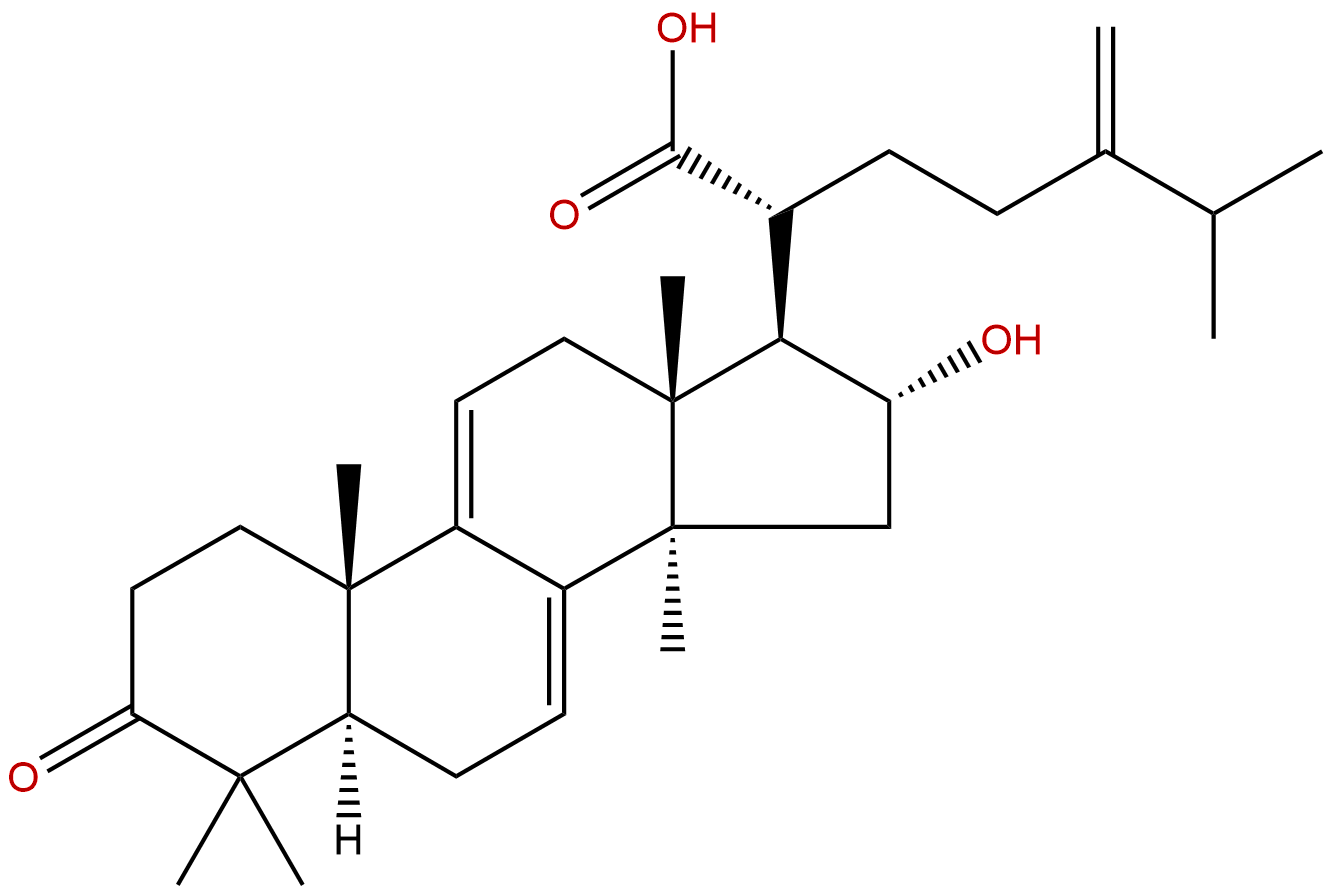


Product name: Polyporenic acid C
Synonym name:
Catalogue No.: BP1720
Cas No.: 465-18-9
Formula: C31H46O4
Mol Weight: 482.705
Botanical Source:
Physical Description: Powder
Type of Compound: Triterpenoids
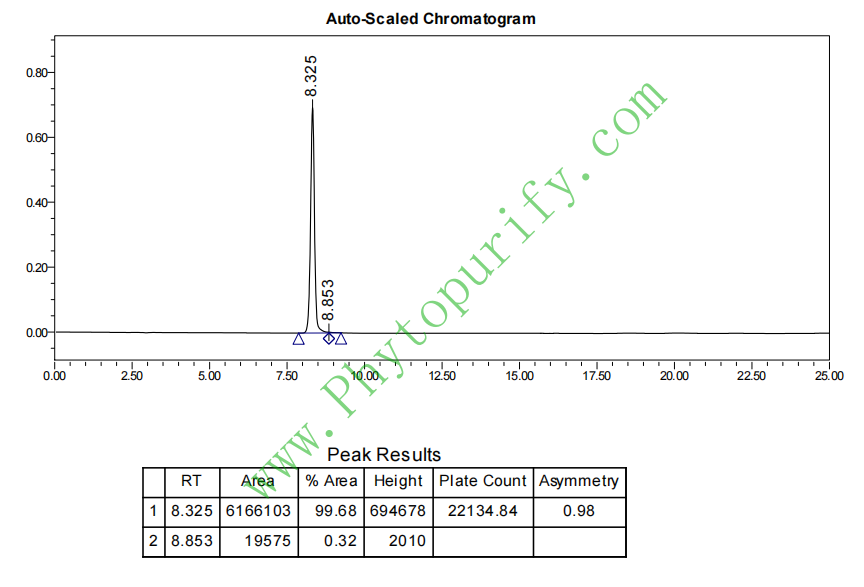
Purity: 95%~99%
Analysis Method: HPLC-DAD or/and HPLC-ELSD
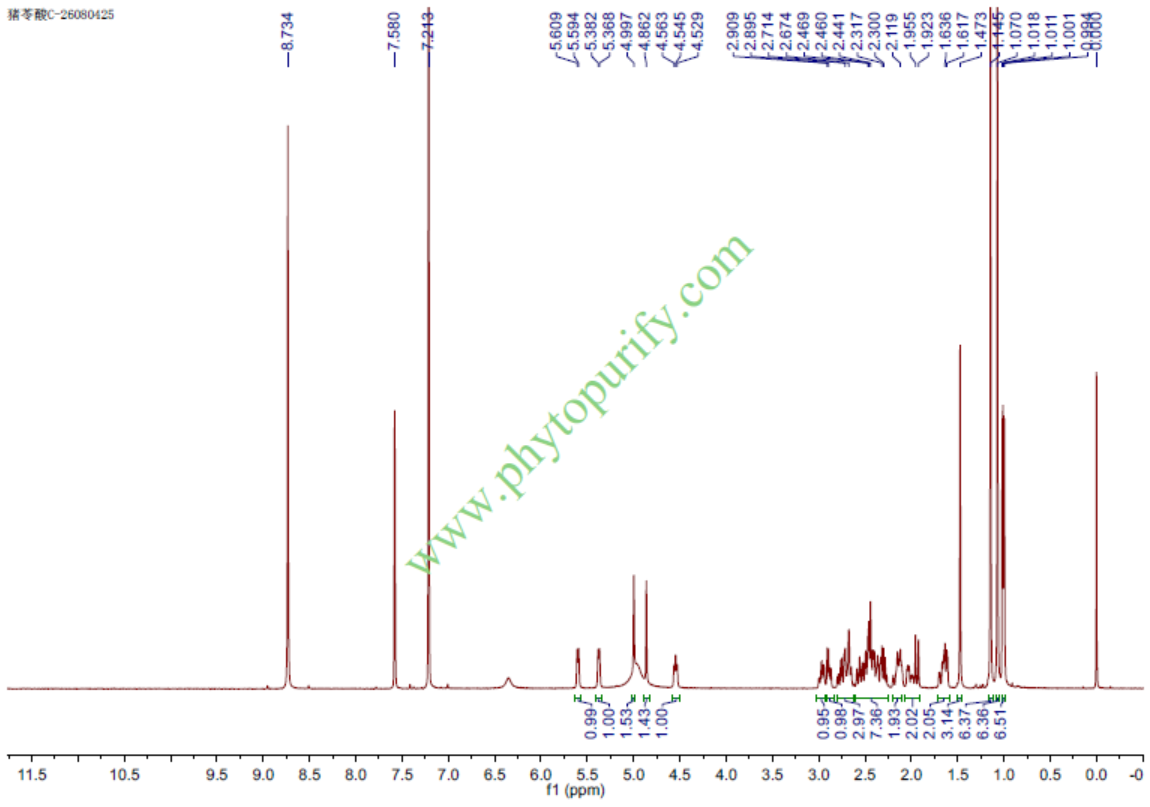
Identification Method: Mass, NMR
Packing: Brown vial or HDPE plastic bottle
The product could be supplied from milligrams to grams. Inquire for bulk scale.
We provide solution to improve the water-solubility of compounds, thereby facilitating the variety of activity tests and clinic uses.
For Reference Standard and R&D, Not for Human Use Directly.
HPLC of Polyporenic acid C
HNMR of Polyporenic acid C
Storage conditions:Short-term storage at 2~8℃, long-term storage at -20 ~ -80℃
74.6000
5.6573
3.7197
.0079
3.2570
9.3508
Low
90.4913
5.0871
No
No
Yes
No
No
No
0.0
No
No
Yes
Yes
Natural products have long been an important source of innovative drug discovery, among which triterpenoids have attracted much attention due to their wide range of biological activities. Polyporinic acid C (CAS number: 465-18-9), as a lanostane type triterpenoid isolated from the traditional medicinal fungus Poria cocos, has shown significant research value in the field of anti-tumor pharmacology in recent years. Early research mainly focused on the traditional water promoting and moisturizing effects of its source plants, while modern pharmacological studies have gradually revealed the strong potential of Poria cocos acid C in inducing tumor cell apoptosis, inhibiting proliferation, and regulating key signaling pathways. Especially its anti-cancer activity demonstrated in non-small cell lung cancer models, as well as its ability to induce apoptosis by regulating multiple pathways such as caspase cascade, PI3K/Akt, p53, and JNK, have made it a highlight in the research of anti-tumor natural products. In addition, its association with multiple potential molecular targets related to lymphoma, such as MCL1, BCL2, STAT3, further broadens its pharmacological spectrum of action. This article aims to systematically review the chemical structure, plant origin, pharmacological activity, molecular mechanism of action, pharmacological characteristics, and clinical application prospects of Poria cocos acid C, in order to provide comprehensive scientific references for the in-depth research and development of this compound.
The chemical name of Poria cocos acid C is (3 β, 16 α) -3,16-Dihydrolanosta-7,9 (11), 24-terien-21-oic acid, with a molecular formula of C30H44O4 and a molecular weight of 482.7050 g/mol. Its core structure belongs to the lanostane type of tetracyclic triterpenes, which is a characteristic skeleton of fungal triterpenes. The structural features include a steroid like nucleus composed of four fused rings A/B/C/D, with one hydroxyl group (3 β - OH, 16 α - OH) attached to each of the C-3 and C-16 positions, and a carboxyl group at the C-21 position, which forms the basis of its acidity. In addition, its structure contains three double bonds located at positions C-7, C-9 (11), and C-24, which have important effects on its conformation and biological activity.
In terms of physicochemical properties, the lipid water partition coefficient (LogP) of Poria cocos acid C is 5.6573, indicating that the compound has high lipophilicity. Its topological polar surface area (TPSA) is 74.6 Å ², which is relatively low. These parameters collectively determine its poor solubility, with a calculated water solubility of approximately 0.0079 mg/mL, making it a poorly soluble compound. High LogP values and low TPSA typically indicate that compounds are easily able to penetrate cell membranes, but may also lead to poor oral absorption, large distribution volume, and easy accumulation in adipose tissue in the body. Preliminary pharmacological predictions indicate that the ability of Poruric Acid C to cross the blood-brain barrier is relatively low, which to some extent limits its direct effects on central nervous system related diseases, but may also reduce potential central side effects. Importantly, its hERG inhibition risk prediction was negative, and the Ames test predicted a value of 0.0, indicating a low potential risk of arrhythmia and genotoxicity, providing preliminary favorable clues for its safety evaluation.
Poria cocos (Schw.) Wolf, a fungus in the family Poriaceae, is the main source of Poria cocos acid C. Poria cocos, as a famous traditional Chinese medicinal herb, has been used for thousands of years in East Asian countries such as China, Japan, and South Korea. It is mainly used to promote diuresis, invigorate the spleen, and calm the heart. Its pharmacological active ingredients are complex, mainly including polysaccharides, triterpenoids, etc. Poria cocos acid C is one of the important members of the triterpenoids in Poria cocos.
The extraction and separation of Poria cocos acid C from Poria cocos are usually carried out using organic solvent extraction combined with various chromatographic techniques. The standard procedure is as follows:
1. Extract Crush the dried Poria cocos sclerotia and first perform reflux extraction or ultrasound assisted extraction using organic solvents such as methanol, ethanol, or ethyl acetate. Sometimes solvents of different polarities are used for gradient extraction to enrich triterpenoid components.
2. Rough classification The extract obtained by vacuum concentration of the extract is often subjected to liquid-liquid distribution extraction using solvents such as petroleum ether, chloroform, and ethyl acetate. Polyporus acid C is often enriched in the ethyl acetate fraction.
3. Separation and purification The ethyl acetate fraction was further separated by silica gel column chromatography, with different ratios of petroleum ether ethyl acetate or chloroform methanol gradient elution. The stream containing the target compound is refined and purified by repeated column chromatography (such as reversed silica gel column, Sephadex LH-20 gel column) and high performance liquid chromatography (HPLC, usually using C18 reversed phase column) to finally obtain the high-purity single compound of umbellate C.
Modern extraction techniques such as supercritical CO2 fluid extraction and microwave-assisted extraction have also been explored to improve extraction efficiency and yield of target components. The optimization of the extraction process, including the selection of solvents, temperature, time, solid-liquid ratio, and other parameters, is a key step in ensuring the sufficient amount of Poria cocos acid C for further pharmacological research.
The pharmacological activity research of Poria cocos acid C mainly focuses on the field of anti-tumor and shows multiple biological effects.
Antitumor activity:
Other potential activities As a member of the triterpenoids of Poria cocos, Poria cocos acid C may also inherit or partially participate in the traditional functions related to Poria cocos, such as anti-inflammatory and immune regulation, but the specificity of these aspects still needs further research. Its anti-inflammatory potential may be related to its regulation of key inflammatory pathways such as NF - κ B.
The anti-tumor effect of Poria cocos acid C, especially its induction of apoptosis, is achieved through the regulation of multiple signaling pathways and key molecular targets, forming a networked mode of action with multiple targets and pathways.
Death receptor pathway and Caspase cascade activation Polyporus acid C treatment can lead to activation of caspase-8. Caspase-8 is a key promoter of the death receptor-mediated exogenous apoptosis pathway. It activates and subsequently cleaves and activates downstream effector caspase-3, ultimately leading to the cleavage and inactivation of poly (ADP ribose polymerase) (PARP). The cleavage of PARP is one of the hallmark events of irreversible apoptosis in cells. This pathway suggests that Poria cocos acid C may initiate exogenous apoptosis by mimicking death ligands or affecting death receptor complexes.
Mitochondrial pathway and regulation of Bcl-2 family proteins The anticancer activity of Poria cocos acid C is closely related to its regulation of Bcl-2 family proteins. It can downregulate the expression or function of anti apoptotic proteins MCL1 and BCL2. MCL1 and BCL2 are key guardians of mitochondrial outer membrane integrity, and their inhibition leads to loss of mitochondrial membrane potential, release of cytochrome C, activation of caspase-9 and caspase-3, and triggering endogenous apoptosis. This is highly correlated with the target of lymphoma treatment.
PI3K/Akt/PTEN signaling pathway Polyporus acid C can significantly reduce the phosphorylation level of Akt protein at Ser473 site, that is, inhibit the activation of Akt. Akt is a core kinase involved in cell survival, proliferation, and metabolism. Meanwhile, it can also increase the phosphorylation/activity of PTEN, an important tumor suppressor protein and negative regulator of Akt. The enhanced PTEN activity further inhibited the PI3K/Akt pathway. Inhibition of Akt signaling will release its inhibitory effects on downstream pro apoptotic proteins (such as Bad) and transcription factors (such as FoxO), thereby promoting apoptosis.
Activation of p53 tumor suppressor protein Polyporus acid C can increase the phosphorylation of p53 protein at the Ser15 site. The phosphorylation of this site can stabilize the p53 protein and prevent its degradation by MDM2 mediated ubiquitination, thereby activating the transcriptional activity of p53. Activated p53 can upregulate the expression of various pro apoptotic genes (such as Bax, PUMA, Noxa) and downregulate anti apoptotic genes, strongly promoting the process of cell apoptosis.
Activation of stress signaling pathway JNK Polyporus acid C can activate c-Jun N-terminal kinase (JNK). JNK is an important signaling molecule that responds to external stress, such as oxidative stress and DNA damage. Continuous JNK activation can phosphorylate and activate multiple transcription factors (such as c-Jun), thereby regulating the expression of genes related to apoptosis and cell cycle arrest, and synergistically inducing cell death with the aforementioned pathways.
Other related targets:
In summary, Poria cocos acid C forms a powerful pro apoptotic network by simultaneously targeting the death receptor pathway, mitochondrial pathway, PI3K/Akt survival pathway, p53 pathway, and JNK stress pathway, and affecting key transcription factors such as STAT3 and NF - κ B, which may be the molecular basis for its highly efficient anti-tumor activity.
Based on its physicochemical properties and preliminary computer predictions, a preliminary evaluation of the pharmacological properties of Poria cocos acid C is conducted
absorb High LogP value (5.66) and low water solubility (0.0079 mg/mL) are the main challenges for its oral absorption. These compounds typically have low bioavailability and may be limited by dissolution rate and intestinal permeability. Formulation strategies, such as making nanocrystals, liposomes, solid dispersions, or encapsulating with cyclodextrin, are necessary means to improve their solubility and oral absorption.
distribution High lipophilicity indicates that it may have a large distribution volume in the body, making it easy to distribute and accumulate in adipose tissue, liver, etc. Its low blood-brain barrier permeability prediction may limit its direct effect on brain tumors, but it also reduces the potential risk of central neurotoxicity.
Metabolism and excretion As a triterpenoid acid compound, Poria cocos acid C may undergo phase I metabolism (such as oxidation and reduction by cytochrome P450 enzyme system) and phase II metabolism (such as glucuronidation and sulfation). The carboxyl group at position C-21 is the main site for binding reactions. The activity, toxicity, and excretion pathways (bile or urine) of metabolites still need to be elucidated through in vitro liver microsomal experiments and in vivo pharmacokinetic studies.
Preliminary Safety Prediction The negative prediction of hERG inhibition is a positive signal that reduces the risk of cardiac toxicity associated with QT interval prolongation and apical torsion type ventricular tachycardia. The negative prediction of Ames test also suggests a lower potential risk of mutagenicity. However, this cannot completely replace actual in vitro and in vivo toxicology experiments. The possible hepatotoxicity, nephrotoxicity, and non-specific cytotoxicity caused by high doses still need to be systematically evaluated.
At present, there is a lack of public reports on the in vivo pharmacokinetic studies of the Poria cocos acid C system, such as plasma concentration time curves, half lives, clearance rates, etc. This is a key data gap that must be filled in the process of drug development.
As a natural triterpenoid compound with clear multi-target anti-tumor activity, the clinical application prospects of Poria cocos acid C are mainly reflected in the following aspects:
Lead compounds of anti-tumor drugs Its strong ability to induce apoptosis and significant activity against non-small cell lung cancer make it a highly valuable anti-tumor lead compound for development. By rational structural modification and optimization, such as improving its water solubility and pharmacokinetic properties, enhancing selectivity and efficacy towards specific targets, it is expected to develop novel small molecule anticancer drugs.
Sensitizer for combination therapy Given that its mechanism of action involves the inhibition of Akt, activation of p53 and JNK, etc., Poria cocos acid C may have a synergistic effect with conventional chemotherapy drugs (such as cisplatin, paclitaxel), targeted drugs, or immune checkpoint inhibitors, reversing tumor cell resistance and reducing chemotherapy drug dosage and side effects. Especially in tumors with abnormal activation of the PI3K/Akt pathway or residual p53 function, the potential for combination therapy is worth further exploration.
Targeting specific hematological tumors The high correlation between its target of action and lymphoma (MCL1, BCL2, STAT3, etc.) suggests that Poria cocos acid C or its derivatives may have unique value in the treatment of refractory lymphomas such as diffuse large B-cell lymphoma and mantle cell lymphoma, and are worthy of special research.
Modernization of Traditional Chinese Medicine and Quality Markers As one of the main active triterpenoids in Poria cocos, the content of Poria cocos acid C can serve as an important chemical marker for evaluating the quality of Poria cocos medicinal materials and related preparations (such as Sijunzi Tang, Wuling San, etc.), connecting traditional efficacy with modern pharmacological effects, and promoting the standardization and internationalization of traditional Chinese medicine.
The challenges faced and future research directions include:
* In depth mechanism research It is necessary to validate its activity in more tumor cell lines and animal models, and use techniques such as gene knockout/knockdown to identify its most critical target.
* Pharmacokinetic and toxicological evaluation of the system Conduct comprehensive ADMET (absorption, distribution, metabolism, excretion, and toxicity) research to clarify its in vivo fate and safety window.
* Structural optimization and formulation development Conduct structure based drug design, synthesize a series of derivatives, screen for candidate molecules with better activity and drug properties, and develop suitable drug delivery systems.
* Explore its potential new applications in anti-inflammatory and immune regulation Expand its application scope.
Zhuling acid C is a lanostane type triterpenoid acid isolated from the traditional medicinal fungus Poria cocos. Its unique chemical structure endows it with multi-target anti-tumor pharmacological activity. Research has shown that it mainly induces apoptosis in tumor cells such as non-small cell lung cancer by synergistically activating exogenous and endogenous apoptotic pathways, inhibiting PI3K/Akt survival signals, activating p53 and JNK stress pathways, and affecting multiple key factors closely related to tumor occurrence and development, such as STAT3 and NF - κ B. Although its high lipophilicity and poor water solubility are the main challenges facing drug development, its clear biological activity, multi-target mechanism of action, and good preliminary safety prediction make it a very promising lead compound for anti-tumor drugs. In the future, through interdisciplinary in-depth research, including precise analysis of the mechanism of action, systematic improvement of pharmacokinetic properties, and rational drug design based on structure, Poria cocos acid C is expected to develop from a natural active ingredient into a new anti-cancer candidate drug or adjuvant therapy with clinical application value, providing new strategies and choices for tumor treatment. At the same time, its research will also contribute to the modern scientific connotation of interpreting the traditional efficacy of Poria cocos and promoting the modernization process of traditional Chinese medicine.
