| Catalog No | Package | Original Price | Price | Inventory | Quantity | Operating |
|---|---|---|---|---|---|---|
| BP4740-5mg | 5mg | $350.00 | Sign in |
|


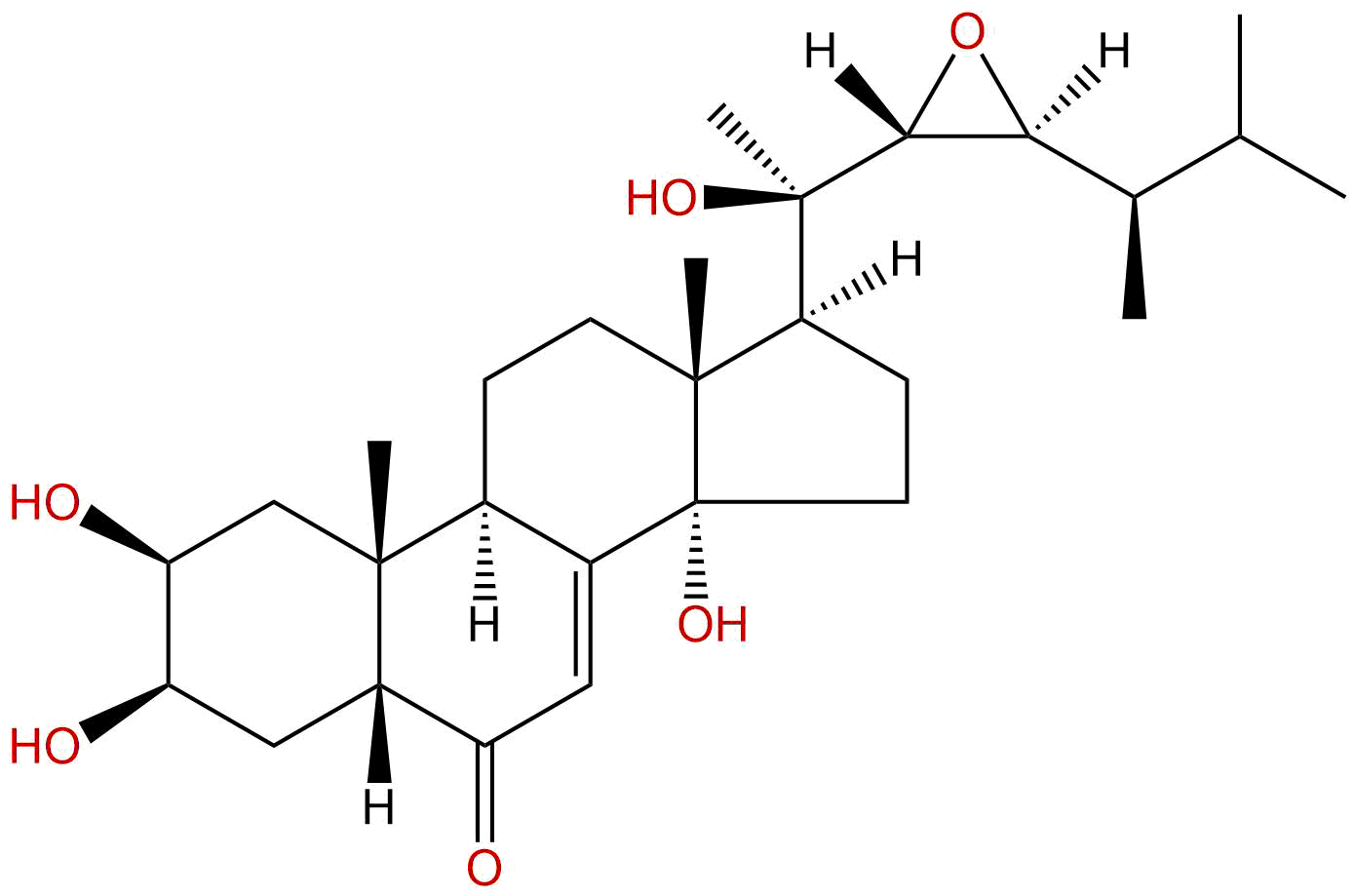
Product name: Polyporusterone C
Synonym name:
Catalogue No.: BP4740
Cas No.: 141360-90-9
Formula: C28H44O6
Mol Weight: 476.654
Botanical Source:
Type of Compound: Triterpenoids
Purity: 95%~99%
Analysis Method: HPLC-DAD or/and HPLC-ELSD
Identification Method: Mass, NMR
Packing: Brown vial or HDPE plastic bottle
Storage: Store in a well closed container, protected from air and light. Put into refrigerate or freeze for long term storage.
Whenever possible, you should prepare and use solutions on the same day. However, if you need to make up stock solutions in advance, we recommend that you store the solution as aliquots in tightly sealed vials at -20℃. Generally, these will be useable for up to two weeks.
The product could be supplied from milligrams to grams
Inquire for bulk scale.
For Reference Standard and R&D, Not for Human Use Directly.
Storage conditions:Short-term storage at 2~8℃, long-term storage at -20 ~ -80℃
Polyporusterone C (CAS number: 141360-90-9) is a natural product isolated from the Polyporus umbellatus fungus in the family Polyporus. As one of the representative compounds of Poridone, Poridone C has gradually attracted the attention of pharmacology and natural product chemistry researchers in recent years due to its unique chemical structure and significant biological activity, especially its potential applications in the field of anti-tumor. As a traditional Chinese medicinal herb, Poria cocos has always been used for promoting diuresis, reducing swelling, anti-inflammatory effects, and immune regulation. In depth research on its active ingredients not only helps to reveal its pharmacological mechanism, but also provides an important chemical framework and target for new drug development.
This article aims to systematically review the chemical structure and physicochemical properties, plant sources and extraction methods, pharmacological activity and mechanism of action, pharmacological evaluation and pharmacokinetic characteristics of Poridone C, and explore its application prospects in the field of anti-tumor by combining its related molecular targets. It is expected to provide theoretical basis and research direction for subsequent basic research and clinical translation.
The molecular formula of Poridone C is C30H44O5, with a molecular weight of 476.6540. Its structure belongs to triterpenoid compounds, with a typical polycyclic skeleton and multiple hydroxyl and ketone functional groups. According to existing literature reports, the LogP value of Poridone C is 2.9132, indicating moderate lipid solubility and facilitating membrane penetration. Its topological polar surface area (TPSA) is 110.52 Å ^ 2, indicating that the molecule has a certain polarity that may affect its bioavailability and targeting.
The low water solubility of Poridone C (0.0388 mg/mL) suggests that its solubility in aqueous phase is limited, and its bioavailability may need to be improved through pharmaceutical formulation technology. The low permeability of the blood-brain barrier indicates that it is difficult to enter the central nervous system, reducing the potential risk of neurotoxicity. The hERG channel inhibition experiment showed a negative result, indicating that the risk of prolonged QT interval in the heart is low for Poridone C. The Ames mutagenicity test result is 0.0, indicating a low risk of genotoxicity and meeting safety requirements.
In summary, the physicochemical properties of Poridone C support its development as a potential drug molecule, especially in the field of anti-tumor applications.
Polyporus umbellatus, a widely distributed fungus in East Asia, is the main source of Poridone C. Zhuling is used in traditional Chinese medicine as a medicinal herb for promoting diuresis, reducing swelling, anti-inflammatory effects, and enhancing immunity. Modern research has shown that Poria cocos contains abundant triterpenoids, sterols, and polysaccharide active ingredients, among which Poria cocos ketone compounds are its important bioactive substances.
The extraction of Poridone C is usually carried out by combining organic solvent extraction with separation and purification. The specific steps include:
In recent years, with the advancement of separation technology, the efficiency of extraction and purification has been continuously improved, providing sufficient material basis for the pharmacological research of Poridone C.
Zhulingketone C has shown significant biological activity in multiple in vitro cell experiments, especially its inhibitory effect on tumor cells. It showed cytotoxicity towards mouse lymphoma cell line L-1210, with IC50 values of 37, 26, and 42 μ g/mL at 3, 5, and 7 days, respectively, demonstrating time-dependent cell inhibition effects.
In addition, the antiproliferative activity of umbrinone C in other tumor cell lines has gradually been reported, covering a variety of tumor types such as breast cancer, lung cancer, liver cancer, etc. Its anti-tumor activity mainly manifests as inducing cell apoptosis, inhibiting cell proliferation and migration, and interfering with the signal transduction pathways of tumor cells.
In addition to its anti-tumor effect, Poridone C also exhibits certain anti-inflammatory and immune regulatory functions, which is consistent with the overall pharmacological effects of Poridone. The safety evaluation of it both in vitro and in vivo shows that the toxicity of Poridone C is relatively low, and it has a good basis for drug safety.
The anti-tumor mechanism of Poridone C involves multiple key molecular targets and signaling pathways, mainly including:
In summary, the synergistic effect of Zhulingketone C on multiple targets and pathways demonstrates its anti-tumor effect, highlighting the advantages of natural product multi-target drugs.
The pharmacological parameters of Poridone C show that it has good potential for drug development. Although the molecular weight of 476.6540 is slightly higher than the ideal drug molecular weight range (<500), it is still within an acceptable range. The LogP value of 2.9132 indicates moderate lipid solubility, which is beneficial for cell membrane permeability and in vivo distribution. The TPSA is 110.52 Å ^ 2, slightly higher than the ideal value (<90 Å ^ 2), which may affect oral absorption, but can be improved through pharmaceutical optimization.
Low water solubility is a major challenge for its drug development, requiring the use of nanocarriers, liposomes, or solid dispersions to improve bioavailability. The low blood-brain barrier permeability of Zhulingketone C reduces the risk of central nervous system toxicity. HERG channel inhibition was negative and Ames test showed no mutagenicity, indicating its high safety.
At present, there is limited research on the pharmacokinetics of Poridone C. Preliminary data indicate that it is metabolically stable in vivo and mainly metabolized through the liver enzyme system. The excretion pathway still needs further clarification. In the future, systematic pharmacokinetic and toxicological studies are needed to provide support for clinical development.
Zhuling ketone C, as a natural product with multi-target anti-tumor activity, has great potential for development. It can effectively inhibit the proliferation, migration, and invasion of tumor cells by regulating multiple tumor related signaling pathways, and has good safety, making it suitable as a candidate molecule for anti-tumor drugs.
Future research directions include:
Overall, as a model of natural product drug development, Poridone C is expected to become a new type of anti-tumor therapy in the future, bringing new treatment options for cancer patients.
As an important triterpenoid active ingredient in Poria cocos, Poridone C exhibits significant anti-tumor activity and good safety characteristics. Its unique chemical structure, multi-target mechanism of action, and superior pharmacological parameters have laid a solid foundation for it as a candidate molecule for anti-tumor drugs. Although its pharmacokinetics and clinical research are still in their early stages, with the continuous advancement of molecular pharmacology and medicinal chemistry techniques, Poridone C is expected to play an important role in the future development of anti-tumor drugs.
In the future, we should strengthen the systematic research on Poridone C, especially in terms of mechanism analysis, pharmacokinetics, formulation development, and clinical validation, to promote its transition from laboratory to clinical application, ultimately achieving efficient utilization of natural product resources and innovative development of new drugs.
