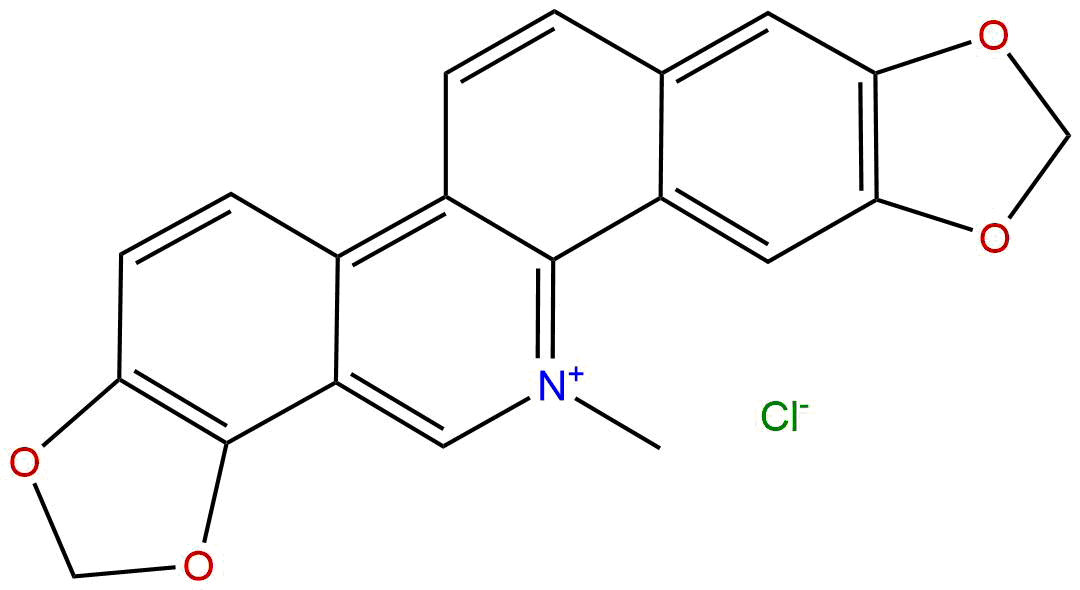


Synonym name: Sanguinarine hydrochloride
Catalogue No.: BP1254
Cas No.: 5578-73-4
Formula: C20H14NO4Cl
Mol Weight: 367.79
Botanical Source:
Purity: 95%~99%
Analysis Method: HPLC-DAD or/and HPLC-ELSD
Identification Method: Mass, NMR
Packing: Brown vial or HDPE plastic bottle
Can be supplied from milligrams to grams.
For Reference Standard and R&D, Not for Human Use Directly.
Inquire for bulk scale.
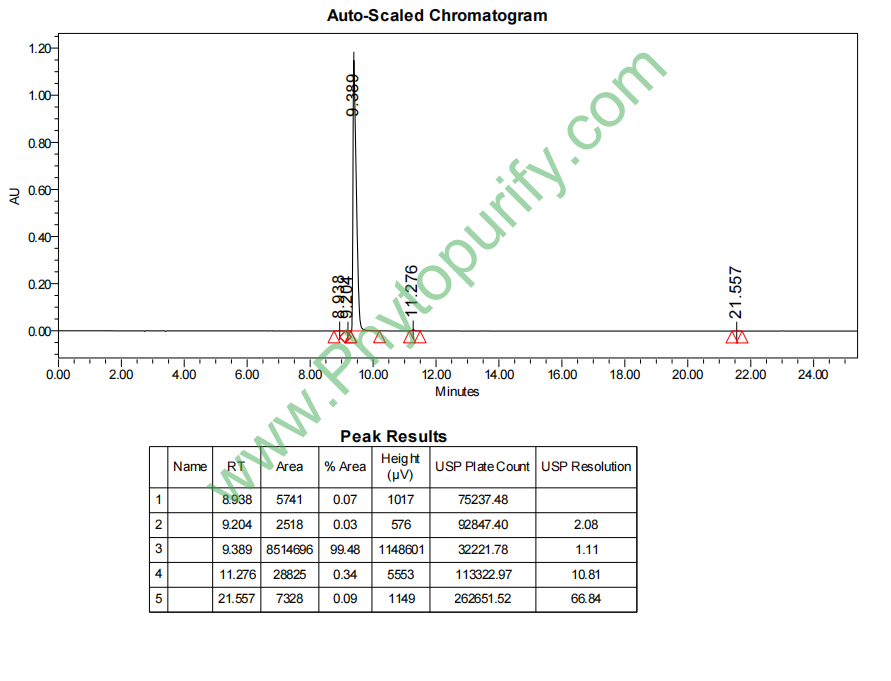
HPLC of Sanguinarium chloride
Storage conditions:Short-term storage at 2~8℃, long-term storage at -20 ~ -80℃
40.8000
.4141
.4140
.0426
2.1710
29.0174
High
22.2875
3.0252
Yes
No
Yes
No
Yes
Yes
2.4
No
No
No
No
Sanguinarium chloride, CAS number 5578-73-4, is a benzylisoquinoline alkaloid derived from plants in the family Papaveraceae, including the genus Berberis. Since its discovery, this compound has attracted much attention due to its unique chemical structure and extensive biological activity. Traditionally, extracts of sanguinarine have been used in folk medicine, while modern pharmacological research has gradually revealed their deep-seated anti-inflammatory, antibacterial, antiviral, and particularly remarkable anti-tumor potential. In recent years, with the increase of tumor incidence rate and the increasingly serious problem of multidrug resistance, the search for new antitumor drugs with high efficiency and low toxicity has become a research hotspot. Hemogen chloride exhibits significant inhibitory activity in various tumor models, particularly in ovarian cancer. Its effects involve inducing cell apoptosis, inhibiting cell proliferation, blocking cell cycle, anti angiogenesis, and reversing multidrug resistance at multiple levels. This article aims to systematically review the chemical properties, plant sources, and pharmacological activities of sanguinarine chloride, with a focus on its key molecular targets and signaling pathways involved in the treatment of ovarian cancer. Combined with its pharmacological parameters, the research status, challenges, and future clinical application prospects of sanguinarine chloride are discussed in depth, in order to provide theoretical reference for the deep development of this natural product.
The chemical name of sanguinarine chloride is 13 methyl [1,3] benzodioxolane [5,6-c] -1,3-dioxolane [4,5-i] phenanthridine chloride, which is a quaternary ammonium alkaloid. Its molecular formula is C20H14NO4 • Cl and its molecular weight is 332.3350. Structurally, it is composed of a fused phenanthrene nucleus and a biphenyldioxolane (methylenedioxybenzene) structural unit, forming a rigid planar aromatic system, with the central nitrogen atom quaternized and bound to chloride ions. This unique planar cationic structure is believed to be the key basis for its ability to insert into DNA double helices and interact with various enzymes and proteins.
In terms of physical and chemical properties, sanguinarine chloride usually appears as orange red needle shaped crystals or powder. The calculated lipid water partition coefficient (LogP) is 0.4141, indicating that the compound has a certain degree of hydrophilicity, but not highly hydrophilic. Its topological polar surface area (TPSA) is 40.8000 Å ², which is relatively small and advantageous for its penetration through the cell membrane. The water solubility data shows that its solubility is 0.0426 mg/mL, which belongs to the category of slightly soluble to poorly soluble. This to some extent limits the development of its formulations, and often requires the use of techniques such as salt formation, cyclodextrin inclusion, or nanoformulation to improve solubility. It is worth noting that its predicted blood-brain barrier permeability is "high", indicating that it may have central nervous system activity or potential neurotoxicity, which needs to be carefully evaluated in drug development. In early safety screening, its hERG channel inhibition was "no", reducing the risk of causing QT interval prolongation in the heart. However, an Ames test value of 2.4 (usually considered a potential mutagenic positive value>1.5) suggests the possibility of genetic toxicity risk, which is a safety indicator that must be focused on in subsequent development.
Cyanine chloride is mainly found in plants of the Macleaya genus in the Papaveraceae family, such as Macleaya cordata and Macleaya microcarpa. In addition, it is also distributed in plants such as Chelidonium majus and Sanguinaria canadensis. In these plants, sanguinarine often exists in the form of quaternary ammonium salts in milk ducts, rhizomes, and other parts.
Its extraction method has undergone development from traditional to modern. Traditional methods often use acid water extraction or organic solvents (such as methanol, ethanol) reflux extraction, and then utilize their alkaloid properties for preliminary purification such as acid precipitation, alkaline precipitation, and solvent extraction. Modern extraction and separation technologies have significantly improved efficiency and purity:
1. Ultrasonic/Microwave Assisted Extraction Utilizing physical field enhancement to shorten extraction time and improve yield.
2. Macroporous resin adsorption method Selecting appropriate polar resins (such as AB-8, D101) for enrichment and purification of crude extract can effectively remove impurities such as pigments and polysaccharides.
3. High speed countercurrent chromatography technology As a liquid-liquid distribution chromatography, it is particularly suitable for the preparation grade separation of such alkaloids, with advantages such as high recovery rate, irreversible adsorption, and maintaining sample activity.
4. Preparation type high-performance liquid chromatography: is the final commonly used method to obtain high-purity sodium chloride monomer.
The optimization of extraction process usually revolves around key parameters such as solvent type and concentration, solid-liquid ratio, extraction temperature and time, pH value, etc., aiming to balance extraction efficiency, cost, and environmental friendliness. At present, research has achieved large-scale preparation of high-purity sanguinarine from Boluohui, providing a material basis for its pharmacological research and application development.
Hemogen chloride exhibits diverse pharmacological activities, with research mainly focused on anti-tumor effects and also exploring areas such as antibacterial and anti-inflammatory properties.
1. Antitumor activity
This is the most concerned activity of sanguinarine chloride. A large number of in vitro and in vivo studies have shown that it has broad-spectrum inhibitory activity on a variety of tumor cell lines, including ovarian cancer, breast cancer, liver cancer, lung cancer, colon cancer, leukemia, etc. Its anti-tumor effect is mainly manifested as:
* Inhibit cell proliferation and colony formation Can dose - and time-dependent inhibit tumor cell growth and reduce their colony forming ability.
* Inducing cell apoptosis Typical morphological and biochemical changes of apoptosis in tumor cells are induced through mitochondrial pathways, death receptor pathways, and other pathways.
* Block cell cycle Cells are often blocked in the G0/G1 or G2/M phase to prevent them from entering mitosis.
* Inhibit invasion and metastasis By downregulating matrix metalloproteinases (MMPs), epithelial mesenchymal transition (EMT) related proteins, etc., the migration and invasion ability of tumor cells is weakened.
* Angiogenesis inhibition Inhibit endothelial cell proliferation, migration, and lumen formation, and reduce tumor microvascular density.
* Reverse multidrug resistance It has a sensitizing effect on drug-resistant tumor cells overexpressing P-glycoprotein (P-gp/ABCB1), which will be described in detail below.
2. Antibacterial and anti-inflammatory activity
Cyanine chloride has inhibitory effects on various Gram positive bacteria (such as Staphylococcus aureus and Streptococcus) and some Gram negative bacteria and fungi, and its mechanism may be related to the destruction of cell membrane integrity and interference with energy metabolism. Its anti-inflammatory effect is related to the inhibition of the expression of key inflammatory signaling molecules and mediators such as nuclear factor kappa B (NF - κ B) and cyclooxygenase-2 (COX-2).
3. Other activities
It also includes antiviral (such as herpes simplex virus), anti plaque formation (already used in certain mouthwashes), etc.
The anti-tumor effect of sanguinarine chloride, especially its activity in ovarian cancer, involves a complex multi-target and multi pathway network. Based on the provided target information, its main mechanism of action can be summarized as follows:
1. Inducing apoptosis and autophagy
* Targeting the BCL2 family BCL2 is a key anti apoptotic protein. Hemogen chloride can downregulate the expression of BCL2 and may upregulate the expression of pro apoptotic proteins such as BAX, disrupting mitochondrial membrane potential and leading to the release of cytochrome C, thereby activating the caspase cascade reaction and inducing intrinsic apoptotic pathways.
* Inhibition of STAT3 signaling pathway STAT3 is an important oncogenic transcription factor that is often continuously activated in ovarian cancer. Hemogen chloride can inhibit the phosphorylation (activated form) of STAT3, block its nuclear translocation and the transcription of downstream target genes (such as Cyclin D1, Bcl-2, VEGF), thereby inhibiting proliferation, promoting apoptosis, and anti angiogenesis.
2. Regulating oxidative stress and detoxification system
* Regulating NRF2 signal NRF2 encoded by NFE2L2 is the main regulatory factor of cellular antioxidant response. In tumors, sustained activation of NRF2 helps tumor cells resist oxidative stress and chemotherapy drugs. Chlorhexidine may interfere with the KEAP1-NRF2 interaction or promote NRF2 degradation, inhibit its overactivation, weaken the defense ability of tumor cells, and increase their sensitivity to oxidative stress and chemotherapy.
3. Interference with DNA metabolism and repair
* Inhibition of Topoisomerase TOP1 and TOP2A are key enzymes that regulate DNA topology and are targets of various chemotherapy drugs. The planar structure of sanguinarine chloride can insert DNA, stabilize DNA topoisomerase complexes ("cleavable complexes"), cause DNA double strand breaks, and thus exert cytotoxic effects.
* Inhibit TDP1 Tyrosine DNA phosphodiesterase 1 (TDP1) is a key enzyme for repairing DNA damage caused by TOP1 inhibitors. Inhibiting TDP1 can enhance the efficacy of TOP1 inhibitors. The inhibition of TDP1 by sanguinarine chloride may be related to its synergistic anti-tumor effect or overcoming drug resistance.
4. Reverse multidrug resistance
* Inhibition of ABCB1/P-glycoprotein The P-gp encoded by ABCB1 gene is one of the main efflux pumps leading to multidrug resistance in tumors. Chlorhexidine itself can serve as a substrate for P-gp, but studies have shown that it is more likely to restore the intracellular accumulation and toxicity of chemotherapy drugs in resistant ovarian cancer cells by competitively inhibiting or downregulating P-gp expression, reducing the efflux of other chemotherapy drugs such as paclitaxel and doxorubicin.
5. Affects cell signal transduction and hormone pathways
* Regulating the MAPK/ERK pathway MAPK1 (ERK2) is a key kinase in the MAPK signaling pathway, involved in cell proliferation and survival. Chlorhexidine may inhibit the pro survival pathway by reducing the phosphorylation level of ERK through upstream inhibition or direct action.
* Interference with ESR1 signal ESR1 encodes estrogen receptor alpha (ER alpha). In some ER α - positive ovarian cancers, sanguinarine chloride may interfere with estrogen driven growth signals by affecting the expression or activity of ER α.
6. Other potential effects
* Inhibition of TYR (Tyrosinase)Although tyrosinase is mainly related to melanin synthesis, its abnormal expression in tumors may also affect tumor progression. The inhibitory effect may be associated with its anti melanoma activity or other unknown functions.
In summary, sanguinarine chloride forms a synergistic network by simultaneously acting on multiple key nodes such as apoptosis regulation (BCL2, STAT3), oxidative stress (NRF2), DNA damage and repair (TOP1/2A, TDP1), drug efflux pump (ABCB1), and critical signaling pathways (MAPK1, ESR1), ultimately leading to the death of ovarian cancer cells and overcoming drug resistance. This multi-target characteristic is its advantage, but it also makes the analysis of its mechanism of action and the prediction of potential side effects more complex.
Based on the provided pharmacological parameters and existing research, a preliminary evaluation of the pharmacological properties of sanguinarine chloride is conducted
Advantage aspects:
1. Clear activity and multi-target effect As mentioned earlier, its anti-tumor mechanisms are diverse and may have better effects on complex tumor microenvironments and drug resistance.
2. Moderate molecular weight 332 Da falls within the typical range of small molecules for drug like properties.
3. No risk of hERG inhibition Reduced concerns about clinical cardiotoxicity.
4. High blood-brain barrier permeability There may be potential advantages in treating brain tumors or metastases.
Challenges and Shortcomings:
1. Poor water solubility The solubility of 0.0426 mg/mL is the main pharmaceutical challenge, affecting oral bioavailability and formulation design for injection administration.
2. Potential genetic toxicity risk A positive Ames test (2.4) is an important warning signal. This is related to its ability to insert DNA, inhibit topoisomerases, and other mechanisms. In subsequent development, more comprehensive genetic toxicity testing (such as micronucleus test, chromosome aberration test) must be conducted, and its relationship with carcinogenic risk must be evaluated.
3. Pharmacokinetic properties need to be optimized Existing literature reports that sanguinarine chloride is metabolized rapidly in the body and may have a first pass effect with a short half-life. The quaternary ammonium salt structure may lead to certain peculiarities in its distribution and excretion.
4. The treatment window needs to be clearly defined The window between effective anti-tumor dose and toxic dose needs to be carefully studied. Its broad biological activity may also lead to off target effects and unknown toxicity.
Progress in Pharmacokinetic Research:
Limited animal pharmacokinetic studies have shown that the oral absorption of sanguinarine chloride is relatively fast but may not be complete, and it is widely distributed in tissues such as the liver and kidneys, mainly excreted through urine and feces. Its metabolic pathways in the body may involve demethylation, oxidation, etc. To enhance its medicinal properties, current research strategies include:
* Structural modification Synthesize derivatives to improve solubility and reduce toxicity while retaining activity.
* New drug delivery system Develop liposomes, nanoparticles, micelles, cyclodextrin inclusion complexes, etc. to improve solubility, targeting, and prolong circulation time.
* combination therapy Combined with conventional chemotherapy drugs such as cisplatin and paclitaxel, reducing their respective doses, synergistically increasing efficacy, and reducing toxic side effects.
As a natural compound with multi-target anti-tumor activity, sanguinarine chloride has shown unique potential in the treatment of malignant tumors such as ovarian cancer. However, its clinical application still faces a series of opportunities and challenges.
Clinical application prospects:
1. As a chemotherapy sensitizer For ABCB1 mediated multidrug-resistant ovarian cancer, the combination of sanguinarine chloride with paclitaxel, doxorubicin, etc. may effectively reverse drug resistance and improve chemotherapy efficacy.
2. Developing targeted formulations Using nanotechnology to construct targeted delivery systems for ovarian cancer (such as folate and hyaluronic acid modified nanoparticles) can increase local drug concentration in tumors and reduce systemic toxicity.
3. Used for combination therapy plans Combination with drugs with other mechanisms of action such as PARP inhibitors and anti angiogenic drugs may produce synergistic effects for the treatment of refractory/recurrent ovarian cancer.
4. Expand other indications In addition to ovarian cancer, its activity in other solid tumors (such as breast cancer, liver cancer) and leukemia is also worth exploring.
Future research focus and prospects:
1. In depth mechanism research By utilizing omics technologies (proteomics, metabolomics) and gene editing tools, we can more accurately elucidate its primary target and network regulatory relationships, and distinguish the mechanisms related to its therapeutic effects and toxicity.
2. System security evaluation It is necessary to conduct comprehensive toxicology studies that comply with Good Clinical Practice (GLP) for drug non clinical research, especially to rigorously evaluate its genetic toxicity and long-term carcinogenicity, which is the key to determining whether it can enter clinical practice.
3. Optimize pharmacokinetics Significantly improve its bioavailability, stability, and tissue distribution through prodrug strategies or advanced delivery systems.
4. Conduct high-quality preclinical and clinical research On the basis of clarifying the safety window, design a reasonable animal pharmacological model and ultimately advance it to Phase I clinical trials to explore its human safety, pharmacokinetic characteristics, and preliminary efficacy.
5. Explore structural optimization Conduct systematic structure-activity relationship research and design and synthesize derivatives with lower toxicity, higher activity, or better pharmacokinetic properties.
Cyanine chloride is a benzyl isoquinoline alkaloid with unique structure and wide biological activity. It exhibits strong potential for synergistic inhibition of multiple pathways in anti-tumor, especially in combating multidrug-resistant ovarian cancer, by acting on multiple key targets such as BCL2, STAT3, ABCB1, TOP1/2A, NRF2, etc. However, its poor solubility, especially the potential risk of genetic toxicity, constitutes the main obstacle to its translation into clinical drugs. Future research needs to focus on improving drug properties through chemical modifications and novel delivery technologies, based on a deep understanding of its molecular mechanisms, and clarify its risk benefit ratio through strict and standardized safety evaluations. Only by overcoming these challenges can the ancient natural molecule of sanguinarine chloride be revitalized, providing a new treatment option or adjuvant strategy for patients with malignant tumors such as ovarian cancer. Natural products remain an important source of innovative drug discovery, and continuous in-depth research on sanguinarine chloride will not only contribute to its own development, but also provide valuable experience for the research and development of similar multi-target anti-tumor drugs.
