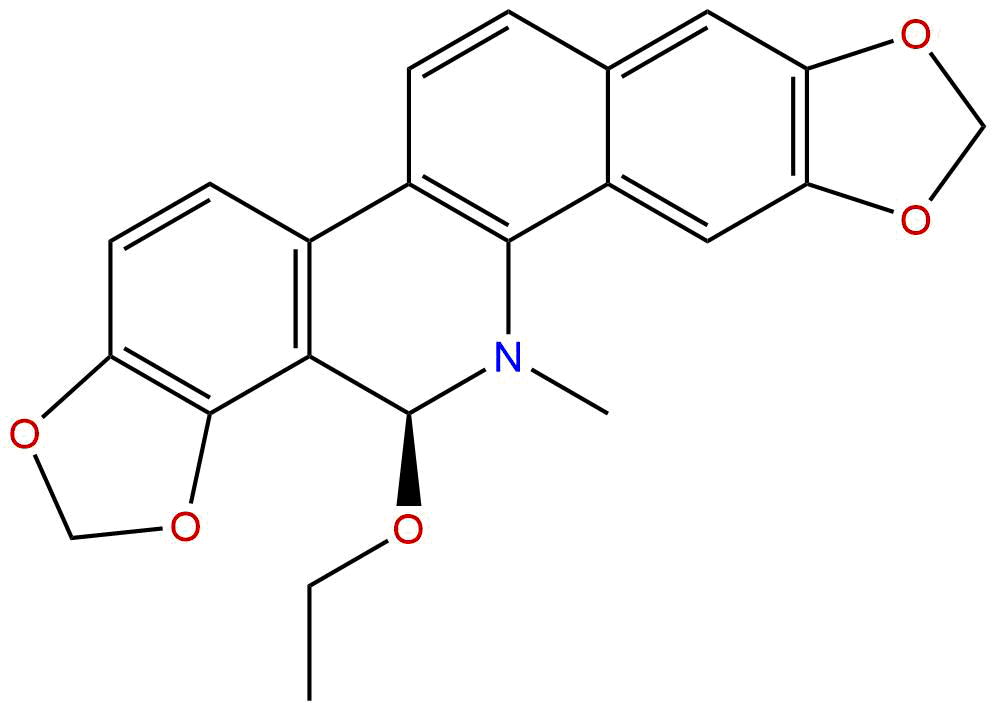


Product name: 6-Ethoxysanguinarine
Synonym name:
Catalogue No.: BP1839
Cas No.: 28342-31-6
Formula: C22H19NO5
Mol Weight: 377.396
Botanical Source:
Physical Description:
Type of Compound: Alkaloids
Purity: 95%~99%
Analysis Method: HPLC-DAD or/and HPLC-ELSD
Identification Method: Mass, NMR
Packing: Brown vial or HDPE plastic bottle
The product could be supplied from milligrams to grams. Inquire for bulk scale.
We provide solution to improve the water-solubility of compounds, thereby facilitating the variety of activity tests and clinic uses.
For Reference Standard and R&D, Not for Human Use Directly.
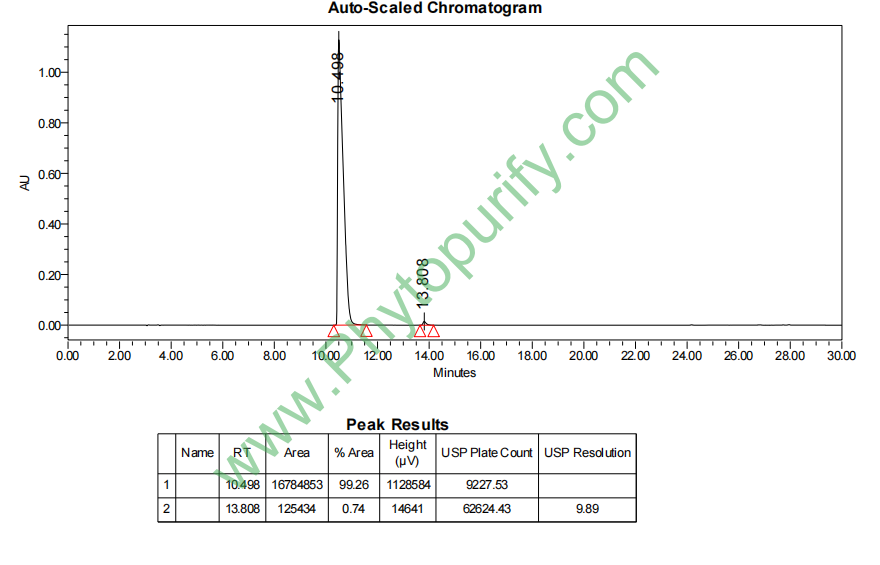
HPLC of 6-Ethoxysanguinarine
Storage conditions:Short-term storage at 2~8℃, long-term storage at -20 ~ -80℃
49.3900
4.1864
4.1861
.0003
8.0676
27.8839
High
88.9052
3.4041
Yes
No
Yes
No
Yes
Yes
1.8
Yes
No
Yes
Yes
6-Ethoxysanguinarine is a benzylisoquinoline alkaloid with significant biological activity. Its CAS number is 28342-31-6, molecular formula is C22H19NO5, and molecular weight is 377.3960 g/mol. This compound is mainly derived from the poppy family plant Boraceae(Macleaya cordata)Separated from the middle. As a traditional medicinal plant, Boluohui has been widely used in folk medicine for a long time, and modern pharmacological research has revealed the enormous potential of its extracts and monomers in anti-inflammatory, antibacterial, anti-tumor and other aspects. 6-Ethoxyhemoglobin, as one of its active ingredients, has attracted much attention in recent years due to its outstanding activity in anti leukemia. Research has shown that it can act on multiple key targets related to cell proliferation, apoptosis, and signal transduction, such as BCL2, MYC, JAK2, etc., exhibiting the characteristics of multi-target and multi pathway intervention. This article will provide a systematic and professional interpretation of this promising natural product from the aspects of its chemical structure, plant origin, pharmacological mechanism, medicinal evaluation, and research prospects.
The chemical structure of 6-ethoxysanguinarine belongs to the derivative of berberine type isoquinoline alkaloids. The SMILES structural formula (CCO [C @ H] 1c2c (ccc3c2OCO3) - c2cc3cc4c (cc3c2N1C) OCO4) reveals its core isoquinoline phenanthridine skeleton, as well as two key methoxy (OCO) rings and one ethoxy (CCO) substituent. This dense ring structure and specific substitution pattern are the structural basis for its interaction with biomolecules (such as DNA, enzymes) and the production of pharmacological activity.
According to the analysis of drug parameters, its molecular weight (MW) is 377.40 g/mol, slightly higher than the ideal standard of "less than 500" in Lipinski's five rules, but still within an acceptable range. The calculated logarithm of the lipid water partition coefficient (LogP) is 4.1864, indicating that the compound has high lipophilicity, which is beneficial for its penetration of cell membranes, but may also affect its water solubility. Its water solubility is extremely low, only 0.0003, which is one of the key physical property challenges that need to be overcome in its pharmaceutical development. The topological polar surface area (TPSA) is 49.39 Å ², which is much lower than the commonly considered "non permeable" threshold (>140 Å ²), indicating its good membrane permeation potential. This prediction is consistent with Caco-2 cell permeability data (27.8839) and effective permeability (Peff: 8.0676), indicating good intestinal absorption potential. It is worth noting that its blood-brain barrier (BBB) penetration is predicted to be "high", indicating that the compound or its derivatives may have potential application value in the treatment of central nervous system related diseases, but caution should also be taken against possible neurotoxicity. The plasma protein binding rate (PPB) is as high as 88.9%, indicating that most drugs in the blood bind to proteins, which may affect their free drug concentration and efficacy.
The main plant source of 6-ethoxysanguinarine is Boluohui(Macleaya cordata (Willd.) R. Br.), Also known as tube pole or mountain fire tube, it belongs to the family Papaveraceae and the genus Boraceae. The plant is widely distributed in most provinces and regions south of the Yangtze River and north of the Nanling Mountain Mountains in China, and also in Japan, Vietnam and other places. In traditional Chinese medicine and folk applications, the whole plant or root of Boluohui is often used to treat injuries caused by falls, rheumatoid arthritis, carbuncles, eczema, snake and insect bites, etc. Its usage is mostly for external use, decoction, washing or pounding, and fresh products have better effects. This is mainly based on its significant antibacterial, anti-inflammatory, and insecticidal activities. Modern plant chemistry research has isolated and identified various isoquinoline alkaloids, including sanguinarine, quercetin, protopine, and 6-ethoxysanguinarine, which are considered the material basis for their pharmacological activity. Traditional applications provide valuable clues for modern research, while modern science reveals the chemical essence behind these traditional effects at the molecular level and further expands their application fields, especially in the field of anti-tumor potential.
The most notable pharmacological activity of 6-ethoxysanguinarine is its anti leukemia effect. Its mechanism of action is complex, involving multiple aspects such as inducing tumor cell apoptosis, inhibiting proliferation, and blocking cell cycle, which is closely related to its ability to act on multiple key signaling pathways and targets. Based on the provided target information, we can conduct a thorough analysis of its possible functional network:
Targeting BCL2 and directly initiating the apoptotic pathway BCL2 family proteins are the core switches that regulate cell apoptosis (programmed cell death). Among them, BCL2 itself is an important anti apoptotic protein, overexpressed in various leukemia cells, helping cancer cells escape apoptosis. 6-Ethoxyhemoglobin can target BCL2, possibly by inhibiting its function or promoting its degradation, thereby relieving the inhibition of apoptosis and initiating mitochondrial pathway cell apoptosis. This is a direct and important pathway for it to exert its anti leukemia effect.
Inhibit MYC and block oncogene drive MYC is a powerful oncogene transcription factor that plays a central regulatory role in cell growth, proliferation, and metabolism. It is often abnormally activated or overexpressed in leukemia, driving unlimited tumor proliferation. The inhibitory effect of 6-ethoxysanguinarine on MYC can suppress the expression of a series of growth and proliferation promoting genes at the transcriptional level, fundamentally inhibiting the malignant phenotype of leukemia cells.
Intervention of JAK2/STAT5 signaling axis JAK2 (Janus kinase 2) and STAT5 (signal transducer and activator of transcription 5) are key molecules in cytokine signaling pathways, particularly playing important roles in hematopoietic system diseases. For example, JAK2 mutations are common in chromosome negative myeloproliferative tumors in Philadelphia. JAK2 activation phosphorylates STAT5, allowing it to enter the nucleus and regulate gene expression, promoting cell survival and proliferation. 6-Ethoxyhemoglobin can simultaneously inhibit JAK2 and STAT5, effectively blocking this signaling pathway closely related to the occurrence and development of leukemia, and inhibiting the survival and colony formation of leukemia cells.
Inhibit BCR-ABL and target classical leukemia driver factors The BCR-ABL fusion gene is a hallmark genetic abnormality in chronic myeloid leukemia (CML), and the BCR-ABL fusion protein encoded by it has sustained activation of tyrosine kinase activity, which is the core driving factor of CML pathogenesis. The inhibitory effect of 6-ethoxyhemoglobin on BCR-ABL suggests its potential therapeutic potential for CML. Despite the existence of classic drugs such as imatinib targeting BCR-ABL, the issue of drug resistance persists, and the development of new mechanisms of action or inhibitors that can overcome resistance remains a research hotspot.
Comprehensive mechanism of action and disease association:
In leukemia, a major malignant tumor of the hematopoietic system, uncontrolled proliferation and inhibited apoptosis of cancer cells are the two core features. The mode of action of 6-ethoxysanguinarine precisely targets these two points: inhibiting MYC, intervening in JAK2/STAT5 and BCR-ABL pathways to suppress proliferation signals; Initiate the apoptosis program by inhibiting the anti apoptotic protein BCL2. The advantage of this multi-target synergistic effect is that it may produce stronger anti-tumor effects and reduce the risk of drug resistance due to single target mutations. Its function may not be limited to inducing the death of mature leukemia cells, but may also affect leukemia stem cells, a key cell population that leads to relapse and drug resistance.
Based on the provided pharmacological parameters, we can conduct a preliminary evaluation of the potential of 6-ethoxyhemoglobin as a drug, and analyze it in conjunction with the famous "Lipinski Rule of Five" (Ro5):
Lipinski Five Rule Compliance:
Absorption, distribution, metabolism, excretion (ADME) characteristics:
comprehensive evaluation:
6-Ethoxyhemoglobin has shown promising potential in pharmacology (multi-target anti leukemia) and preliminary physicochemical and absorption properties. However, it Outstanding genetic toxicity and potential hepatotoxicity, phototoxicity This poses a significant obstacle to its direct development as a systemic drug delivery system. These toxicities are likely related to the condensed aromatic ring system and its metabolites in its chemical structure, which are prone to embedding or covalent binding with DNA, leading to genetic damage.
At present, research on 6-ethoxyhemoglobin is still mainly in the preclinical stage. A large number of in vitro studies have shown that it has significant proliferation inhibition and apoptosis induction effects on various leukemia cell lines (such as K562, HL-60, U937, etc.), and its multi-target mechanism of action has been preliminarily revealed. A few in vivo studies have also observed its anti-tumor effect in mouse leukemia models.
However, as mentioned earlier, its clear genetic toxicity and other toxicities severely limit its direct clinical translation as a prototype drug. Therefore, current and future research priorities may focus on the following directions:
Application Prospects Despite facing toxicity challenges, the value of 6-ethoxysanguinarine as a natural product lead compound with a unique multi-target mechanism cannot be ignored. It is more like a valuable 'template' or 'probe', and its most likely future is as Lead compounds have been systematically optimized to develop new chemical entities with lower toxicity and better drug properties In addition, under the premise of fully evaluating the risk return ratio, its topical formulations may also be a worthwhile direction to explore in the treatment of skin related diseases (such as certain skin cancers and psoriasis), which can avoid systemic toxicity. In summary, in-depth research on 6-ethoxyhemoglobin will continue to provide new ideas and candidate molecules for the development of anti leukemia drugs.
