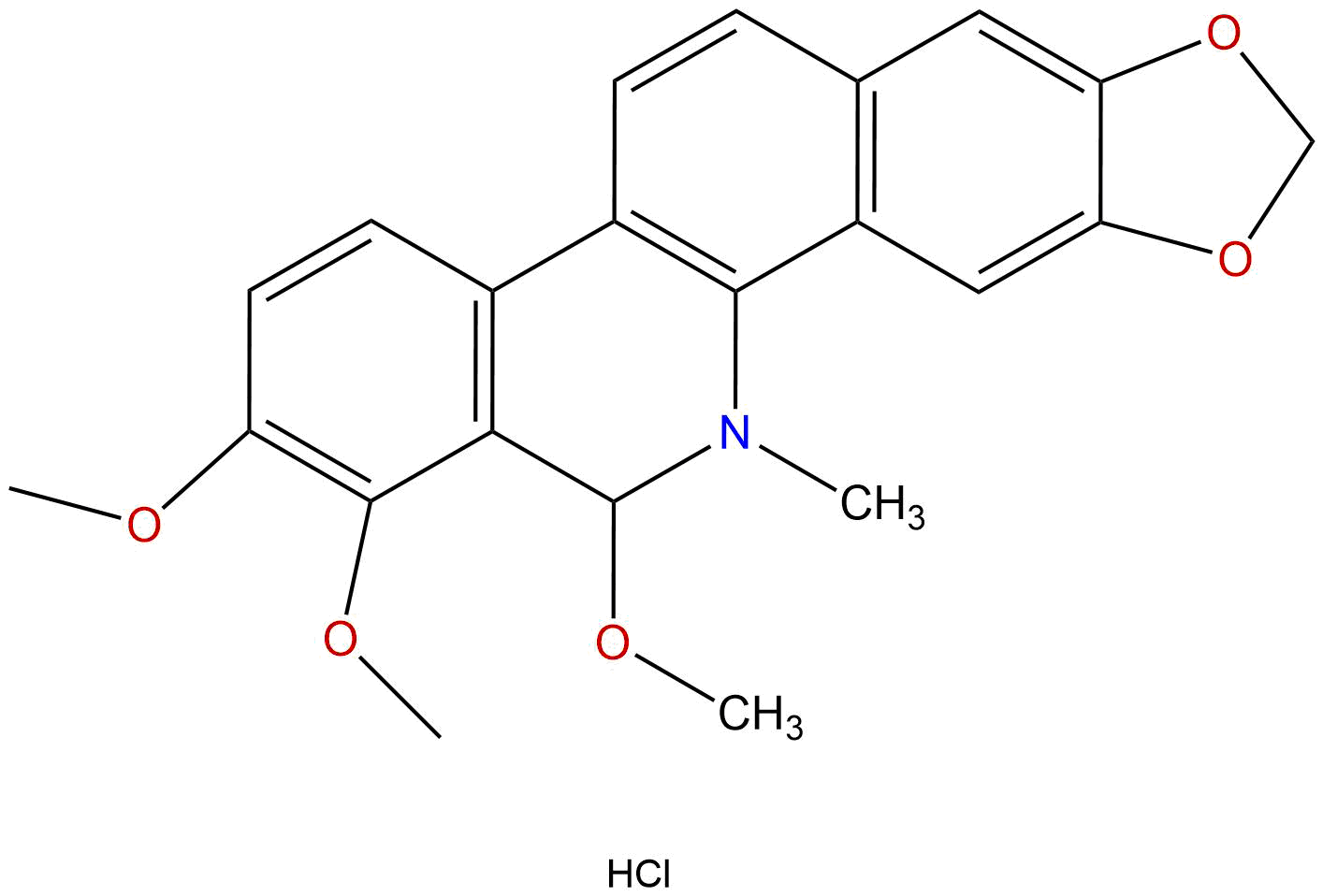


Product name: 6-Methoxyldihydrochelerythrine chloride
Synonym name: 6-methoxy-5,6-dihydrochelerythrine
Catalogue No.: BP2134
Cas No.: 1071676-04-4
Formula: C22H22ClNO5
Mol Weight: 415.87
Botanical Source: Macleaya cordata (Willd.) R. Br.
Type of Compound: Alkaloids
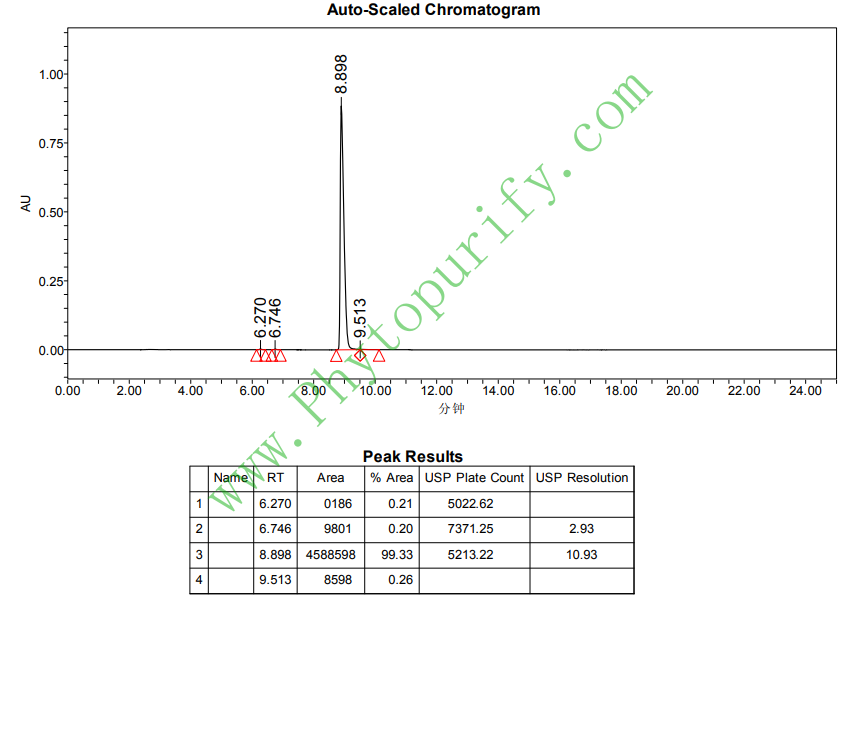
Purity: 95%~99%
Analysis Method: HPLC-DAD or/and HPLC-ELSD
Identification Method: Mass, NMR
Packing: Brown vial or HDPE plastic bottle
Storage: Store in a well closed container, protected from air and light. Put into refrigerate or freeze for long term storage.
Whenever possible, you should prepare and use solutions on the same day. However, if you need to make up stock solutions in advance, we recommend that you store the solution as aliquots in tightly sealed vials at -20℃. Generally, these will be useable for up to two weeks.
The product could be supplied from milligrams to grams
Inquire for bulk scale.
For Reference Standard and R&D, Not for Human Use Directly.
HPLC of 6-Methoxyldihydrochelerythrine chloride
Storage conditions:Short-term storage at 2~8℃, long-term storage at -20 ~ -80℃
49.3900
4.0782
4.0779
.0007
6.9523
27.8547
High
89.1051
3.3117
Yes
No
Yes
No
Yes
Yes
1.8
Yes
No
Yes
Yes
Colorectal cancer (CRC), as one of the malignant tumors with high incidence rate and mortality worldwide, poses a serious threat to human health. Although traditional surgical resection, radiotherapy, chemotherapy, and targeted therapy have improved patient prognosis to some extent, drug resistance and side effects remain prominent, and there is an urgent need to develop new highly efficient and low toxicity anti-cancer drugs. Natural products have become important resources for the development of anti-cancer drugs due to their structural diversity and rich biological activity. 6-methoxydihydrochelerythrine chloride (6-MDHC), as an emerging natural alkaloid, has shown significant pharmacological activity in the field of colorectal cancer in recent years, attracting the attention of many researchers.
6-MDHC belongs to the isoquinoline alkaloid class, which has a unique chemical structure and good biological activity. Its targets include multiple signaling pathways and key proteins closely related to the occurrence and development of colorectal cancer, including AMPK, BCL2, STAT3, etc., demonstrating the potential for multi-target synergistic regulation. In addition, 6-MDHC exhibits high blood-brain barrier permeability and low risk of cardiac toxicity, indicating good potential for drug development. This article provides a systematic review of the chemical structure and physicochemical properties, plant sources and extraction methods, pharmacological activity and mechanism of action, pharmacological evaluation and pharmacokinetic characteristics of 6-MDHC, and explores its clinical application prospects and future development directions. The aim is to provide theoretical basis and reference for the in-depth research and drug development of this natural product.
6-methoxydihydroquercetin hydrochloride (CAS number: 1071676-04-4) has the molecular formula C21H23NO4Cl and a molecular weight of 379.4120. Its structure is based on the core skeleton of chelerythrine, which introduces a methoxy substituent at position 6 and forms a dihydrochelerythrine structure through hydrogenation treatment. The hydrochloride form increases its water solubility and stability. This compound belongs to the isoquinoline alkaloid class and has a typical polycyclic aromatic structure and nitrogen-containing heterocycle. The structure contains functional groups such as methoxy and phenolic hydroxyl, endowing it with unique chemical and biological activities.
In terms of physical and chemical properties, the LogP value of 6-MDHC is 4.0782, indicating its moderate lipophilicity, which is beneficial for membrane penetration. The topological polar surface area (TPSA) is 49.39 Å ², indicating that its polarity is moderate and beneficial for bioavailability and blood-brain barrier permeability. Very low water solubility (0.0007 mg/mL) suggests poor solubility in water, which may limit oral absorption and in vivo distribution. The high permeability of the blood-brain barrier suggests that 6-MDHC may play a role in the central nervous system or pose a risk of neurotoxicity. The negative result of hERG channel inhibition experiment indicates a low risk of cardiac toxicity. The Ames mutagenicity test value is 1.8, indicating a low risk of genotoxicity and meeting drug safety requirements.
In summary, the chemical structure of 6-MDHC provides it with a good basis for biological activity, and its physicochemical properties show that it has certain pharmacokinetic advantages. However, its poor water solubility and high lipid solubility may limit its in vivo application, and it is necessary to optimize the administration method through pharmaceutical means.
6-methoxydihydroquercetin hydrochloride mainly comes from certain species of the genus Chelidonium in the family Papaveraceae, especially Chelidonium majus and its related species. Bai Qu Cai is a perennial herbaceous plant widely distributed in parts of Europe and Asia. It is used in traditional Chinese medicine for the treatment of ulcers, liver and gallbladder diseases, and other conditions. The rhizome and aboveground parts of this plant are rich in various isoquinoline alkaloids, among which 6-MDHC is one of the important active ingredients.
The common methods for extracting 6-MDHC include organic solvent extraction, acid-base extraction, and column chromatography separation. The general steps are:
In recent years, ultrasound assisted extraction and microwave-assisted extraction techniques have also been applied to the efficient extraction of 6-MDHC, significantly improving the extraction rate and purity. By combining high-performance liquid chromatography (HPLC) and mass spectrometry (MS) techniques, rapid qualitative and quantitative analysis of 6-MDHC can be achieved.
The pharmacological activity of 6-MDHC in the treatment of colorectal cancer has become a research hotspot. In vitro cell experiments have shown that 6-MDHC has significant inhibitory effects on proliferation, induction of apoptosis, and inhibition of migration and invasion in various colorectal cancer cell lines. Its IC50 value is usually at the micromolar level, showing high cytotoxicity selectivity.
6-MDHC can inhibit the progression of cancer cells in the G0/G1 or G2/M phase and suppress cell proliferation by regulating cell cycle related proteins. The relevant mechanisms involve the activation of the AMPK signaling pathway, promoting energy metabolism regulation, and inhibiting metabolic reprogramming of tumor cells.
The mechanism by which 6-MDHC induces apoptosis in colorectal cancer cells mainly includes activating the mitochondrial pathway and regulating the expression of BCL2 family proteins. It can downregulate the anti apoptotic protein BCL2, promote the release of pro apoptotic proteins, activate the Caspase cascade reaction, and lead to programmed cell death.
By inhibiting the expression and activity of matrix metalloproteinase MMP2, 6-MDHC effectively reduces the matrix degradation ability of cancer cells and blocks the migration and invasion of tumor cells. In addition, 6-MDHC can also regulate immune related molecules such as TLR4 in the tumor microenvironment, enhancing immune surveillance function.
6-MDHC has inhibitory effects on tumor resistance associated transporters ABCB1 and ABCG2, which can reverse multidrug resistance and improve the sensitivity of chemotherapy drugs. This provides a theoretical basis for its combination chemotherapy.
By activating the NFE2L2 (nuclear factor erythroid 2-related factor 2) signaling pathway, 6-MDHC enhances cellular antioxidant defense and reduces oxidative stress damage. Meanwhile, inhibiting the STAT3 signaling pathway, reducing the release of pro-inflammatory factors, and exerting anti-inflammatory effects can help suppress tumor occurrence and development.
The anti colorectal cancer effect of 6-MDHC involves multiple signaling pathways and key targets, reflecting its characteristics of multi-target and multi mechanism synergistic regulation.
As a cellular energy sensor, AMPK regulates cellular metabolic balance. 6-MDHC activates AMPK, promotes metabolic inhibition of tumor cells, induces cell cycle arrest and apoptosis, and inhibits tumor growth.
BCL2 family proteins regulate mitochondrial pathway apoptosis. 6-MDHC downregulates BCL2 expression, disrupts mitochondrial membrane potential, releases cytochrome c, activates Caspase, and induces apoptosis.
Carboxyesterase 1 (CES1) is involved in drug metabolism and lipid metabolism. 6-MDHC regulates CES1 activity, which may affect the metabolic status and pharmacokinetics of tumor cells.
Toll like receptor 4 (TLR4) mediates immune inflammatory responses. 6-MDHC regulates TLR4 signaling, inhibits the release of pro-inflammatory cytokines, improves the tumor microenvironment, and enhances anti-tumor immunity.
Signal transducer and activator of transcription factor 3 (STAT3) is an important regulatory factor for tumor cell proliferation and immune escape. 6-MDHC inhibits STAT3 phosphorylation, blocks its nuclear translocation, suppresses tumor cell proliferation and immune suppression.
Tumor cell multidrug resistance associated transporter protein. 6-MDHC inhibits the expression and function of these two pumps, reverses drug resistance, and enhances the efficacy of chemotherapy drugs.
Matrix metalloproteinase-2 is involved in the degradation and metastasis of tumor cell matrix. 6-MDHC inhibits MMP2 expression, blocks tumor cell migration and invasion.
Antioxidant stress transcription factors. 6-MDHC activates NFE2L2, enhances cellular antioxidant capacity, reduces oxidative damage, and inhibits tumor progression.
Topoisomerase I is involved in DNA replication and transcription. 6-MDHC may interfere with tumor cell DNA metabolism and promote cell death by regulating TOP1 activity.
In summary, 6-MDHC exerts its comprehensive pharmacological effects against colorectal cancer through the synergistic regulation of multiple targets and signaling pathways.
The pharmacological evaluation of 6-MDHC shows that it has certain potential for drug development, but there are still challenges.
The molecular weight of 6-MDHC is moderate (379.4 Da), with a LogP of 4.0782, indicating good lipid solubility and facilitating membrane penetration. The TPSA is 49.39 Å ², indicating moderate polarity and meeting the ideal range for oral drug absorption. Very low water solubility (0.0007 mg/mL) suggests that oral bioavailability may be limited. High blood-brain barrier permeability suggests its ability to distribute in the central nervous system, but may also pose a risk of neurotoxicity.
The hERG channel inhibition experiment was negative, indicating a low risk of cardiac toxicity for 6-MDHC. The Ames mutagenicity test value is 1.8, indicating a low risk of genotoxicity and meeting safety requirements. Further in vivo toxicology research is needed to comprehensively evaluate its long-term safety.
Given the poor water solubility of 6-MDHC, strategies to enhance its bioavailability include novel pharmaceutical technologies such as nanocarrier encapsulation, liposome formulations, and solid dispersions. In addition, the preparation of the hydrochloride form improves its water solubility and stability, which is beneficial for formulation development.
At present, research on the in vivo metabolic pathways of 6-MDHC is limited, and it is speculated that it may be metabolized by the liver cytochrome P450 enzyme system. The metabolites and their activities still need further investigation. Kidney and bile excretion may be the main pathways of excretion.
In summary, 6-MDHC has a good pharmacological basis, but it requires pharmaceutical optimization and systematic pharmacokinetic studies to address issues of water solubility and bioavailability, ensuring its feasibility for clinical application.
6-MDHC, as a multi-target natural product against colorectal cancer, has shown broad clinical application prospects.
6-MDHC has significant proliferation inhibition and apoptosis induction effects on colorectal cancer cells, and has good safety. It is expected to enter the clinical trial stage as a new anti-cancer monotherapy, especially suitable for drug-resistant or recurrent patients.
By inhibiting multidrug resistance transporters ABCB1 and ABCG2, 6-MDHC can reverse drug resistance and improve the efficacy of traditional chemotherapy drugs such as irinotecan and oxaliplatin. The combination therapy strategy is expected to reduce chemotherapy dosage and alleviate toxic side effects.
6-MDHC regulates the TLR4 and STAT3 signaling pathways, improves the tumor immune microenvironment, enhances the body's immune surveillance function, and provides auxiliary support for immunotherapy.
Its high blood-brain barrier permeability suggests that 6-MDHC may be applied in the treatment of brain metastatic colorectal cancer or other central nervous system tumors, which is worth further exploration.
6-methoxydihydroquercetin hydrochloride, as a natural isoquinoline alkaloid with significant anti colorectal cancer activity, exhibits excellent pharmacological activity and potential as a drug due to its multi-target and multi mechanism comprehensive effects. Despite facing challenges such as poor water solubility and incomplete pharmacokinetics, it is expected to break through bottlenecks and promote its clinical application through modern pharmaceutical technology and systematic preclinical research. In the future, 6-MDHC is expected to become an important candidate drug in the field of colorectal cancer treatment, providing patients with new treatment options and promoting the continuous development of natural product pharmacology and anti-cancer drug research and development.
