


Product name: Allocryptopine
Synonym name: Thalictrimine; alpha-Fagarine; γ-Homochelidonine; Beta-Homochelidonine
Catalogue No.: BP0143
Cas No.: 485-91-6
Formula: C21H23NO5
Mol Weight: 369.417
Botanical Source: Macleaya cordata (Willd.) R. Br.
Physical Description:
Type of Compound: Alkaloids
Purity: 95%~99%
Analysis Method: HPLC-DAD or/and HPLC-ELSD
Identification Method: Mass, NMR
Packing: Brown vial or HDPE plastic bottle
Storage: Store in a well closed container, protected from air and light. Put into refrigerate or freeze for long term storage.
Whenever possible, you should prepare and use solutions on the same day. However, if you need to make up stock solutions in advance, we recommend that you store the solution as aliquots in tightly sealed vials at -20℃. Generally, these will be useable for up to two weeks.
The product could be supplied from milligrams to grams
Inquire for bulk scale.
Chengdu Biopurify Phytochemicals Ltd. is a leading company in the research, development, manufacture and marketing of High Quality Phytochemicals and Extracts(especially Active Ingredients from Traditional Chinese Medicine,TCM), Natural Active Pharmaceutical Ingredients worldwide.
The main services:
A. Supply active ingredients and reference standards of TCM, from mgs to kgs scale
B. Custom extraction and purification, target Herb Active Ingredients
C. Custom synthesis and semi-synthesis for Natural Active Ingredients
D. CR(contract research), CM(contract manufacture) and PD(process development) services from lab scale, pilot scale to commercial scale(GMP is also available)
E. TCM compounds library for drug screen,more than 3000 compounds available, many of them are rare and unique.
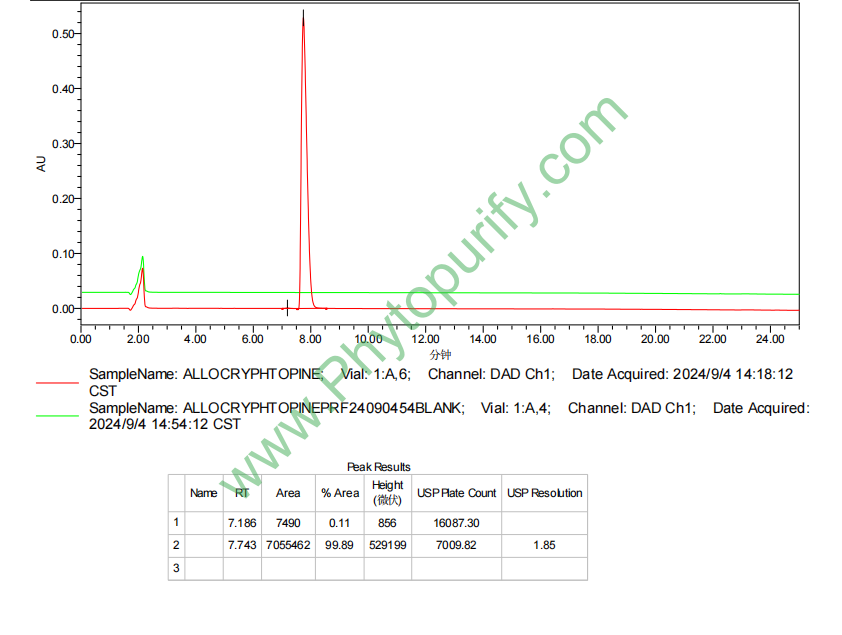
HPLC of Allocryptopine
Storage conditions:Short-term storage at 2~8℃, long-term storage at -20 ~ -80℃
61.3800
3.0000
Unknown
Unknown
Unknown
Unknown
Unknown
Unknown
Unknown
Unknown
Allocryptopine, CAS number 485-91-6, is a natural alkaloid with multiple biological activities, mainly extracted from the Macleaya cordata genus of the poppy family. As a derivative of berberine, allopurine has attracted widespread attention in the field of natural product pharmacology due to its potential therapeutic value in liver protection, cardiovascular regulation, and neurological diseases. In recent years, with the in-depth study of its molecular mechanism, allopurine has shown unique pharmacological properties, especially in the areas of anti liver fibrosis, anti arrhythmia, and central nervous system regulation, providing theoretical and experimental basis for the development of new natural medicines.
This article will provide a systematic review of the chemical structure and physicochemical properties, plant sources, and extraction methods of allopurine. It will elaborate on its pharmacological activity and mechanism of action, and explore its prospects and challenges in clinical applications based on drug evaluation and pharmacokinetic data. The aim is to provide comprehensive reference for further research and drug development of this natural product.
Bieyinpin alkaloids belong to aromatic ether organic heterocyclic compounds with complex chemical structures, including various functional groups such as dibenzazaalkaloid skeleton, cyclic ketone, tertiary amino, and cyclic aldehyde. Its molecular formula is C21H21NO5, molecular weight is 369.41, and LogP value is about 3.0, indicating that it has moderate lipid solubility, which is conducive to cell membrane penetration. The topological polar surface area (TPSA) is 61.38 Å ², and the number of hydrogen bond acceptors is 6, indicating that it has a certain affinity and selectivity when binding to biomolecules.
Structurally, the benzodiazepine skeleton of the base gives it stable aromaticity and specific spatial configuration, while the cyclic ketone and cyclic aldehyde groups provide potential reactive sites. The presence of tertiary amino groups allows them to form diverse binding modes with target proteins through hydrogen and ionic bonds in vivo. In addition, the structural characteristics of allopurine make it highly modifiable in drug design, facilitating the optimization of its pharmacological and pharmacokinetic properties through chemical synthesis methods.
The main source of berberine is Macleaya cordata (South China Corydalis) and its related species in the genus Corydalis of the family Papaveraceae. Macleaya cordata is a perennial herbaceous plant widely distributed in southern China and Southeast Asia. Its roots, stems, and whole plant are commonly used in traditional Chinese medicine to promote blood circulation, remove blood stasis, relieve pain, and reduce swelling.
The traditional method for extracting allopurine alkaloids usually uses alcohol solvents (such as ethanol, methanol) to reflux or ultrasonically extract dried plant materials, followed by separation and purification through acid-base extraction, liquid-liquid distribution, and column chromatography. Modern extraction techniques such as supercritical CO ₂ extraction and high-performance liquid chromatography (HPLC) purification have been applied to improve extraction efficiency and purity.
The specific steps include:
This method has the advantages of mature technology, moderate cost, and suitability for large-scale production, providing a stable material basis for subsequent pharmacological research and drug development.
Numerous in vitro and in vivo experiments have shown that allopurine has significant anti damage effects on liver cells. Its mechanism mainly manifests as improving liver function indicators, reducing liver cell necrosis and inflammatory response, and inhibiting the process of liver fibrosis. Research has found that allopurine can reduce collagen deposition in the liver and decrease the expression of fibrosis related factors such as α - SMA and TGF - β, suggesting that it exerts anti fibrotic effects by regulating the activation of hepatic stellate cells.
In addition, allopurine is independent of the aromatic hydrocarbon receptor (AhR) pathway and can significantly upregulate the mRNA levels of cytochrome P450 1A (CYP1A) in human liver cells and HepG2 cells, enhance the detoxification metabolism ability of the liver, and alleviate liver toxicity damage.
Bieyinpin alkaloids have antiarrhythmic effects, mainly achieved by blocking hERG (human ether-a-go-go related gene) potassium channels. The hERG channel plays a crucial role in the process of cardiac repolarization, and its functional abnormalities are the pathological basis of various arrhythmias. Bieyinpin alkaloid effectively inhibits hERG current, prolongs action potential duration, stabilizes myocardial cell electrical activity, and thus reduces the occurrence of arrhythmia.
In addition, allopurine inhibits phosphodiesterase (PDE) activity, promotes ileal smooth muscle relaxation, increases intracellular cAMP levels, and regulates alpha adrenergic receptor-mediated bladder contraction response, demonstrating its potential in regulating smooth muscle function and vascular relaxation.
There are potential interactions between allopurine and various neurotransmitter receptors and transporters, including SIGMAR1, acetylcholinesterase (ACHE), serotonin receptor 2B (HTR2B), dopamine receptor D1 (DRD1), serotonin receptor 7 (HTR7), cholinergic receptors M1 and M3 (CHRM1, CHRM3), dopamine transporter (SLC6A3), and serotonin transporter (SLC6A4). These targets are closely related to depression and other mental illnesses, suggesting that allopurine may exert antidepressant or neuroprotective effects by regulating the neurotransmitter system.
At present, relevant research is still in the preliminary stage, and in the future, it is necessary to further explore its effects and mechanisms on the central nervous system by combining cell and animal models.
The multi-target mechanism of action of allopurine reflects its complex pharmacological properties. Its main targets and mechanisms include:
CYP1A induction Bisoprolol can induce CYP1A gene expression independently of the AhR pathway, enhance liver cell metabolic enzyme activity, promote harmful substance metabolism and detoxification, and alleviate liver damage.
PDE inhibition and cAMP regulation By inhibiting phosphodiesterase activity, allopurine increases intracellular cAMP levels, regulates smooth muscle cell function, promotes ileal relaxation and bladder contraction, reflecting its role in smooth muscle physiological regulation.
HERG channel blockade Bisoprolol can effectively block the expression of human hERG potassium channels in HEK293 cells, delay cardiomyocyte repolarization, and exert anti arrhythmic effects.
Regulation of neurotransmitter receptors and transporters The interaction between allopurine and various neural targets such as SIGMAR1, ACHE, 5-HT receptors, dopamine receptors, and transporters may affect the synthesis, release, and reuptake of neurotransmitters, regulate neural function, and have potential antidepressant and neuroprotective effects.
The diversity of these mechanisms makes allopurine a multifunctional natural drug candidate molecule with broad clinical application potential.
The molecular weight (369.41) and LogP (3.0) of Bieyinpin alkaloid both comply with Lipinski's rule, indicating its good oral bioavailability potential. Its TPSA (61.38 Å ²) is moderate, which is conducive to penetrating cell membranes and some biological barriers.
However, key pharmacological indicators such as blood-brain barrier permeability, hepatotoxicity, cardiotoxicity (including hERG inhibition related safety), and mutagenicity (Ames test) of allopurine have not been clearly defined, which limits its clinical development process. Especially, although hERG channel blockade has antiarrhythmic effects, excessive blockade may cause cardiac toxicity, and the safe dose window needs to be carefully evaluated.
In terms of pharmacokinetics, there are few existing literature reports and a lack of systematic absorption, distribution, metabolism, and excretion (ADME) data. In the future, in vivo pharmacokinetic studies need to be conducted to clarify the bioavailability, half-life, metabolic pathways, and excretion mode of allopurine, providing a basis for clinical dosage form design and administration regimens.
As a multifunctional natural alkaloid, allopurine has significant potential application value in liver diseases, cardiovascular diseases, and central nervous system diseases. Its anti fibrotic and liver protective effects provide a new treatment approach for patients with chronic liver disease, especially in terms of reversing liver fibrosis and improving liver function. The pharmacological activity of antiarrhythmic drugs provides a possible natural drug option for patients with arrhythmia, especially when traditional antiarrhythmic drugs have significant side effects, allopurine may be used as an adjuvant therapy.
In the field of neurological and psychiatric disorders, allopurine has shown potential antidepressant and neuroprotective effects by regulating multiple neurotransmitter system targets, and is expected to become a new target for the development of psychiatric disorders drugs in the future.
However, the clinical translation of allopurine still faces many challenges, including insufficient safety evaluation, lack of pharmacokinetic data, formulation development, and clinical trial design. Future research should focus on:
Overall, as a natural product with multiple pharmacological activities, allopurine has broad prospects for drug development, but requires interdisciplinary collaboration to achieve its clinical application value.
As a typical alkaloid extracted from Macleaya cordata, berberine has shown potential in liver protection, cardiovascular regulation, and treatment of neurological diseases due to its unique chemical structure and diverse pharmacological activities. Its multi-target mechanism of action provides important basis for the development of new natural medicines. Although there are still shortcomings in drug formulation, safety, and pharmacokinetics, with the deepening of research and the development of technology, allopurine is expected to become a star molecule in the field of natural product pharmacology, promoting the treatment progress of related diseases.
In the future, interdisciplinary research combining modern medicinal chemistry, molecular biology, and clinical medicine will provide a solid scientific foundation for the development and clinical application of allopurine, promoting its transition from laboratory to clinical use and contributing new natural drug resources to human health.
