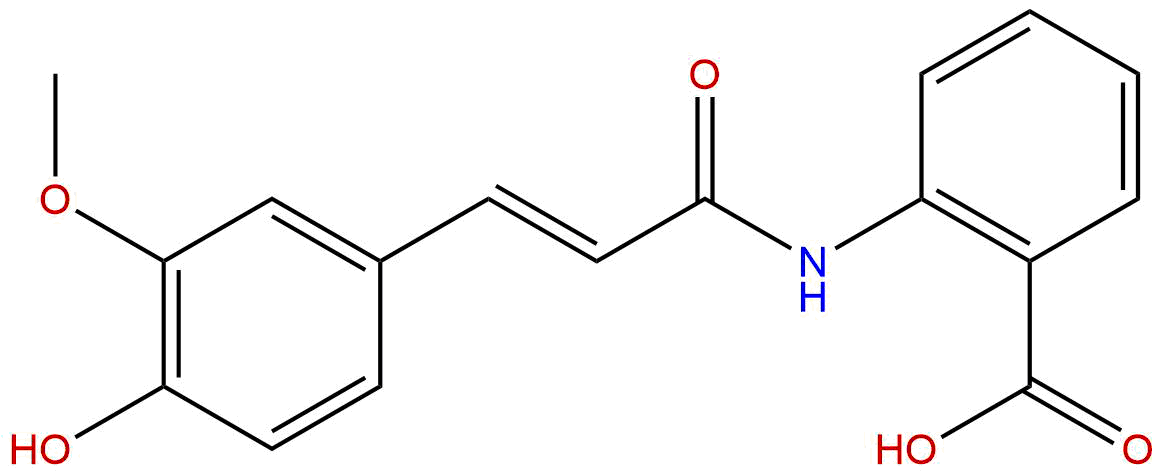


Product name: Avenanthramide E
Synonym name: 4-Demethyl Tranilast
Catalogue No.: BP5196
Cas No.: 93755-77-2
Formula: C17H15NO5
Mol Weight: 313.309
Botanical Source:
Type of Compound: Alkaloids
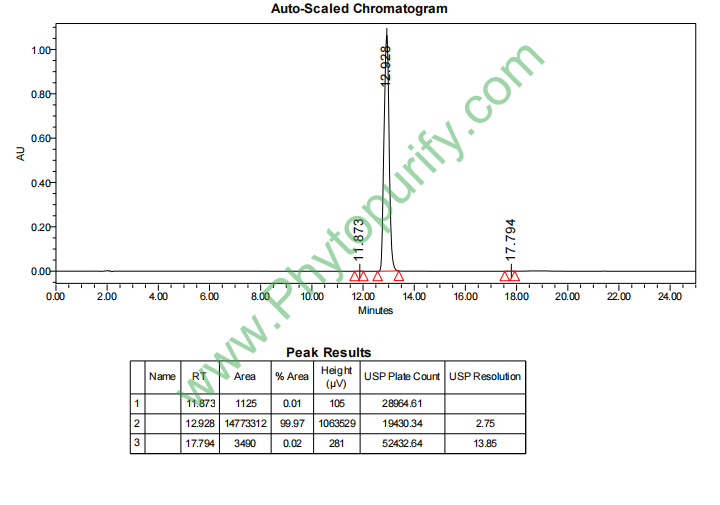
Purity: 95%~99%
Analysis Method: HPLC-DAD or/and HPLC-ELSD
Identification Method: Mass, NMR
Packing: Brown vial or HDPE plastic bottle
Storage: Store in a well closed container, protected from air and light. Put into refrigerate or freeze for long term storage.
Whenever possible, you should prepare and use solutions on the same day. However, if you need to make up stock solutions in advance, we recommend that you store the solution as aliquots in tightly sealed vials at -20℃. Generally, these will be useable for up to two weeks.
The product could be supplied from milligrams to grams
Inquire for bulk scale.
For Reference Standard and R&D, Not for Human Use Directly.
HPLC of Avenanthramide E
Storage conditions:Short-term storage at 2~8℃, long-term storage at -20 ~ -80℃
95.8600
3.5239
.5249
.0648
4.6229
7.3557
Low
93.7835
1.9081
Yes
Yes
No
No
No
No
0.0
No
No
Yes
No
Avenanthramide E (CAS number: 93755-77-2) is a natural alkaloid found in oats (Avena sativa L.) and belongs to the class of benzamide compounds. As an important member of the Avenanthramides (Avns) family, Avenanthramides E has received widespread attention in the field of natural product pharmacology in recent years due to its unique chemical structure and diverse biological activities. Oat anthracycline compounds are renowned for their significant antioxidant, anti-inflammatory, and anti allergic effects, particularly in skin pathology and immune regulation, demonstrating potential therapeutic value.
This review aims to systematically summarize the chemical structure and physicochemical properties, plant sources, and extraction methods of oat anthracene amide E, explore its pharmacological activity and mechanism of action, evaluate its pharmacological properties and pharmacokinetic characteristics, and prospect its potential in clinical applications. By integrating existing research data, it is expected to provide theoretical basis and research direction for the drug development of oat anthracene amide E and the development of functional foods.
Oat anthracene amide E is a benzamide alkaloid with a molecular formula of C18H19NO5 and a molecular weight of 313.3090. Its structural feature is that the benzamide skeleton is connected to an aromatic ring containing hydroxyl and methoxy groups, forming its unique bioactive group. The LogP value is 3.5239, indicating that it has moderate lipid solubility, which is beneficial for membrane permeation. The polar surface area (TPSA) is 95.8600, indicating that the molecule has a certain polarity, which may affect its binding ability with biomolecules and pharmacokinetic behavior.
Low water solubility (0.0648) suggests limited solubility in aqueous phase, which may pose challenges for formulation design. The low permeability of the blood-brain barrier (BBB) indicates limited distribution in the central nervous system, which is beneficial for reducing central nervous system side effects. The hERG channel inhibition experiment showed a negative result, indicating a low risk of cardiac toxicity. The Ames test result is 0.0, indicating that it has no significant genotoxicity and meets the preliminary requirements for safety evaluation.
Oat anthracene amide E mainly exists in the outer tissues of oat grains, especially in the seed coat and endosperm. Oats, as one of the world's important food crops, contain abundant natural products such as polyphenols and benzamides in their grains. The content of anthracene amide E in oats is significantly affected by factors such as variety, planting environment, maturity, and processing technology.
The common methods for extracting oat anthracene amide E include organic solvent extraction, ultrasound assisted extraction, and high-performance liquid chromatography (HPLC) separation and purification. Ethanol or methanol are generally used as extraction solvents, combined with ultrasound assisted technology to improve extraction efficiency. Subsequently, high-purity oat anthracene amide E was obtained through liquid-liquid extraction, silica gel column chromatography, or reverse phase HPLC for separation and purification. In recent years, green extraction techniques such as supercritical CO2 extraction and microwave-assisted extraction have also been gradually applied to the extraction of this compound, aiming to improve yield and reduce the use of organic solvents.
The pharmacological activities of oat anthracene amide E mainly focus on anti allergic, anti-inflammatory, and antioxidant aspects. Numerous in vitro and in vivo studies have shown that oat anthracene amide E can effectively regulate immune responses, alleviate allergic symptoms, and has potential therapeutic value.
Antiallergic activity
Oat anthracene amide E significantly inhibits degranulation of mast cells and release of inflammatory mediators by regulating multiple allergy related targets. Its targets include lipoxygenase 5 (ALOX5), histamine H1 receptor (HRH1), interleukin 4 (IL4), IL5, IL13, Fc ε RI α receptor (FCER1A), thromboxane A2 receptor (TBXA2R), signal transduction and transcription activator 6 (STAT6), and thymic stromal lymphopoietin (TSLP). These targets play a crucial role in the occurrence and maintenance of allergic reactions. Oat anthracycline E exhibits good anti allergic effects by synergistically regulating multiple targets, inhibiting Th2 cell-mediated immune responses, reducing IgE mediated allergic reactions.
anti-inflammatory effect
Oat anthracene amide E can inhibit the production of inflammatory mediators and the activation of inflammatory signaling pathways, reducing inflammatory responses. It exerts anti-inflammatory effects by inhibiting the NF - κ B and MAPK signaling pathways, reducing the expression of pro-inflammatory cytokines such as TNF - α and IL-6.
antioxidant activity
As a polyphenol derivative, oat anthracene amide E has significant free radical scavenging ability and can alleviate oxidative stress damage to cells. Its antioxidant effect helps to protect cells from oxidative damage, delay the progression of inflammation and related diseases.
Other potential activities
Some studies also suggest that oat anthracene amide E may have anti-tumor, neuroprotective, and cardiovascular protective effects, but the relevant mechanisms still need further verification.
The anti allergic mechanism of oat anthracene amide E mainly involves the regulation of key targets in allergic reactions:
ALOX5 (Lipoxygenase 5)ALOX5 catalyzes the production of leukotrienes from arachidonic acid, promoting allergic inflammatory reactions. Oat anthracene amide E inhibits ALOX5 activity, reduces leukotriene production, alleviates inflammation and airway hyperresponsiveness.
HRH1 (histamine H1 receptor)Histamine mediates allergic symptoms such as itching and vasodilation through HRH1. The antagonistic effect of oat anthracene amide E on HRH1 helps alleviate allergic symptoms.
IL4、IL5、IL13 These cytokines are key mediators secreted by Th2 cells, promoting IgE production and eosinophil activation. Oat anthracene amide E inhibits the expression of these cytokines, regulates Th1/Th2 balance, and alleviates allergic reactions.
FCER1A (high affinity IgE receptor alpha chain)Mediate IgE dependent activation of mast cells. Oat anthracene amide E inhibits degranulation of mast cells by regulating FCER1A expression.
TBXA2R (thromboxane A2 receptor)Participate in platelet aggregation and inflammatory response. Oat anthracene amide E inhibits the activity of this receptor, which helps alleviate inflammation and allergic symptoms.
STAT6 (Signal Transduction and Transcription Activation Factor 6)As a key transcription factor in the IL4 and IL13 signaling pathways, STAT6 regulates the expression of allergy related genes. Oat anthracene amide E inhibits the phosphorylation and activation of STAT6, blocking allergy signal transduction.
TSLP (thymic stromal lymphopoietin)As a pro-inflammatory cytokine secreted by epithelial cells, TSLP activates dendritic cells and promotes Th2 immune response. Oat anthracene amide E downregulates TSLP expression and inhibits allergic inflammation.
By synergistically regulating the above multiple targets, oat anthracene amide E effectively regulates the immune microenvironment and inhibits the occurrence and development of allergic reactions.
The pharmacological parameters of oat anthracene amide E demonstrate its advantages and challenges as a potential drug molecule:
Molecular weight (313.3090)Meet the ideal range of drug design, which is conducive to absorption and distribution in the body.
LogP(3.5239)It indicates that it has moderate lipid solubility, which is conducive to transmembrane absorption, but excessive solubility may affect water solubility.
TPSA(95.8600)The prompt molecule has moderate polarity, which is beneficial for binding to the target and affects bioavailability.
Water solubility (0.0648)Low, may limit the dissolution and absorption of oral preparations, and needs to be improved through formulation technology.
Low blood-brain barrier penetration Reduce the risk of central nervous system side effects, but limit its application in central nervous system diseases.
HERG channel inhibition negative It indicates good cardiac safety and reduces the potential risk of arrhythmia.
Ames test negative, indicating no significant genetic toxicity and high safety.
At present, there is limited pharmacokinetic data on oat anthracene amide E. Preliminary studies have shown that its oral absorption rate is moderate, and its distribution in the body is mainly concentrated in the liver and immune related tissues. The metabolic pathway may involve the liver cytochrome P450 enzyme system. Its excretion is mainly carried out through bile and urine. Further systematic pharmacokinetic and toxicological studies are needed in the future to clarify its in vivo behavior and safety.
Oat anthracene amide E has broad clinical application potential due to its significant anti allergic and anti-inflammatory activities. At present, the incidence of allergic diseases such as asthma, allergic rhinitis, atopic dermatitis and other incidence rate continues to rise, which urgently needs safe and effective treatment. Oat anthracene amide E has shown promising therapeutic prospects by regulating immune responses through multiple targets.
In addition, oat anthracene amide E, as a natural product, has high safety and is suitable for development as a functional food or health supplement for the prevention and adjuvant treatment of allergic diseases. Its antioxidant and anti-inflammatory properties also provide the possibility for intervention in chronic inflammation related diseases.
However, the clinical translation of oat anthracene amide E still faces several challenges:
Insufficient bioavailability Poor water solubility limits oral absorption, and new drug delivery systems or chemical modifications need to be developed to improve bioavailability.
Lack of pharmacokinetic data Systematic research is needed to study its absorption, distribution, metabolism, and excretion characteristics in the body, in order to guide clinical dose design.
Insufficient clinical trial validation At present, most of them are in vitro and animal experiments, lacking systematic clinical research data, and requiring multi center, large sample clinical trials.
Difficulties in formulation development Stability, solubility, and release characteristics need to be optimized to meet clinical application requirements.
Future research should focus on the structural optimization, formulation innovation, and clinical efficacy verification of oat anthracene amide E, in order to promote its translation into clinical applications. At the same time, modern molecular biology and medicinal chemistry techniques can be combined to deeply analyze its mechanism of action and expand its indications.
Oat anthracene amide E, as a natural alkaloid derived from oats, has become a hot topic in natural product pharmacology research due to its unique chemical structure and significant anti allergic and anti-inflammatory activities. The mechanism of multi-target regulation of immune response provides new ideas for the treatment of allergic diseases. The drug efficacy evaluation shows that it has good safety and suitable drug properties, but its water solubility and bioavailability still need to be optimized.
In the future, through systematic pharmacokinetic studies, formulation development, and clinical validation, oat anthracene amide E is expected to become an important natural drug candidate molecule in the field of anti allergy. Meanwhile, its application as a functional food ingredient also has broad prospects. Overall, the research on oat anthracene amide E not only enriches the theoretical basis of natural product pharmacology, but also provides valuable resources for the development of natural medicines, which is worthy of continuous and in-depth exploration.
