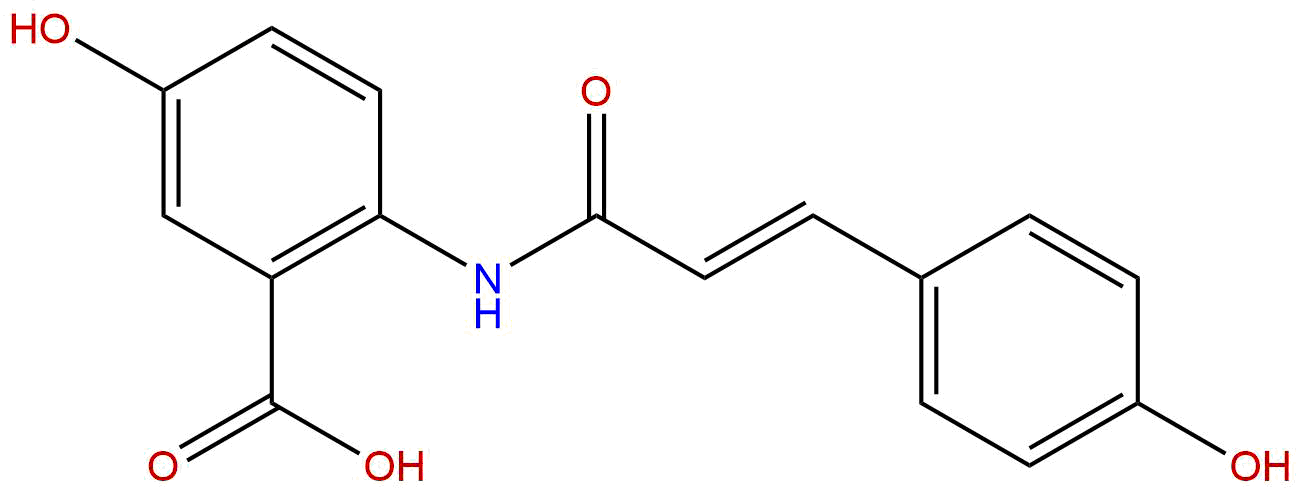


Product name: Avenanthramide A
Synonym name: Avenanthramide 2p;Avenanthramide Bp
Catalogue No.: BP5205
Cas No.: 108605-70-5
Formula: C16H13NO5
Mol Weight: 299.282
Botanical Source:
Type of Compound: Alkaloids
Purity: 95%~99%
Analysis Method: HPLC-DAD or/and HPLC-ELSD
Identification Method: Mass, NMR
Packing: Brown vial or HDPE plastic bottle
Storage: Store in a well closed container, protected from air and light. Put into refrigerate or freeze for long term storage.
Whenever possible, you should prepare and use solutions on the same day. However, if you need to make up stock solutions in advance, we recommend that you store the solution as aliquots in tightly sealed vials at -20℃. Generally, these will be useable for up to two weeks.
The product could be supplied from milligrams to grams
Inquire for bulk scale.
For Reference Standard and R&D, Not for Human Use Directly.
Storage conditions:Short-term storage at 2~8℃, long-term storage at -20 ~ -80℃
Avenanthramide A (CAS number: 108605-70-5) is a unique natural phenolic compound mainly found in oats(Avena sativa L. In (). As a characteristic secondary metabolite in oats, oat anthracene amide A plays an important role in plant defense mechanisms and has received widespread attention in the field of pharmacology due to its multiple biological activities. In recent years, with the deepening development of natural product pharmacology, oat anthracycline A has become a research hotspot due to its significant antioxidant, anti-inflammatory, and anti-tumor activities, especially its potential application value in the treatment of colorectal cancer (CRC).
This review systematically summarizes the chemical structure and physicochemical properties, plant sources, and extraction methods of oat anthracene amide A. It focuses on analyzing its pharmacological activity and mechanism of action, exploring its pharmacokinetic characteristics in combination with pharmacological parameters, and looking forward to its clinical application prospects. Intended to provide comprehensive reference for natural product pharmacology researchers and new drug development.
Oat anthracene amide A belongs to the anthracene amide class compounds and is a complex formed by connecting phenylpropanoid and aniline structures through amide bonds. Its molecular formula is C17H17NO5 and its molecular weight is 299.2820. Structurally, oat anthracene amide A contains a hydroxyl modified benzene ring and an aromatic amine group with an amide bond, forming a stable conjugated system that endows it with excellent antioxidant activity.
In terms of physical and chemical properties, the LogP value of oat anthracene amide A is 3.1365, indicating that it has moderate lipid solubility and is beneficial for cell membrane penetration. Its topological polar surface area (TPSA) is 106.8600, indicating that the molecule has a certain polarity that facilitates binding to biological targets. Low water solubility (0.0987 mg/mL) suggests limited solubility in the aqueous phase, which may affect its bioavailability. The low permeability of the blood-brain barrier indicates that it mainly acts on peripheral tissues. Importantly, oat anthracycline A did not exhibit hERG channel inhibitory activity, and the Ames mutagenicity test result was 0.0, indicating its high safety and promising drug development potential.
Oat anthracene amide A is mainly present in the endosperm and ectoderm of oat seeds and is a unique secondary metabolite of oats. Its content is significantly affected by variety, planting environment, maturity, and processing method. In common oat varieties, the content of anthracene amide A in oats is about several hundred micrograms to several milligrams per gram of dry weight.
The extraction method usually uses organic solvent extraction combined with liquid chromatography separation technology. Using ethanol or methanol as the main extraction solvent, ultrasound assisted extraction or hot reflux extraction can improve efficiency. After purification steps such as liquid-liquid distribution and solid-phase extraction, the extraction solution is subjected to qualitative and quantitative analysis using high-performance liquid chromatography (HPLC) combined with mass spectrometry (MS) or nuclear magnetic resonance (NMR). In recent years, supercritical CO2 extraction and membrane separation technologies have also been attempted to improve extraction purity and yield.
Oat anthracene amide A has significant antioxidant capacity, which can clear free radicals and alleviate cell damage caused by oxidative stress. It activates the NFE2L2 (nuclear factor erythroid 2-related factor 2, NRF2) signaling pathway, induces the expression of downstream antioxidant enzymes such as superoxide dismutase (SOD1, SOD2), catalase (CAT), glutathione peroxidase (GPX1), and heme oxygenase 1 (HMOX1), and enhances the intracellular antioxidant defense system. Multiple in vitro cell models and animal experiments have confirmed that oat anthracene amide A can effectively reduce oxidative damage, protect nerve cells and the cardiovascular system.
In addition, oat anthracycline A exhibits good anti-inflammatory activity by inhibiting the expression of pro-inflammatory factors and the NF - κ B signaling pathway. This dual antioxidant and anti-inflammatory effect lays the foundation for its application in chronic inflammation related diseases.
Oat anthracycline A exhibits significant cytotoxicity in colorectal cancer (CRC) cells. The mechanism involves targeting RNA helicase DDX3, leading to mitochondrial swelling and increased production of reactive oxygen species (ROS), which in turn induces cell apoptosis. DDX3, as a multifunctional RNA helicase, plays a key role in tumor cell proliferation, migration, and transcriptional regulation. Oat anthracycline A achieves anti-tumor effects by regulating this target.
In vivo mouse model studies have shown that orally administered oat anthracycline A significantly inhibits tumor growth without significant toxic side effects, indicating its good efficacy and safety. This discovery provides a theoretical basis for the development of anticancer natural drugs based on oat anthracene amide A.
The mechanism of action of oat anthracene amide A mainly includes the following aspects:
Activate NFE2L2/NRF2 signaling pathway
Oat anthracycline A promotes the translocation of NRF2 from the cytoplasm to the nucleus, binds to antioxidant response elements (ARE), upregulates the expression of antioxidant enzymes such as SOD1, SOD2, CAT, GPX1, and HMOX1, and enhances the cell's resistance to oxidative stress.
Targeting RNA helicase DDX3
DDX3 plays an important role in RNA metabolism and tumor cell survival. Oat anthracene amide A binds to DDX3, inhibiting its function, leading to loss of mitochondrial membrane potential, mitochondrial swelling, increased ROS generation, and induction of CRC cell apoptosis.
Regulating apoptosis related signaling pathways
By activating the mitochondrial pathway, it promotes the release of cytochrome C, activates caspase family proteins, and ultimately triggers programmed cell death.
Anti inflammatory pathway regulation
Inhibiting the NF - κ B signaling pathway, reducing the expression of pro-inflammatory cytokines such as TNF - α and IL-6, and alleviating chronic inflammation.
Overall, oat anthracycline A exhibits complex and effective pharmacological activity through multi-target and multi-path synergistic effects.
The pharmacological parameters of oat anthracene amide A indicate that it has certain potential for drug development. The molecular weight is 299.2820, which meets the basic requirements of Lipinski rule for oral active drugs. The LogP value of 3.1365 indicates that it has moderate lipid solubility, which is beneficial for cell membrane permeability, but its water solubility is low (0.0987 mg/mL), which may limit its oral bioavailability. Therefore, formulation optimization is needed to improve dissolution.
The low permeability of the blood-brain barrier suggests that it mainly acts on peripheral tissues, reducing the risk of central nervous system side effects. HERG channel inhibition was negative and Ames test showed no mutagenicity, indicating its good safety.
At present, there is limited research on the pharmacokinetics of oat anthracene amide A. Oral administration experiments in mice have shown that it has oral activity, can be absorbed by the body, and exert pharmacological effects. In the future, systematic research on in vivo absorption, distribution, metabolism, and excretion (ADME) is needed to clarify its half-life, metabolic pathways, and potential drug interactions, providing data support for clinical translation.
Based on the significant antioxidant, anti-inflammatory, and anti-tumor activities of oat anthracene amide A, it has broad clinical application prospects in various disease fields.
Adjuvant therapy for colorectal cancer
The mechanism of targeting DDX3 to induce apoptosis in tumor cells provides a new approach for the treatment of CRC. As an orally active natural product, oat anthracycline A is expected to be used as an adjuvant chemotherapy drug, improving efficacy and reducing side effects.
Chronic inflammation and oxidative stress-related diseases
Including cardiovascular diseases, neurodegenerative diseases, and metabolic syndrome, it exerts a protective effect by activating the NRF2 pathway, reducing oxidative damage and inflammatory response.
Functional foods and nutritional supplements
Oat anthracene amide A, as a natural component of oats, is suitable for development as a functional food ingredient to promote health and prevent chronic diseases.
Future research needs to focus on optimizing extraction and purification processes, improving bioavailability, conducting systematic toxicological evaluations, and preclinical efficacy verification. At the same time, by combining modern drug design with nanocarrier technology, the targeting and stability of oat anthracene amide A can be improved, promoting its clinical translation.
Oat anthracene amide A, as an important natural product in oats, has shown great potential in the fields of antioxidant, anti-inflammatory, and anti-tumor due to its unique chemical structure and multi-target pharmacological activity. The discovery of targeting DDX3 to induce apoptosis in colorectal cancer cells provides a new direction for the development of natural anti-cancer drugs. The pharmacological evaluation shows that it has good safety and oral activity, but its water solubility and pharmacokinetic characteristics still need further optimization and in-depth research.
With the continuous advancement of natural product pharmacology and modern drug development technology, oat anthracycline A is expected to become an important candidate molecule for the treatment and prevention of various diseases, promoting the application of natural products in precision medicine. The mechanism research, pharmacokinetic analysis, and preclinical evaluation of future systems will lay a solid foundation for their clinical translation.
