
| Catalog No | Package | Original Price | Price | Inventory | Quantity | Operating |
|---|---|---|---|---|---|---|
| BP0200-20mg | 20mg | $36.00 | Sign in |
|


Synonym name: Asarum camphor; trans-Asarone; trans-Isoasaron; trans-Isoasarone; alpha-Asaron; alpha-Asarone
Catalogue No.: BP0200
Cas No.: 2883-98-9
Formula: C12H16O3
Mol Weight: 208.257
Botanical Source: Asarum spp., Angelica tenuissimae, Daucus carota and other plants.
Purity: 95%~99%
Analysis Method: HPLC-DAD or/and HPLC-ELSD
Identification Method: Mass, NMR
Packing: Brown vial or HDPE plastic bottle
Can be supplied from milligrams to grams.
For Reference Standard and R&D, Not for Human Use Directly.
Inquire for bulk scale.
HPLC of Asarone
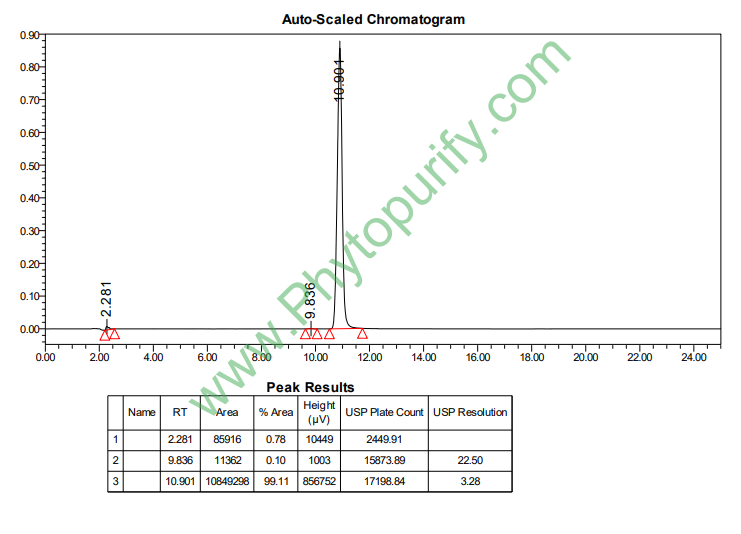
Storage conditions:Short-term storage at 2~8℃, long-term storage at -20 ~ -80℃
27.6900
2.5000
2.2000
High
No
No
Unknown
Yes
No
Positive
No
Alpha Asarone (CAS number: 2883-98-9) is a natural product belonging to the class of styrene compounds, widely present in traditional Chinese medicine such as Asarum spp. As the trans isomer of Asarone, Alpha Asarone has received widespread attention in pharmacological research in recent years due to its unique chemical structure and biological activity. Its main manifestations are anticonvulsant effects and its ability to regulate gamma aminobutyric acid (GABA) receptors, indicating its potential value in the treatment of neurological diseases. In addition, Alpha Asarone interacts with various disease-related targets, particularly in the molecular mechanism research of complex diseases such as obstructive sleep apnea (OSA).
This article will provide a systematic review of the chemical structure and physicochemical properties, plant sources and extraction methods, pharmacological activity, mechanism of action and molecular targets, pharmacological evaluation and pharmacokinetic characteristics of Alpha Asarone, and explore its clinical application prospects in depth. The aim is to provide scientific basis and theoretical support for further research and development of this natural product.
The chemical name of Alpha Asarone is 1-methoxy-4- (2-propenyl) benzene, with the molecular formula C12H16O and a molecular weight of 208.26. Its structural feature is the connection of a methoxy group and a trans propylene side chain on the benzene ring, belonging to the class of styrene compounds. Compared with its cis isomer Asarone, the trans configuration of Alpha Asarone endows it with different spatial conformation and biological activity.
In terms of physical and chemical properties, the LogP value of Alpha Asarone is about 2.5, indicating that it has moderate lipid solubility and is conducive to penetrating cell membranes and the blood-brain barrier (BBB), which is consistent with its high blood-brain barrier permeability. The polar surface area (TPSA) is 27.69 Å ², and the number of hydrogen bond acceptors is 3, further supporting its excellent membrane permeability. Its molecular structure contains methoxy and allyl groups, which have important effects on its binding to biological targets.
Toxicological data shows that the median lethal dose (LD50) of Alpha Asarone is approximately 200 mg/kg, indicating a certain degree of acute toxicity. In addition, the risk of liver toxicity has been clearly identified, while the effects of cardiac toxicity and hERG channel inhibition are not yet clear. The Ames test showed positive, suggesting that it may have a certain genetic toxicity risk, which poses a challenge to its safety evaluation.
Alpha Asarone mainly exists in plants of the Asarum genus, especially in traditional Chinese medicinal herbs such as Asarum heterotropoides var. mandshuricum and Asarum sieboldii. As a commonly used medicinal herb in traditional Chinese medicine, Asarum has the effects of dispelling wind, dispelling cold, and relieving pain. Its volatile oil contains a high content of Alpha Asarone ether.
The common methods for extracting Alpha Asarone include steam distillation and organic solvent extraction. Steam distillation is suitable for extracting volatile oils and can effectively preserve the activity of volatile components. Solvent extraction often uses organic solvents such as ethanol, ether, or petroleum ether, and the yield is improved through ultrasound assisted extraction or Soxhlet extraction. After rotary evaporation and concentration of the extract, purification and component identification were carried out using column chromatography, gas chromatography-mass spectrometry (GC-MS) and other techniques to ensure the purity and structural confirmation of Alpha Asarone.
In recent years, supercritical CO2 extraction technology has also been applied to the extraction of volatile oil from Asarum, which has the advantages of environmental protection, high efficiency, and strong selectivity, and is expected to become a potential method for industrial extraction of Alpha Asarone ether.
The pharmacological activity research of Alpha Asarone mainly focuses on the field of neurological diseases, and its anticonvulsant effect and regulatory function on GABA receptors are the most significant biological effects.
Multiple in vitro and in vivo experiments have shown that Alpha Asarone can significantly inhibit epileptic seizures induced by chemical or electrical stimulation. Its mechanism of action may involve enhancing the function of the inhibitory neurotransmitter GABA in the central nervous system, reducing neuronal excitability, and thus achieving anticonvulsant effects. Compared with traditional antiepileptic drugs, Alpha Asarone exhibits lower neurotoxicity and good tolerability, indicating its potential as a novel anticonvulsant drug.
Alpha Asarone enhances GABA mediated chloride ion influx, promotes neuronal hyperpolarization, and inhibits neuronal excitation by regulating GABA receptor subtypes, especially GABAA receptors. Both in vitro receptor binding experiments and electrophysiological studies support its function as a GABA modulator. In addition, Alpha Asarone may indirectly affect GABA levels by regulating the activity of GABA metabolizing enzymes, further enhancing its sedative and anticonvulsant effects.
In addition to its role in the nervous system, Alpha Asarone has also been preliminarily reported to have anti-inflammatory, antioxidant, and anti-tumor effects. For example, its inhibitory effect on cyclooxygenase (PTGS1) activity suggests its potential anti-inflammatory activity. Given its binding ability to various disease-related targets, the mechanism of action of Alpha Asarone in complex diseases such as obstructive sleep apnea has also become a research hotspot.
The mechanism of action of Alpha Asarone involves the regulation of multiple targets and pathways, particularly in the regulation of targets related to the nervous system and obstructive sleep apnea.
GABA receptors are one of the main targets of Alpha Asarone. Alpha Asarone effectively reduces neuronal excitability, exerts anticonvulsant and sedative effects by enhancing GABAA receptor-mediated inhibitory nerve conduction. In addition, Alpha Asarone may affect the function of GABAB receptors, regulate neurotransmitter release, and stabilize neural circuits.
Obstructive sleep apnea (OSA) is a complex multifactorial disease involving multiple molecular pathways. Alpha Asarone has potential interactions with various OSA related targets, including:
The multiple regulation of these targets provides a molecular basis for the treatment of OSA and related neurological diseases with Alpha Asarone.
Alpha Asarone has shown certain advantages in medicinal properties, but there are also safety hazards.
In summary, Alpha Asarone has certain potential for medicinal properties, but safety issues must be fully addressed in subsequent research.
Alpha Asarone, as a natural product with multiple pharmacological activities, has shown broad application prospects, especially in the field of neurological diseases. Its anticonvulsant and GABA regulating effects provide new ideas for the treatment of diseases such as epilepsy and anxiety. Obstructive sleep apnea, as a high incidence and complex disease, Alpha Asarone may become a new candidate drug for adjuvant therapy through multi-target regulation.
Future research should focus on:
In addition, combining modern drug design with natural product chemistry to develop Alpha Asarone derivatives or compound formulations may further enhance their clinical value.
Alpha Asarone, as an important natural styrene compound, has shown significant research and application value in neurological diseases and obstructive sleep apnea due to its unique chemical structure and significant pharmacological activity. Its anticonvulsant and GABA regulatory effects provide new ideas for the treatment of central nervous system diseases, while its interaction with multiple targets provides a molecular basis for multidimensional regulation of complex diseases.
Although it has shown certain advantages in medicinal properties, safety issues such as liver toxicity and genetic toxicity still need to be highly valued. In the future, through interdisciplinary collaboration, in-depth analysis of its mechanism of action, optimization of drug design and safety evaluation, Alpha Asarone is expected to become a model for natural product drug development and promote its practical application in clinical treatment.
In summary, Alpha Asarone not only enriches the research content of natural product pharmacology, but also provides new drug candidate molecules for the treatment of related diseases, which has important scientific significance and application prospects.
