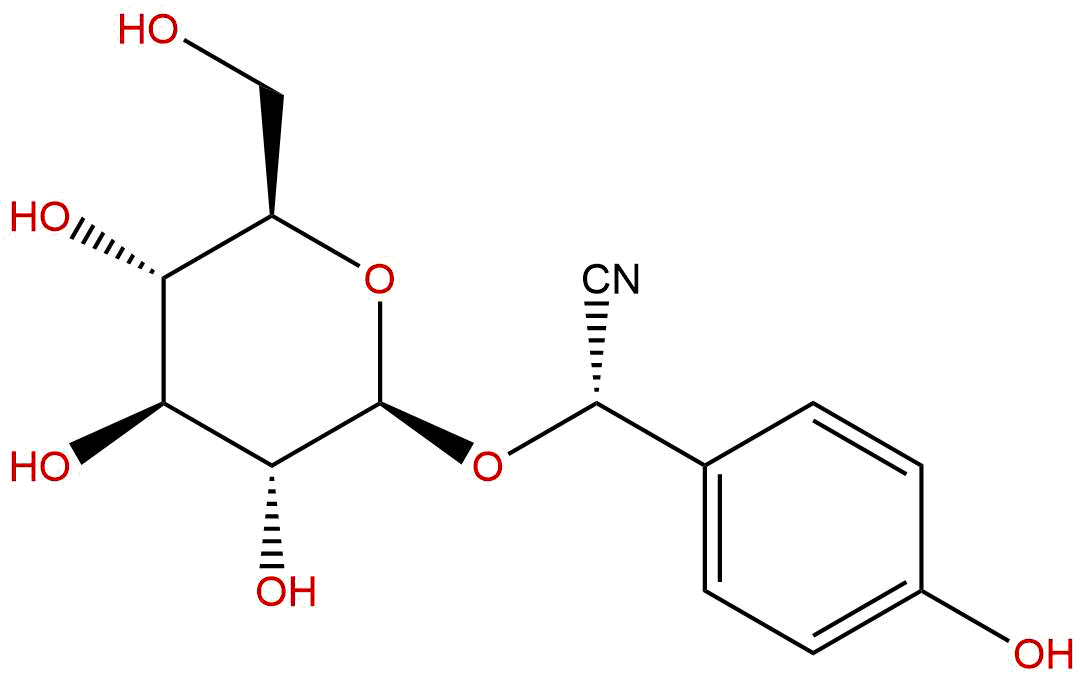


Product name: Dhurrin
Synonym name: (S)-α-Cyano-p-hydroxybenzyl glucoside
Catalogue No.: BP2293
Cas No.: 499-20-7
Formula: C14H17NO7
Mol Weight: 311.29
Botanical Source:
Type of Compound:
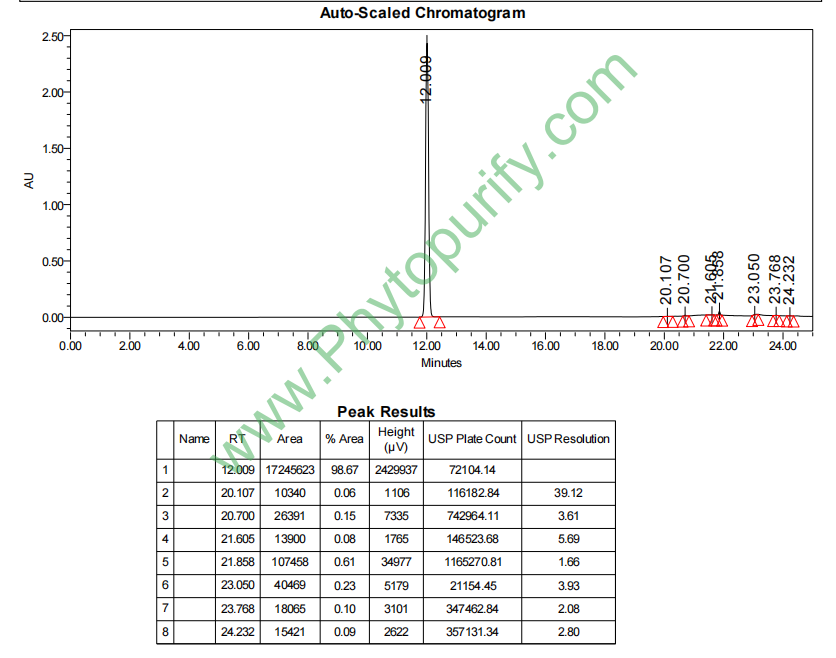
Purity: 95%~99%
Analysis Method: HPLC-DAD or/and HPLC-ELSD
Identification Method: Mass, NMR
Packing: Brown vial or HDPE plastic bottle
Storage: Store in a well closed container, protected from air and light. Put into refrigerate or freeze for long term storage.
Whenever possible, you should prepare and use solutions on the same day. However, if you need to make up stock solutions in advance, we recommend that you store the solution as aliquots in tightly sealed vials at -20℃. Generally, these will be useable for up to two weeks.
The product could be supplied from milligrams to grams
Inquire for bulk scale.
For Reference Standard and R&D, Not for Human Use Directly.
HPLC of Dhurrin
Storage conditions:Short-term storage at 2~8℃, long-term storage at -20 ~ -80℃
Dhurrin (CAS number: 499-20-7) is a typical cyanogenic glycoside natural product, first isolated from sorghum (Sorghum spp.). As a secondary metabolite of plants, zeaxanthin mainly plays a defensive role in the plant body, resisting the invasion of pathogens and herbivorous insects. In recent years, with the development of natural product pharmacology, zeatin has attracted extensive attention due to its unique chemical structure and diverse biological activities, especially its potential application in the field of anti diabetes. This article aims to systematically review the chemical structure and physicochemical properties, plant sources and extraction methods, pharmacological activity and mechanism of action, pharmacological evaluation and pharmacokinetic characteristics of salidroside, and explore its clinical application prospects and development directions, providing theoretical basis and reference for subsequent research and drug development.
The chemical name of salidroside is (S) -4-hydroxytonsillonitrile β - D-glucoside, with a molecular formula of C ₁₄ H ₁₇ NO ₇ and a molecular weight of 311.29. Its structure is composed of a (S) - prenasin skeleton with a hydroxyl group at position 4 of the benzene ring, which is connected to β - D-glucose through a glycosidic bond. It belongs to the typical class of cyanogenic compounds. The structure contains a cyanide group (- CN) and multiple hydroxyl groups (- OH), giving it strong polarity and water solubility.
In terms of physicochemical properties, the LogP value of salidroside is approximately -0.6788, indicating its strong hydrophilicity and easy solubility in water (with a water solubility of approximately 28.87 mg/mL), which has a significant impact on its bioavailability and pharmacokinetic behavior. Its topological polar surface area (TPSA) is 143.4 Å ², indicating that the molecule has a large number of polar groups, which may limit its ability to pass through the blood-brain barrier, consistent with its low blood-brain barrier permeability. In addition, salidroside does not have hERG channel inhibitory activity, and the Ames test result is 0, indicating its good toxicological safety and potential for drug development.
Sorghum glycoside is mainly present in plants of the Sorghum genus, especially in the seeds and seedlings of Sorghum bicolor, where it is abundant. Sorghum, as an important grain and feed crop, can have a certain percentage of zeaxanthin content in its seeds and seedlings, and its content is significantly affected by variety, environmental conditions, and growth stage.
The traditional method for extracting syringol glycosides often uses polar solvents such as water or methanol for extraction, combined with ultrasound assisted extraction or hot reflux extraction techniques to improve extraction efficiency. The specific steps usually include:
In recent years, green extraction techniques such as supercritical fluid extraction and microwave-assisted extraction have also been applied to the extraction of paeoniflorin, aiming to improve extraction efficiency, reduce solvent usage, and environmental pollution.
The pharmacological activities of sorghum saponin mainly focus on its anti diabetes, antioxidant, anti-inflammatory and antibacterial activities, especially its anti diabetes activity.
Numerous in vitro and in vivo experiments have shown that paeoniflorin can significantly improve glucose metabolism abnormalities, lower blood glucose levels, and alleviate pancreatic beta cell damage. Its anti diabetes mechanism involves multiple signaling pathways and molecular targets, including activation of AMPK pathway, regulation of insulin signal transduction, inhibition of DPP4 enzyme activity, etc.
Sorghum glycoside can clear free radicals, alleviate oxidative stress damage, reduce the expression of inflammatory factors, and protect tissue cells from oxidative and inflammatory damage. This is of positive significance for the prevention and treatment of diabetes and its complications.
Some studies have shown that salidroside has inhibitory effects on certain bacteria and fungi, indicating that it may have certain anti infective potential. In addition, its defense function in plants also provides theoretical support for its biological activity research.
The anti diabetes effect of zeatin is closely related to a variety of molecular targets, mainly including:
AMPK(5’ AMP-activated protein kinase)As a key regulator of cellular energy metabolism, AMPK activation promotes glucose uptake and lipid metabolism, improving insulin resistance. Sorghum glycoside can activate AMPK and enhance cellular metabolic activity.
SGLT2 (Sodium Glucose Co Transporter 2)Regulating renal glucose reabsorption and inhibiting SGLT2 can help lower blood sugar levels. Sorghum glycoside has a certain regulatory effect on SGLT2 and promotes glucose excretion.
GCK (Glucokinase)The key enzyme involved in glucose metabolism regulates the perception of blood glucose by pancreatic beta cells. Sorghum glycoside can promote GCK activity and enhance insulin secretion.
PPARG (Peroxisome proliferator activated receptor gamma)Regulating lipid metabolism and insulin sensitivity. Sorutin improves insulin resistance by activating PPARG.
AKT1 (protein kinase B)The core protein of the insulin signaling pathway regulates glucose transport and metabolism. Sorutin enhances the phosphorylation level of AKT1 and promotes insulin signaling.
DPP4 (dipeptidyl peptidase 4)Degradation of glucagon like peptide-1 (GLP-1) and inhibition of DPP4 can help prolong the action time of GLP-1. Sorghum glycosides exhibit certain DPP4 inhibitory activity.
IRS1 (Insulin Receptor Substrate 1): Mediate insulin signaling, and promote the expression and activity of IRS1 with zeaxanthin.
SLC2A4(GLUT4)The main insulin-dependent glucose transporter, zeaxanthin, promotes the transport of GLUT4 to the cell membrane and enhances glucose uptake.
PIK3R1 (Phosphatidylinositol 3-kinase regulatory subunit 1)and INSR (Insulin Receptor)Participate in insulin signaling, regulate its expression with zeaxanthin, and promote the activation of signaling pathways.
To sum up, sorghum glucoside regulates glucose metabolism and insulin signal through multi target and multi pathway synergy, and exerts anti diabetes effect.
The pharmacological evaluation of salidroside shows that it has good safety and certain pharmacokinetic advantages. Its low LogP value and high TPSA indicate good water solubility, but may limit oral absorption and blood-brain barrier penetration. The in vitro hERG channel inhibition experiment was negative, indicating a low risk of cardiac toxicity. The Ames test result is 0, indicating no significant genetic toxicity.
In terms of pharmacokinetics, salidroside is absorbed quickly after oral administration, but its bioavailability may be limited due to its strong polarity. It mainly releases cyanide groups through hydrolytic enzymes in the body, and its metabolites include glucose and cyanide, the latter of which should be noted for potential toxicity. Liver metabolic enzymes are involved in its metabolic process, and excretion is mainly completed through urine.
Further systematic pharmacokinetic and toxicological studies are needed in the future to clarify its absorption, distribution, metabolism, and excretion (ADME) characteristics, providing a basis for clinical development.
As a natural cyanoside compound, sorghum saponin shows good application potential in the field of anti diabetes. Its multi target mechanism of action meets the needs of modern multi factor disease treatment, and is expected to be a candidate molecule or adjuvant for new anti diabetes drugs. In addition, the antioxidant and anti-inflammatory activities of sorghum glucoside provide a possibility for the prevention and treatment of complications of diabetes.
However, the safety issues of cyanide glycoside compounds, especially the potential risk of cyanide release, are the main obstacles to their clinical application. Future research should focus on the safe dose range of salidroside, toxicological evaluation of metabolites, and structural modification to reduce toxicity.
In addition, by combining modern drug design techniques and optimizing the pharmacokinetic properties of salidroside through molecular modification, its oral bioavailability and targeting can be improved, which will promote its clinical translation. The implementation of multicenter clinical trials is also a key step in verifying its efficacy and safety.
As a natural cyanoside with rich source and unique structure, sorghum glucoside has significant anti diabetes and multiple biological activities. Its multi target and multi mechanism mode of action provides a new idea for the treatment of diabetes and related metabolic diseases. Despite certain safety and pharmacokinetic challenges, with the help of modern medicinal chemistry and pharmacology techniques, salidroside still has great potential for development. In the future, in-depth mechanism research, systematic pharmacokinetic and toxicological evaluations, and clinical trials will lay a solid foundation for its transformation into safe and effective clinical drugs.
