Prunasin: Exploration of antioxidant and anti fibrotic candidate molecules from traditional bitter almonds to modern ones
1. Overview
Prunasin (CAS number: 99-18-3) is a naturally occurring cyanogenic glucoside widely distributed in the seeds of various plants in the Rosaceae family, particularly the bitter almond (Prunus armanica). In terms of chemical classification, it belongs to aromatic cyanogenic glycosides and is one of the main metabolites of the more well-known amygdalin in the body. Traditionally, plants containing such ingredients have been used in folk medicine, but they have also attracted attention due to their potential cyanide release toxicity. However, modern pharmacological research is gradually revealing the unique biological activity exhibited by wild cherry blossom glycosides at low doses or under specific conditions, transforming them from a "toxic ingredient" to an active molecule with research value.
In recent years, studies have confirmed that wild cherry blossom glycosides have oral activity and can specifically inhibit rat DNA polymerase β, with an IC50 value of 98 μ M. More notably, it exhibits significant anti-inflammatory and anti-fibrotic Activity, especially in liver fibrosis models, has shown potential therapeutic value. Its mechanism of action is closely related to the regulation of intracellular oxidative stress balance, and it exerts cellular protective effects by acting on a series of key antioxidant targets such as NFE2L2, SOD1, CAT, GPX1, and HMOX1. This article will provide a systematic and professional review of wild cherry blossom glycoside from its chemical essence, plant origin, pharmacological mechanism, potential for medicinal properties, and research prospects, aiming to provide reference for natural product research and drug development.
2. Chemical structure and physicochemical properties
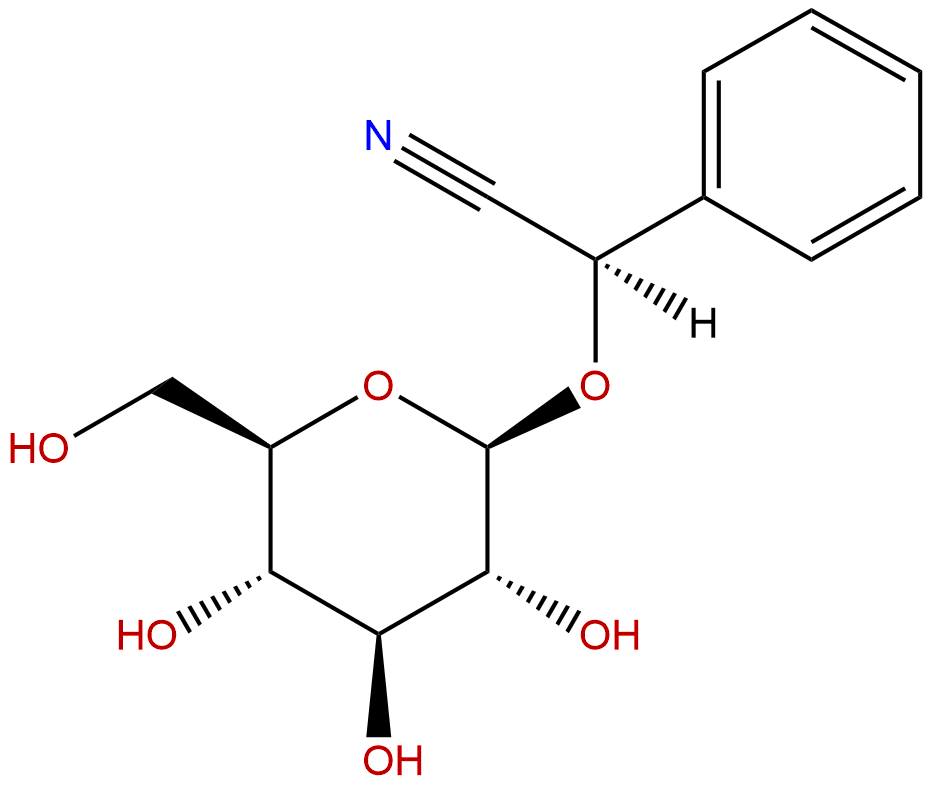
The molecular formula of wild cherry blossom glycoside is C14H17NO6, with a molecular weight of 295.2910 g/mol. From its SMILES structural formula (N # C)C@H C1ccccc1) can clearly analyze its chemical composition: it consists of a benzaldehyde unit connected to a glucose group through a glycosidic bond, and a cyanide group (- C # N) extending from the para position of the benzene ring. This molecule contains multiple chiral centers and has a specific stereoconfiguration, which has a significant impact on its biological activity and metabolic pathways.
From the analysis of drug forming parameters, its physicochemical properties exhibit typical polar molecular characteristics:
- Lipophilic nature The calculated LogP value is -0.3105 and LogD is -0.3102, indicating that the molecule is in a physiological pH environment Highly hydrophilic Very low fat solubility. This is consistent with the presence of multiple hydroxyl and sugar groups in its structure.
- Polar Surface Area The topologically polar surface area (TPSA) is as high as 123.1700 Å ², which further confirms its strong polarity characteristics and usually indicates poor membrane permeability.
- solubility The water solubility is as high as 49.7490 mg/mL, making it a highly soluble compound in water, which is beneficial for its formulation development in aqueous media.
- Permeability The permeability (0.4720) and effective permeability (Peff: 0.5696) values of Caco-2 cells are both low, combined with its low BBB (blood-brain barrier) penetration prediction, indicating that its oral absorption may be limited and difficult to enter the central nervous system.
These physicochemical properties determine the pharmacokinetic behavior of wild cherry blossom glycoside in vivo and serve as the basis for evaluating its potential as a drug.
3. Plant sources and traditional applications
The main plant source of wild cherry blossom glycosides is Rosaceae Prunus Plants, especially Bitter almond(Prunus armeniaca L.)。 Bitter almonds, as a traditional Chinese medicinal herb, have a long history and were first recorded in the "Shennong Bencao Jing". They are listed as essential medicines for stopping cough, relieving asthma, moistening the intestines, and promoting bowel movements. According to traditional Chinese medicine theory, bitter almonds have a bitter taste, a slightly warm nature, and a small toxicity. They belong to the lung and colon meridians, and their "toxicity" mainly comes from the cyanogenic glycosides such as bitter almond glycosides and their metabolites, such as wild cherry blossom glycosides, contained in them.
In traditional applications, bitter almonds are usually processed through process(such as frying or stir frying) to reduce toxicity. The principle is that during the processing, the coexisting β - glucosidase is inactivated by heating, thereby preventing endogenous enzymes from hydrolyzing non-toxic cyanogenic glycosides into toxic hydrogen cyanide. This wisdom of "reducing toxicity and preserving effectiveness" reflects the ancient people's empirical grasp of the complexity of natural products. Traditionally, bitter almonds are mainly used to treat symptoms such as cough, asthma, chest fullness, phlegm accumulation, intestinal dryness, and constipation. Modern pharmacological research has also confirmed that bitter almonds and their main glycosides have various effects such as cough control, asthma relief, anti-inflammatory, and immune regulation. Some mechanisms are related to the regulation of related pathways by their metabolites.
However, it must be emphasized that,Improper processing or excessive consumption of plant materials containing cyanogenic glycosides (such as bitter almonds and peach kernels) may lead to cyanide poisoning In severe cases, it can endanger life. Therefore, as a key metabolic intermediate, the dual properties of "toxicity" and "efficacy" of wild cherry blossom glycoside have always been the focus of research.
4. Pharmacological activity and mechanism of action
The pharmacological activity research of wild cherry blossom glycoside is gradually shifting from concerns about its toxicity to exploring its therapeutic potential. Existing research indicates that its core activity is concentrated in Antioxidant, anti-inflammatory, and anti fibrotic properties These effects are closely related to their precise regulation of intracellular redox homeostasis.
4.1 Core pharmacological activity
- Inhibition of DNA polymerase βWild cherry blossom glycoside can specifically inhibit rat DNA polymerase β with an IC50 of 98 μ M. DNA polymerase β is a key enzyme responsible for basal excision repair in eukaryotic cells. This inhibitory activity suggests that wild cherry blossom glycoside may affect the process of DNA damage repair and may have research value under specific conditions (such as active DNA repair in tumor cells), but its selectivity, therapeutic window, and relationship with toxicity need to be further studied.
- Anti inflammatory and anti fibrotic activity This is currently the most promising direction for treatment. In models of liver fibrosis and other diseases, wild cherry blossom glycosides have been shown to alleviate inflammatory infiltration, inhibit hepatic stellate cell activation, and reduce extracellular matrix deposition. Fibrosis is essentially the result of disordered repair after tissue damage, and chronic inflammation and oxidative stress are the core drivers of fibrosis.
4.2 Mechanism of action: Targeting antioxidant signaling pathways
The above protective effects of wild cherry blossom glycosides are mainly attributed to their effects on Nuclear factor E2 related factor 2 (NFE2L2, commonly known as Nrf2) signaling pathway Activation and regulation of downstream antioxidant enzyme expression. The target information provided by the database (NFE2L2, SOD1, CAT, GPX1, HMOX1) perfectly outlines this functional network:
-
Core regulator: NFE2L2 (Nrf2)
Nrf2 is the main switch for cellular antioxidant response. In the resting state, Nrf2 binds to its inhibitory protein Keap1 and is degraded by ubiquitination. When stimulated by oxidative stress or certain compounds such as kaempferol, Nrf2 dissociates from Keap1, translocates to the nucleus, binds to antioxidant response elements (ARE), and initiates transcription of a series of cell protective genes. Wild cherry blossom glycosides are likely to act as Nrf2 activators, initiating this cascade reaction.
-
Downstream effector enzyme group:
- SOD1 (Superoxide Dismutase 1)Catalytic dismutation of superoxide anion (O ₂•⁻) into hydrogen peroxide (H ₂ O ₂) and oxygen is the first line of defense against oxidative damage.
- CAT (catalase) and GPX1 (Glutathione Peroxidase 1)Both are responsible for clearing the H ₂ O ₂ produced by SOD1, converting it into harmless water, and preventing the accumulation of H ₂ O ₂ to produce more destructive hydroxyl radicals (• OH). CAT directly catalyzes decomposition, while GPX1 requires reduced glutathione (GSH) as a cofactor.
- HMOX1 (Heme Oxygenase 1)Decompose hemoglobin to produce biliverdin (a strong antioxidant), carbon monoxide (which has anti-inflammatory and cell protective effects), and iron ions. The induction of HMOX1 is an important marker of Nrf2 pathway activation, and its products play multiple roles in anti-inflammatory, antioxidant, and anti apoptotic effects.
Mechanism integration explanation:
In pathological processes such as liver fibrosis, sustained damage (such as viruses, alcohol, toxins) leads to the production of large amounts of reactive oxygen species (ROS), triggering oxidative stress. Excessive ROS not only directly damages lipids, proteins, and DNA, but also activates pro-inflammatory pathways such as NF - κ B and stimulates the transformation of hepatic stellate cells into activated myofibroblasts, which secrete large amounts of collagen and lead to fibrosis.
Wild cherry blossom glycoside activates Nrf2,Systematically upregulate the expression of SOD1, CAT, GPX1, and HMOX1 The enhancement of enzyme activity in this series constitutes a powerful and collaborative antioxidant defense network: SOD1 clears the initial O ₂•⁻, CAT and GPX1 efficiently clear the intermediate H ₂ O ₂, while HMOX1 provides additional antioxidant protection by producing biliverdin and other substances, and alleviates pathological processes through its anti-inflammatory effects. By effectively clearing ROS, reducing oxidative stress and subsequent inflammatory reactions, wild cherry blossom glycoside can inhibit the activation and proliferation of hepatic stellate cells, thereby slowing down or even reversing the process of fibrosis.
4.3 Association with antioxidant related diseases
The database lists "antioxidant" as a related disease, which accurately summarizes its fundamental role. Oxidative stress is a common pathological basis for many chronic diseases such as neurodegenerative diseases, cardiovascular diseases, metabolic diseases, fibrotic diseases, aging, etc. Wild cherry blossom glycosides enhance endogenous antioxidant defense through the Nrf2 pathway, which is a common driving factor in combating these diseases from the root. This is why they serve as Candidate molecules for disease modifying drugs with multi-target and multi pathway regulation Provided theoretical basis.
5. Evaluation of drug properties
Based on the provided pharmacological parameters and in combination with classic standards such as the "Lipinski Rule of Five," a preliminary assessment of the pharmacological potential of wild cherry blossom glycosides can be conducted
-
Lipinski Five Rule Compliance:
- Molecular weight (MW): 295.29 Da<500 Da (compliant)
- Calculate LogP: -0.31<5 (compliant)
- Hydrogen bond donor (HBD): Depending on the structure, approximately 4 (OH and NH?)<5 (compliant)
- Hydrogen bond acceptors (HBAs): According to the structure, there are approximately 7>10 (compliant, but close to the upper limit)
- Number of rotatable keys: estimated to be around 5<10 (compliant)
Conclusion Wild cherry blossom glycoside basically conforms to the Lipinski rule (with only slightly higher HBA), indicating that it has a good oral drug like pharmacological basis.
-
Absorption, distribution, metabolism, excretion (ADME) characteristics:
- absorb High TPSA (123) and low LogP lead to its Poor membrane permeability(Caco-2 and Peff values are low). This suggests that its oral bioavailability may be low. It may rely on active transporters in the intestine, such as glucose transporters, to promote absorption.
- distribution The plasma protein binding rate (PPB) is about 29%, belonging to Low degree combination It means that the proportion of free drugs in the blood is high, which is beneficial for the efficacy of the drug. The low penetration of BBB indicates that it is not easily able to enter the brain, which is a disadvantage for treating central nervous system diseases, but may help reduce the risk of central neurotoxicity.
- Metabolism and excretion As a glucoside, it is likely to undergo hydrolysis under the action of gut microbiota and/or glycosidase in the body, releasing cyanobenzyl alcohol and glucose, the former of which can be further metabolized. Its high water solubility suggests that it may be mainly excreted through the kidneys.
-
Preliminary assessment of safety (toxicity):
- Genotoxicity The Ames test result is 0.0 (negative), indicating no direct bacterial gene mutation. but chromosome aberration The test is' yes', which requires high vigilance Potential risk signals This indicates that it may cause damage on higher-level genetic material, and its mechanism needs to be clarified (whether it is related to cyanide release or DNA polymerase inhibition).
- cardiotoxicity HERG inhibition is' no ', preliminarily ruling out the serious cardiac risk of QT interval prolongation and apical torsion transition ventricular tachycardia.
- Organ toxicity Serological indicators suggest an effect on alkaline phosphatase (ALK), gamma glutamyl transferase (GGT), and alanine aminotransferase (ALT) ("Yes"), but no effect on aspartate aminotransferase (AST) ("No"). This suggests that it may have some impact on the liver, but the pattern is atypical and needs to be further evaluated in conjunction with pathology.
- Other No skin sensitization, respiratory sensitization, or phototoxicity.
Comprehensive evaluation of drug properties:
Wild cherry blossom glycosides have clear pharmacological activity targets and mechanisms, and their pharmacological basis is still acceptable. its main advantages It has a clear mechanism of action (Nrf2 pathway activation), excellent water solubility, low plasma protein binding rate, and no risk of cardiac hERG. its Key shortcoming In: ① Poor oral permeability May lead to low bioavailability; ② Potential risk of chromosomal aberrations It is a major obstacle to drug development; ③ The essence of cyanogenic glycosides Bringing inherent safety window concerns, dose control is crucial. In addition, the toxicity of its metabolites, especially cyanide, still needs to be closely monitored in in vivo models.
Therefore, wild cherry blossom glycosides are more likely to serve as a lead compound Rather than molecules directly used as drugs. Future development may require Structural modification Optimize its ADME/T (toxicity) properties by preparing prodrugs to improve lipid solubility and permeability, or modifying cyanide groups to reduce toxicity risks.
6. Research Status and Application Prospects
At present, research on wild cherry blossom glycoside is still in the preclinical stage, mainly focusing on in-depth exploration of its mechanism of action and validation of its efficacy in different disease models. In addition to liver fibrosis, its potential in pulmonary fibrosis, renal fibrosis, and other inflammatory diseases dominated by oxidative stress (such as colitis, atherosclerosis) is being tapped. Its role as a natural activator of Nrf2 has attracted much attention, as the Nrf2 pathway is considered a golden target for the development of antioxidant and anti-inflammatory drugs.
Future research directions may focus on the following areas:
1. Deepening mechanism Accurately elucidate the specific molecular targets of wild cherry blossom glycoside activating Nrf2 (whether it directly acts on Keap1 or indirectly activates through the production of trace amounts of active molecules)? )And comprehensively evaluate its impact on the DNA repair system (by inhibiting Pol β) in long-term treatment, including its advantages and disadvantages.
2. Structural Optimization and Medicinal Chemistry Reasonably design for its drug defects. For example, synthesizing its lipophilic prodrug to enhance absorption; Perform bioisostructural substitution of cyanide groups to completely eliminate the risk of cyanide release while retaining their activity; Or simplify the structure and search for more active fragment molecules.
3. Delivery system development By utilizing novel delivery technologies such as nanomaterials and liposomes, we aim to improve their solubility, stability, and targeting, enhance their bioavailability, and reduce the toxicity risks associated with systemic exposure.
4. Security system evaluation The mechanism, reversibility, and dose-dependent nature of its chromosomal aberrations must be thoroughly studied, which is the key to determining whether it can be developed. Meanwhile, long-term toxicokinetics studies need to be conducted in animal models that are closer to humans.
5. Exploration of combination therapy Given its multi-target antioxidant properties, exploring the combination therapy of wild cherry blossom glycoside (or its derivatives) and existing anti fibrotic drugs (such as pirfenidone and nintedanib) may result in synergistic effects, reducing their respective dosages and toxicity.
Application Prospects:
Despite facing challenges, wild cherry blossom glycoside, as an active molecule derived from traditional medicinal herbs, provides valuable clues for the development of new antioxidant, anti-inflammatory, and anti fibrotic drugs. Its value lies not only in the molecule itself, but also in what it reveals Regulating the endogenous defense system through the Nrf2 pathway system for the treatment of chronic diseases The strategy. With the deepening understanding of the law of "toxicity effect" transformation and the advancement of modern medicinal chemistry technology, wild cherry blossom glycosides and their derivatives are expected to become important candidates in the drug development pipeline for treating difficult to treat diseases such as liver fibrosis in the future, achieving a leap from "toxic glycosides" to "therapeutic drugs". This process is also the charm and challenge of natural product pharmaceutical research.