


Synonym name: Isophellopterin; Knidilin
Catalogue No.: BP0377
Cas No.: 14348-22-2
Formula: C17H16O5
Mol Weight: 300.31
Botanical Source: Cnidium dubium
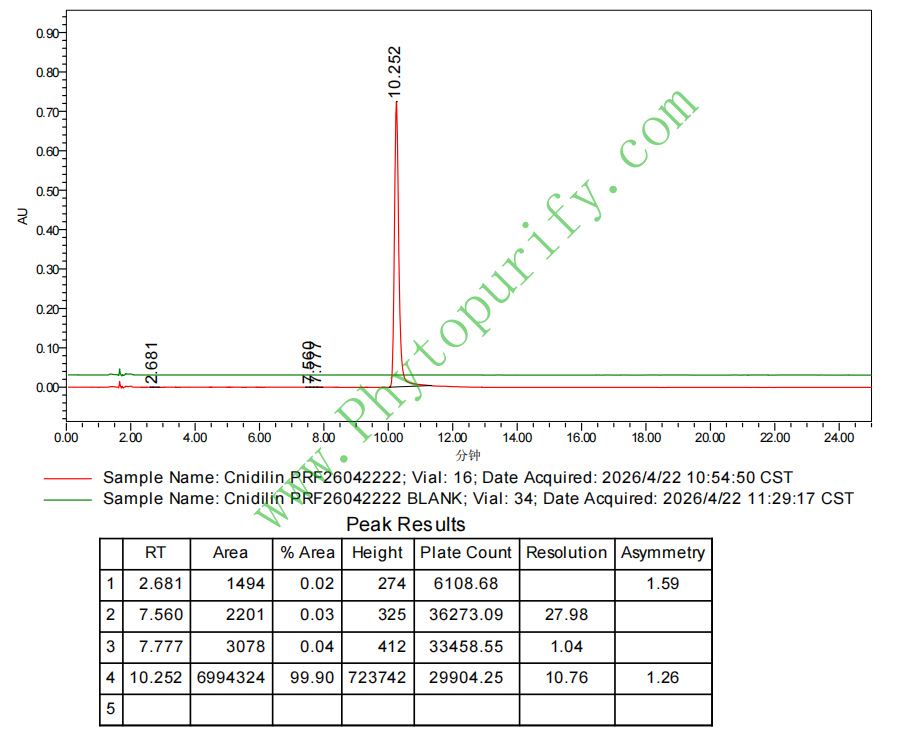
Purity: 95%~99%
Analysis Method: HPLC-DAD or/and HPLC-ELSD
Identification Method: Mass, NMR
Packing: Brown vial or HDPE plastic bottle
Can be supplied from milligrams to grams.
For Reference Standard and R&D, Not for Human Use Directly.
Inquire for bulk scale.
HPLC of Cnidilin
Storage conditions:Short-term storage at 2~8℃, long-term storage at -20 ~ -80℃
69.0600
3.1700
3.1700
High
No
No
No
No
No
Negative
Natural products, as an important source of drug discovery, occupy a central position in new drug development due to their structural diversity and biological activity. 8-Methoxyisoeugenol (Cnidilin), also known as Knidilin, is a type of isoeugenol compound isolated from the root of traditional Chinese medicine Angelica dahurica. In recent years, with the in-depth research on the anti-tumor potential of natural products, Cnidilin has attracted extensive attention because of its potential therapeutic effect in breast cancer and other tumor diseases. This article aims to systematically review the chemical structure and physicochemical properties, plant origin and extraction process, pharmacological activity, mechanism of action and molecular targets, pharmacological evaluation and pharmacokinetic characteristics of Cnidilin, and explore its clinical application prospects and future development directions, providing theoretical basis and research reference for the drug development of this natural product.
8-Methoxyisoeugenol (Cnidilin, CAS number 14348-22-2) belongs to the class of isoeugenol compounds, with a molecular formula of C17H16O6 and a molecular weight of 300.31. The core structure of this plant is the European anterior Hu lactone skeleton, which is characterized by the introduction of a methoxy substituent at position 8, endowing it with unique chemical properties and biological activity. The LogP value of Cnidilin is approximately 3.17, indicating its moderate lipid solubility, which is beneficial for cell membrane permeability and in vivo distribution. The polar surface area (TPSA) is 69.06 Å ², and the number of hydrogen bond acceptors is 5, indicating that it has good affinity and selectivity when binding to biomolecules.
In terms of physical and chemical properties, Cnidilin exhibits good stability and suitable water solubility, making it suitable for the design and optimization of drug delivery systems. Its high blood-brain barrier penetration ability (BBB High) provides potential applications in the treatment of central nervous system related diseases. The toxicity evaluation shows that Cnidilin has no hepatotoxicity or cardiotoxicity, and does not inhibit hERG channels. The Ames mutagenicity test is negative, indicating high safety and meeting the basic requirements for drug development.
Cnidilin mainly comes from the roots of Angelica dahurica, a plant in the Umbelliferae family. Angelica dahurica, as a traditional Chinese medicine, is widely used in the treatment of various diseases such as rheumatic pain, headache, and cold. Its roots are rich in various active ingredients, including volatile oils, coumarins, and isovalerolactones. Cnidilin, as a representative component of isoeugenol, although its content is not high, its biological activity has made it a research hotspot.
The extraction process usually uses organic solvent extraction combined with column chromatography separation technology. The specific steps include: crushing the dried Angelica dahurica roots, refluxing with ethanol or methanol for extraction, concentrating the extract, separating it by silica gel column chromatography, and purifying it by high performance liquid chromatography (HPLC) to obtain high-purity Cnidilin. In recent years, the application of new technologies such as ultrasound assisted extraction and microwave-assisted extraction has improved extraction efficiency and purity, laying the foundation for large-scale production.
Numerous in vitro and in vivo studies have shown that Cnidilin has significant anti-tumor activity, especially in breast cancer models. Its anti-cancer mechanism involves multiple aspects such as cell proliferation inhibition, induction of apoptosis, inhibition of tumor cell migration and invasion.
Anti breast cancer activity
Cnidilin significantly inhibits the proliferation and survival of breast cancer cell lines (such as MCF-7, MDA-MB-231) by regulating multiple signal pathways. Cell cycle analysis shows that Cnidilin can induce G1 phase arrest and reduce cell division in cancer cells. Apoptosis detection showed that Cnidilin promotes mitochondrial dependent apoptosis, accompanied by changes in BCL2 family protein expression.
Anti multidrug resistance
Multidrug resistance (MDR) in the treatment of breast cancer is a clinical problem. Cnidilin inhibits the function of ABC transporters (ABCB1, ABCG2), reduces drug efflux, increases intracellular accumulation of chemotherapy drugs, and enhances chemotherapy sensitivity.
Anti inflammatory and antioxidant effects
Chronic inflammation and oxidative stress in the microenvironment of breast cancer promote tumor progression. Cnidilin activates the NFE2L2 (nuclear factor erythroid 2-related factor 2) signaling pathway, enhances cellular antioxidant capacity, reduces inflammatory response, and helps inhibit tumor development.
Other pharmacological effects
In addition to anti-tumor effects, Cnidilin has also been preliminarily reported in the fields of neuroprotection and antibacterial properties, demonstrating its multi-target and multi effect pharmacological characteristics.
The pharmacological mechanism of action of Cnidilin involves multiple signaling pathways and key molecular targets, mainly including:
AMPK (PRKAA1) activation
Cnidilin regulates cellular energy metabolism and inhibits tumor cell growth by activating the AMPK signaling pathway. As an energy sensor, AMPK activation promotes metabolic reprogramming of tumor cells, induces cell cycle arrest and apoptosis.
BCL2 family regulation
Cnidilin down regulates the expression of anti apoptotic protein BCL2, promotes the loss of mitochondrial membrane potential, releases cytochrome C, activates the apoptosis cascade reaction, and induces programmed death of breast cancer cells.
STAT3 inhibition
STAT3, as an important transcription factor, is involved in tumor cell proliferation, immune escape, and angiogenesis. Cnidilin inhibits the phosphorylation and nuclear translocation of STAT3, blocks its transcriptional activity, and suppresses tumor progression.
Regulation of estrogen receptor beta (ESR2)
The hormone dependence of breast cancer makes ESR2 a therapeutic target. Cnidilin has a regulatory effect on ESR2, affecting hormone signaling and inhibiting hormone driven proliferation of tumor cells.
ABC transporter inhibition
Cnidilin reverses multidrug resistance in tumor cells and enhances the efficacy of chemotherapy drugs by inhibiting the drug efflux function of ABCB1 and ABCG2.
PRKCA and MAPT regulation
Cnidilin affects the expression of protein kinase C α (PRKCA) and microtubule associated protein Tau (MAPT), interferes with cell signal transduction and cytoskeleton dynamics, and inhibits tumor cell migration and invasion.
NFE2L2 activation
By activating NFE2L2, Cnidilin enhances cellular antioxidant defense and reduces oxidative stress-related tumor promotion.
TOP1 inhibition
Cnidilin has inhibitory activity against topoisomerase I (TOP1), blocking DNA replication and transcription, inducing DNA damage and death in tumor cells.
To sum up, Cnidilin exerts its comprehensive pharmacological effect against breast cancer through multi target and multi pathway synergy, reflecting the advantages of multi-dimensional regulation of tumor biology by natural products.
The development of medicinal properties is a crucial step in the development of natural product drugs. Cnidilin has shown promising potential in medicinal chemistry and toxicology
Physical and chemical properties of drugs
The molecular weight is 300.31, which conforms to Lipinski's rule. LogP 3.17 is moderate, and TPSA 69.06 Å ² is conducive to cell membrane penetration and oral absorption.
safety evaluation
No hepatotoxicity, cardiac toxicity, no inhibitory effect on hERG channel, negative Ames test, low toxicological risk.
Blood-brain barrier penetration
The high blood-brain barrier penetration ability provides the possibility for its treatment in central nervous system diseases and broadens its application fields.
Pharmacokinetic characteristics
Although pharmacokinetic data in vivo are currently limited, preliminary studies have shown that Cnidilin is well absorbed orally, has moderate bioavailability, is widely distributed in the body, has stable metabolism, and is mainly excreted through the liver metabolic enzyme system. Further systematic pharmacokinetic and toxicological studies are needed in the future to clarify its in vivo behavior and safe dosage range.
Potential for formulation development
The physicochemical properties of Cnidilin are suitable for the design of formulations for various routes of administration, including oral, injection, and nanocarrier delivery systems, which are expected to improve its bioavailability and targeting.
Breast cancer, as one of the malignant tumors with the highest incidence rate among women in the world, is in urgent need of new highly effective and low toxic therapeutic drugs. With its multi-target anti-tumor mechanism and good safety, Cnidilin shows the potential to become a new drug for adjuvant therapy or combined chemotherapy of breast cancer.
Future research directions include:
In depth analysis of the mechanism
Combining genomics, proteomics and other multi omics technologies, further elucidate the molecular network and signaling pathways of Cnidilin's action, and reveal its overall anti-tumor effect.
Pharmacokinetic and Toxicological System Research
Through animal models and preclinical studies, clarify the in vivo metabolic pathways, pharmacokinetic relationships, and long-term safety of Cnidilin.
Development of new formulations and drug delivery systems
Utilizing nanotechnology and targeted delivery systems to enhance the bioavailability and tumor targeting of Cnidilin, while reducing dosage and side effects.
Exploration of clinical trials
Promote Cnidilin to enter the preclinical trial phase, evaluate the efficacy and safety of its single drug and combination drugs, and explore its application potential in breast cancer and other tumors.
Expansion of indications for multiple diseases
Exploring the therapeutic value of Cnidilin in neurodegenerative and inflammatory diseases based on its anti-inflammatory, antioxidant, and neuroprotective effects.
As an important active ingredient in Angelica dahurica, 8-methoxyisoprostolide (Cnidilin) shows a broad application prospect in the field of breast cancer treatment by virtue of its unique chemical structure and multi-target anti-tumor mechanism. Its good medicinal properties and safety provide strong support for the development of natural product drugs. In the future, Cnidilin is expected to become a new generation of anti breast cancer drugs and bring new treatment options for tumor patients by combining modern pharmaceutical chemistry, pharmacology and pharmaceutical technology to deeply tap its pharmacological potential and clinical value.
