Introduction/Overview
Isopropylidenylacetyl marmesin (CAS number: 35178-20-2), also known as (±) - Prantschmgin, is a natural coumarin compound isolated from F. braccata. Coumarin compounds have attracted much attention in the field of natural product pharmacology due to their diverse biological activities and unique chemical structures. As a novel coumarin derivative, isovalerolactone isopentenyl ester has shown significant potential in various pharmacological activities such as anti-inflammatory studies in recent years. Its mechanism of action involves multiple inflammation related molecular targets, such as IL-6, STAT3, CASP1, TRPV1, PTGS1, TNF, TRPA1, NOS2, PTGS2, and NFKB1, indicating its complex and multi-level network of action in regulating inflammatory responses.
This article aims to systematically review the chemical structure and physicochemical properties, plant sources and extraction methods, pharmacological activity and mechanism of action, pharmacological evaluation and pharmacokinetic characteristics of isovalerolactone isopentenyl ester, and prospects its clinical application prospects, in order to provide theoretical basis and reference for the in-depth research and drug development of this compound.
Chemical structure and physicochemical properties
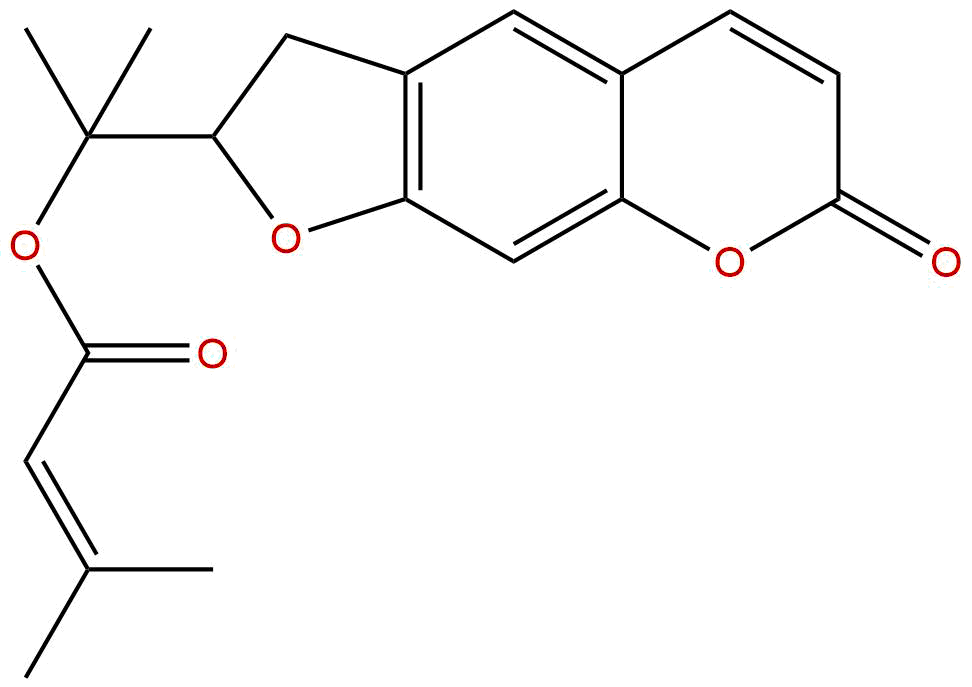
Isopentenyl esters of isoquercetin belong to coumarin lactone derivatives, with a molecular formula of C19H20O5 and a molecular weight of 328.3640. The core structure of this compound is a coumarin skeleton, containing lactone rings and isopentenyl ester side chains. The structure introduces isopropylated acyl groups, giving it a unique spatial configuration and physicochemical properties.
In terms of physical and chemical properties, the LogP value of this compound is 3.6123, indicating moderate lipid solubility, which is beneficial for its cell membrane permeability and in vivo distribution. Its topological polar surface area (TPSA) is 65.74 Å ², indicating that the molecule has a certain polarity that facilitates binding to biomolecule targets. Low water solubility (0.0064 mg/mL), which may affect its oral bioavailability and formulation design. It is worth noting that isovalerolactone isopentenyl ester has a high blood-brain barrier permeability, suggesting its potential central nervous system activity. The negative result of hERG channel inhibition experiment indicates a low risk of cardiac toxicity. The Ames test result is 0.6, indicating that its genotoxicity risk is relatively low and has a good safety basis.
Plant sources and extraction methods
Isovalerolactone isopentenyl ester is mainly isolated from Ferula bracteata, a plant in the Umbelliferae family. Purple flowered Houttuynia cordata is a perennial herbaceous plant widely distributed in Central and West Asia, traditionally used to treat rheumatism, inflammation, and digestive system diseases. This plant is rich in various coumarin compounds and is a valuable resource for studying the pharmacological activity of natural products.
During the extraction process, organic solvents such as ethanol, methanol, or ethyl acetate are usually used to extract dried plant roots, stems, or leaves. After concentration, the extraction solution was purified using separation and purification techniques such as silica gel column chromatography and reverse phase high performance liquid chromatography (RP-HPLC) to obtain high-purity isopentenyl isoquercetin. In recent years, the application of ultrasound assisted extraction and supercritical fluid extraction technology has improved extraction efficiency and purity, providing technical support for large-scale preparation.
Pharmacological activity research
The pharmacological activity research of isovalerolactone isopentenyl ester mainly focuses on the field of anti-inflammatory effects. Multiple in vitro and in vivo experiments have shown that this compound can significantly inhibit the production and release of inflammatory mediators, and alleviate inflammatory reactions.
In vitro cell models, isovalerolactone isopentenyl ester can inhibit the expression of pro-inflammatory cytokines such as IL-6 and TNF - α in macrophages and fibroblasts, and weaken the transmission of inflammatory signals. Its inhibitory effect on inflammation related enzymes such as cyclooxygenase-1 (PTGS1) and cyclooxygenase-2 (PTGS2) helps reduce prostaglandin synthesis and alleviate inflammatory symptoms.
In vivo experiments, the compound has shown good anti-inflammatory effects in various inflammatory models, such as acute inflammation and mouse plantar edema models, significantly reducing local inflammatory responses and tissue damage. Its regulatory effect on TRPV1 and TRPA1 channels may be involved in the regulation of pain conduction, indicating its potential application value in the treatment of inflammatory pain.
In addition, the inhibitory effect of isovalerolactone isopentenyl ester on inflammation related signaling pathways such as STAT3 and NF - κ B provides a molecular basis for its anti-inflammatory mechanism. The regulatory role of CASP1 suggests that it may affect the activation of inflammasomes and further regulate immune responses.
Mechanism of action and molecular targets
The anti-inflammatory mechanism of isovalerolactone isopentenyl ester involves multiple key molecular targets and signaling pathways, reflecting its multi-target and multi pathway synergistic regulation characteristics.
-
IL-6 and TNF - αAs the main pro-inflammatory cytokines, IL-6 and TNF - α play a central role in the inflammatory response. Isopentenoic acid esters of Peucedanum besylate inhibit the expression of these two cytokines, reduce the release of inflammatory mediators, and alleviate inflammatory reactions.
-
STAT3 signaling pathway STAT3 is an important transcription factor for inflammation and immune regulation. This compound exerts anti-inflammatory effects by inhibiting the phosphorylation and activation of STAT3, blocking the transcription of pro-inflammatory genes.
-
NF - κ B pathway NF - κ B is a key factor regulating the expression of inflammatory genes. Isopentenoic acid esters of Peucedanum besylate can inhibit the activation of NF - κ B, reduce the expression of inflammation related enzymes (such as PTGS2) and cytokines.
-
CASP1 (inflammasome)CASP1 is involved in the activation of inflammasomes, promoting the maturation and release of inflammatory factors such as IL-1 β. The regulatory effect of this compound on CASP1 may inhibit the excessive activation of inflammasomes and alleviate inflammatory damage.
-
TRPV1 and TRPA1 ion channels These two channels play an important role in the transmission of inflammatory pain. Isopentenyl ester of isoquercetin alleviates inflammation related pain symptoms by regulating the activity of these channels.
-
NOS2 (inducible nitric oxide synthase)NOS2 produces a large amount of nitric oxide during the inflammatory process, promoting the inflammatory response. This compound inhibits the expression of NOS2, reduces oxidative stress levels, and protects tissues from inflammatory damage.
-
PTGS1 and PTGS2 (cyclooxygenase)By inhibiting the activity of these two enzymes, isoquercetin reduces the synthesis of prostaglandins, alleviates inflammatory symptoms and pain.
In summary, isovalerolactone isopentenyl ester exerts significant anti-inflammatory and analgesic effects through multi-target synergistic effects, regulating the inflammatory signaling pathway.
Evaluation of drug properties and pharmacokinetics
The development of medicinal properties is an important consideration factor in the development of natural product drugs. The isovalerolactone isopentenyl ester showed good potential in terms of pharmacological parameters.
- Molecular weight (328.3640)Complies with Lipinski's rules and facilitates oral absorption.
- LogP value (3.6123)Displaying moderate lipid solubility is beneficial for cell membrane permeability and drug distribution.
- TPSA(65.74 Ų)Moderate, indicating that its polarity is suitable for binding to the target and has good bioavailability.
- Low water solubility (0.0064 mg/mL)May limit its oral absorption and formulation development, requiring improvement through drug carriers or salt forms.
- High blood-brain barrier permeability It suggests that it may be used for the treatment of central nervous system related diseases.
- HERG channel inhibition negative Reduced the risk of cardiac toxicity.
- Ames test result (0.6)Indicating low risk of genotoxicity and good safety.
In terms of pharmacokinetics, there is currently a lack of systematic in vivo metabolism and pharmacokinetic research. Based on its structure and physicochemical properties, it is speculated that isovalerolactone isopentenyl ester may be metabolized by liver metabolic enzymes (such as cytochrome P450), producing active or inactive metabolites. Its high lipid solubility and blood-brain barrier permeability suggest that it is widely distributed in the body, especially possibly enriched in the central nervous system. In the future, it is necessary to conduct systematic in vivo pharmacokinetic, toxicological, and metabolite identification studies to improve its pharmacological evaluation.
Clinical application prospects and prospects
As a natural coumarin derivative with significant anti-inflammatory activity, isovalerolactone isopentenyl ester has broad clinical application potential. Its multi-target and multi pathway mechanism of action provides new ideas for the treatment of complex inflammatory diseases, especially in the following areas with great application prospects:
-
Treatment of inflammatory diseases Including rheumatoid arthritis, inflammatory bowel disease, chronic obstructive pulmonary disease, etc., isoquercetin isopentenyl ester is expected to become an effective anti-inflammatory drug by regulating the inflammatory signaling pathway.
-
pain management Its regulatory effect on TRPV1 and TRPA1 channels makes it potentially valuable in the treatment of inflammatory and neuropathic pain.
-
Central nervous system diseases High blood-brain barrier permeability suggests that it may be used as an adjuvant therapy for neurodegenerative diseases related to inflammation, such as multiple sclerosis and Alzheimer's disease.
-
Combination therapy strategy Can be used in conjunction with existing anti-inflammatory drugs to reduce dosage and side effects, and improve treatment efficacy.
However, the clinical translation of isovalerolactone isopentenyl ester still faces many challenges, including limited bioavailability due to low water solubility, lack of systematic pharmacokinetic and toxicological data, and insufficient preclinical and clinical research. Future research should focus on optimizing drug formulations, understanding in vivo metabolic mechanisms, evaluating long-term safety, and verifying clinical efficacy.
Conclusion
As a natural coumarin compound derived from Peucedanum praeruptorum, isovalerolactone has demonstrated great potential for drug development due to its unique chemical structure and significant anti-inflammatory activity. The multi-target and multi pathway mechanism of action provides a new pharmacological basis for the treatment of inflammatory diseases. The drug efficacy evaluation shows that it has good safety and blood-brain barrier permeability, making it suitable for further drug development and clinical research.
In the future, it is necessary to strengthen systematic research on its pharmacokinetics, toxicology, and clinical efficacy, optimize its drug formulation, and promote its translation into clinical applications. Isopentenyl ester of isoquercetin is expected to become an important candidate for the new generation of anti-inflammatory drugs, contributing new strength to the fields of natural product pharmacology and inflammatory disease treatment.