


Synonym name: 3'-Hydroxy-3,4,4',5-tetramethoxybibenzyl
Catalogue No.: BP0550
Cas No.: 95041-90-0
Formula: C18H22O5
Mol Weight: 318.369
Botanical Source: Eria carinata
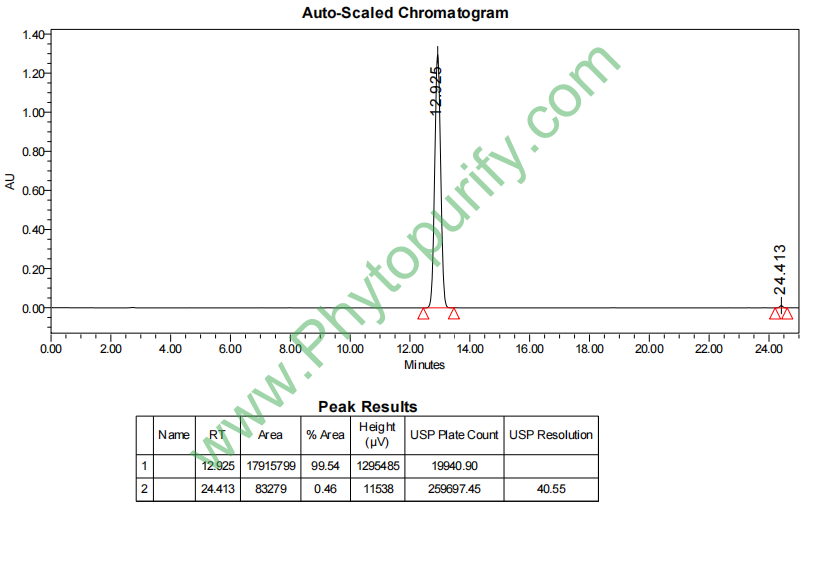
Purity: 95%~99%
Analysis Method: HPLC-DAD or/and HPLC-ELSD
Identification Method: Mass, NMR
Packing: Brown vial or HDPE plastic bottle
Can be supplied from milligrams to grams.
For Reference Standard and R&D, Not for Human Use Directly.
Inquire for bulk scale.
Description:
Erianin, often used as an antipyretic and analgesic agent, it also has antiangiogenic action by inhibiting endothelial metabolism in a JNK/SAPK-dependent manner and inducing endothelial cytoskeletal disorganisation.
References:
Invest New Drugs. 2012 Oct;30(5):1899-907.
ZJU-6, a novel derivative of Erianin, shows potent anti-tubulin polymerisation and anti-angiogenic activities.
ZJU-6 was designed to enhance anti-angiogenesis and anti-tumour activity of its parent compound Erianin, a clinic anti-tumour agent. This study investigated the detailed biological mechanism of ZJU-6 in comparison with that of Erianin.
METHODS AND RESULTS:
Both ZJU-6 and Erianin substantially reduced cell viability and induced apoptosis in human cancer cell lines. Profound G2/M cell arrest was observed 24 h after treatment of MCF-7 cells with ZJU-6 (≥ 2.5 μM) or Erianin (≥ 0.1 μM); being consistent with mitotic collapse. 0.5 μM of Erianin or ZJU-6 failed to stabilise tubulin. Pre-G1 MCF-7 cell accumulating 24 h post treatment indicated apoptosis. Caspase-3 activity, PARP cleavage and Annexin V + ve /PI -ve populations correlate the apoptotic destiny of cells exposed to either ZJU-6 or Erianin. Furthermore ZJU-6 showed potent anti-angiogenetic property and demonstrated radical scavenging capacity.
CONCLUSIONS:
Due to its potent anti-proliferative, pro-apoptotic and anti-angiogenic activities ZJU-6 is an attractive chemotherapeutic agent to be developed.
Acta Pharmacol Sin. 2001 Nov;22(11):1018-22.
Erianin induces apoptosis in human leukemia HL-60 cells.
To investigate the effect of Erianin on human HL-60 cell line and explore its mechanism of apoptosis in vitro.
METHODS AND RESULTS:
Inhibition of proliferation was measured with colorimetric MTT assay. The morphologic changes were observed by fluorescence and electron microscopes. DNA fragmentation was visualized by agarose gel electrophoresis, and the DNA degradation was determined by flow cytometry. Immunohistochemical analysis was used to identify the expression of bcl-2 and bax genes. The growth of human HL-60 cells was significantly inhibited by Erianin 20-81.9 nmol/L during 72 h treatment (P < 0.01). The IC50 value was 38 nmol/L after a 24-h exposure to Erianin, while that of vincristine, the positive control, was 101 nmol/L. The typical morphologic changes were observed and the nuclear DNA fragmentation exhibited "ladder" pattern. The cell cycle of HL-60 cells was arrested in G2/M phase, and expression of bcl-2 gene was decreased while that of bax was increased.
CONCLUSIONS:
Erianin showed potent inhibitory activity on the proliferation of HL-60 cells. The inhibition might be relative to the apoptosis induced by Erianin and the altered expression of bcl-2 and bax genes in HL-60 cells.
Eur J Cancer. 2004 Jul;40(10):1554-65.
In vivo and in vitro evaluation of erianin, a novel anti-angiogenic agent.
This study evaluated the anti-angiogenic activities of Erianin in vivo and in vitro.
METHODS AND RESULTS:
Erianin, a natural product from Dendrobium chrysotoxum, caused moderate growth delay in xenografted human hepatoma Bel7402 and melanoma A375 and induced significant vascular shutdown within 4 h of administering 100 mg/kg of the drug. Erianin also displayed potent anti-angiogenic activities in vitro: it abrogated spontaneous or basic fibroblast growth factor-induced neovascularisation in chick embryo; it inhibited proliferation of human umbilical vein endothelial cells (EC(50) 34.1+/-12.7 nM), disrupted endothelial tube formation, and abolished migration across collagen and adhesion to fibronectin. Erianin also exerted selective inhibition toward endothelial cells, and quiescent endothelium showed more resistance than in proliferative and tumour conditions. In a cytoskeletal study, Erianin depolymerised both F-actin and beta-tubulin, more significantly in proliferating endothelial cells than in confluent cells. In conclusion, Erianin caused extensive tumour necrosis, growth delay and rapid vascular shutdown in hepatoma and melanoma models; it inhibited angiogenesis in vivo and in vitro and induced endothelial cytoskeletal disorganisation.
CONCLUSIONS:
These findings suggest that Erianin has the therapeutic potential to inhibit angiogenesis in vivo and in vitro.
HPLC of Erianin
Storage conditions:Short-term storage at 2~8℃, long-term storage at -20 ~ -80℃
57.1500
3.3614
3.3585
.0394
8.7821
10.1957
High
90.1847
1.9192
Yes
No
Yes
No
No
No
0.0
No
No
No
No
Natural products have long been an important treasure trove for innovative drug discovery, with many compounds receiving significant attention due to their unique chemical structures and broad biological activities. Erianin, also known as 2-methoxy-5- [2- (3,4,5-trimethoxyphenyl) ethyl] phenol, is a benzyl compound isolated from plants of the Dendrobium genus in the Orchidaceae family. Since its discovery, berberine has become a hot topic in natural product pharmacology research due to its significant anti-tumor, anti-inflammatory, analgesic, antipyretic and other multiple pharmacological activities. Of particular note is the strong anti angiogenic and direct anti-tumor effects exhibited by Maolansu in various tumor models. Its mechanism of action involves inducing cell apoptosis, autophagy, ferroptosis, and regulating multiple signaling pathways closely related to tumor occurrence and development. With the development of modern molecular biology and pharmacology techniques, the target network of berberine is becoming increasingly clear, laying a solid scientific foundation for its development as a lead compound. This article aims to systematically review the chemical properties, plant sources, pharmacological activities, molecular mechanisms of action, pharmacological evaluation, and clinical application prospects of Ranunculin, in order to provide comprehensive references for the in-depth research and future drug development of this compound.
Maolansu is a derivative of diphenylethane, specifically 1,2-dihydrostilbene substituted with hydroxyl at position 3 and methoxy at positions 4, 3 ', 4', and 5 '. Its molecular formula is C18H22O5 and its molecular weight is 318.3690. Structurally, Ranunculin belongs to the class of benzyl compounds, with its core structure consisting of two benzene rings connected by an ethane bridge. This structure endows it with a certain hydrophobicity, and its calculated LogP value is 3.3614, indicating that it has good lipid solubility. Its topological polar surface area (TPSA) is 57.15 Å ², which is relatively small due to the presence of only one phenolic hydroxyl group and four methoxy groups in its molecule.
In terms of physical and chemical properties, Maolansu has poor water solubility, with a calculated value of about 0.0394 mg/mL. This to some extent limits its direct development as an aqueous formulation, but also suggests that it may have good cell membrane penetration ability. Pharmacokinetic predictions indicate that berberine has a high potential to penetrate the blood-brain barrier, providing possibilities for its potential neuroprotective or therapeutic applications in central nervous system related diseases. The preliminary safety assessment shows that the hERG inhibition risk is negative, and the Ames test prediction result is negative (0.0), indicating a low potential risk of arrhythmia and genetic toxicity, providing favorable early safety features for its drug development.
Maolansu mainly comes from various plants of the Dendrobium genus in the Orchidaceae family, and is one of the characteristic active ingredients of these medicinal plants. Common sources include Dendrobium nobile, Dendrobium officinale, and Dendrobium huoshanense. Dendrobium plants are commonly used in traditional Chinese medicine to nourish yin, clear heat, benefit the stomach, and produce fluids. Modern research has gradually revealed the material basis of their anti-tumor, immune regulating, and other activities, with Ranunculin being one of the key components.
Organic solvent extraction is commonly used to extract berberine from plant materials. The common process includes crushing the dried stem of Dendrobium officinale, and using high concentration ethanol (such as 95% ethanol) or methanol for reflux extraction or ultrasound assisted extraction. The extract is concentrated under reduced pressure to obtain a paste, which is then extracted in stages using solvents of different polarities such as petroleum ether, ethyl acetate, and n-butanol. Maolansu is mainly enriched in the ethyl acetate extraction site. Subsequently, high-purity Ranunculin monomer can be obtained through separation and purification techniques such as silica gel column chromatography and preparative high-performance liquid chromatography, combined with thin-layer chromatography or high-performance liquid chromatography for tracking and detection. With the development of technology, green extraction methods such as supercritical fluid extraction have also been applied to improve extraction efficiency and reduce the use of organic solvents.
Maolansu exhibits broad and powerful pharmacological activities, making it a highly valuable lead compound for research.
The various pharmacological activities of berberine, especially its core anti-tumor effect, are achieved by intervening in complex intracellular signaling networks. Taking liver cancer as an example, its effects involve multiple key targets and pathways:
In summary, Maolansu forms a powerful anti-tumor network through multi-target and multi pathway synergistic effects, which is also one of its potential advantages in not easily developing drug resistance.
Although Maolansu has shown excellent activity in vitro and preclinical models, its pharmacological properties still need to be comprehensively evaluated.
Maolansu has moved from laboratory research to clinical application, with broad prospects but challenges.
The challenges faced mainly include:① Insufficient pharmacokinetic and toxicological data in the system;② Poor water solubility requires the development of an efficient delivery system;③ The target network is complex, and it is necessary to clarify the core targets and potential off target effects that exert therapeutic effects;④ Need to design and complete standardized preclinical studies and clinical trials To confirm its safety and effectiveness.
Future research directions should focus on: delving into the precise molecular mechanisms underlying its multi-target effects; Using structural biology and computer-aided drug design to optimize its structure and improve its drug properties; Accelerate the development of new nano or prodrug formulations; Conduct systematic preclinical safety and efficacy evaluations, and actively promote eligible candidate drugs to enter the clinical research stage.
Maolansu, as a natural benzyl compound derived from traditional medicinal plants, has become a star in the field of natural product anti-tumor drug research due to its diverse pharmacological activities and unique multi-target mechanism of action. From chemical structure to plant origin, from basic pharmacology to complex action networks, research has preliminarily outlined the clear outline of Ranunculin as an efficient and multifunctional lead compound. Its outstanding ability to induce multiple programmed cell deaths, inhibit tumor angiogenesis, and regulate immune inflammatory responses provides new strategies and hope for its treatment in major diseases such as tumors and inflammation. Although there are still many challenges in drug formulation, delivery technology, and clinical translation, these obstacles are gradually being overcome with the rapid development of modern pharmaceutical technology. Through interdisciplinary and continuous in-depth research and development, it is highly likely that Maolansu will move from the laboratory to clinical practice, ultimately benefiting human health and fully demonstrating the immortal value and vitality of natural products in innovative drug development.
