


Product name: Palmatine
Synonym name: Berbericinine; Hindarinine
Catalogue No.: BP1058
Cas No.: 3486-67-7
Formula: C21H22NO4+
Mol Weight: 352.409
Botanical Source: Quaternary alkaloid from Jateorhiza palmata (Menispermaceae) and a large number of other spp., mostly in Berberis and Mahonia (Berberidaceae), but spread into many families
Physical Description: Yellow Powder
Type of Compound: Alkaloids
Purity: 95%~99%
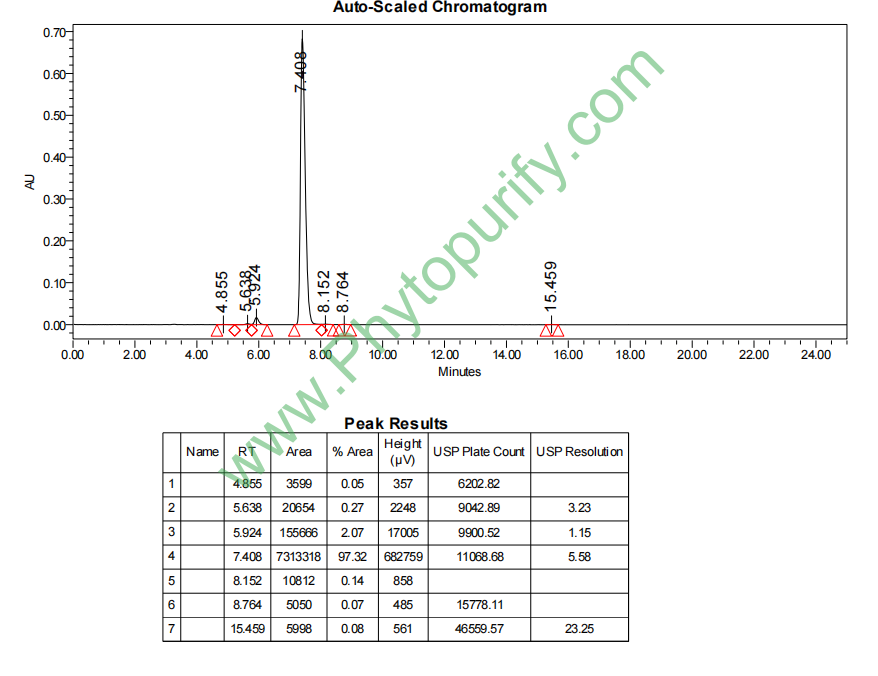
Analysis Method: HPLC-DAD or/and HPLC-ELSD
Identification Method: Mass, NMR
Packing: Brown vial or HDPE plastic bottle
Storage: Store in a well closed container, protected from air and light. Put into refrigerate or freeze for long term storage.
Whenever possible, you should prepare and use solutions on the same day. However, if you need to make up stock solutions in advance, we recommend that you store the solution as aliquots in tightly sealed vials at -20℃. Generally, these will be useable for up to two weeks.
The product could be supplied from milligrams to grams, up to kilograms
Inquire for bulk scale.
Descriptions:
Palmatine , a protoberberine alkaloid, is present in preparations from medicinal plants such as Coptis chinensis and Corydalis yanhusuo, palmatine activates the AhR-CYP1A pathway in HepG2 monolayer, while the potential for CYP1A induction is irrelevant in cell systems which are closer to the in vivo situation, i.e. in HepG2 spheroids and primary cultures of human hepatocytes. [1]
Palmatine exerts protective effect on hepatocytes, the inhibitory effects on I(K) and I(CRAC) could be one of the mechanisms.[2]
The alkaloids berberine, palmatine and sanguinarine are toxic to insects and vertebrates and inhibit the multiplication of bacteria, fungi and viruses; berberine and palmatine were most active at the alpha 2-receptor (binding with IC50 476 and 956 nM, respectively). [3]
Palmatine at a low concentration (50 μg/mL) begins to inhibit the growth of T. thermophila BF5, and when the concentration of palmatine reached 600 μg/mL, T. thermophila BF5 could not grow at all, shows the strong toxic action of palmatine on T. thermophila BF5 growth. [4]
References:
[1] Vrba J, Havlikova M, Gerhardova D, et al. Toxicol Vitro, 2014, 28(4):693-9.
[2] Fang W, Zhou H Y, Lan C, et al. World J Gastroentero, 2003, 9(2):329-33.
[3] Schmeller T, Latz-Brüning B, Wink M. Phytochemistry, 1997, 44(2):257-266(10).
[4] Kong W J, Zhao Y L, Xiao X H, et al. J Hazard Mater, 2009, 168(168):609-13.
[5] Huang J, Weng W, Cao D, et al. Chromatographia, 2005, 62(62):471-74.
HPLC of Palmatine
Storage conditions:Short-term storage at 2~8℃, long-term storage at -20 ~ -80℃
40.8000
.6061
.6063
.3973
3.1107
24.6646
High
32.3375
2.6201
Yes
No
Yes
No
Yes
Yes
1.8
No
No
No
No
Palmatine, also known as 2,3,9,10-Tetramethoxyberberine, is an isoquinoline alkaloid widely found in various medicinal plants. Its CAS number is 3486-67-7, and it has long been used in the traditional medical system, especially in traditional Chinese medicine, to treat inflammation, infections, and digestive system diseases. With the deepening of modern pharmacological research, the various biological activities of palmatine have gradually been revealed, and its effects have far exceeded traditional understanding. Research has shown that palmatine is an orally active, irreversible indoleamine 2,3-dioxygenase 1 (IDO-1) inhibitor with potential in tumor immune regulation. At the same time, it can non competitively inhibit West Nile virus protease and has broad-spectrum anti-cancer, anti-inflammatory, neuroprotective, antibacterial, and antiviral activities. Its unique chemical structure and multi-target mechanism of action make it a bridge connecting traditional natural medicines with modern innovative drug development, especially in fields such as tumor immunotherapy, neurodegenerative diseases, and drug-resistant bacterial infections. This article aims to systematically review the chemical properties, plant sources, pharmacological activities, mechanisms of action, and pharmacological properties of palmatine, and to explore its clinical application prospects.
The molecular formula of palmatine is C21H22NO4 ⁺, with a molecular weight of 352.4100. Its core structure is the original berberine skeleton, which belongs to the quaternary ammonium isoquinoline alkaloid. The structural feature is based on the parent nucleus of berberine, which is replaced by methoxy (- OCH3) at positions 2, 3, 9, and 10, forming a highly conjugated planar aromatic system with a positively charged nitrogen atom. This structure determines its unique physicochemical properties and biological activity.
In terms of physicochemical properties, the lipid water partition coefficient (LogP) of palmatine is 0.6061, indicating that it has a certain degree of lipophilicity, but overall it still leans towards amphiphilicity. Its topological polar surface area (TPSA) is 40.8000 Å ², which is relatively small and conducive to transmembrane transport. The water solubility data is 0.3973 mg/mL, which belongs to the category of slightly soluble to poorly soluble, which to some extent limits its bioavailability and is also a key issue that needs to be overcome in the development of formulations. Bamatine has good blood-brain barrier permeability (predicted as "high"), which provides a structural basis for its application in central nervous system diseases such as neuroprotection. The preliminary safety assessment shows that the risk of hERG inhibition is "no", indicating a low risk of cardiac toxicity; The Ames test value is 1.8, indicating a low risk of mutagenicity and a good genetic toxicity safety window.
Bamatine is widely distributed in nature and mainly exists in various plants of the Papaveraceae, Menispermaceae, Ranunculaceae, and Berberidaceae families. Common medicinal plants rich in palmatine include: Huangteng(Fibraurea recisa)Yellow Cypress(Phellodendron chinense or P. amurense)Tree bark and Corydalis yanhusuo(Corydalis yanhusuo)Tubers and various species of Coptis(Coptis)Plants. These plants have a long history of application in traditional Asian medicine.
The extraction method of palmatine mainly follows the conventional process of natural product chemistry. Firstly, dry and crush the plant raw materials, and then extract them using a suitable solvent. Common extraction solvents include methanol, ethanol, acidic water, or mixed solutions of alcohol and water in different ratios. Heating reflux, ultrasound assisted, or microwave-assisted techniques are used to improve extraction efficiency. After filtration and concentration, the crude extract is subjected to a series of separation and purification steps to obtain the monomer of palmatine. Classic purification methods include: acid-base treatment (utilizing the characteristics of palmatine quaternary ammonium base, dissolving in acidic water, alkalizing and precipitating or transferring to organic solvents), column chromatography (often using silica gel, alumina or macroporous adsorption resin, using chloroform methanol ammonia water system as eluent), and high-performance liquid chromatography (HPLC) preparation method. Modern technology has also explored efficient separation techniques such as high-speed countercurrent chromatography (HSCCC). The optimization goal of the extraction process is to improve the yield and purity of palmatine while maintaining its biological activity.
A large number of in vitro and in vivo studies have confirmed that palmatine has broad and significant pharmacological activities, mainly including the following aspects:
anticancer activity Palmatine has growth inhibition and apoptosis promoting effects on a variety of human cancer cell lines, including liver cancer, gastric cancer, colon cancer, lung cancer, breast cancer and leukemia cells. Its anti-cancer mechanism involves inducing cell cycle arrest (such as G1 phase or G2/M phase), activating mitochondrial apoptosis pathway, inhibiting cell migration and invasion, etc. As a new role of IDO-1 inhibitor, it can block the metabolism of tryptophan to kynurenine in the tumor microenvironment, reverse the immunosuppressive state, activate T cells, and thus exert immunomodulatory anti-tumor effects.
anti-inflammatory activity Bamatine has a good inhibitory effect on both acute and chronic inflammation models. It can significantly inhibit the excessive production of nitric oxide (NO), prostaglandin E2 (PGE2), as well as pro-inflammatory factors such as tumor necrosis factor - α (TNF - α) and interleukin-6 (IL-6) in macrophages induced by lipopolysaccharides (LPS). Its anti-inflammatory effect is closely related to the inhibition of the activation of nuclear factor kappa B (NF - κ B) and mitogen activated protein kinases (MAPKs) signaling pathways.
Neuroprotective activity With its excellent blood-brain barrier penetration ability, Bamatine has shown protective effects in various neurodegenerative diseases and injury models. Research has reported that it has an improvement effect on models of Alzheimer's disease, Parkinson's disease, cerebral ischemia-reperfusion injury, and depression. The mechanism may involve antioxidant stress, inhibition of neuroinflammation, regulation of neurotransmitter levels, and anti neuronal apoptosis.
Antibacterial and antifungal activity Bamatine has inhibitory effects on various Gram positive bacteria (such as Staphylococcus aureus) and Gram negative bacteria (such as Escherichia coli). Its antibacterial spectrum is related to diverse targets of action (see the following section for details). In addition, it also has a certain inhibitory effect on fungi such as Candida albicans.
Antiviral activity In addition to inhibiting the West Nile virus (WNV) NS2B-NS3 protease (IC50 of 96 μ M), studies have also shown that palmatine has certain inhibitory activity against human immunodeficiency virus (HIV), hepatitis B virus (HBV), influenza virus, and herpes simplex virus (HSV), mainly by interfering with key steps in the virus replication cycle.
The multiple pharmacological activities of palmatine stem from its interactions with various biomolecules, making it a typical multi-target natural compound.
Immune regulatory target - IDO-1 Bamatine has been identified as an irreversible IDO-1 inhibitor, with IC50 values of 3 μ M and 157 μ M for HEK 293-hIDO-1 and rhIDO-1, respectively. IDO-1 is a key enzyme for tumor immune escape, and palmatine inhibits its activity through covalent or potent non covalent means, reducing tryptophan depletion and accumulation of toxic metabolite kynurenine, thereby relieving inhibition of effector T cells and enhancing anti-tumor immune response.
Antiviral target - WNV protease Bamatine inhibits the activity of West Nile virus NS2B-NS3 protease in a non competitive manner (IC50 96 μ M), which is crucial for the processing and maturation of viral polyproteins. Its inhibition can effectively block viral replication.
Antibacterial target group The antibacterial effect of palmatine involves multiple targets, reflecting its multi pathway strategy in combating bacterial resistance. The relevant targets include:
Signal pathways and transcription factors Bamatine can regulate multiple intracellular signaling pathways, which is the core of its anti-inflammatory, anticancer, and neuroprotective effects. It downregulates the expression of downstream pro-inflammatory factors and anti apoptotic proteins by inhibiting inflammation and survival related pathways such as IKK/NF - κ B, MAPK (p38, JNK, ERK), PI3K/Akt, etc. Meanwhile, it can also activate antioxidant pathways such as Nrf2/HO-1.
Other targets The study also suggests that palmatine may affect ion channels, monoamine oxidase (MAO) activity, and mitochondrial function.
Although palmatine has a wide range of pharmacological activities, its pharmacological properties still require systematic evaluation. Its molecular weight is moderate and its polar surface area is small, which is conducive to absorption. However, its poor water solubility is the main physical and chemical bottleneck affecting oral bioavailability. As a quaternary ammonium alkaloid, its absorption in the gastrointestinal tract may be limited and there may be first pass effects.
Pharmacokinetic studies (mainly based on animal experiments) have shown that palmatine is rapidly absorbed after oral administration, but its absolute bioavailability is not high. It is widely distributed in the body, and due to its lipophilicity and quaternary ammonium structure, it can be enriched in tissues such as the liver, kidneys, and lungs, and can enter the central nervous system. The metabolic pathways of palmatine in the body mainly include II combination reactions such as demethylation, glucuronidation, and sulfation, which generate various metabolites. It is mainly excreted through urine and bile. Existing data suggests that the half-life of palmatine in vivo is relatively short, and it may require frequent administration or formulation techniques (such as nanoparticles, liposomes, solid dispersions) to improve its solubility, prolong circulation time, enhance targeting, and optimize pharmacokinetic characteristics.
In terms of safety, the preliminary pharmacokinetic parameters (hERG negative, low Ames test risk) provide positive signals, but comprehensive preclinical toxicology studies, including long-term toxicity, reproductive toxicity, etc., are still an indispensable part of its clinical translation.
The potential for Bamatin to transition from traditional medicine to modern clinical applications is enormous, but it also faces challenges.
Potential clinical application directions:
1. Tumor immunotherapy combined therapy As an IDO-1 inhibitor, palmatine can be used in combination with existing immune checkpoint inhibitors (such as PD-1/PD-L1 antibodies), chemotherapy, or radiotherapy, with the potential to synergistically enhance anti-tumor immune responses, overcome tumor immune tolerance, and is particularly suitable for tumor types with high IDO-1 expression.
2. Neurological disorders Its neuroprotective and anti-inflammatory properties make it valuable for development in adjuvant therapy for Alzheimer's disease, Parkinson's disease, stroke, and depression.
3. Treatment of drug-resistant bacterial infections In response to the increasingly serious problem of antibiotic resistance, the multi-target antibacterial mechanism of palmatine may help develop new antibiotics or enhancers for the treatment of multidrug-resistant bacterial infections.
4. Chronic inflammatory diseases For conditions such as arthritis and colitis, the anti-inflammatory effects of Bamatine may provide new treatment options.
Challenges and Prospects Faced:
1. Optimization of bioavailability This is the core challenge of current research and development. It is necessary to significantly improve its oral absorption and target tissue distribution through structural modification (development of derivatives or prodrugs) or advanced drug delivery systems.
2. Deep analysis of the mechanism of action Although multiple targets are known, more precise chemical biology research is still needed to clarify the contribution weights of each target in specific diseases and their network relationships.
3. Preclinical and clinical research It is urgent to carry out systematic preclinical pharmacological and toxicological evaluations that comply with international standards, and ultimately advance them to clinical trials to verify their safety, effectiveness, and optimal medication regimens in humans.
4. Interdisciplinary innovation By combining computational chemistry, structural biology, medicinal chemistry, and pharmacy, the rational design of palmatine is expected to develop a new generation of candidate drugs with stronger activity, higher selectivity, and better pharmacokinetic properties.
Bamatine, as a naturally occurring quinoline alkaloid with abundant sources, has become a star molecule in natural product pharmacology research due to its diverse pharmacological activities and unique multi-target mechanism of action. From traditional antibacterial and anti-inflammatory applications to cutting-edge fields such as modern tumor immunotherapy and neuroprotection, its value is constantly being re recognized and explored. Despite challenges in drug formulation, particularly in terms of solubility and bioavailability, these bottlenecks are expected to be gradually overcome with the advancement of modern drug development technology. In the future, through in-depth basic research, rational structural optimization, and innovative formulation strategies, palmatine and its derivatives are highly likely to move from the laboratory to clinical practice, providing new drug options for the treatment of major health problems such as tumors, neurodegenerative diseases, and drug-resistant bacterial infections, fully demonstrating the sustained vitality of natural products in innovative drug development.
