


Product name: Homoplantaginin
Synonym name: Hispiduloside
Catalogue No.: BP0734
Cas No.: 17680-84-1
Formula: C22H22O11
Mol Weight: 462.407
Botanical Source: Salvia plebeia R. Br.
Physical Description:
Type of Compound: Flavonoids
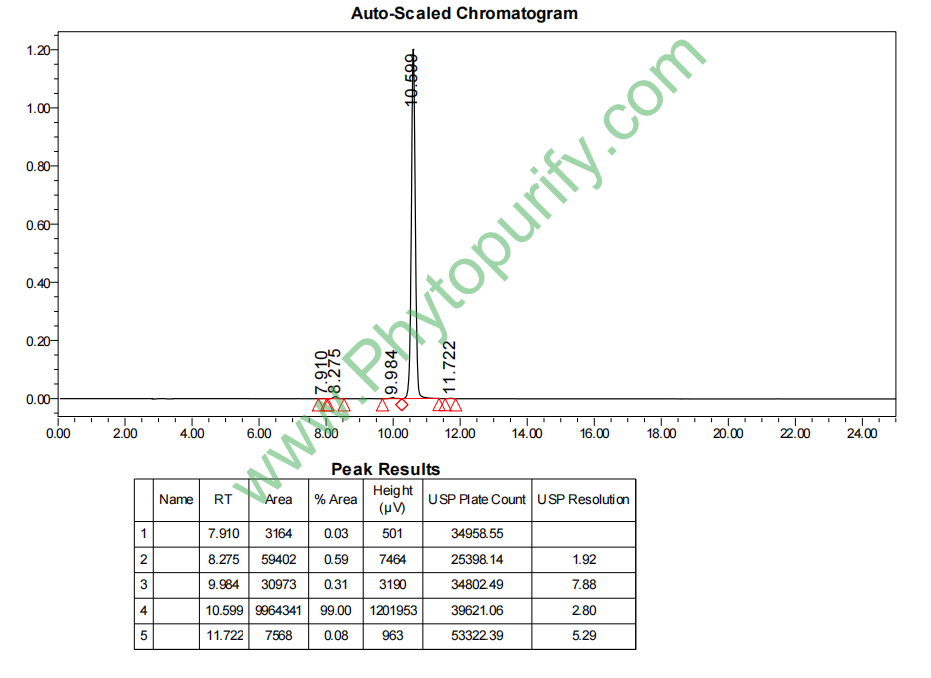
Purity: 95%~99%
Analysis Method: HPLC-DAD or/and HPLC-ELSD
Identification Method: Mass, NMR
Packing: Brown vial or HDPE plastic bottle
Storage: Store in a well closed container, protected from air and light. Put into refrigerate or freeze for long term storage.
Whenever possible, you should prepare and use solutions on the same day. However, if you need to make up stock solutions in advance, we recommend that you store the solution as aliquots in tightly sealed vials at -20℃. Generally, these will be useable for up to two weeks.
The product could be supplied from milligrams to grams
Inquire for bulk scale.
Description:
Homoplantaginin shows anti-inflammatory and antioxidant properties, it also has a protective and therapeutic effect on hepatocyte injury and shows potent inhibitory activities against influenza. Homoplantaginin may be used for the prevention and treatment of endothelial dysfunction associated with insulin resistance, it ameliorates endothelial insulin resistance by inhibiting inflammation and modulating cell signalling via the IKKβ/IRS-1/pAkt/peNOS pathway.
References:
Food Chem Toxicol. 2009 Jul;47(7):1710-5.
Protective effects of Salvia plebeia compound homoplantaginin on hepatocyte injury.
Salvia plebeia R. Br is a traditional Chinese herb which has been considered as an inflammatory mediator used for treatment of many infectious diseases including hepatitis. Previously, the compound Homoplantaginin was isolated in our group.
METHODS AND RESULTS:
Hence, we evaluated the protective effects of Homoplantaginin on hepatocyte injury. Homoplantaginin displayed an antioxidant property in a cell-free system and showed IC(50) of reduction level of DPPH radical at 0.35 microg/ml. In human hepatocyte HL-7702 cells exposed to H(2)O(2), the addition of 0.1-100 microg/ml of Homoplantaginin, which did not have a toxic effect on cell viability, significantly reduced lactate dehydrogenase (LDH) leakage, and increased glutathione (GSH), glutathione peroxidase (GSH-Px) and superoxide dismutase (SOD) in supernatant. In vivo assay, we employed the model of Bacillus Calmette-Guérin (BCG)/lipopolysaccharide (LPS)-induced hepatic injury mice to evaluate efficacy of Homoplantaginin. Homoplantaginin (25-100mg/kg) significantly reduced the increase in serum alanine aminotranseferase (ALT) and aspartate aminotransferase (AST), decreased the levels of tumor necrosis factor-alpha (TNF-alpha) and interleukin-1 (IL-1). The same treatment also reduced the content of thiobarbituric acid-reactive substances (TBARS), elevated the levels of GSH, GSH-Px and SOD in hepatic homogenate. The histopathological analysis showed that the grade of liver injury was ameliorated with reduction of inflammatory cells and necrosis of liver cells in Homoplantaginin treatment mice.
CONCLUSIONS:
These results suggest that Homoplantaginin has a protective and therapeutic effect on hepatocyte injury, which might be associated with its antioxidant properties.
HPLC of Homoplantaginin
Storage conditions:Short-term storage at 2~8℃, long-term storage at -20 ~ -80℃
Homoplantaginin, CAS number 17680-84-1, is a flavonoid compound derived from the traditional Chinese medicine Salvia plexeia. In recent years, with the deepening of pharmacological research on natural products, high plantain glycosides have received widespread attention due to their significant anti-inflammatory and antioxidant activities. Inflammatory response plays a crucial role in the occurrence and development of various diseases, including autoimmune diseases, metabolic syndrome, neurodegenerative diseases, and tumors. Natural flavonoids have become important candidate molecules for the development of anti-inflammatory drugs due to their structural diversity and biological activity. As one of the main active ingredients in Salvia plexeia, high plantain glycoside has demonstrated good pharmacological activity and safety, and has high potential for development.
This article provides a systematic review of the chemical structure and physicochemical properties, plant sources, and extraction methods of psyllin, with a focus on analyzing its pharmacological activity and mechanism of action. Combined with drug evaluation and pharmacokinetic data, it explores its clinical application prospects, aiming to provide theoretical basis and reference for further research and development of psyllin.
Plantago asiatica belongs to the flavonoid glycoside class, with a molecular formula of C22H22O11 and a molecular weight of 462.4070. Its chemical structure is based on the flavonoid core, which is connected to multiple hydroxyl and glycoside residues, giving it strong polarity and water solubility. The specific structure is characterized by a flavonoid core connected to glucosides through glycosidic bonds, containing abundant phenolic hydroxyl groups that facilitate free radical scavenging and antioxidant activity.
In terms of physicochemical properties, the LogP value of high plantain glycoside is 0.0425, indicating its strong hydrophilicity and water solubility of 1.0912, making it suitable for pharmaceutical formulations in aqueous systems. Its topological polar surface area (TPSA) is 179.2800, indicating that the molecular polarity is high and may limit its ability to pass through biofilms. The low permeability of the blood-brain barrier suggests that its efficacy in the central nervous system is limited. The hERG channel inhibition experiment showed a negative result, indicating a low risk of cardiac toxicity. The Ames mutagenicity test score is 0.6, indicating that its genetic toxicity risk is relatively low and has a good safety basis.
In summary, the chemical structure of Plantago asiatica endows it with excellent antioxidant activity and high water solubility. Its physicochemical properties support its potential as an oral drug, but its high polarity may affect its bioavailability and tissue distribution.
Plantago asiatica glycoside is mainly found in the lip shaped plant Salvia plexeia (commonly known as Plantago asiatica). Salvia plexeia is a perennial herbaceous plant widely distributed in East Asia, including China, Japan, and South Korea. It is traditionally used to treat various diseases such as colds, coughs, inflammation, and liver disease. The whole plant and leaves are the main enrichment sites of high plantain glycosides.
The process of extracting high plantain glycoside usually uses polar solvents such as ethanol or methanol aqueous solution for reflux or ultrasound assisted extraction. The extraction steps include:
This extraction method is simple and efficient, which can ensure the stability and yield of active ingredients in high plantain glycoside, and is suitable for laboratory and industrial scale production.
The core pharmacological activity of Plantago asiatica glycoside is its anti-inflammatory effect. Multiple in vitro and in vivo studies have shown that high plantain glycosides can significantly inhibit the production of inflammatory mediators and the activation of inflammatory signaling pathways. In macrophage cell lines such as RAW264.7 cells, treatment with high levels of psyllin can reduce the expression of pro-inflammatory cytokines such as IL-6 and TNF - α, inhibit the activity of inducible nitric oxide synthase (NOS2) and cyclooxygenase-2 (PTGS2), and alleviate inflammatory responses.
In animal models, high plantain glycoside has shown the effect of reducing inflammatory edema and inhibiting inflammatory cell infiltration. For example, in mouse plantar inflammation models and rat arthritis models, high levels of plantain glycosides significantly reduced inflammatory markers and improved histopathological manifestations.
Plantago asiatica glycoside contains abundant phenolic hydroxyl structures and has strong free radical scavenging ability. Its antioxidant effect is achieved by directly clearing reactive oxygen species (ROS), inhibiting lipid peroxidation, and enhancing the activity of endogenous antioxidant enzymes such as superoxide dismutase (SOD) and glutathione peroxidase (GSH Px). Antioxidant activity helps alleviate oxidative stress-related cell damage, indirectly exerting anti-inflammatory and tissue protective effects.
In addition to anti-inflammatory and antioxidant effects, some studies suggest that high plantain glycosides may have potential activities such as pain relief, anti-tumor, and immune regulation, but related research is still in the preliminary stage and needs further verification.
The anti-inflammatory mechanism of Plantago asiatica involves multiple signaling pathways and molecular targets, including:
IL-6/STAT3 pathway High plantain glycoside can inhibit the expression of pro-inflammatory cytokine IL-6 and the activation of its downstream transcription factor STAT3, block the transmission of inflammatory signals, and reduce the expression of inflammatory genes.
NF - κ B signaling pathway By inhibiting the activation of NFKB1, high plantain glycoside reduces the transcription levels of pro-inflammatory genes and weakens the inflammatory response.
Regulation of inflammation related enzymes High plantain glycoside inhibits the activity of cyclooxygenases PTGS1 and PTGS2, reduces prostaglandin synthesis, and alleviates inflammation and pain.
Regulation of inflammatory mediators By regulating CASP1 (inflammasome associated protein) and NOS2 (inducible nitric oxide synthase), high plantain glycoside inhibits the release of inflammatory mediators.
The role of TRP channel High plantain glycoside has a regulatory effect on TRPV1 and TRPA1 channels, which play important roles in inflammation and pain perception. Its inhibition helps alleviate pain caused by inflammation.
Overall, high plantain glycoside exerts its anti-inflammatory activity through multi-target and multi pathway synergistic effects, demonstrating the advantages of natural product multi-target intervention in diseases.
The pharmacological parameters of high plantain glycoside show that it has certain development potential:
Molecular weight and polarity The molecular weight of 462.4 is slightly higher than the ideal range of traditional oral drugs (<500), but still within an acceptable range. A higher TPSA (179.28) suggests a higher polarity, which may limit cell membrane permeability and oral absorption.
Fat solubility and water solubility The LogP value is close to zero, indicating strong hydrophilicity and good water solubility, which is beneficial for formulation development, but may affect the bioavailability related to lipid solubility.
Blood-brain barrier permeability Predicted as low, indicating limited distribution in the central nervous system and suitable for the treatment of peripheral inflammatory diseases.
safety HERG inhibition negative and low mutagenicity in Ames test indicate low risk of cardiotoxicity and genotoxicity, and good safety.
Pharmacokinetic studies are relatively limited, with preliminary data indicating that the absorption of high plantain glycosides after oral administration is slow and their bioavailability is limited. They are mainly metabolized through the liver and excreted through urine and bile pathways. In the future, systematic pharmacokinetic and metabolic studies need to be conducted to optimize dosing regimens and enhance clinical application value.
Plantago asiatica glycoside, as a natural flavonoid with significant anti-inflammatory and antioxidant activities, has broad clinical application potential. Its main indications include:
Chronic inflammatory diseases For diseases such as rheumatoid arthritis, inflammatory bowel disease, chronic obstructive pulmonary disease, etc., utilizing their multi-target anti-inflammatory mechanisms is expected to improve the condition and alleviate symptoms.
Inflammation associated with metabolic syndrome For example, diabetes and atherosclerosis, the dual effects of anti-oxidation and anti-inflammatory can help slow down the pathological process.
Skin inflammation and wound repair Local application of high plantain glycoside preparations can promote inflammation resolution and tissue healing.
Assisted cancer treatment By regulating the inflammatory microenvironment and assisting traditional treatments, the risk of side effects and recurrence can be reduced.
Future research directions should focus on:
As a new star in the development of natural product drugs, high plantain glycoside, combined with modern pharmacology and medicinal chemistry methods, is expected to become an important candidate for new anti-inflammatory drugs.
As an important flavonoid component in Salvia plexeia, high plantain glycoside exhibits excellent pharmacological value and potential for drug development due to its outstanding anti-inflammatory and antioxidant activities. Its multi-target and multi pathway mechanism of action provides new ideas for the development of natural anti-inflammatory drugs. Although there is currently insufficient research on its pharmacokinetics and clinical applications, there is data supporting its safety and efficacy. In the future, through in-depth mechanism research and clinical verification, high plantain glycosides are expected to become a new natural medicine for the treatment of various inflammation related diseases, promoting the modernization of traditional Chinese medicine and the development of natural product pharmacology.
