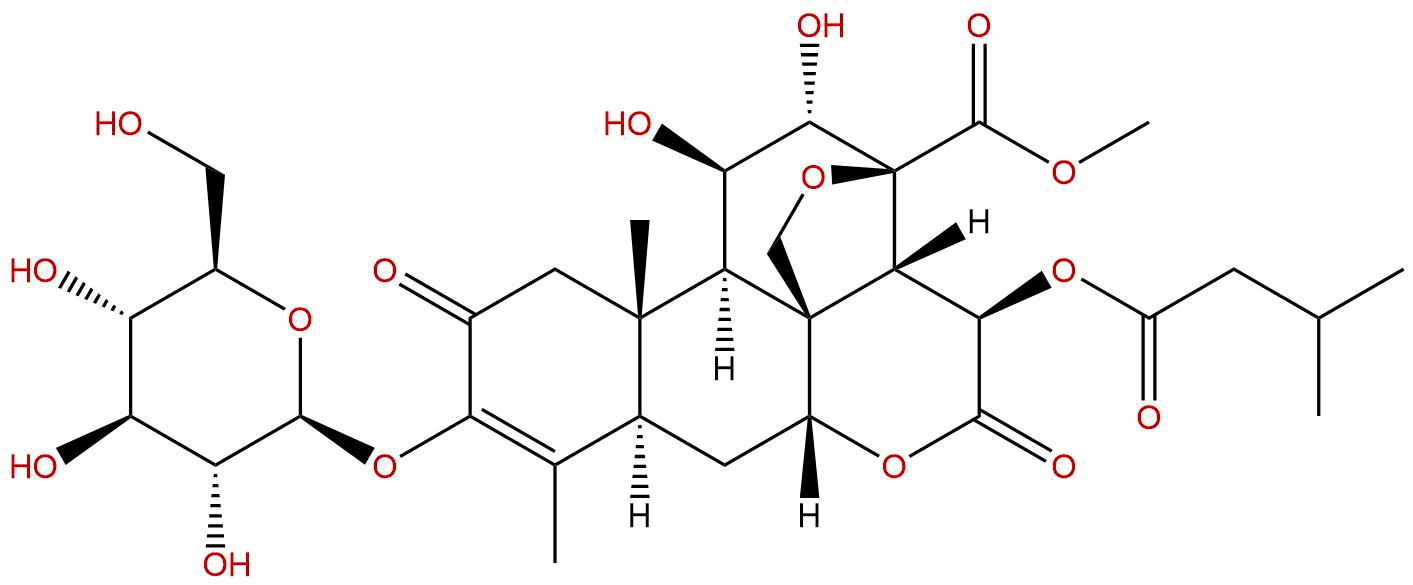


Product name: Yadanziolide B
Synonym name:
Catalogue No.: BP4227
Cas No.: 95258-13-2
Formula: C20H26O11
Mol Weight: 442.417
Botanical Source: Brucea javanica(L.)Merr.
Type of Compound: Diterpenoids
Purity: 95%~99%
Analysis Method: HPLC-DAD or/and HPLC-ELSD
Identification Method: Mass, NMR
Packing: Brown vial or HDPE plastic bottle
Storage: Store in a well closed container, protected from air and light. Put into refrigerate or freeze for long term storage.
Whenever possible, you should prepare and use solutions on the same day. However, if you need to make up stock solutions in advance, we recommend that you store the solution as aliquots in tightly sealed vials at -20℃. Generally, these will be useable for up to two weeks.
The product could be supplied from milligrams to grams
Inquire for bulk scale.
For Reference Standard and R&D, Not for Human Use Directly.
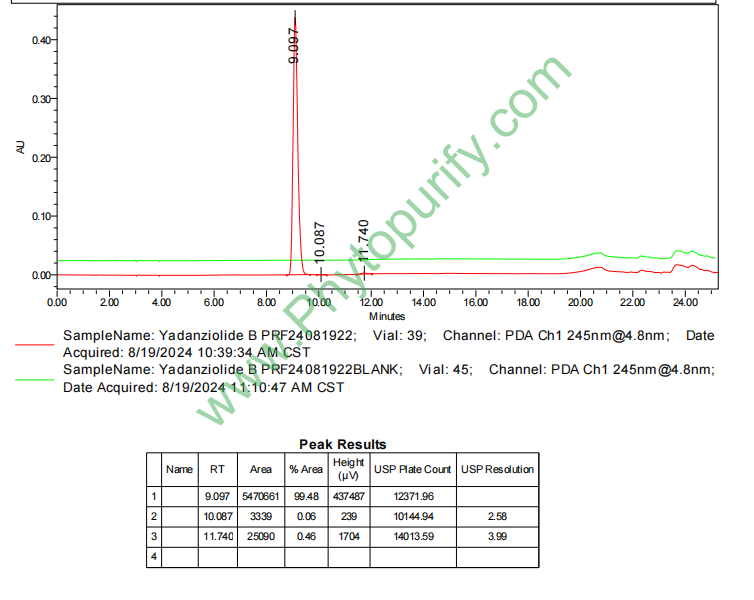
HPLC of Yadanziolide B
Storage conditions:Short-term storage at 2~8℃, long-term storage at -20 ~ -80℃
194.2100
-1.3914
-1.3914
8.5499
.4589
2.4742
Low
30.1515
6.8772
Yes
No
No
No
Yes
No
0.0
Yes
No
Yes
Yes
Yadanziolide B (CAS number: 95258-13-2) is a natural bitter lignin compound derived from the genus Kudzu. Due to its unique chemical structure and diverse biological activities, it has attracted widespread attention in the field of natural product pharmacology in recent years. As a type of δ - lactone secondary α - hydroxy ketone compound, brucea jasmonate B not only exhibits significant anti-tumor activity, but has also been found to have potential H5N1 neuraminidase inhibition, demonstrating its potential application in the field of antiviral therapy. Its complex molecular structure endows it with multi-target regulatory ability, involving multiple key biological pathways such as cell apoptosis, signal transduction, and metabolic regulation.
This article aims to provide a systematic review of the chemical structure and physicochemical properties, plant sources and extraction methods, pharmacological activity and mechanism of action, pharmacological evaluation and pharmacokinetic characteristics of brucelloid B, and explore its clinical application prospects and future research directions, providing theoretical basis and research references for the development of this natural product.
Brucea Javanolide B belongs to the class of bitter lignin compounds, with a chemical structure based on the 13,20-epoxypicras-3-ene skeleton, a molecular formula of C24H-34O8, and a molecular weight of 442.4170. Its structural features include hydroxyl substitution at positions 1, 6, 11, 12, 14, 15, and 21, and oxygen substitution at positions 2 and 16, forming multiple hydroxyl and ketone groups, endowing it with high polarity and rich chemical reactivity. This compound contains a δ - lactone ring structure and belongs to the category of secondary α - hydroxyketone organic heterocyclic compounds, with functional groups such as enone and heptanol.
In terms of physical and chemical properties, the LogP value of brucea jasmonate B is -1.3914, indicating its strong hydrophilicity. The TPSA (topological polar surface area) is 194.2100, indicating that its molecule has a high polarity and the number of hydrogen bond donors/acceptors, which may affect its cell membrane penetration ability. The water solubility is 8.5499, indicating good solubility in aqueous phase, which is beneficial for absorption and distribution in vivo. The permeability of the blood-brain barrier is low, the hERG channel inhibition test result is negative, and the Ames mutagenicity test result is 0, indicating its high safety and low potential risk of cardiac toxicity.
Brucea Javanolide B is mainly isolated from ethanol extracts of the stems of plants in the genus Sapindaceae. Bitterwood plants are widely distributed in tropical and subtropical regions of Asia, and their roots, stems, leaves, and other parts are commonly used in traditional Chinese medicine to treat various diseases. During the extraction process, 70% -95% ethanol is usually used as the solvent to extract plant active ingredients through reflux extraction or ultrasound assisted extraction methods. The extraction solution was concentrated, separated, and purified by column chromatography (such as silica gel column, reverse phase C18 column) and high performance liquid chromatography (HPLC) to obtain high-purity brucellolactone B.
The optimization of extraction process includes adjusting parameters such as solvent selection, extraction time, temperature, and extraction times to improve yield and purity. In addition, the application of modern separation techniques such as preparative HPLC and counter current chromatography has promoted the efficient separation and purification of this compound.
The pharmacological activity research of Brucea Javanese Lactone B mainly focuses on anti-tumor and antiviral fields. Multiple in vitro cell experiments have shown that this compound has significant cytotoxic effects on various tumor cell lines, inducing tumor cell apoptosis, inhibiting cell proliferation and migration. In addition, brucea jasmonate B exhibits inhibitory activity against the neuraminidase of H5N1 influenza virus, indicating its potential as an antiviral candidate drug.
Brucea Javanese Lactone B exerts anti-tumor effects through multi-target regulation. It inhibits anti apoptotic proteins such as MCL1 and BCL2, promoting cancer cell apoptosis; By inhibiting the STAT3 signaling pathway, the proliferation and immune escape of tumor cells are blocked; At the same time, inhibiting MMP2 expression reduces the invasion and metastasis ability of tumor cells. The inhibitory effects of TOP1 and TOP2A interfere with DNA replication and transcription processes, blocking tumor cell cycle progression. The regulation of HIF1A helps to inhibit the adaptation of tumor hypoxic microenvironment and reduce tumor drug resistance. The regulation of MAPK1 pathway further affects the balance between cell proliferation and apoptosis. The effect of Brucea javanica lactone B on ESR1 and CYP19A1 suggests its potential therapeutic value in hormone dependent tumors (such as breast cancer).
As an inhibitor of H5N1 neuraminidase, brucea jasmonate B can block virus release and transmission, and inhibit virus replication. Although the current research is relatively preliminary, its unique structure provides important clues for designing new anti influenza drugs.
The multi-target mechanism of action of Brucea Javanese Lactone B reflects its complex molecular regulatory network. By directly or indirectly acting on multiple protein targets, regulating intracellular signaling pathways and exerting their biological functions.
MCL1 and BCL2 regulate cell apoptosis
MCL1 and BCL2 are members of the anti apoptotic protein family, and brucelloid B promotes mitochondrial mediated apoptosis and induces programmed cell death in tumor cells by inhibiting their expression or function.
STAT3 signaling pathway inhibition
STAT3 plays a central role in tumor cell proliferation, survival, and immune regulation. Brucea Javanese Lactone B inhibits STAT3 phosphorylation, suppresses its transcriptional activity, and reduces the malignant phenotype of tumor cells.
MMP2 inhibits tumor invasion
MMP2 participates in extracellular matrix degradation and promotes tumor cell migration. Brucea Javanese Lactone B inhibits MMP2 expression and weakens the metastatic potential of tumors.
TOP1 and TOP2A interfere with DNA metabolism
Topoisomerase I and II are key enzymes involved in DNA replication and transcription. The inhibition of its activity by Brucea Javanese Lactone B leads to the accumulation of DNA damage and blocks the cell cycle process.
HIF1A regulates the tumor microenvironment
HIF1A is activated under hypoxic conditions in tumors, promoting angiogenesis and metabolic reprogramming. Brucea Javanese Lactone B weakens tumor adaptability and drug resistance by inhibiting HIF1A.
MAPK1 signal regulation
MAPK1 is involved in cell proliferation and stress response. Brucea Javanese Lactone B regulates MAPK1 activity and affects cell fate decision-making.
ESR1 and CYP19A1 regulate endocrine signaling
ESR1 is an estrogen receptor and CYP19A1 is an aromatase, both of which are crucial in hormone dependent tumors. Brucea javanica lactone B regulates it, suggesting its potential application in breast cancer and other diseases.
The pharmacological evaluation of Brucea Javanese Lactone B shows that it has certain potential for drug development. Its molecular weight is moderate (442.4170), although LogP is negative, indicating high hydrophilicity, the larger TPSA (194.2100) may limit its cell membrane penetration ability and oral bioavailability. Good water solubility, conducive to distribution and excretion in the body.
The low permeability of the blood-brain barrier suggests that it is not easily able to enter the central nervous system, reducing the risk of neurotoxicity, but also limiting its application in neurological diseases. HERG channel inhibition is negative, indicating a low risk of cardiac toxicity and good safety. The Ames test result is negative, supporting its absence of significant mutagenicity.
At present, there is limited pharmacokinetic data on brucelloid B, and further in vivo absorption, distribution, metabolism, and excretion (ADME) studies are needed to clarify its half-life, bioavailability, and metabolic pathways, providing a basis for preclinical drug development.
Due to its multi-target anti-tumor activity and potential antiviral effects, Brucella Javanese Lactone B has broad clinical application prospects. For tumor therapy, it may become a candidate molecule for new anticancer drugs by regulating key apoptosis and signal pathways, especially in hormone dependent tumors such as breast cancer. In the field of antiviral therapy, the neuraminidase inhibitory activity against H5N1 influenza virus provides a new approach for the treatment of influenza virus infections.
Future research should focus on the following aspects:
Structural optimization and derivative design
By chemical modification, its membrane permeability and oral bioavailability can be improved, enhancing drug efficacy and safety.
Pharmacokinetic and toxicological studies of the system
Clarify the metabolic pathways, potential toxicity, and long-term safety in the body, laying the foundation for clinical translation.
In depth analysis of mechanisms and construction of multi-target action networks
Using omics and systems biology methods to comprehensively reveal its mechanism of action and guide precision medication.
Preclinical animal model validation
Evaluate its anti-tumor and antiviral effects in vivo, verify its efficacy and safety.
Exploration of Combination Medication Strategy
Explore synergistic effects with existing chemotherapy or antiviral drugs to enhance efficacy and reduce drug resistance.
As a natural bitter lignin compound with a unique structure and multiple biological activities, Brucea Javanese Lactone B exhibits excellent anti-tumor and antiviral potential. Its multi-target mechanism of action provides a valuable example for the development of natural product drugs. Although there are still shortcomings in pharmacokinetics and preclinical research, with the deepening of research and advances in technology, brucelloid B is expected to become an important candidate molecule for the new generation of anti-tumor and antiviral drugs. Future systematic research will provide a solid scientific foundation for its clinical application and drug development.
