


Product name: Schaftoside
Synonym name:
Catalogue No.: BP1260
Cas No.: 51938-32-0
Formula: C26H28O14
Mol Weight: 564.496
Botanical Source: Desmodii styracifolii herba
Physical Description:
Type of Compound: Flavonoids
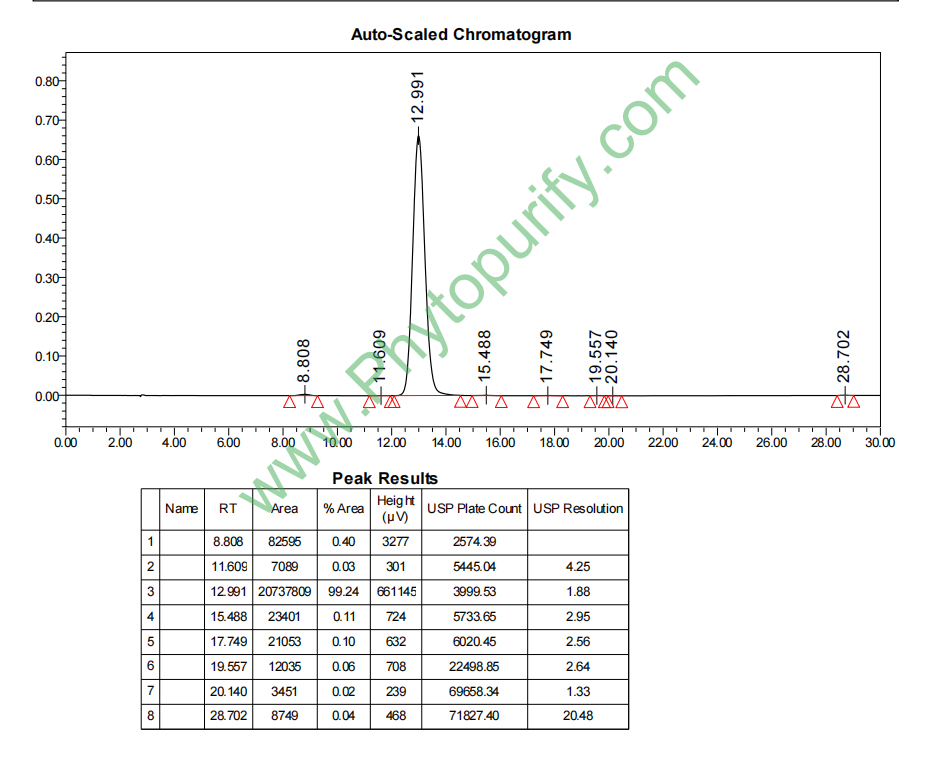
Purity: 95%~99%
Analysis Method: HPLC-DAD or/and HPLC-ELSD
Identification Method: Mass, NMR
Packing: Brown vial or HDPE plastic bottle
The product could be supplied from milligrams to grams
Inquire for bulk scale.
Description:
Schaftoside has antioxidant activity, it also can inhibit phospholipase, lipoxygenase and cyclooxygenase, three pro-inflammatory enzymes.
References:
J Chromatogr B Analyt Technol Biomed Life Sci. 2013 Aug 1;932:66-73.
Simultaneous determination of four flavonoids and one phenolic acid in rat plasma by LC-MS/MS and its application to a pharmacokinetic study after oral administration of the Herba Desmodii Styracifolii extract
METHODS AND RESULTS:
A sensitive and selective liquid chromatography and tandem mass spectrometry (LC-MS/MS) method was developed and validated for the simultaneous determination of four flavonoids (Schaftoside, isovitexin, luteolin, and apigenin) and one phenolic acid (ferulic acid) in rat plasma using sulfamethoxazole as the internal standard (IS). The separation was performed using a Diamonsil C18 column, which was eluted with methanol (A) and 0.1‰ acetic acid (B). The gradient condition was as follows: 0-5min, 40-60% A; 5-6min, 60-95% A; and 6-10min, maintained at 95% A. The analytes were detected using a hybrid quadrupole linear ion trap mass spectrometer that was equipped with an electrospray ionization source in the negative ion and multiple-reaction monitoring modes. A full validation of the method was performed. The linearity of the analytical response was good, with correlation coefficients greater than 0.9925 for all of the compounds within the concentration range. The lower limits of quantitation (LLOQ) of Schaftoside, isovitexin, luteolin, apigenin, and ferulic acid in rat plasma were 1.66, 0.84, 3.69, 1.70, and 3.91ng/mL, respectively. The intra-day and inter-day precisions of the investigated components exhibited an RSD within 13.20%, and the accuracy (RE%) ranged from -8.47% to 10.90%.
CONCLUSIONS:
The results indicated that the developed method is sufficiently reliable for the pharmacokinetic study of Schaftoside, isovitexin, apigenin, luteolin, and ferulic acid in rats following oral administration of the Herba Desmodii Styracifolii extract.
Zuckerindustrie Sugar Industry, 2015, 140(10):632-639.
An HPLC-DPPH method for antioxidant activity from sugarcane molasses.
Sugarcane molasses is potentially rich in health-promoting phenolic compounds. Present study was designed to optimize experimental conditions for ultrasonic-assisted extraction of antioxidant compounds from sugarcane molasses using response surface methodology.
METHODS AND RESULTS:
An HPLCDPPH method for simultaneous determination of antioxidant activity was also developed. Ethanol concentration 80-84% (v/v), temperature 58-59 degrees C, and 47-50 min time duration were the most favorable conditions. In these conditions, the optimal experimental results were total phenolic content 18 mg gallic acid equivalents/g, with DPPH free radical scavenging ability of 92%, which was same as the predicted values by RSM model. Catechin, vanillic acid, isorhamnetin-3-O-glucoside, eugenol, Schaftoside, diosmetin-7-O-beta-D-glucopyranoside, ferulic acid, and caffeoylquinic acid were identified using HPLC-MS/MS. Among the antioxidant compounds, Schaftoside was the most abundant antioxidant (92.081 mu g/g dry substance), while ferulic acid exhibited the highest antioxidant activity.
CONCLUSIONS:
These results suggest that HPLC-DPPH method is more specific, accurate and less time consuming and can sever as a quality control tool.
HPLC of Schaftoside
Storage conditions:Short-term storage at 2~8℃, long-term storage at -20 ~ -80℃
Schaftoside (CAS number: 51938-32-0) is a natural flavonoid compound that is widely present in various Chinese herbal medicines, especially in the Eleusine indica plant of the Poaceae family. As a bioactive flavonoid glycoside, Xiafuta glycoside has received widespread attention in the fields of pharmacology and natural product chemistry in recent years due to its diverse pharmacological activities. Its main manifestations include multiple biological effects such as antioxidant, anti-inflammatory, and regulation of mitochondrial function, especially in inhibiting the TLR4/MyD88 signaling pathway and regulating mitochondrial dynamics, showing significant potential. This article aims to provide a systematic review of the chemical structure, plant sources, extraction methods, pharmacological activities, mechanisms of action, pharmacological evaluation, and clinical application prospects of Xafotaxin, with the hope of providing theoretical basis and research directions for its subsequent drug development and clinical translation.
Xiafota glycoside belongs to the flavonoid glycoside class, with a molecular formula of C27H30O14 and a molecular weight of 564.4960. Its structural characteristics are that the flavonoid mother nucleus is connected to multiple glycosides through glycosidic bonds, specifically, glucose and arabinose residues are connected to the C-6 and C-8 positions of flavonoids, forming a double glycosidic structure. This structure endows Xafota glycoside with good water solubility (1.8667, unit not specified), but its lipid solubility is low, with a LogP value of -0.7354, indicating a certain degree of hydrophilicity. The topological polar surface area (TPSA) is 250.97 Å ², indicating that its molecular polarity is high and may affect its cell membrane permeability and bioavailability.
Xiafota glycoside has good chemical stability, is not easily oxidized and decomposed, and has no significant hERG channel inhibition effect. The Ames mutagenicity test result is 0.6, indicating a low risk of genetic toxicity. The multiple hydroxyl and sugar groups in its molecular structure provide the basis for its antioxidant activity, while also limiting its ability to pass through the blood-brain barrier (which has low permeability).
Xiafota glycoside is mainly found in various traditional Chinese medicinal materials, especially in Eleusine indica (dog sage), a plant of the Poaceae family, which has a high content. In addition, some other plants containing flavonoid glycosides such as licorice and Scutellaria baicalensis have also been reported to contain this ingredient. Eleusine indica, as a common weed plant, is used in traditional Chinese medicine for clearing heat, detoxifying, stopping bleeding, and other purposes. The study of its active ingredients provides a scientific basis for its pharmacological effects.
The extraction of Xiafota glycoside is usually carried out using ethanol or methanol as solvents, and crude extracts are obtained through reflux extraction or ultrasound assisted extraction techniques. Subsequently, high-purity Xiafuta glycoside was obtained through liquid-liquid distribution, column chromatography (such as silica gel column, reverse phase C18 column), and high-performance liquid chromatography (HPLC) separation and purification methods. In recent years, supercritical CO2 extraction and membrane separation technologies have also been attempted to be applied to the extraction of Xafotaxin to improve yield and purity.
The optimization of the extraction process mainly focuses on the regulation of parameters such as solvent polarity, extraction time, temperature, and pH value, in order to maximize the retention of the active ingredients of Xafotaxin and reduce impurity interference. At the same time, identification methods often use techniques such as mass spectrometry (MS), nuclear magnetic resonance (NMR), and ultraviolet visible spectroscopy (UV Vis) to ensure the accuracy of compound structures.
Xiafota glycoside exhibits significant antioxidant capacity, effectively clearing free radicals and reducing cellular damage caused by oxidative stress. Its mechanism of action mainly involves activating the intracellular antioxidant enzyme system, including the expression and activity enhancement of key enzymes such as superoxide dismutase (SOD1, SOD2), catalase (CAT), glutathione peroxidase (GPX1), and heme oxygenase 1 (HMOX1). In addition, Xafota glycoside can promote nuclear translocation of nuclear factor E2 related factor 2 (NFE2L2/NRF2), activate antioxidant response elements (ARE), and enhance the cell's defense against oxidative damage.
Xiafota glycoside exhibits inhibitory activity on inflammatory responses in various inflammatory models. It mainly targets Toll like receptor 4 (TLR4) and its downstream adapter protein MyD88, blocking the transmission of inflammatory signals and reducing the release of pro-inflammatory cytokines such as TNF - α, IL-6, and IL-1 β, thereby alleviating the inflammatory response. This effect has potential therapeutic significance for chronic inflammatory diseases such as rheumatoid arthritis and inflammatory bowel disease.
Mitochondrial dynamics imbalance is an important mechanism for the occurrence and development of various diseases. Xiafota glycoside can reduce the expression and phosphorylation level of mitochondrial fission protein Drp1, inhibit excessive mitochondrial fission, and maintain the integrity and functional stability of the mitochondrial network. By regulating mitochondrial morphology, shafotaxin helps reduce mitochondrial mediated apoptosis and oxidative damage, protecting cell viability.
Some studies have also found that Xafota glycoside has potential activities such as anti-tumor, antibacterial, and neuroprotective effects, but the relevant mechanisms have not been fully elucidated and further in-depth research is needed.
The multiple pharmacological effects of Xafota glycoside are attributed to its regulation of key molecular targets, mainly involving the following aspects:
Inhibition of TLR4/MyD88 signaling pathway
TLR4, as an important receptor of the innate immune system, mediates the initiation of inflammatory responses. Xiafota glycoside exerts anti-inflammatory effects by inhibiting the expression of TLR4 and its downstream adapter protein MyD88, blocking the activation of inflammatory signaling pathways such as NF - κ B, reducing the production of pro-inflammatory factors.
NFE2L2/NRF2 pathway activation
Xiafota glycoside promotes NFE2L2 nuclear translocation, activates ARE driven antioxidant gene expression, enhances cellular antioxidant defense ability, and protects cells from oxidative stress damage.
Mitochondrial Dynamics Regulation
By reducing the expression and phosphorylation levels of Drp1, shafotaxin inhibits excessive mitochondrial division, maintains the stability of the mitochondrial network, and prevents mitochondrial dysfunction and cell apoptosis.
Regulation of antioxidant enzyme system
Enhance the expression and activity of antioxidant enzymes such as SOD1, SOD2, CAT, GPX1, HMOX1, and improve the ability of cells to clear reactive oxygen species (ROS).
The synergistic effect of these mechanisms enables Xafotaxin to exhibit excellent pharmacological activities in antioxidant, anti-inflammatory, and cell protection, providing a theoretical basis for its potential as a natural drug candidate molecule.
The pharmacological evaluation of Xafota glycoside shows that it has certain advantages and challenges:
Molecular weight and polarity
The molecular weight of 564.5 is relatively high, with a TPSA value of up to 250.97 Å ², indicating its strong polarity, which may limit oral absorption and cell membrane permeability.
Fat solubility and water solubility
LogP is -0.7354, indicating strong hydrophilicity and good water solubility (1.8667), which is beneficial for solubility issues in formulation development, but may affect lipid solubility related bioavailability.
Blood-brain barrier penetrability
The prediction is low, indicating that Xafotaxin is difficult to pass through the blood-brain barrier, limiting its application in central nervous system diseases.
safety
The hERG channel inhibition test is negative, reducing the risk of cardiac toxicity; The Ames test result is 0.6, indicating a low risk of genetic toxicity and good safety.
pharmacokinetics
At present, there is limited data on the in vivo absorption, distribution, metabolism, and excretion (ADME) of Xafotaxin. Due to its high polarity, oral bioavailability may be limited and intestinal absorption rate may be low. The metabolic pathway may involve hepatic glycoside hydrolysis and corresponding flavonoid metabolism, and the activity and safety of metabolites need further research.
In summary, Xafotaxin has certain potential as a drug, but its pharmacokinetic properties need to be optimized through structural modifications or drug delivery systems to improve bioavailability and targeting.
Based on the antioxidant, anti-inflammatory, and mitochondrial protective effects of Xafota glycoside, its potential application prospects in various diseases are broad:
Chronic inflammatory diseases
For diseases such as rheumatoid arthritis and inflammatory bowel disease, Xafotaxin may become a candidate molecule for natural anti-inflammatory drugs by inhibiting the TLR4/MyD88 signaling pathway and reducing inflammatory responses.
Oxidative stress-related diseases
Including cardiovascular diseases, diabetes, neurodegenerative diseases, etc. Chaffetaside activates NRF2 pathway, enhances cell antioxidant capacity, and is expected to delay disease progression.
Mitochondrial dysfunction disease
Neurological diseases such as Parkinson's disease and Alzheimer's disease have potential neuroprotective effects by regulating mitochondrial dynamics and protecting nerve cells.
Antitumor adjuvant therapy
Preliminary studies have shown that Xafotaxin may participate in tumor suppression by regulating cell apoptosis and oxidative stress, but the specific mechanism and clinical value still need to be further validated.
Future research should focus on the pharmacokinetic optimization, formulation development, and preclinical safety evaluation of Xafotaxin. At the same time, by combining modern molecular biology techniques, we can deeply analyze its mechanism of action and expand its indications. The development of multi center clinical trials will be a key step in verifying their clinical application value.
As a natural flavonoid glycoside with multiple biological activities, Xiafota glycoside has shown great potential for drug development due to its significant antioxidant, anti-inflammatory, and mitochondrial protective effects. Its unique molecular structure and mechanism of action provide important examples for the pharmacological research of natural products. Although there are still some challenges in pharmacokinetics and clinical translation at present, with the assistance of structural optimization and modern drug delivery technology, Xafotaxin is expected to become an important candidate molecule for future natural drug development. The in-depth basic research and clinical verification of the system will lay a solid foundation for its clinical application and promote the widespread use of natural products in modern medicine.
